Subtotal $0.00


Email : 94
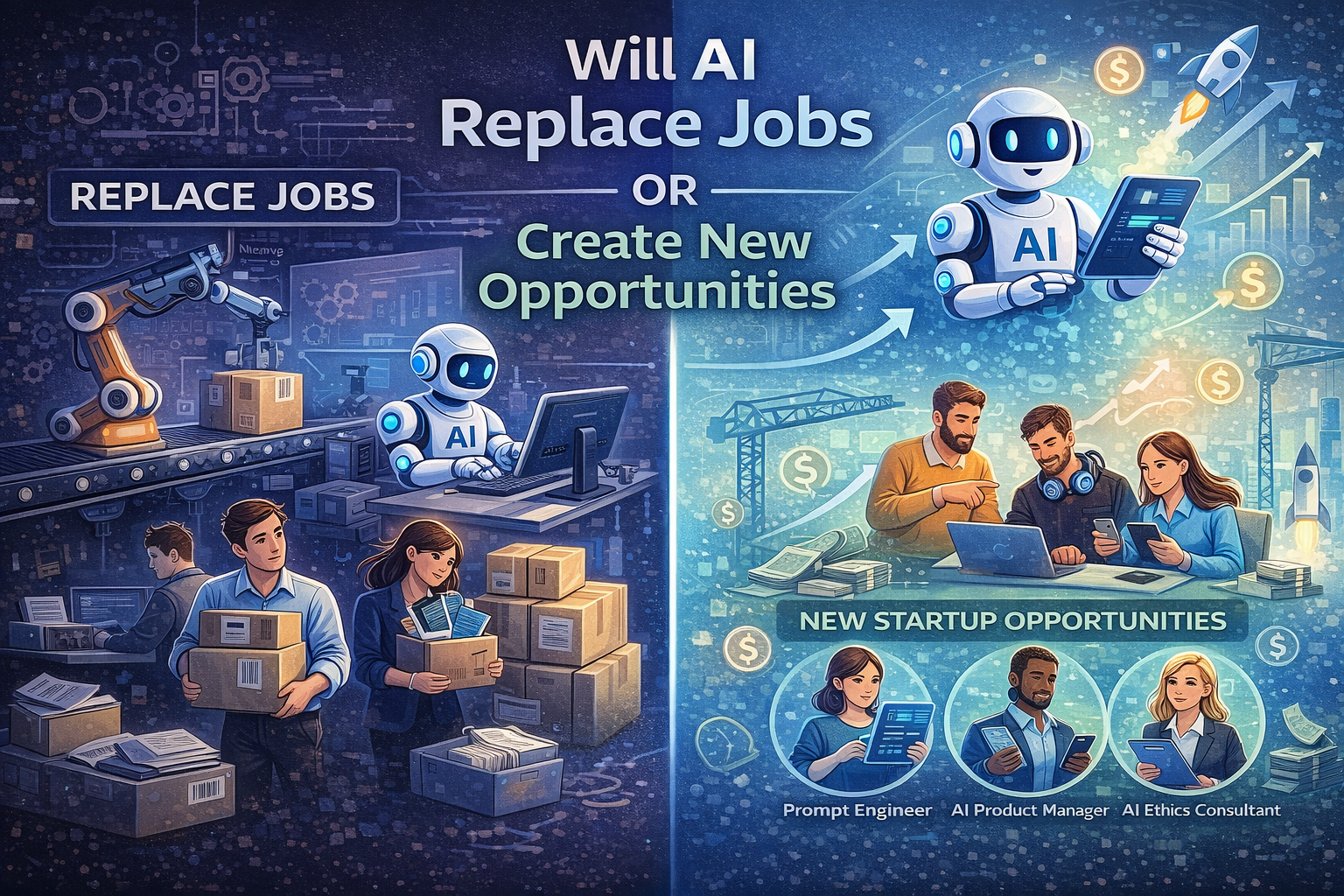
Whenever a new technology becomes popular, people ask the same question: Will this technology take away jobs? Artificial Intelligence (AI) is no different. News headlines often suggest that AI will replace workers, automate roles, and reduce human involvement in business. This creates fear, confusion, and resistance, especially among employees and startup founders.
However, history shows something important. Technology does not simply destroy jobs. It changes the nature of work and creates new opportunities. The same is happening with AI.
AI is automating repetitive and time-consuming tasks, but at the same time, it is opening doors for new skills, new roles, and entirely new startup ideas. Instead of replacing humans completely, AI is shifting how humans work and what businesses can build.
This article explores whether AI will replace jobs or create new startup opportunities, in a balanced and practical way. It explains the risks, the reality, and the opportunities so founders, professionals, and startups can prepare instead of panic.
Why People Fear AI Replacing Jobs
Fear usually comes from uncertainty.
People fear AI because:
- AI works faster than humans
- AI does not get tired
- AI reduces manual effort
- AI is improving quickly
These factors make it look like humans are becoming unnecessary.
But this view is incomplete.
How Job Replacement Has Happened in the Past
Every major technology created fear.
Examples include:
- Machines in factories
- Computers in offices
- The internet in media
- Automation in manufacturing
Each time, some jobs disappeared. But many new jobs were created.
AI follows the same pattern.
The Real Question Is Not Replacement, But Transformation
AI does not remove work.
It changes what humans do.
Instead of asking:
“Will AI replace jobs?”
The better question is:
“How will jobs change because of AI?”
This mindset helps founders and workers adapt.
Which Jobs Are Most Likely to Be Replaced by AI
AI is best at handling repetitive, rule-based tasks.
Jobs at higher risk include:
- Data entry
- Manual reporting
- Basic customer support
- Routine admin work
- Simple content rewriting
These tasks are predictable and automatable.
Why These Jobs Are Vulnerable
These roles:
- Follow fixed processes
- Require limited creativity
- Involve repetitive actions
AI performs these tasks more efficiently.
Which Jobs Are Less Likely to Be Replaced
Jobs that require human thinking and emotion are safer.
These include:
- Strategy and leadership
- Creative problem-solving
- Relationship building
- Innovation and design
- Ethical decision-making
AI supports these roles, but does not replace them.
How AI Actually Creates New Jobs
AI creates jobs in multiple ways.
AI Creates New Technical Roles
As AI grows, new roles appear.
Examples include:
- AI tool specialists
- Prompt engineers
- AI workflow designers
- Data analysts
- AI product managers
These roles did not exist before.
AI Creates Non-Technical Roles Too
Not all AI jobs require coding.
New non-technical roles include:
- AI operations managers
- AI adoption consultants
- AI trainers and educators
- AI ethics advisors
Startups need people who understand AI from a business angle.
AI Increases Demand for Human Skills
AI increases the value of skills like:
- Creativity
- Critical thinking
- Communication
- Strategy
- Leadership
Humans focus on thinking. AI handles execution.
How AI Creates New Startup Opportunities
AI does more than change jobs.
It creates entirely new business ideas.
AI Lowers the Barrier to Starting a Business
Earlier, startups needed large teams.
Now, AI allows:
- Solo founders
- Small teams
- Faster launches
- Lower costs
This increases startup creation.
AI Enables New Business Models
AI makes new models possible, such as:
- AI-powered SaaS tools
- Automation-as-a-service
- Personalised digital products
- Data-driven platforms
Founders can build smarter products faster.
AI Creates Niches That Did Not Exist Before
AI opens niche markets like:
- AI for healthcare startups
- AI for finance planning
- AI for marketing automation
- AI for education and training
Each niche creates startup opportunities.
AI Helps Startups Scale Without Large Teams
Scaling was expensive earlier.
With AI:
- One founder can manage operations
- Support is automated
- Marketing is optimised
- Decisions are data-driven
This makes startups more sustainable.
AI as a Job Multiplier, Not a Job Killer
AI multiplies productivity.
One person with AI can do the work of many.
This:
- Increases output
- Creates demand for new services
- Expands markets
More markets create more jobs.
How Startups Benefit from AI-Driven Job Changes
Startups gain advantage when work shifts.
Lower Operating Costs
AI reduces manual labour costs.
Faster Execution
AI speeds up workflows.
Better Decision-Making
AI provides insights.
Competitive Advantage
AI-ready startups move faster than others.
The Risk of Not Adapting to AI
The real risk is not AI replacing jobs.
The real risk is ignoring AI.
Those who avoid AI may face:
- Job loss
- Business failure
- Reduced competitiveness
Adaptation is the key.
How Founders Should Prepare for AI-Driven Job Changes
Preparation matters more than fear.
Build AI-Ready Teams
Teams should:
- Learn AI basics
- Use AI tools daily
- Collaborate with AI
Training beats resistance.
Redesign Roles, Not Remove People
Founders should:
- Shift people to strategic work
- Remove repetitive tasks
- Upskill teams
This improves morale and productivity.
Create AI-Based Startup Opportunities
Founders should:
- Identify manual pain points
- Build AI solutions
- Solve real problems
Opportunity comes from inefficiency.
How Employees Can Stay Relevant in the AI Era
AI does not eliminate people who adapt.
Learn to Work With AI
Employees should:
- Use AI tools
- Understand AI output
- Improve efficiency
AI becomes a career booster.
Focus on Human Strengths
Skills that matter most:
- Thinking
- Creativity
- Emotional intelligence
- Strategy
These cannot be automated easily.
The Future of Jobs in an AI-Driven World
Jobs will not disappear.
They will evolve.
Future jobs will be:
- More strategic
- More creative
- More analytical
- Less repetitive
AI changes work quality, not human value.
Will AI Create More Jobs Than It Replaces?
Over time, yes.
AI:
- Creates new industries
- Expands markets
- Enables entrepreneurship
This leads to more opportunities.
Common Myths About AI and Jobs
Let’s clear some myths.
Myth 1: AI Will Replace Everyone
Reality: AI replaces tasks, not humans.
Myth 2: Only Tech People Benefit
Reality: AI benefits all industries.
Myth 3: AI Means Fewer Startups
Reality: AI enables more startups.
Myth 4: AI Removes Creativity
Reality: AI increases creative capacity.
Final Thoughts
AI is not the enemy of jobs. It is a tool that changes how work is done. Some roles will disappear, but many more will evolve or be created. For startups, AI is one of the biggest opportunity creators in history.
Founders who understand this shift will build new products, create new markets, and lead the next generation of businesses. Those who fear AI may miss the biggest opportunity of their lifetime.
The future belongs to people and startups who learn, adapt, and build with AI.
Read More Blog-The Future of AI in Startups: What Founders Must Prepare For
Frequently Asked Questions (FAQs)
1. Will AI replace all jobs?
No. AI replaces repetitive tasks, not all jobs.
2. Will AI create startup opportunities?
Yes. AI enables new business models and markets.
3. Should founders fear AI?
No. Founders should use AI strategically.
4. Can non-technical founders use AI?
Yes. Many AI tools require no coding.
5. What is the best way to prepare for AI?
Learn, experiment, and adapt early.