
Subtotal $0.00


Email : 72
Every startup wants growth, but most struggle with the same issues. Teams are small, work is manual, decisions are slow, and costs increase faster than revenue. Founders often feel that growth requires hiring more people or working longer hours. This approach leads to burnout and unstable scaling.
The AI Startup Edge Playbook offers a smarter path. It shows how startups can move step by step from basic automation to sustainable, data-driven growth using artificial intelligence. AI is not about replacing people or adding complexity. It is about removing inefficiency, improving clarity, and enabling teams to focus on what truly matters.
This playbook explains how startups can use AI systematically, starting with simple automation and gradually building toward smarter decisions, better customer experience, and scalable growth. It is designed for founders who want practical guidance, not theory. If you want to grow faster without increasing chaos or costs, this playbook is for you.
What Is the AI Startup Edge Playbook?
The AI Startup Edge Playbook is a step-by-step approach that helps startups adopt AI in a structured way.
It focuses on:
- Automation before expansion
- Data before opinions
- Systems before scaling
- Growth with control
The playbook ensures AI delivers real business value.
Why Startups Need a Playbook for AI
Many startups use AI randomly.
This creates problems such as:
- Tool overload
- Confusion across teams
- Poor adoption
- No clear results
A playbook provides direction and discipline.
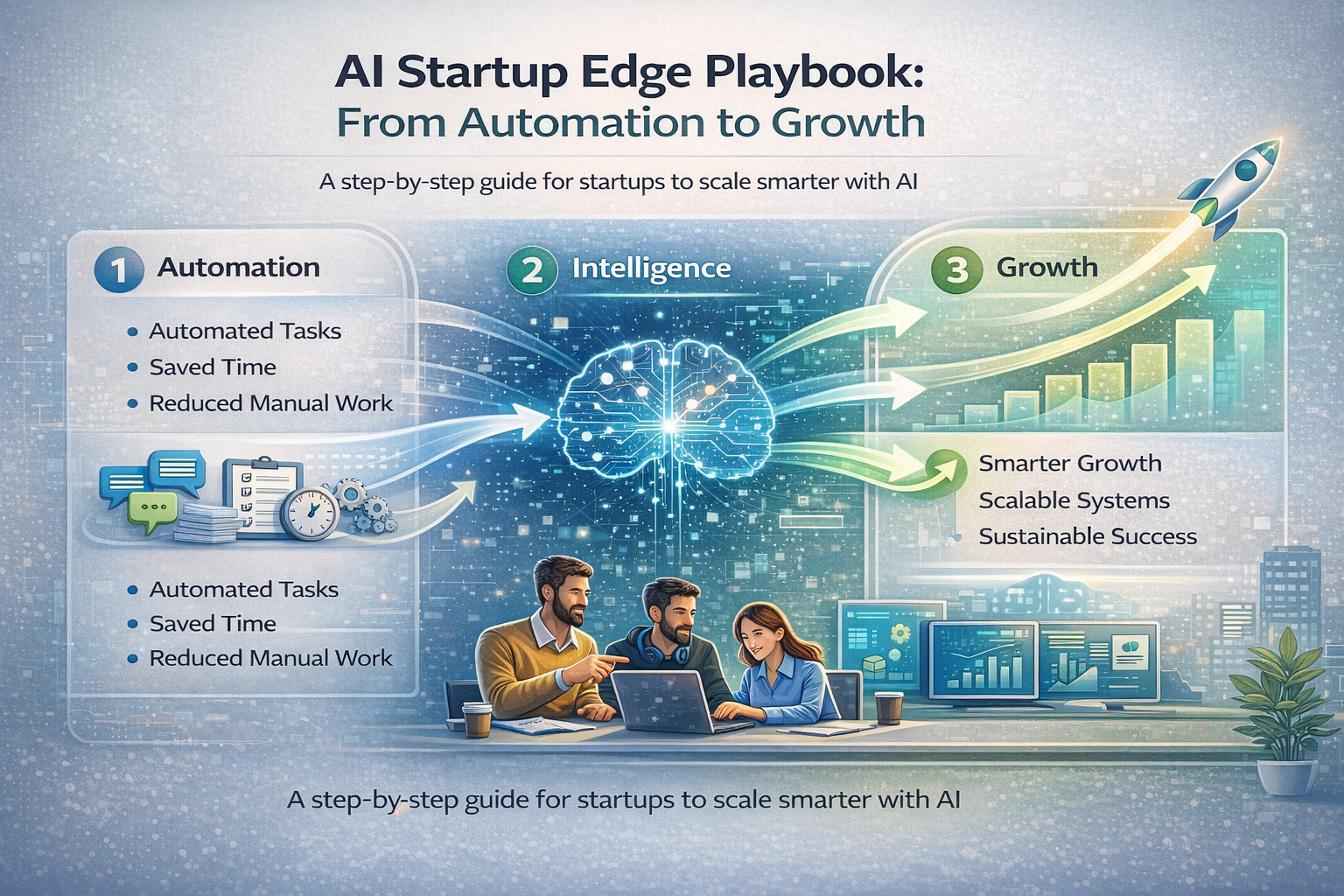
The Core Philosophy: From Automation to Growth
AI adoption should follow a logical journey.
That journey has three phases:
- Automation
- Intelligence
- Growth
Each phase builds on the previous one.
Phase 1: Automation — Building the Foundation
Automation is the starting point.
Why Automation Comes First
Manual work drains time and energy.
Automation helps startups:
- Save time
- Reduce errors
- Lower costs
- Improve consistency
Without automation, growth becomes expensive.
Step 1: Identify Repetitive Tasks
Startups should first find tasks that repeat daily.
These usually include:
- Customer support queries
- Sales follow-ups
- Data entry
- Reporting
These tasks are ideal for AI automation.
Step 2: Implement Simple AI Automation
Automation should start small.
Examples include:
- AI chat handling FAQs
- Automated email follow-ups
- Workflow automation tools
- Auto-generated reports
Early wins build confidence.
Step 3: Measure Time and Cost Savings
Automation must be measured.
Founders should track:
- Hours saved
- Tasks reduced
- Cost efficiency
This proves AI value early.
Phase 2: Intelligence — Turning Data into Clarity
Once automation is in place, intelligence follows.
Why Intelligence Is the Next Step
Automation saves time.
Intelligence improves decisions.
AI intelligence helps startups:
- Understand performance
- Predict outcomes
- Reduce uncertainty
This is where AI becomes strategic.
Step 4: Centralise Business Data
Data often lives in silos.
AI Startup Edge recommends:
- Connecting marketing data
- Integrating sales tools
- Combining customer data
- Linking financial metrics
Centralised data creates visibility.
Step 5: Convert Data into Actionable Insights
Raw data alone is useless.
AI converts data into:
- Clear insights
- Trends and patterns
- Growth indicators
Founders gain clarity.
Step 6: Use AI for Predictive Decisions
AI enables prediction.
This includes:
- Revenue forecasting
- Churn prediction
- Demand forecasting
- Risk detection
Startups move from reactive to proactive.
Phase 3: Growth — Scaling Smarter, Not Harder
Growth is the final goal.
Why Growth Must Come After Automation and Intelligence
Scaling without systems creates chaos.
AI-driven growth ensures:
- Control during expansion
- Consistent quality
- Predictable outcomes
Growth becomes sustainable.
Step 7: AI-Driven Marketing Optimisation
Marketing drives growth.
AI improves marketing by:
- Optimising ad spend
- Improving targeting
- Enhancing content performance
- Reducing acquisition cost
Growth becomes measurable.
Step 8: Smarter Sales Using AI
Sales efficiency is critical.
AI helps sales teams by:
- Scoring leads
- Prioritising prospects
- Improving follow-ups
Sales output increases without extra effort.
Step 9: AI-Powered Customer Experience
Retention supports growth.
AI improves customer experience by:
- Faster support
- Personalised communication
- Predicting customer needs
Customers stay longer.
Step 10: AI-Based Financial Control
Growth without financial control is risky.
AI helps founders:
- Track cash flow
- Control burn rate
- Forecast runway
- Plan budgets
Growth stays stable.
Building an AI-First Growth Culture
Technology alone is not enough.
Why Culture Matters
AI success depends on people.
AI-first culture:
- Encourages learning
- Reduces fear
- Promotes experimentation
Culture ensures adoption.
How Founders Lead AI Culture
Founders should:
- Use AI themselves
- Encourage curiosity
- Support upskilling
- Reward efficiency
Leadership sets the tone.
Common Mistakes Startups Make with AI
Avoiding mistakes saves time.
Mistake 1: Using Too Many Tools
Focus on impact, not quantity.
Mistake 2: Expecting Instant Growth
AI is a process, not magic.
Mistake 3: Ignoring Data Quality
Poor data limits AI value.
Mistake 4: Skipping Team Training
Adoption requires understanding.
How AI Startup Edge Makes This Playbook Practical
AI Startup Edge focuses on execution.
It provides:
- Clear implementation steps
- Business-focused AI solutions
- Continuous optimisation
- Founder-friendly guidance
The playbook becomes action, not theory.
Real Benefits of Following the AI Startup Edge Playbook
Startups experience:
- Faster execution
- Lower costs
- Better decisions
- Higher productivity
- Sustainable growth
AI becomes a growth engine.
Who This Playbook Is For
This playbook is ideal for:
- Early-stage startups
- Growing businesses
- Solo founders
- Lean teams
AI adapts to all sizes.
The Long-Term Vision: Intelligent Growth
In the future:
- AI will be standard
- Growth will be data-driven
- Efficiency will define success
The playbook prepares startups for this reality.
Final Thoughts
The AI Startup Edge Playbook shows that growth does not require chaos, burnout, or massive hiring. It requires smart systems, clear data, and focused execution. By moving step by step from automation to intelligence and finally to growth, startups can scale sustainably and confidently.
AI is not a shortcut. It is a multiplier. Startups that follow this playbook will grow smarter, faster, and stronger in an increasingly competitive world.
Read More Blog–Real-World Examples of AI Solving Startup Problems
Frequently Asked Questions (FAQs)
1. Is this playbook suitable for non-tech startups?
Yes. It focuses on business use, not coding.
2. Do startups need big budgets for AI?
No. Many tools are affordable and scalable.
3. How long does it take to see results?
Automation benefits appear within weeks.
4. Can small teams really scale with AI?
Yes. AI enables lean, high-output teams.
5. Is this playbook only for AI Startup Edge users?
No. The framework applies broadly.







Comments are closed