

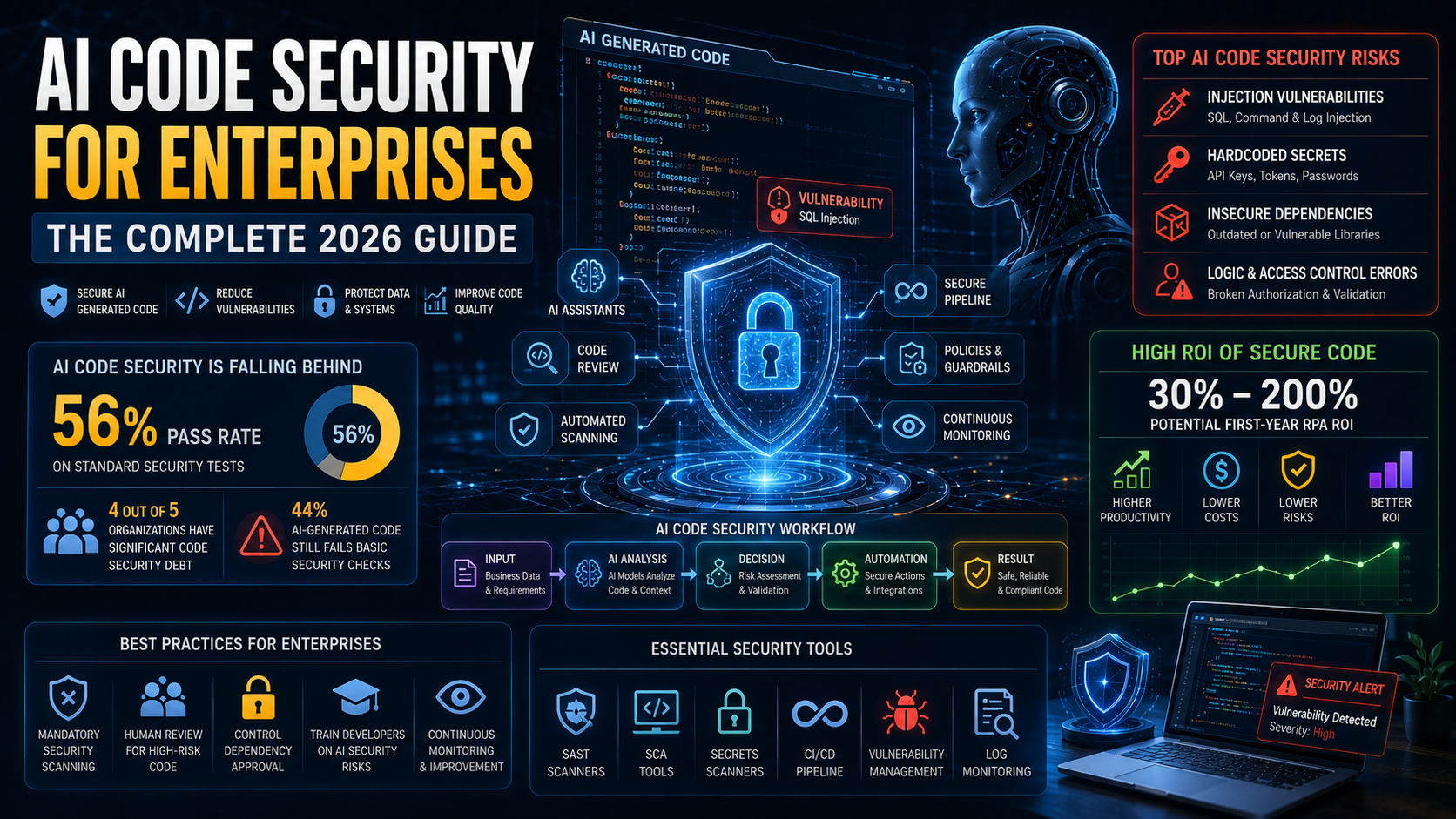
Enterprise teams now ship AI-generated code every day. But security has not kept pace. A 2026 industry analysis of over 100 AI models found that AI code security for enterprises has stalled at just a 56% pass rate on standard security tests. This guide breaks down the real risks, the categories that matter most, and a practical framework for locking down AI-generated code before it reaches production.
Why AI Code Security for Enterprises Matters in 2026
AI coding assistants now write a large share of enterprise code. However, that speed comes with a cost. Independent testing across major language models found that AI-generated code still fails basic security checks roughly 44% of the time. In addition, separate industry research shows four out of five organizations are already carrying significant security debt in their codebases. So, the risk is not theoretical. It is showing up in production systems right now.
The problem compounds because AI models learn from public code, including code that already contains vulnerabilities. As a result, an assistant can confidently generate a function that compiles cleanly and still contains a serious flaw. Because the code looks polished, reviewers often trust it more than they should.
Common AI Code Security Risks
Most AI code security failures fall into a handful of recurring categories. Understanding them helps security teams know exactly where to focus.
Injection Vulnerabilities
Injection flaws remain the single most common issue in AI-generated code. For example, an AI assistant might build a database query by concatenating raw user input instead of using parameterized statements. Similarly, generated code sometimes builds shell commands or log entries the same unsafe way, opening the door to SQL injection, command injection, and log injection attacks.
Hardcoded Secrets and Credentials
AI assistants frequently hardcode API keys, passwords, or tokens directly into generated code. Instead of pulling credentials from a secrets manager, the model often mirrors patterns from public repositories where someone leaked secrets by mistake. That habit turns a small oversight into a direct path for attackers.
Insecure Dependency Choices
AI models sometimes recommend outdated libraries or packages with known vulnerabilities. In other words, the suggestion looks correct on the surface, but the underlying dependency carries a documented security flaw. Enterprises that auto-install suggested packages without a review step inherit that risk immediately.
Logic and Access Control Errors
Beyond obvious vulnerabilities, AI-generated code frequently gets authorization logic wrong. A generated endpoint might confirm that a user holds a valid session but forget to confirm that the same user should access a specific record. This is exactly the kind of subtle flaw that automated scanners can miss and human reviewers often skim past.
High-Risk Areas Enterprises Should Watch
Not every part of an application carries equal risk. These areas deserve extra scrutiny whenever an AI assistant writes the code.
- Authentication and session handling: AI-written login flows and token handling frequently miss edge cases that attackers exploit first.
- Database access layers: query-building code is a top source of injection vulnerabilities in AI-generated code.
- Third-party integrations: AI models often generate integration code with weak validation on incoming data from external services.
- Configuration and infrastructure-as-code files: AI-generated cloud configuration can quietly open storage buckets or ports that should stay closed.
- Payment and financial logic: even small logic errors here create outsized business risk, so this code needs the strictest review.
- Internal admin tools: these are often built quickly with AI assistance and reviewed less carefully than customer-facing code.
Overall, the common thread is speed. Code written quickly, and reviewed quickly, is where AI code security for enterprises breaks down most often.
How to Build an AI Code Security Program
Enterprises do not need to ban AI coding tools to stay secure. Instead, they need a structured program around how those tools get used.
Step 1: Establish Mandatory Security Scanning
Every AI-generated pull request should pass through automated static analysis before a human ever reviews it. This catches the obvious injection flaws and hardcoded secrets before they cost review time.
Step 2: Add Human Review for High-Risk Code
Authentication, payment logic, and access control changes should always get a dedicated security-focused review. As a result, the riskiest code gets the most scrutiny instead of the least.
Step 3: Control Dependency Approval
Require that any new library an AI assistant suggests goes through an approval process instead of an automatic install. This closes the insecure dependency gap before it reaches a build pipeline.
Step 4: Train Developers on AI-Specific Risks
First, developers who understand how AI models fail catch more issues during review. Likewise, teams that treat AI output as a first draft, not a finished product, ship measurably fewer vulnerabilities.
Common Pitfalls in AI Code Security for Enterprises
Even security-conscious teams fall into predictable traps when adopting AI coding tools.
- Trusting confident-looking code: clean, well-formatted AI output is not the same as secure output. Instead, verify it the same way you would verify any other contribution.
- Skipping review because a scanner passed: automated tools catch known patterns, not every logic flaw. So, human review still matters.
- Allowing unmonitored AI tool sprawl: unmanaged coding assistants across teams make consistent policy enforcement nearly impossible.
- Treating this as a one-time fix: AI models change constantly, so security policies need regular updates too.
- No ownership for AI-generated code quality: someone needs to be accountable for tracking vulnerability trends across AI-assisted projects.
Tools That Help With AI Code Security for Enterprises
First, static analysis platforms, software composition analysis tools, and secrets-scanning tools all play a role here. Many enterprises now run these tools directly inside their CI/CD pipeline so nothing reaches production unchecked. For deeper industry benchmarking, the 2026 GenAI Code Security Report tracks how top AI models perform against real security tests. Meanwhile, teams building their own AI automation projects should apply the same scanning discipline to any code those workflows generate or deploy.
Frequently Asked Questions About AI Code Security for Enterprises
Is AI-generated code less secure than human-written code?
Not necessarily less secure across the board, but it fails common security tests at a high rate. Independent testing puts the pass rate at around 56%, which means a large share of AI-generated code needs a fix before it is safe to ship.
What is the biggest AI code security risk for enterprises?
Injection vulnerabilities remain the most common issue. However, hardcoded secrets and insecure dependency choices are close behind and just as damaging.
Can automated tools catch every AI code security issue?
No. Automated scanners catch known patterns well, but logic errors and access control mistakes often require human review to catch.
Should enterprises stop using AI coding assistants?
Not usually. Instead, most enterprises adopt structured review processes and mandatory scanning rather than banning the tools outright.
How often should AI code security policies get updated?
Regularly. AI models and their failure patterns change often, so a policy written a year ago may already miss new risks.
Key Takeaways
AI code security for enterprises comes down to treating AI output as a first draft that always needs verification. Mandatory scanning, human review for high-risk code, and controlled dependency approval close most of the gap. For instance, the organizations with the fewest AI-related incidents are usually the ones that built these steps into their pipeline early, not the ones that reacted after an incident. Overall, the tools are not the risk. The absence of a process around them is.
This guide reflects AI code security research and industry benchmarks as of August 2026. Findings vary by model, codebase, and how a team configures its security tooling.