Subtotal $0.00



Email : 26
Modern customers expect more than generic ads and one-size-fits-all messages. They want brands to understand their needs, preferences, and behaviour. For startups and growing businesses, this expectation creates a big challenge. Personalising marketing manually for every customer is almost impossible when time, budget, and team size are limited.
This is where Artificial Intelligence (AI) becomes extremely powerful.
AI allows startups to personalise marketing at scale, meaning they can deliver the right message to the right person at the right time—automatically. Instead of sending the same content to everyone, AI uses data to understand each customer and adjust marketing messages accordingly. This improves engagement, increases conversions, and reduces wasted marketing spend.
This article explains how AI personalises marketing at scale, why it matters for startups, and how businesses can use AI to create meaningful customer experiences without increasing workload. If you want better results from your marketing with fewer resources, this guide will give you clear and practical answers.
What Does Marketing Personalisation Mean?
Marketing personalisation means customising messages, content, and offers based on individual customer data.
Instead of treating all users the same, personalised marketing adapts to:
- User behaviour
- Interests and preferences
- Location and timing
- Past interactions
Personalisation helps customers feel understood, not targeted randomly.
Why Personalisation Is Difficult Without AI
Manual personalisation works only for very small audiences.
Without AI, startups struggle because:
- Customer data is too large to analyse manually
- Behaviour changes constantly
- Personalisation takes too much time
- Teams cannot scale efforts
This leads to generic marketing that performs poorly.
How AI Enables Personalisation at Scale
AI processes large amounts of data quickly and learns patterns that humans cannot easily detect.
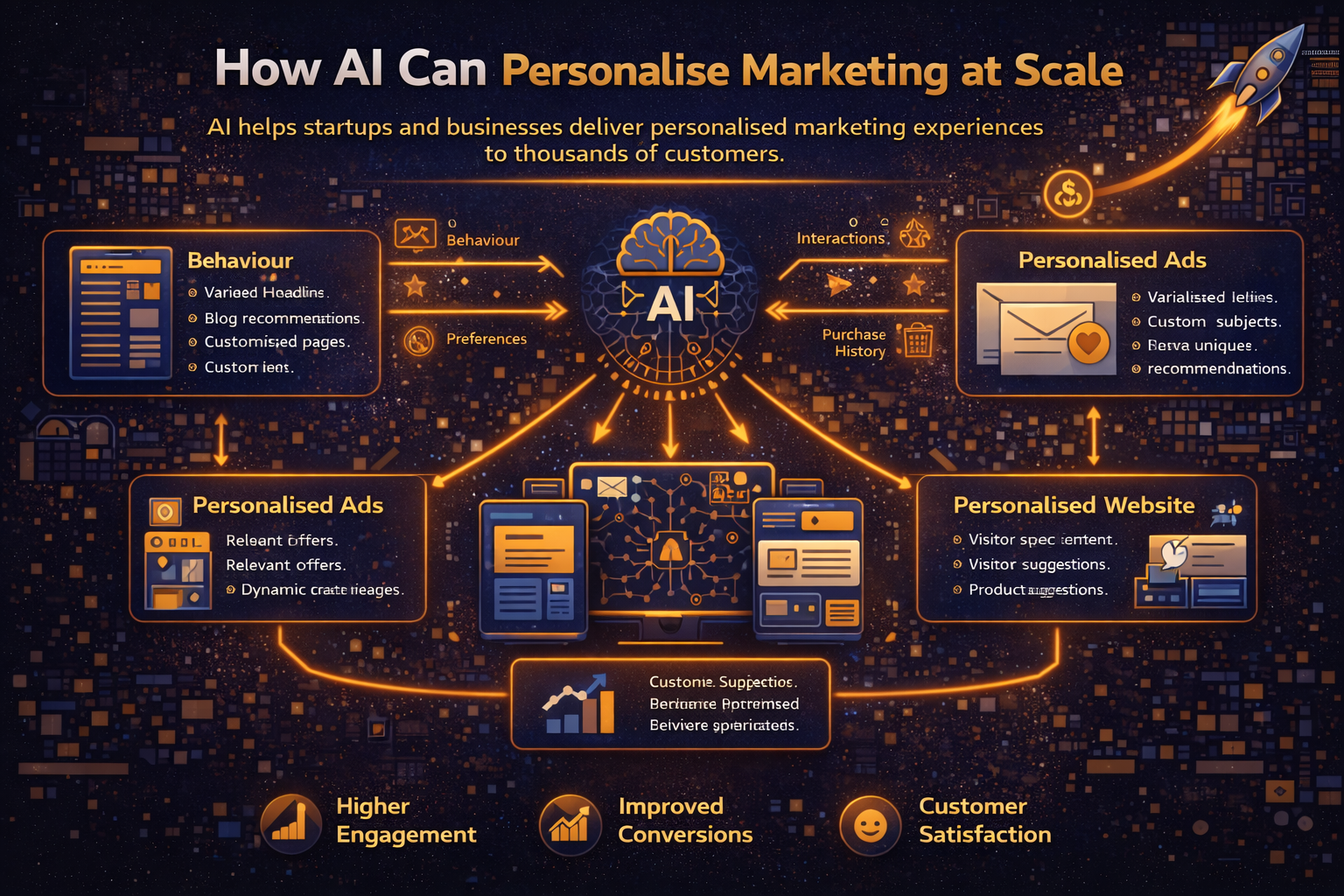
AI personalises marketing by:
- Analysing user data in real time
- Identifying patterns and preferences
- Predicting what users want next
- Automating personalised actions
This makes large-scale personalisation possible.
AI Collects and Understands Customer Data
Personalisation starts with understanding customers.
AI analyses data such as:
- Website visits
- Search behaviour
- Purchase history
- Email clicks
- Social media engagement
This data helps AI create detailed customer profiles automatically.
AI Segments Audiences Automatically
Segmentation means grouping users with similar behaviour.
AI creates smart segments based on:
- Interests
- Buying intent
- Engagement level
- Demographics
These segments update automatically as behaviour changes.
AI Personalises Content for Each User
Content is more effective when it feels relevant.
AI personalises content by:
- Showing different headlines to different users
- Recommending relevant blogs or products
- Customising landing pages
- Adjusting call-to-action messages
This increases engagement and time spent.
AI Personalises Email Marketing at Scale
Email marketing performs best when personalised.
AI improves email marketing by:
- Writing personalised subject lines
- Sending emails at the best time
- Recommending relevant offers
- Adjusting content based on behaviour
Each user receives a message tailored to them.
AI Improves Ad Personalisation
Generic ads waste money.
AI personalises ads by:
- Showing ads based on user interest
- Adjusting creatives automatically
- Retargeting high-intent users
- Optimising budget in real time
This improves return on ad spend.
AI Personalises Website Experience
AI adapts website content dynamically.
AI helps by:
- Displaying different content to different visitors
- Customising product recommendations
- Personalising banners and offers
- Improving user journey
This increases conversion rates.
AI Uses Predictive Analytics for Personalisation
Prediction is a key strength of AI.
AI predicts:
- What a user may buy next
- When a user is ready to convert
- Which users may leave
- Which message works best
This allows proactive personalisation.
AI Automates Personalised Marketing Actions
Automation makes scale possible.
AI automates:
- Personalised email sequences
- Retargeting campaigns
- Content recommendations
- Follow-up messages
Marketing continues even when teams are offline.
Benefits of Personalised Marketing Using AI
AI-driven personalisation delivers clear benefits.
Higher Engagement Rates
Personalised messages feel relevant.
This leads to:
- More clicks
- Longer sessions
- Better interaction
Improved Conversion Rates
Relevant content converts better.
AI personalisation helps:
- Reduce drop-offs
- Increase sign-ups
- Improve sales
Lower Customer Acquisition Cost
Better targeting reduces waste.
This means:
- Less money spent on wrong audiences
- Higher ROI
Better Customer Experience
Customers feel understood.
This builds:
- Trust
- Loyalty
- Repeat business
Personalisation at Scale Without Extra Cost
AI replaces manual effort.
This allows:
- Scaling without hiring more people
- Consistent marketing quality
Common Mistakes Startups Make with AI Personalisation
Even with AI, mistakes happen.
Common issues include:
- Using poor quality data
- Over-personalising aggressively
- Ignoring privacy rules
- Not testing results
Balanced personalisation works best.
How Startups Should Start Using AI for Personalisation
A step-by-step approach is recommended.
Startups should:
- Collect clean customer data
- Use AI analytics tools
- Personalise one channel first
- Measure results
- Expand gradually
Small steps lead to big improvements.
AI Personalisation vs Manual Personalisation
Manual personalisation:
- Is slow
- Does not scale
- Requires large teams
AI personalisation:
- Is fast
- Scales automatically
- Learns continuously
This difference gives startups a competitive edge.
The Future of Marketing Personalisation with AI
Personalisation will become smarter and more predictive.
In the future:
- Marketing will adapt in real time
- Every interaction will feel personal
- Customer journeys will self-optimise
AI will drive this evolution.
Final Thoughts from AI Startup Edge
Personalisation is no longer optional in modern marketing. Customers expect relevance, and AI makes it possible to deliver that relevance at scale.
AI helps startups:
- Understand customers better
- Deliver personalised experiences
- Increase conversions
- Reduce marketing costs
At AI Startup Edge, we believe AI-powered personalisation is one of the strongest growth tools for startups and modern businesses.
Frequently Asked Questions (FAQs)
1. Can small startups use AI for personalised marketing?
Yes. Many AI tools are affordable and easy to use.
2. Does personalisation really improve conversions?
Yes. Relevant messaging converts significantly better.
3. Is AI personalisation safe for customer data?
Yes, when privacy laws and ethical practices are followed.
4. Which marketing channels benefit most from AI personalisation?
Email, ads, websites, and content marketing benefit the most.
5. How does AI Startup Edge help?
AI Startup Edge helps startups design and implement AI-driven personalised marketing systems.