Subtotal $0.00




Email : 31
Every startup founder faces decisions every day. Some decisions are small, like replying to emails or approving expenses. Others are big, like pricing, hiring, marketing strategy, or product direction. The challenge is not making decisions — the challenge is making the right decisions fast, with limited time and limited information.
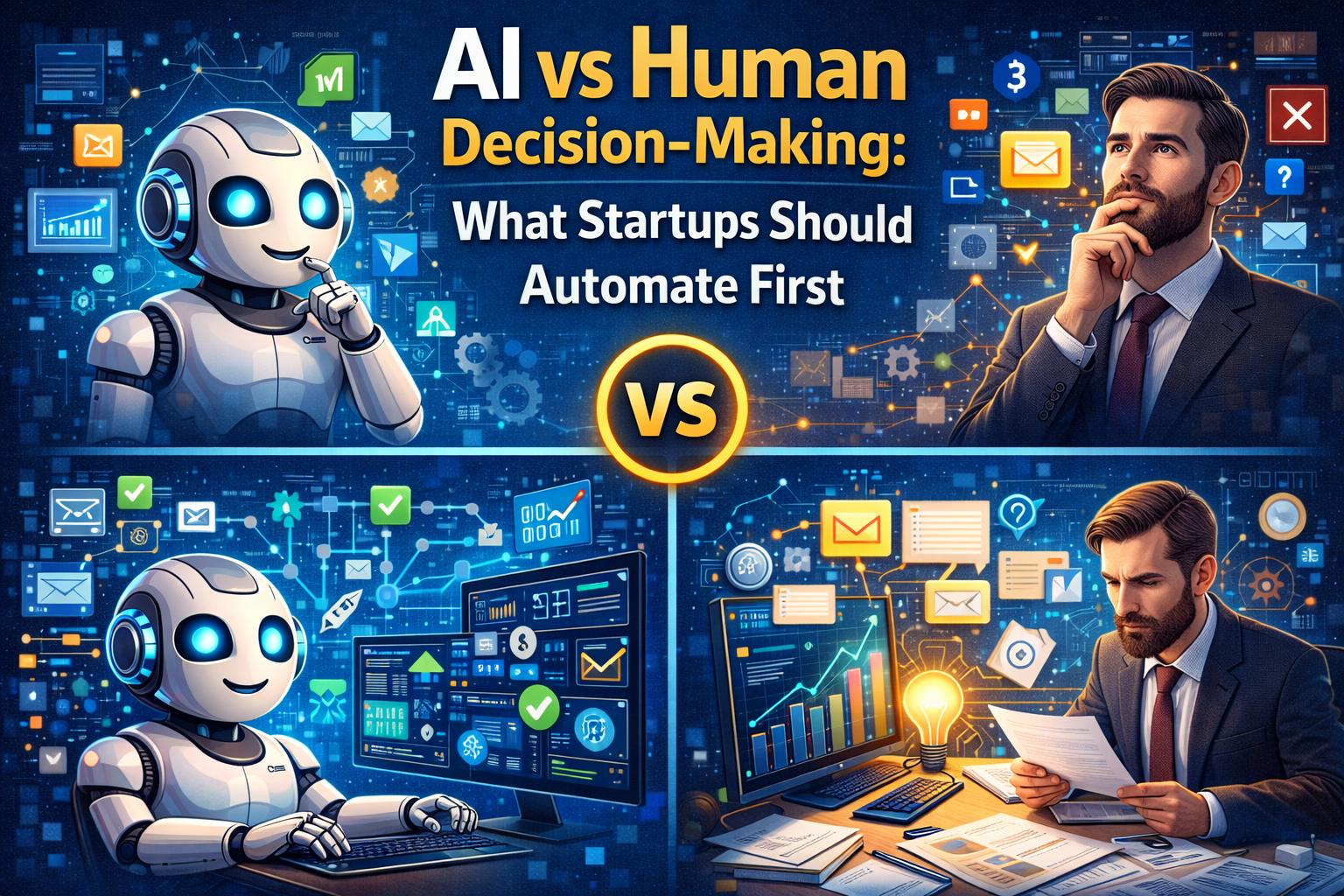
This is where the debate of AI vs human decision-making becomes important for startups.
Artificial Intelligence can analyse data, spot patterns, and suggest actions faster than any human. But humans bring creativity, intuition, ethics, and emotional understanding that AI cannot replace. Many startups fail not because they use AI, but because they automate the wrong things or trust AI where human judgment is required.
This article explains what startups should automate first using AI and what decisions must stay human, in a genuine, practical way. If you want smarter decisions, less stress, and better growth, this guide is for you.
Why Decision-Making Is a Critical Problem for Startups
Startups operate in uncertainty. Unlike big companies, startups do not have unlimited data, money, or time. Wrong decisions can cost growth, customers, or even survival.
Common decision-making problems in startups include:
- Too many decisions in one day
- Limited data and unclear insights
- Emotional or rushed decisions
- Manual processes slowing speed
- Founder burnout
AI helps by reducing mental load and improving accuracy. But automation must be done carefully.
Understanding AI Decision-Making in Simple Terms
AI decision-making means using systems that analyse data and suggest or take actions based on patterns.
AI is very good at:
- Handling large amounts of data
- Repeating tasks consistently
- Finding trends humans may miss
- Making fast, logical decisions
However, AI does not understand emotions, values, or long-term vision the way humans do.
Understanding Human Decision-Making in Startups
Human decision-making is based on experience, intuition, creativity, and ethics.
Humans are strong at:
- Strategic thinking
- Emotional intelligence
- Ethical judgment
- Creativity and innovation
- Understanding context
Humans are weak at handling repetitive tasks, large data sets, and fatigue-driven decisions.
Why Startups Need Both AI and Humans
The goal is not AI vs humans, but AI with humans.
At AI Startup Edge, we believe:
- AI should handle repeatable and data-heavy decisions
- Humans should handle strategic and creative decisions
Automation should support founders, not replace them.
What Startups Should Automate First Using AI
Before listing areas to automate, it is important to understand one rule:
If a task is repetitive, rule-based, data-driven, and time-consuming, it should be automated first.
1. Data Collection and Data Analysis
Startups generate data from marketing, sales, customers, and operations. Analysing this manually is slow and error-prone.
AI should automate data analysis first because it saves time and improves clarity.
AI can help by:
- Collecting data automatically
- Creating dashboards
- Identifying trends and patterns
- Generating reports
Humans should focus on interpreting insights, not collecting data.
2. Routine Operational Decisions
Operational decisions happen daily and follow clear rules.
Examples include inventory updates, task assignments, or approval workflows.
AI should automate these because:
- Rules are clear
- Decisions are repetitive
- Errors are costly
- Speed matters
Automation reduces delays and operational chaos.
3. Marketing Performance Optimisation
Marketing decisions based on guesswork waste money. AI can optimise marketing faster than humans.
AI should automate:
- Ad budget allocation
- Campaign optimisation
- Audience targeting
- Performance tracking
Humans should still define brand voice and messaging strategy.
4. Lead Scoring and Sales Prioritisation
Sales teams waste time chasing low-quality leads. AI helps identify high-intent prospects.
AI should automate lead scoring because:
- It analyses behaviour patterns
- It predicts buying intent
- It improves conversion rates
Humans should handle relationship-building and negotiations.
5. Customer Support and Query Routing
Customers expect quick responses. AI ensures speed and consistency.
AI should automate:
- FAQs and basic support
- Ticket categorisation
- Response prioritisation
- Chatbot conversations
Humans should handle complex, emotional, or sensitive issues.
6. Financial Tracking and Expense Monitoring
Financial decisions must be accurate and consistent.
AI should automate:
- Expense categorisation
- Invoice processing
- Cash flow tracking
- Financial alerts
Humans should handle financial strategy and investment decisions.
7. Hiring Screening and Shortlisting
Hiring takes time and effort. AI can speed up the early stages.
AI should automate:
- Resume screening
- Skill matching
- Candidate shortlisting
- Interview scheduling
Humans should make final hiring decisions based on culture and fit.
8. Workflow and Process Automation
Manual workflows slow scaling. AI helps build repeatable systems.
AI should automate:
- Task handovers
- Process approvals
- Notifications
- Reporting
Humans should design workflows and improve processes.
Decisions Startups Should NOT Fully Automate
Not all decisions should be given to AI. Some decisions need human judgment.
1. Vision and Long-Term Strategy
AI cannot understand purpose, values, or long-term vision.
Humans must decide:
- Company mission
- Business direction
- Market positioning
- Growth philosophy
AI can support with data, not direction.
2. Product Innovation and Creativity
AI can suggest improvements, but creativity comes from humans.
Humans should decide:
- What to build
- Why to build it
- How it feels to users
AI should support testing and feedback analysis.
3. Ethical and Sensitive Decisions
AI does not understand ethics or social impact.
Humans must decide:
- Data privacy policies
- Customer trust issues
- Employee well-being
- Social responsibility
AI should never replace ethical judgment.
4. Leadership and Team Management
Leadership is about emotions, motivation, and trust.
Humans should handle:
- Conflict resolution
- Team motivation
- Culture building
- Performance feedback
AI can support with insights, not leadership.
Common Mistakes Startups Make with AI Automation
Many startups fail to get value from AI due to wrong expectations.
Common mistakes include:
- Automating everything too fast
- Trusting AI blindly
- Ignoring human oversight
- Not training teams
- Choosing tools without strategy
Balanced automation is the key.
How Startups Should Decide What to Automate First
A simple decision framework helps.
Startups should ask:
- Is this task repetitive?
- Is it data-driven?
- Does it require creativity?
- Can mistakes be costly?
- Does it consume too much time?
If the answer fits automation, AI should handle it.
The Future of AI and Human Decision-Making in Startups
In the future, AI will become more supportive, not dominant.
AI will:
- Offer better predictions
- Reduce decision fatigue
- Improve operational clarity
- Support founders mentally
Humans will remain decision leaders, not operators.
Final Thoughts from AI Startup Edge
AI is not here to replace founders. It is here to protect their time, energy, and focus.
The smartest startups are not choosing between AI and humans. They are choosing the right balance.
Automate what is repeatable. Humanise what is meaningful.
That is how startups scale sustainably.
Read More Blog–Top AI Tools Every Startup Founder Should Use in 2026
Frequently Asked Questions (FAQs)
1. Can AI replace human decision-making in startups?
No. AI supports decisions but cannot replace human judgment, creativity, and ethics.
2. What should startups automate first?
Repetitive, data-driven, and rule-based decisions should be automated first.
3. Is AI decision-making risky?
It can be if used blindly. Human oversight is always necessary.
4. Do non-tech startups benefit from AI automation?
Yes. AI helps across marketing, sales, finance, operations, and support.
5. How does AI Startup Edge help startups?
AI Startup Edge helps startups choose, implement, and balance AI automation with human leadership.