Subtotal $0.00




Email : 58
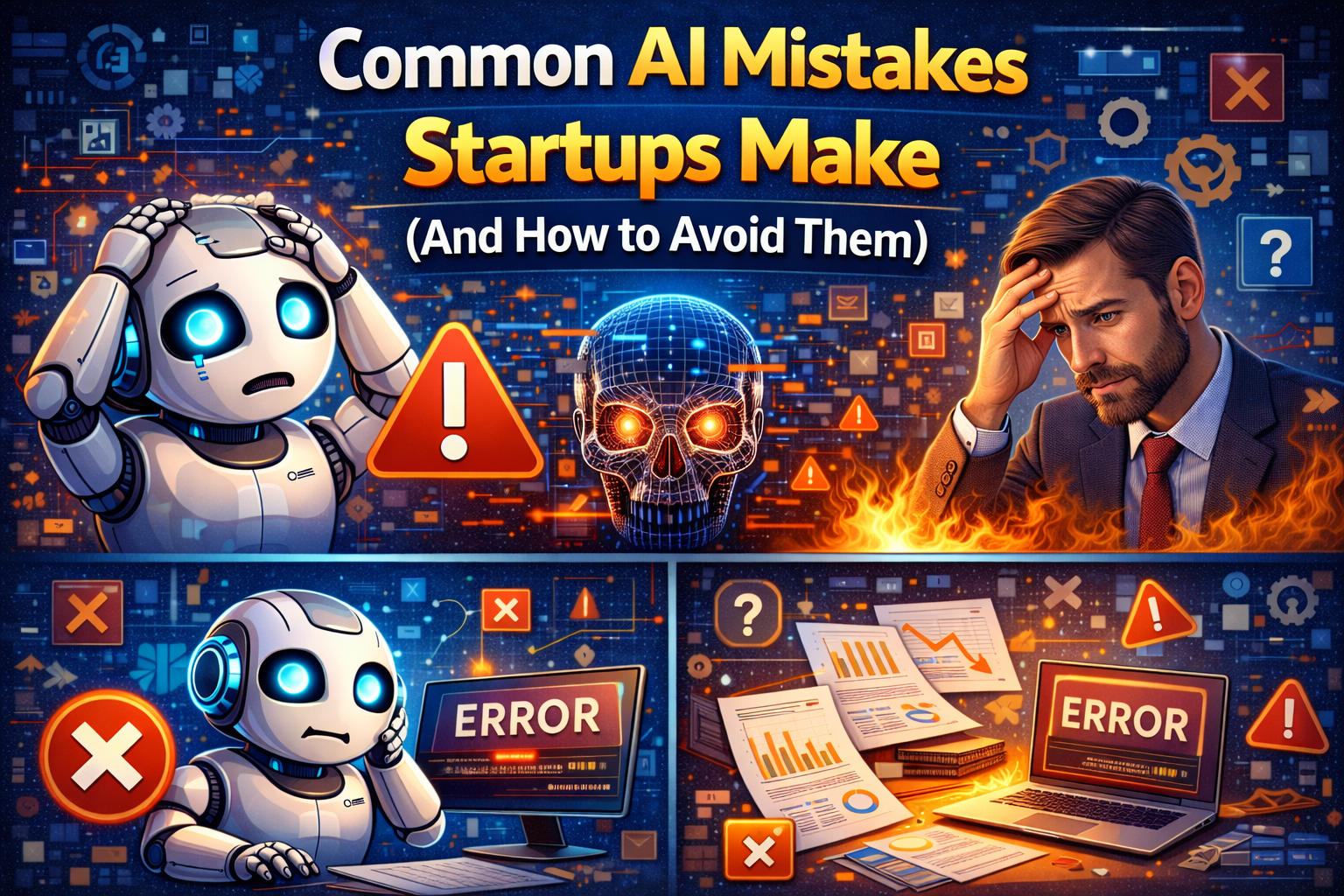
Artificial Intelligence is changing how startups work, grow, and scale. From marketing and sales to customer support and operations, AI promises speed, accuracy, and efficiency. Because of this, many startups rush to adopt AI, hoping it will solve all their problems quickly.
But here is the reality — AI does not fail startups; wrong usage of AI does.
Many startups invest in AI tools but do not see results. Some waste money, others confuse their teams, and a few even harm customer trust. These failures usually happen because founders make common mistakes while adopting or using AI. They either expect too much from AI, use it in the wrong areas, or forget the human side of decision-making.
This article explains the most common AI mistakes startups make and how to avoid them, in very simple language. If you are planning to use AI or already using it, this guide will help you save time, money, and effort while building smarter, sustainable growth.
Why Startups Make Mistakes with AI
Before discussing the mistakes, it is important to understand why they happen.
Most startups:
- Are under pressure to grow fast
- Have limited budgets and teams
- Hear too much hype about AI
- Do not have clear AI strategy
- Want quick results
Because of this, founders often adopt AI emotionally instead of strategically. AI should be a tool, not a shortcut.
Mistake 1: Adopting AI Without a Clear Business Problem
Many startups start using AI because it is trending, not because it solves a real problem.
They buy AI tools without understanding:
- What task it will improve
- Which process it will replace
- How success will be measured
This leads to wasted money and confusion.
How to Avoid This Mistake
Before adopting AI, startups should:
- Identify a specific problem
- Define clear goals
- Decide what success looks like
AI should always solve a real business pain, not just look impressive.
Mistake 2: Trying to Automate Everything Too Early
Some startups believe AI should handle everything immediately. They try to automate all tasks at once.
This creates problems such as:
- Broken workflows
- Team resistance
- Loss of control
- Poor customer experience
Not every task should be automated.
How to Avoid This Mistake
Startups should:
- Automate only repetitive tasks first
- Keep humans involved in critical decisions
- Test automation in small steps
Smart automation grows slowly and safely.
Mistake 3: Expecting AI to Replace Human Judgment
AI is powerful, but it is not human. Many founders expect AI to make perfect decisions.
This is risky because:
- AI lacks emotional intelligence
- AI cannot understand ethics
- AI does not know long-term vision
Blind trust in AI can damage relationships and brand value.
How to Avoid This Mistake
Use AI as:
- A decision support system
- A data analyser
- An efficiency tool
Humans must always handle strategy, ethics, and leadership.
Mistake 4: Choosing the Wrong AI Tools
There are thousands of AI tools in the market. Startups often choose tools based on popularity, not suitability.
Wrong tools cause:
- Poor integration
- Low adoption
- High costs
- Limited results
How to Avoid This Mistake
When choosing AI tools, startups should:
- Check ease of use
- Match tools with business size
- Test free versions first
- Ensure scalability
The best AI tool is the one your team actually uses.
Mistake 5: Ignoring Data Quality
AI is only as good as the data it receives. Many startups feed AI poor or incomplete data.
This results in:
- Wrong insights
- Bad predictions
- Poor decisions
Garbage data leads to garbage results.
How to Avoid This Mistake
Startups should:
- Clean data regularly
- Use reliable data sources
- Set data standards
- Review AI outputs carefully
Good data is the foundation of good AI.
Mistake 6: Not Training the Team Properly
Some founders introduce AI tools without explaining them to the team.
This creates:
- Fear of job loss
- Resistance to change
- Low tool adoption
AI then remains unused or misused.
How to Avoid This Mistake
Founders should:
- Educate teams about AI benefits
- Explain that AI supports, not replaces
- Provide basic training
- Encourage experimentation
Team confidence leads to AI success.
Mistake 7: Overcomplicating AI Implementation
Some startups make AI implementation too complex.
They:
- Use too many tools
- Add unnecessary features
- Create complex workflows
This slows growth instead of speeding it up.
How to Avoid This Mistake
Keep AI simple by:
- Using fewer tools
- Focusing on core functions
- Reviewing workflows regularly
Simple AI systems perform better.
Mistake 8: Ignoring Customer Experience
Some startups focus only on automation and forget customers.
This leads to:
- Robotic communication
- Poor support experiences
- Loss of trust
Customers want efficiency, not cold interactions.
How to Avoid This Mistake
Balance AI with human touch by:
- Using AI for basic support
- Escalating emotional issues to humans
- Collecting customer feedback
AI should improve experience, not reduce empathy.
Mistake 9: Not Measuring AI Performance
Many startups use AI tools but never measure results.
Without measurement:
- Ineffective tools stay active
- Money is wasted
- Improvements are missed
How to Avoid This Mistake
Startups should track:
- Time saved
- Cost reduction
- Productivity improvement
- Customer satisfaction
AI must deliver measurable value.
Mistake 10: Assuming AI Is a One-Time Setup
AI is not “set and forget”. Many startups assume once AI is installed, it will work forever.
But AI systems need:
- Regular updates
- Data refinement
- Strategy alignment
Ignoring this reduces effectiveness.
How to Avoid This Mistake
Treat AI as:
- An evolving system
- A long-term partner
- A continuous improvement tool
Review AI performance regularly.
Mistake 11: Overlooking Ethical and Privacy Concerns
Some startups ignore data privacy and ethics while using AI.
This can cause:
- Legal issues
- Loss of customer trust
- Brand damage
How to Avoid This Mistake
Startups must:
- Respect data privacy laws
- Be transparent with users
- Use AI responsibly
Ethical AI builds long-term trust.
How Startups Should Use AI the Right Way
A healthy AI approach includes:
- Clear strategy
- Gradual automation
- Human oversight
- Team involvement
- Continuous learning
AI works best when it supports people, not controls them.
The Future of AI for Startups
AI will become smarter, simpler, and more integrated.
Successful startups will:
- Use AI for efficiency
- Keep humans for creativity
- Balance automation and judgment
- Build trust-driven systems
The future belongs to AI-powered but human-led startups.
Read More Blog-AI Agents for Automating Business Task
Final Thoughts from AI Startup Edge
AI is a powerful growth tool, but only when used wisely.
Startups that avoid common AI mistakes can:
- Save money
- Improve decisions
- Scale faster
- Build sustainable businesses
At AI Startup Edge, we believe AI should simplify startup life, not complicate it. The goal is not to chase trends, but to build systems that truly support growth.
Frequently Asked Questions (FAQs)
1. Why do startups fail with AI?
Mostly due to wrong expectations, poor strategy, and lack of human oversight.
2. Should early-stage startups use AI?
Yes, but in limited and well-defined areas.
3. Is AI expensive for startups?
Many AI tools are affordable and scalable.
4. Can AI harm customer experience?
Yes, if overused without human touch.
5. How does AI Startup Edge help?
AI Startup Edge helps startups adopt AI correctly, strategically, and sustainably.