Subtotal $0.00




Email : 18
In today’s fast-moving business world, startups can no longer rely only on intuition or guesswork to make decisions. Competition is high, customer behaviour changes quickly, and small mistakes can cost time, money, and growth opportunities. Many startups fail not because they lack ideas, but because they make decisions without enough data or make sense of data too late.
This is where data-driven decision-making powered by AI becomes a major advantage.
AI helps startups collect, analyse, and understand large amounts of data in real time. Instead of spending hours on spreadsheets or relying on assumptions, founders can make decisions based on clear insights. AI turns raw data into actionable intelligence that helps startups move faster, reduce risks, and stay ahead of competitors.
This article explains how AI enables data-driven decisions and gives startups a competitive edge, using simple language and practical examples. If you want to grow smarter, faster, and more confidently, this guide will help you understand why AI-driven decisions matter.
What Are Data-Driven Decisions?
Data-driven decisions are decisions made using facts, data, and analysis rather than opinions or guesswork.
Instead of asking:
“What do we think will work?”
Startups ask:
“What does the data show will work?”
This approach improves accuracy and reduces risk.
Why Data-Driven Decisions Matter for Startups
Startups operate with limited resources.
Making wrong decisions can:
- Waste money
- Slow growth
- Damage customer trust
- Increase failure risk
Data-driven decisions help startups:
- Move with confidence
- Reduce uncertainty
- Learn faster
- Compete with larger companies
AI makes this approach practical and scalable.
The Role of AI in Data-Driven Decision-Making
AI enhances data-driven decisions by handling complex data quickly.
AI helps by:
- Collecting data from multiple sources
- Analysing large datasets instantly
- Identifying patterns and trends
- Predicting future outcomes
This allows startups to act before competitors do.
How AI Collects and Processes Data
Startups generate data everywhere.
AI collects data from:
- Websites and apps
- Marketing campaigns
- Sales systems
- Customer interactions
- Social media
- Operational tools
AI processes this data automatically, without manual effort.
AI Turns Raw Data into Insights
Raw data alone is not useful.
AI converts data into insights by:
- Cleaning and organising data
- Finding meaningful patterns
- Highlighting important metrics
- Removing noise
Founders get clarity instead of confusion.
How AI Gives Startups a Competitive Edge
AI-driven insights allow startups to outperform competitors.
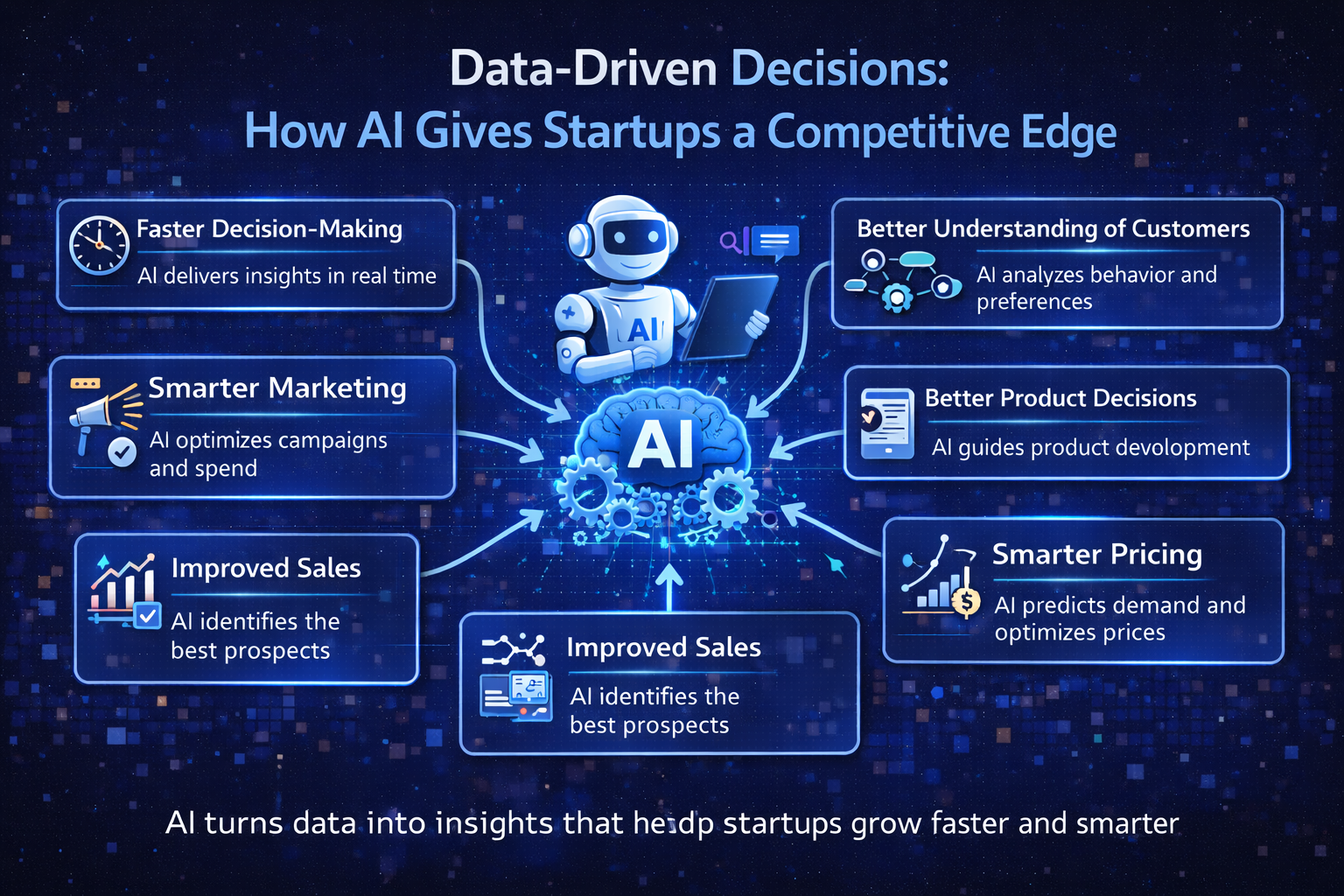
Faster Decision-Making
Speed matters in startups.
AI enables faster decisions by:
- Providing real-time insights
- Automating analysis
- Reducing reporting delays
Startups act quickly while competitors are still analysing.
Better Understanding of Customers
Customer understanding is critical.
AI analyses customer data to:
- Identify preferences
- Track behaviour
- Predict needs
- Personalise experiences
This leads to higher engagement and loyalty.
Smarter Marketing Decisions
Marketing without data wastes money.
AI helps marketing by:
- Identifying high-performing channels
- Optimising campaigns in real time
- Predicting customer response
- Reducing acquisition cost
Marketing budgets are used more efficiently.
Improved Sales Decisions
Sales teams often rely on instincts.
AI improves sales decisions by:
- Scoring leads automatically
- Identifying high-intent prospects
- Predicting deal outcomes
- Optimising follow-ups
Sales efforts focus where success is most likely.
Better Product Decisions
Building the wrong features wastes time.
AI supports product decisions by:
- Analysing user behaviour
- Identifying feature usage patterns
- Detecting friction points
- Suggesting improvements
Products evolve based on real usage data.
Smarter Pricing Decisions
Pricing is often based on guesswork.
AI helps pricing decisions by:
- Analysing demand patterns
- Studying competitor pricing
- Predicting price sensitivity
- Optimising revenue
This improves profitability.
Risk Reduction and Predictive Insights
Startups face constant risks.
AI reduces risk by:
- Predicting churn
- Identifying performance issues early
- Detecting anomalies
- Forecasting trends
Problems are solved before they become serious.
Key Areas Where Startups Use AI for Data-Driven Decisions
AI supports decision-making across all departments.
Marketing and Growth
AI improves growth decisions by:
- Tracking campaign performance
- Optimising SEO and ads
- Analysing conversion funnels
- Predicting growth opportunities
Growth becomes predictable, not random.
Sales and Revenue
AI helps revenue decisions by:
- Forecasting sales
- Improving pipeline visibility
- Reducing sales cycles
- Increasing conversion rates
Revenue planning becomes more accurate.
Operations and Workflow
Operational efficiency matters.
AI improves operations by:
- Analysing workflows
- Identifying bottlenecks
- Optimising resource use
- Reducing manual work
Teams operate more efficiently.
Finance and Budgeting
Financial decisions require accuracy.
AI supports finance by:
- Tracking expenses
- Forecasting cash flow
- Identifying cost leaks
- Improving budget planning
Financial stability improves.
Human Resources and Hiring
Hiring mistakes are expensive.
AI helps HR decisions by:
- Analysing hiring data
- Predicting candidate fit
- Improving workforce planning
- Reducing turnover
Teams are built more strategically.
AI-Driven Decisions vs Gut-Based Decisions
Gut-based decisions:
- Depend on personal opinion
- Are inconsistent
- Carry higher risk
AI-driven decisions:
- Are data-backed
- Are repeatable
- Reduce uncertainty
This difference creates a competitive advantage.
Common Mistakes Startups Make with Data and AI
AI must be used correctly.
Common mistakes include:
- Using poor-quality data
- Expecting instant results
- Ignoring human judgment
- Over-automating decisions
AI works best when combined with human insight.
How Startups Should Start Using AI for Decisions
A simple approach works best.
Startups should:
- Identify key decision areas
- Collect clean data
- Use AI analytics tools
- Review insights regularly
- Act on data consistently
Small improvements compound over time.
The Future of Data-Driven Startups
Data-driven decision-making will become the standard.
In the future:
- AI will predict decisions automatically
- Real-time insights will guide actions
- Startups will operate leaner and smarter
Those who adopt AI early will stay ahead.
Final Thoughts
Data alone does not give startups an advantage. Using data intelligently does. AI enables startups to make smarter, faster, and more confident decisions by turning complex data into clear insights.
By adopting AI-driven decision-making, startups reduce risks, improve efficiency, and compete with larger companies despite limited resources. In a competitive market, the ability to act on data faster than others becomes the true edge.
Read More Blog–How AI Can Personalise Marketing at Scale
Frequently Asked Questions (FAQs)
1. What are data-driven decisions?
Decisions based on data analysis instead of intuition or guesswork.
2. Can small startups use AI for decision-making?
Yes. Many AI tools are affordable and designed for small teams.
3. Does AI replace founders’ judgment?
No. AI supports decisions, founders make the final call.
4. How fast can startups see results?
Some insights appear quickly, while long-term impact grows over time.
5. Is AI data-driven decision-making safe?
Yes, when data quality and ethical practices are followed.