Subtotal $0.00




Email : 29
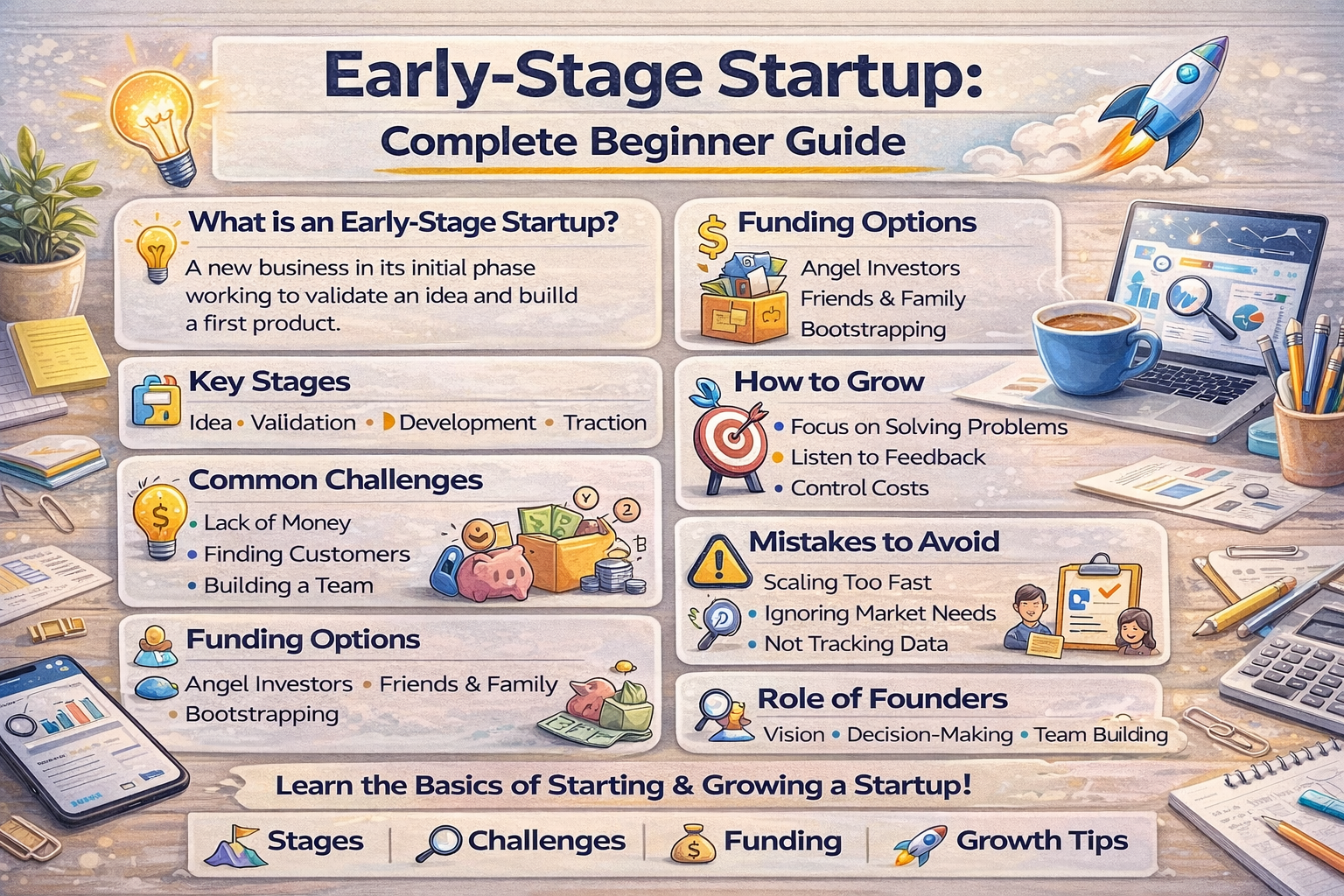
Starting a business is exciting, but it can also be confusing and risky. Many people dream of building a startup, but they often do not understand the early steps clearly. This is why many people search for the term early-stage startup. An early-stage startup is the foundation phase of a business, where ideas are tested, products are built, and the first customers are acquired.
This stage is very important because most startups fail at this point if decisions are not made wisely. Founders face many questions like: Is my idea good? How do I get customers? How do I raise money? How do I build a team? This article answers all these questions in a genuine and easy way.
This guide is written in very simple grammar so that anyone can understand it. Whether you are a student, first-time founder, or aspiring entrepreneur, this article will help you understand what an early-stage startup is and how to move forward confidently.
What Is an Early-Stage Startup?
Before going deeper, it is important to clearly understand the meaning of an early-stage startup.
An early-stage startup is a new business that is still in its initial phase. At this stage, the company is usually working on an idea, a basic product, or a minimum viable product (MVP). The focus is on testing the idea, understanding the market, and finding the first customers.
At this stage, startups usually:
- Have a small team
- Have limited money
- Are still learning from mistakes
- Are experimenting with their business model
The early-stage startup phase is all about learning, improving, and surviving.
Why the Early-Stage Startup Phase Is Important
The early-stage phase decides the future of a startup. Decisions made here can make or break the business.
This stage is important because:
- The foundation of the business is built
- The product idea is tested in the real market
- Customer feedback is collected
- The startup learns what works and what does not
A strong foundation helps the startup grow faster in later stages.
Stages of an Early-Stage Startup
An early-stage startup does not grow overnight. It passes through different steps.
Idea Stage
This is the starting point where the founder has a business idea. The idea may come from a problem the founder faced or a gap in the market.
At this stage:
- The idea is only on paper
- Research is done
- The problem is clearly defined
Validation Stage
After the idea is ready, it needs to be tested.
At this stage:
- Market research is done
- Target customers are identified
- Feedback is collected
This stage helps founders know if people actually need the product.
Product Development Stage
This stage focuses on building a basic version of the product.
At this stage:
- MVP is created
- Features are kept simple
- Cost is controlled
The goal is not perfection but usability.
Early Traction Stage
This stage begins when the startup gets its first users or customers.
At this stage:
- Marketing starts
- Sales begin
- Customer feedback improves the product
This stage shows whether the startup has growth potential.
Common Challenges Faced by Early-Stage Startups
Early-stage startups face many problems. Understanding these challenges helps founders prepare better.
Lack of Money
Most early-stage startups struggle with limited funds. Revenue is low or zero, but expenses are high.
This affects:
- Hiring
- Marketing
- Product development
Finding the Right Customers
Many startups build products but fail to find the right audience.
This happens because:
- Market research is weak
- Target audience is unclear
- Marketing strategy is poor
Building the Right Team
Hiring skilled people is difficult with limited money.
Founders struggle with:
- Finding talent
- Retaining employees
- Managing small teams
Product-Market Fit
Many startups fail because the product does not solve a real problem.
Without product-market fit:
- Customers do not return
- Growth slows down
- Startup fails
Funding Options for Early-Stage Startups
Money is important for survival and growth. Early-stage startups have different funding options.
Bootstrapping
Bootstrapping means using personal savings or business revenue.
This option:
- Gives full control to founders
- Is risky
- Grows slowly
Friends and Family Funding
This is money taken from friends or relatives.
This option:
- Is easier to get
- Has emotional risk
- Requires trust
Angel Investors
Angel investors are individuals who invest in early-stage startups.
They provide:
- Money
- Mentorship
- Business connections
Government Schemes
Many governments support startups. In India, initiatives like Startup India help early-stage startups with funding, tax benefits, and support.
How to Grow an Early-Stage Startup
Growth at an early stage should be slow and smart.
Focus on Solving One Problem
Startups should focus on solving one main problem clearly.
This helps:
- Build a strong product
- Attract loyal customers
- Reduce confusion
Listen to Customer Feedback
Customers are the best teachers.
Feedback helps:
- Improve product quality
- Fix mistakes early
- Build trust
Control Costs
Spending wisely is very important.
Cost control helps:
- Extend runway
- Avoid financial stress
- Improve survival chances
Use Technology and Automation
Using tools and automation saves time and money.
This improves:
- Productivity
- Accuracy
- Speed
Mistakes Early-Stage Startups Should Avoid
Many startups fail because of common mistakes.
Scaling Too Fast
Growing too fast without preparation can destroy a startup.
This leads to:
- High expenses
- Poor service
- Team burnout
Ignoring the Market
Some founders fall in love with their idea and ignore market needs.
This causes:
- Low demand
- Poor sales
- Failure
Not Tracking Data
Decisions without data are risky.
Data helps:
- Measure progress
- Improve strategies
- Reduce guesswork
Role of Founders in an Early-Stage Startup
Founders play a critical role at this stage.
They are responsible for:
- Vision
- Decision-making
- Team motivation
- Problem-solving
Founders must be flexible, patient, and ready to learn daily.
Early-Stage Startup vs Established Startup
Understanding the difference helps set expectations.
Early-Stage Startup
- Small team
- Limited revenue
- High risk
- High learning
Established Startup
- Stable revenue
- Larger team
- Clear processes
- Lower risk
Both stages need different strategies.
Future of Early-Stage Startups
The future of early-stage startups looks promising.
Trends include:
- AI-based startups
- Digital-first businesses
- Remote teams
- Global markets
Founders who adapt early will succeed.
Frequently Asked Questions (FAQs)
1. What is an early-stage startup?
An early-stage startup is a new business in its initial phase, focused on idea validation, product development, and early customers.
2. How long does the early-stage startup phase last?
It usually lasts from 1 to 3 years, depending on growth and funding.
3. Is funding necessary for early-stage startups?
Not always. Some startups grow through bootstrapping.
4. Why do early-stage startups fail?
Common reasons include lack of money, poor market fit, weak teams, and bad decisions.
5. Can students start an early-stage startup?
Yes. Many successful startups were started by students.
6. What skills are important for early-stage founders?
Leadership, problem-solving, communication, and adaptability.
7. How can an early-stage startup grow faster?
By focusing on customer needs, controlling costs, and improving the product continuously.
Final Conclusion
An early-stage startup is the most critical phase of a business journey. It is full of challenges, learning, and opportunities. Founders must stay patient, focused, and open to change. This stage is not about quick success but about building a strong foundation.
By understanding the early-stage startup process, avoiding common mistakes, and making smart decisions, founders can increase their chances of success. Every big company once started as an early-stage startup. What matters most is consistency, learning, and belief in the vision.
Read More Blog–Top 10 AI Tools You Must Use in 2026