Subtotal $0.00




Email : 9
Artificial intelligence is evolving faster than ever before, and one of the most exciting developments is the rise of AI agents. These intelligent systems can perform tasks, analyze data, make decisions, and even collaborate with other AI tools to solve complex problems. Businesses, startups, and individuals are already using AI agents to automate customer support, marketing, research, and many other processes.
However, what we see today is only the beginning.
In the next five years, AI agents are expected to become much more powerful, autonomous, and integrated into everyday life. They may manage entire workflows, assist businesses in making strategic decisions, and even operate as digital employees.
This rapid evolution will reshape industries, transform the workplace, and create new opportunities for innovation.
In this article, we will explore the future of AI agents, key trends that will shape their development, and what businesses and individuals should expect in the coming years.



What Are AI Agents?
Before discussing the future, it is important to understand what AI agents are.
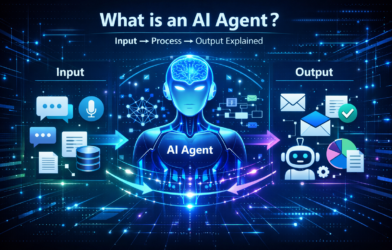
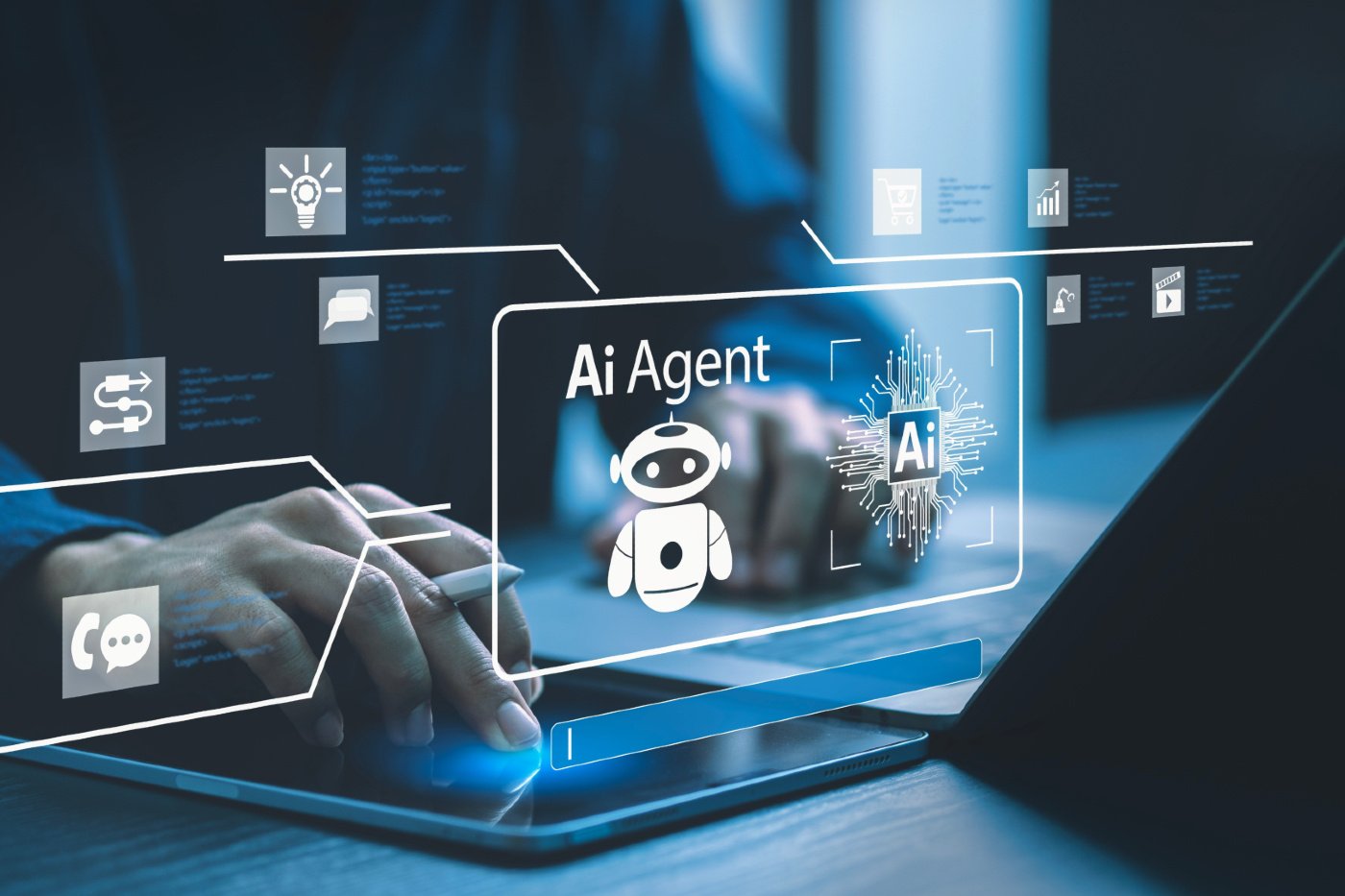
AI agents are intelligent software systems that can perform tasks automatically using artificial intelligence technologies such as machine learning, natural language processing, and predictive analytics.
Unlike traditional software programs, AI agents can analyze data, learn from experience, and adapt their behavior.
These systems can interact with humans and other digital systems to complete tasks.
AI agents are currently used in many areas including:
- customer support automation
- digital assistants
- marketing automation
- research and data analysis
- workflow management
Because of their flexibility, AI agents are becoming an essential part of modern digital systems.
Why AI Agents Are Growing So Fast
The rapid growth of AI agents is driven by several technological advancements.
Before exploring future trends, it is helpful to understand why AI agents are becoming so popular.
Improved Artificial Intelligence Models
Modern AI models are far more powerful than earlier systems.
They can understand language, analyze images, and generate useful information.
This makes AI agents more capable and reliable.
Increasing Demand for Automation
Businesses want to automate repetitive tasks to reduce costs and improve efficiency.
AI agents provide a practical solution for automation.
Growth of Cloud Computing
Cloud platforms allow companies to deploy AI systems quickly and scale them easily.
This makes AI technology more accessible.
Better Integration Tools
Modern AI frameworks allow developers to connect AI agents with other software systems.
This enables AI agents to perform more complex tasks.
Major Trends That Will Shape the Future of AI Agents
Over the next five years, several trends are expected to shape the development of AI agents.
These trends will transform how businesses and individuals use AI technology.
1. Autonomous AI Agents
One of the biggest developments will be the rise of autonomous AI agents.
These systems will be able to complete complex tasks with minimal human supervision.
Autonomous AI agents may:
- plan multi-step workflows
- gather information from multiple sources
- make decisions based on data
- complete tasks independently
This will allow businesses to automate entire processes rather than individual tasks.
2. AI Agents as Digital Employees
In the future, AI agents may function like digital employees.
Businesses may use AI agents to perform roles such as:
- customer service assistants
- marketing analysts
- research assistants
- project managers
These agents could handle large volumes of work while humans focus on strategic tasks.
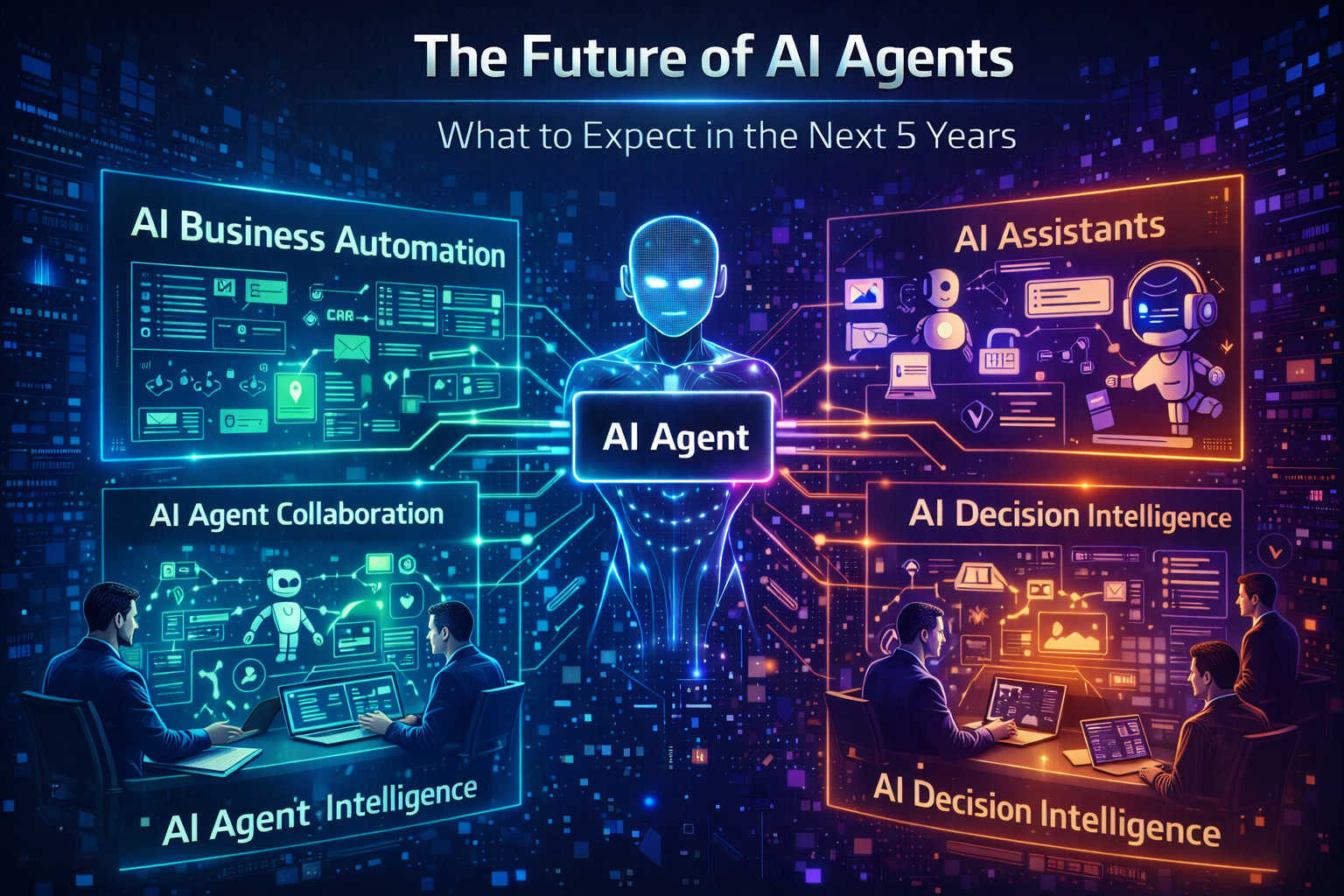
3. Multi-Agent Collaboration
Another important trend is the development of multi-agent systems.
Instead of using a single AI agent, organizations may deploy multiple agents working together.
Each agent may specialize in a different task.
For example:
- one agent gathers information
- another analyzes data
- another generates reports
This collaborative approach will improve efficiency and accuracy.
4. AI Agents Integrated into Everyday Apps
In the future, AI agents will likely be integrated into many everyday applications.
Examples may include:
- email platforms
- project management tools
- messaging apps
- business software
Users may interact with AI agents as part of their normal workflow.
5. Personalized AI Assistants
AI agents will become more personalized.
Instead of generic systems, users may have AI assistants tailored to their preferences.
These assistants may:
- manage schedules
- organize information
- provide recommendations
- automate daily tasks
This will improve productivity and convenience.
Industries That Will Be Transformed by AI Agents
AI agents will impact many industries over the next five years.
Several sectors are expected to experience significant changes.
1. Business and Startups
Startups will use AI agents to automate operations and reduce costs.
AI agents may manage tasks such as:
- marketing campaigns
- customer support
- financial analysis
This will allow startups to operate with smaller teams.
2. Healthcare
AI agents may assist doctors by analyzing medical data and suggesting treatments.
They could also help manage patient records and appointments.
3. Education
AI agents may become intelligent tutors that help students learn more effectively.
These systems could personalize lessons based on each student’s needs.
4. Finance
Financial institutions may use AI agents for:
- fraud detection
- risk analysis
- automated investment strategies
This will improve financial decision-making.
Challenges the Future of AI Agents May Bring
While AI agents offer many benefits, they also present challenges.
Understanding these challenges will help organizations prepare for the future.
Job Displacement Concerns
Automation may reduce the need for certain types of jobs.
Workers may need to learn new skills to adapt.
Ethical Issues
AI systems must be designed responsibly to avoid bias and unfair decisions.
Security Risks
AI agents may become targets for cyber attacks.
Organizations must implement strong security measures.
Data Privacy Concerns
AI systems often process sensitive information.
Protecting user data will remain a critical priority.
How Businesses Should Prepare for AI Agents
Businesses that prepare early will benefit most from the AI revolution.
Several steps can help organizations adapt to the future of AI.
Invest in AI Education
Companies should train employees to understand and use AI technologies.
Adopt AI Gradually
Instead of replacing existing systems completely, businesses should introduce AI gradually.
Focus on Human-AI Collaboration
The most successful organizations will combine human expertise with AI capabilities.
Prioritize Ethical AI Development
Responsible AI practices will help build trust and prevent misuse.
The Long-Term Vision of AI Agents
Looking further into the future, AI agents may become essential components of digital ecosystems.
These systems could:
- manage entire companies
- coordinate global supply chains
- support scientific research
- assist governments in decision-making
While these possibilities may seem futuristic, many early examples are already emerging today.
Conclusion
The next five years will be an exciting period for artificial intelligence. AI agents will become more capable, autonomous, and integrated into everyday life.
Businesses will increasingly rely on these intelligent systems to automate tasks, analyze data, and improve decision-making. At the same time, new opportunities will emerge for innovation and economic growth.
However, the future of AI agents also requires responsible development. Issues such as data privacy, security, and ethical AI must be carefully addressed.
Organizations that embrace AI technology while maintaining strong ethical standards will be best positioned to succeed in the AI-driven future.
FAQs
1. What are AI agents?
AI agents are intelligent software systems that can perform tasks automatically using artificial intelligence technologies.
2. Will AI agents replace human workers?
AI agents will automate many tasks but are more likely to assist humans rather than completely replace them.
3. What industries will benefit from AI agents?
Industries such as healthcare, finance, education, and business operations will benefit significantly from AI agents.
4. How fast will AI agents evolve?
AI technology is evolving rapidly, and major advancements are expected over the next five years.
5. Are AI agents safe?
AI agents can be safe when developed responsibly and protected with strong security and privacy measures.