Subtotal $0.00




Email : 22
1. Introduction: The Blueprint for a “Viksit Bharat” in a Volatile World
On February 1, 2026, the Union Finance Minister, Smt. Nirmala Sitharaman, rose in the Lok Sabha to present the Union Budget for the fiscal year 2026-27. This event was historic for several reasons. Not only did it mark her ninth consecutive budget presentation—a record that speaks to policy continuity—but it was also the first budget tabled in the newly inaugurated “Kartavya Bhawan.” This architectural shift is symbolic of the government’s broader philosophical pivot: moving from a narrative of “rights” to one of “duties” or Kartavya, framed as the essential engine to drive India toward its centenary goal of becoming a developed nation (Viksit Bharat) by 2047.
The economic backdrop against which this budget was presented is arguably the most complex of the last decade. While India has successfully navigated the post-pandemic recovery phase, the global environment remains fraught with peril. The world economy is grappling with supply chain realignments, energy transitions, and currency volatility. Notably, the Indian Rupee has faced significant pressure, touching a historic low of ₹92 against the US dollar just days before the budget presentation, driven by foreign investment outflows and rising global commodity prices. Domestically, while growth remains robust, the challenge has shifted from “recovery” to “resilience.” The government faces the dual imperative of shielding the domestic economy from external shocks while aggressively modernizing its defense and infrastructure capabilities.
The Budget 2026 is, therefore, not merely a statement of accounts; it is a strategic doctrine. It is anchored in three core “Kartavyas” (Duties) that the Finance Minister outlined as the guiding principles for the fiscal year:
- Accelerating Economic Growth: This involves enhancing productivity and building resilience against volatile global dynamics. The focus is on making the Indian economy shock-proof.
- Fulfilling Aspirations: This targets the demographic dividend, aiming to build the capacity of the youth and the workforce so they become active partners in prosperity rather than passive beneficiaries.
- Inclusive Development (Sabka Saath, Sabka Vikas): This ensures that the fruits of growth—resources, amenities, and opportunities—permeate to every family, community, and region, bridging the gap between the “haves” and the “have-nots”.
This comprehensive research report dissects the Budget 2026-27 with granular precision. We move beyond the headlines to analyze the structural shifts in taxation through the new “Income Tax Act, 2025,” the geopolitical signaling in the massive defense outlay post-“Operation Sindoor,” and the industrial strategy embedded in schemes like “Biopharma SHAKTI.” Whether you are a salaried professional calculating your take-home pay, a manufacturer eyeing the new chemical parks, or an investor adjusting to the STT hike, this document serves as your exhaustive guide to navigating the Indian economy in 2026.
2. Big Picture Context: Navigating Geopolitics and Economics
To truly understand the allocations and tax changes in Budget 2026, one must first appreciate the macroeconomic and geopolitical theater in which India is operating. The budget is a response to specific stressors and opportunities that have emerged over the last fiscal year.
2.1 The Geopolitical Shadow: “Operation Sindoor” and National Security
Perhaps the most significant, albeit grim, context for this budget is the security situation on India’s borders. The budget documents and analysis make multiple references to “Operation Sindoor,” a significant military engagement or mobilization that appears to have occurred in the preceding fiscal year. While the specific operational details remain classified, the fiscal footprint is undeniable. The security environment has necessitated a shift from “modernization at a steady pace” to “emergency procurement and rapid capability building.” This has fundamentally altered the expenditure priorities, forcing the government to balance its cherished infrastructure-led growth model with the hard realities of national defense. The acknowledgement of a “volatile global dynamic” in the Finance Minister’s speech is a diplomatic nod to these security challenges, as well as the economic warfare (trade barriers, currency manipulation) visible globally.
2.2 The Macro-Fiscal Framework: Growth with Discipline
Despite the pressures to spend on defense and welfare, the government has refused to abandon the path of fiscal consolidation. The fiscal deficit target for FY 2026-27 has been set at 4.3% of GDP. This is a marginal but meaningful reduction from the 4.4% estimated in the Revised Estimates (RE) of 2025-26.
This 0.1% consolidation might seem small, but in absolute terms, it represents a significant effort to control borrowing while expanding the size of the budget.
- Total Expenditure: The government plans to spend ₹53.5 lakh crore, a sharp increase from the ₹49.6 lakh crore spent in the previous year.
- Total Receipts (Non-Debt): Estimated at ₹36.5 lakh crore.
- The Gap: To bridge the gap between earnings and spending, the government will borrow heavily. Gross market borrowings are estimated at ₹17.2 lakh crore.
Analytical Insight: The decision to keep the fiscal deficit at 4.3% rather than pushing for a steeper cut to 4.0% suggests that the Finance Ministry prioritizes growth support over aggressive austerity. With private consumption showing signs of unevenness and exports facing headwinds, the government has decided it must continue to do the heavy lifting in the economy. The high borrowing number (₹17.2 lakh crore) will likely keep bond yields firm, affecting interest rates in the broader economy.
2.3 The “Capex” Story: The Engine That Won’t Quit
For the past five years, the Modi government has bet the house on Capital Expenditure (Capex)—spending on building productive assets like roads, railways, and power plants—to drive growth. Budget 2026 continues this trend but with a nuanced shift.
- The Number: Public Capex has been enhanced to ₹12.2 lakh crore, up from ₹11.2 lakh crore in the previous year.
- The Trend: While this is an absolute increase, the rate of growth in Capex is moderating compared to the 30%+ jumps seen in previous post-COVID budgets. This suggests a maturing of the infrastructure cycle. The government believes the initial heavy lifting is done, and now the focus must shift to execution and quality of infrastructure rather than just the quantum of money allocated.
- New Directions: The Capex is no longer just about asphalt. The budget introduces concepts like “City Economic Regions” (CERs) and “High-Speed Rail Corridors” as distinct from general highway construction. This indicates a move toward urbanization-led growth rather than just connectivity-led growth. The logic is that cities are the engines of GDP, and upgrading their infrastructure yields a higher tax-GDP ratio in the long run.
2.4 The “Make in India” Pivot: From Assembly to Deep Tech
A critical theme in the Big Picture context is the evolution of the “Make in India” initiative. In previous years, the focus was on assembly (e.g., mobile phones). Budget 2026 signals a decisive pivot toward upstream manufacturing—making the components and raw materials that go into the final products.
- Strategic Autonomy: The launch of India Semiconductor Mission 2.0 and the Biopharma SHAKTI initiative are direct responses to supply chain vulnerabilities exposed by global conflicts. By funding the manufacturing of APIs (active pharmaceutical ingredients) and chips, India aims to insulate itself from import shocks, particularly from dominant suppliers like China.
- Critical Minerals: The budget explicitly targets the supply chain of the future by eliminating duties on capital goods required to process lithium, cobalt, and rare earths. This is an admission that energy security in the 21st century is about mineral security.
2.5 The Currency Factor: Protecting the Rupee
The reference to the rupee falling to ₹92 against the dollar is crucial context. A weaker currency imports inflation, especially in energy and electronics. The budget’s heavy emphasis on reducing imports (through higher duties on non-essentials and incentives for domestic production) is as much a monetary stability measure as it is an industrial policy. By substituting imports with domestic goods, the government hopes to reduce the demand for dollars and stabilize the rupee without burning through foreign exchange reserves.
3. Key Budget 2026 Facts: The Numbers That Matter
In this section, we distill the massive budget documentation into the critical figures that define the fiscal landscape of 2026-27. These numbers are the bedrock upon which the policy narrative is built.
3.1 Expenditure Profile: Where is the Money Going?
The total estimated expenditure of ₹53.5 lakh crore is distributed across key ministries and sectors. The allocation reflects the government’s dual priority of security (Defence) and development (Infrastructure/Social).
| Ministry / Sector | Allocation (₹ Crore) | % Change (Approx) | Primary Focus / Insight |
| Ministry of Defence | ₹7,84,678 | +15.19% | Massive jump due to “Operation Sindoor” and modernization needs. |
| Transport (Rail + Road) | ~₹5,99,000 | Marginal Inc. | Focus on High-Speed Rail and Freight Corridors. |
| Ministry of Education | ₹1,39,000 | +14.2% | Higher Ed, AI Centers, and Digital Infrastructure. |
| Ministry of Health | ₹1,06,530 | +10% | Infrastructure (PM-ABHIM) and Biopharma R&D. |
| Renewable Energy | ₹32,911 | +24% | Solar (PM Surya Ghar) and Green Hydrogen. |
| Rural Development | ₹2,73,000 | Moderate | Sustaining the rural safety net (MGNREGA, Housing). |
| Home Affairs | ₹2,55,000 | Stable | Internal security and border management. |
Insight on Allocations: The disparity in growth rates is telling. While Defence grew by over 15% and Renewable Energy by 24%, sectors like Rural Development saw more moderate increases. This clearly indicates a security-and-energy-first budget. The government is betting that high-tech manufacturing and energy transition will create jobs, reducing the long-term need for rural welfare safety nets, although it continues to fund them for stability.
3.2 The Deficit & Debt Metrics
- Fiscal Deficit: 4.3% of GDP.
- Revenue Deficit: The gap between recurrent earnings and recurrent spending continues to be a concern, necessitating borrowing for consumption, though the quality of expenditure is improving.
- Debt-to-GDP Ratio: Estimated to be 55.6% in BE 2026-27, a slight improvement from 56.1% in RE 2025-26.
- Analysis: A declining Debt-to-GDP ratio, even if the decline is slow, is a positive signal to credit rating agencies. It suggests that the economy (the denominator) is growing faster than the debt (the numerator).
3.3 New Strategic Funds
The Budget 2026 introduces several “Strategic Funds” designed to bypass bureaucratic hurdles and inject capital directly into priority areas:
- SME Growth Fund: A ₹10,000 Crore corpus to provide equity and risk capital to MSMEs. This is distinct from loans; it is about government-backed investment in small businesses to help them scale.
- Biopharma SHAKTI: A ₹10,000 Crore outlay dedicated to the “Strategy for Healthcare Advancement through Knowledge, Technology and Innovation.” This fund targets the development of biologics and biosimilars, high-value segments of the pharma industry.
- Innovation & R&D: The budget continues the trend of allocating funds for “Centers of Excellence” (CoEs) in AI and 5G/6G, aimed at keeping India on the technological frontier.
3.4 Receipts: The Tax Buoyancy Assumption
- Net Tax Receipts: ₹28.7 lakh crore.
- Assumption: The government assumes a tax buoyancy greater than 1. This means they expect tax collections to grow faster than the nominal GDP. This optimism is based on the widening tax base (more filers under GST and Income Tax) and improved compliance through technology. If growth falters, this revenue target might be missed, threatening the fiscal deficit target.
4. Taxation: The “New Income Tax Act, 2025” and Your Wallet
The centerpiece of Budget 2026 for the common citizen is the overhaul of the direct tax code. The Finance Minister announced that the New Income Tax Act, 2025 will officially come into effect from April 1, 2026. This is not just a tweaking of rates; it is a legislative reboot aimed at simplifying the tax structure, reducing the volume of litigation, and forcefully nudging the entire taxpayer base toward the “New Tax Regime.”
4.1 The New Income Tax Regime: Slabs & Rates (FY 2026-27)
The government has doubled down on making the New Tax Regime the default and most attractive option for the vast majority of taxpayers. For FY 2026-27, the slab structure has been relaxed further to provide relief to the middle class and counter the effects of inflation.
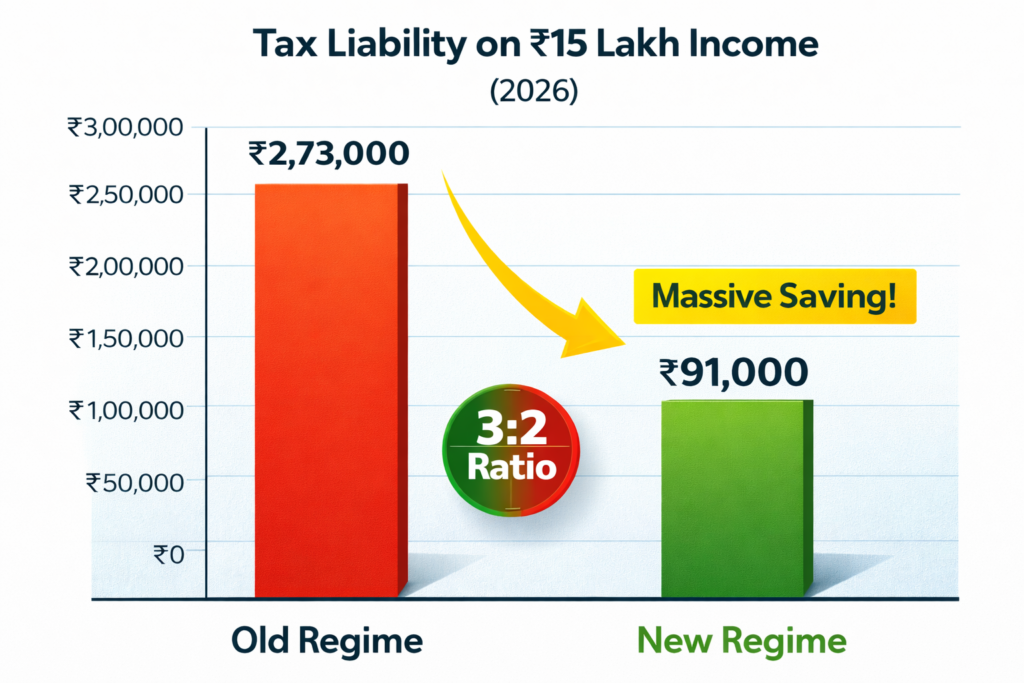
New Tax Regime Slabs (Effective April 1, 2026):
| Income Slab (₹) | Tax Rate |
| 0 – 4,00,000 | Nil |
| 4,00,001 – 8,00,000 | 5% |
| 8,00,001 – 12,00,000 | 10% |
| 12,00,001 – 16,00,000 | 15% |
| 16,00,001 – 20,00,000 | 20% |
| 20,00,001 – 24,00,000 | 25% |
| Above 24,00,000 | 30% |
| (Source: Derived from , adjusting for the ₹4L exemption mention in and progressive steps). |
The “Zero Tax” Reality: While the slab shows 5% tax starting at ₹4 Lakh, the Section 87A Rebate plays a magical role here. The Finance Minister announced an increase in the rebate limit, effectively ensuring that individuals with an annual income of up to ₹12 Lakh will pay zero tax.
- How does this work? If your taxable income is ₹12 Lakh or less, the government gives you a rebate equal to the tax payable. If you earn ₹12,00,001, you lose the rebate and pay tax on the slab basis.
- Standard Deduction: The standard deduction for salaried employees remains at ₹75,000. This means a salaried person earning ₹12.75 Lakh effectively pays no tax.
Other Key Changes in the New Regime:
- Surcharge Cap: The maximum surcharge rate on income tax for the super-rich (income above ₹2 crore) has been capped at 25% under the new regime, down from 37% in the old regime. This significantly reduces the effective tax rate for high-net-worth individuals (HNIs), encouraging them to switch.
4.2 The Old Regime: A Slow Death?
The Old Tax Regime—favored by those who claim deductions for HRA, 80C (PPF/LIC), and Home Loans—remains on the books, but it has been left to stagnate.
- No Change in Slabs: The basic exemption limit remains a paltry ₹2.5 Lakh. The 30% tax rate kicks in at just ₹10 Lakh income.
- The Math: With the New Regime offering tax-free income up to ₹12 Lakh, a taxpayer in the Old Regime would need deductions worth nearly ₹4-5 Lakhs just to break even. For most people, the Old Regime is now mathematically obsolete. The introduction of the “New Income Tax Act, 2025” is a clear signal that the Old Regime will likely be phased out entirely in the near future.
4.3 Capital Gains & STT: The Trader’s Pain
Budget 2026 takes a hard stance on speculative trading, likely in response to RBI and SEBI concerns about retail participation in derivatives.
- STT Hike: The Securities Transaction Tax (STT) on Futures & Options (F&O) has been raised from 0.02% to 0.05%.
- Impact: This more than doubles the tax cost on every trade. For high-frequency traders and scalpers who operate on thin margins, this is a massive blow. It raises the “break-even” point for every trade, requiring larger market moves to generate a net profit.
- Capital Gains: While there was speculation about harmonizing tax rates and holding periods, the primary market intervention this year is the STT hike.
4.4 Tax Deduction at Source (TDS) & TCS: Ease of Living
The budget introduces several procedural changes aimed at reducing the friction of daily financial transactions.
- Foreign Travel & Education (TCS Cut): In a major relief for the middle class, the Tax Collected at Source (TCS) on overseas tour packages and remittances for foreign education has been slashed to a flat 2%. This replaces the confusing and punitive 5%/20% tiered structure that existed previously. This frees up cash flow for families sending kids abroad or planning vacations.
- Motor Accident Claims: Interest awarded by the Motor Accident Claims Tribunal is now fully exempt from income tax, and the requirement for TDS on these payments has been abolished. This is a humanitarian move to help accident victims receive their full compensation without tax deduction.
- TDS on Manpower Supply: To reduce litigation between contractors and the tax department, the TDS rate on manpower supply services has been rationalized to 1% (for individuals) or 2% (for companies), removing ambiguity.
4.5 Customs Duty Rationalization
The changes in customs duties reflect the “Make in India” vs. “Green Transition” balancing act.
- Cancer Drugs: To make healthcare affordable, the Basic Customs Duty (BCD) on 17 life-saving cancer drugs has been reduced to Nil.
- Mobile Phones: Duty on mobile phones and chargers has been reduced to 10% (from 15-20%). This is aimed at boosting exports by integrating India into the global value chain where import-export fluidity is key, and also slightly lowering prices for consumers.
- Critical Minerals: Capital goods used for processing lithium, cobalt, and rare earth minerals are now exempt from customs duty. This is a strategic move to encourage the setting up of battery processing plants in India.
- Solar Glass: Exemptions on solar glass and copper used in renewables continue, supporting the energy transition.
5. Audience-Specific Impact: The Personal Finance View
The budget affects different segments of society in unique ways. Here, we analyze the impact based on your specific profile.
5.1 The Salaried Professional
- The Winner: If you earn between ₹7 Lakh and ₹15 Lakh, you are the biggest winner. The switch to the New Tax Regime with the ₹12 Lakh rebate limit effectively eliminates your tax burden or reduces it drastically. The Standard Deduction of ₹75,000 is the cherry on top.
- The Loser: If you are in the ₹18-25 Lakh bracket and live in a rented house (high HRA) with a large home loan, the stagnation of the Old Regime slabs hurts. You are forced to choose between a simpler New Regime (with lower rates but no deductions) and an Old Regime where inflation is pushing you into the 30% bracket faster.
- Action: Recalculate your taxes. It is highly probable that the New Regime is now better for you. Stop investing in insurance solely for tax saving; invest for returns instead.
5.2 The Healthcare Worker
- Growth: The health sector is flush with funds (₹1.06 lakh crore).
- Opportunities: The massive expansion of PM-ABHIM (Health Infrastructure Mission) with ₹4,770 crore allocation means new Critical Care Blocks and Integrated Public Health Labs are being built in every district. This translates to hiring of doctors, nurses, lab technicians, and hospital administrators in Tier-2 and Tier-3 cities.
- Research: If you are in medical research, the Biopharma SHAKTI fund opens up grants for research in biologics. The government is actively funding the transition from “manufacturing” to “innovation.”
5.3 The MSME Owner
- Equity Access: The SME Growth Fund (₹10,000 crore) is a game-changer. If you have a scalable business, you can now access government-backed equity capital, reducing your reliance on high-interest debt.
- Liquidity: The mandatory use of TReDS by CPSEs is a massive relief. It means if you supply goods to a PSU, you can upload the invoice and get paid almost immediately by a financier, rather than waiting 90 days.
- Compliance: The “Corporate Mitras” scheme will provide affordable professional help for compliance, lowering your administrative burden.
5.4 The Investor & Trader
- The Trader: The STT hike to 0.05% on F&O is a clear signal to deleverage. Intraday trading costs have risen significantly. You need to review your strategy; low-margin scalping may no longer be viable.
- The Investor: The budget is bullish for Defence (15% hike), Infrastructure (Rail/Road capex), and Renewables (Solar allocation). These sectors are likely to outperform. The “New Income Tax Act” promises stability, which equity markets generally like.
- Crypto: The strict penalty provisions (₹200 daily fine for reporting delays) signal that the government is tightening the noose on Virtual Digital Asset (VDA) compliance.
5.5 The Student & Young Professional
- Study Abroad: The reduction of TCS to 2% on foreign education remittances is a huge relief for your parents. It reduces the upfront cost of sending fees and living expenses abroad.
- Skilling: The focus on AI Centers of Excellence and “Education to Employment” pathways means that government-funded courses in AI, coding, and robotics will likely become available at your university or local ITI.
- Jobs: The push for manufacturing (Chemicals, Electronics, Biopharma) aims to create high-quality technical jobs, moving beyond the gig-economy roles.
6. Sector Deep Dive: Allocations & Implications
6.1 Defence: The “Operation Sindoor” Effect
The single most striking statistic in Budget 2026 is the 15.19% increase in the Defence Budget to ₹7.85 lakh crore. To put this in context, defense spending usually grows by 5-7% to cover inflation and salaries. A 15% jump is an “Emergency Budget” signal.
- Context: The mention of “Operation Sindoor” implies a significant military contingency that depleted reserves and highlighted capability gaps.
- Modernization: ₹2.19 lakh crore is allocated purely for Capital Outlay (buying new hardware).
- Where will it go? Aircraft and Aero Engines (₹63,733 cr), Naval Fleet (₹25,023 cr), and UAVs/Drones. The focus is on “Network Centric Warfare”—fighting with data and drones as much as with bullets.
- Indigenization: The budget emphasizes purchasing from domestic industry. This is a massive opportunity for Indian private sector defense companies (Tata, L&T, Bharat Forge, Startups) to secure long-term contracts. The 15% hike is effectively a stimulus package for the domestic military-industrial complex.
6.2 Energy: The Transition to “Baseload” Green
The Ministry of New and Renewable Energy (MNRE) received ₹32,911 crore, a robust increase. However, the composition of this spending reveals a maturity in thinking.
- Solar Saturation: While PM Surya Ghar gets ₹22,000 crore to put panels on roofs , the government realizes that solar works only when the sun shines.
- The Nuclear Pivot: Budget 2026 marks the return of nuclear power. The Nuclear Energy Mission and the SHANTI Act mentioned in the context of the budget support the development of Small Modular Reactors (SMRs). Customs duty exemptions for nuclear projects have been extended to 2035. This acknowledges that India needs clean baseload power (power that runs 24/7), which solar cannot provide without expensive batteries.
- Green Hydrogen: The allocation remains at ₹600 crore. This might seem low, but it is seed money for pilot projects. The real incentive here is the policy framework and the expectation of future PLI schemes.
- Grid Integration: A key challenge identified is moving green power from where it is generated (e.g., Rajasthan) to where it is consumed. Significant funds are embedded in the power ministry budget for the “Green Energy Corridor” transmission lines.
6.3 Healthcare: From Cure to Capability
The Health Ministry budget of ₹1.06 lakh crore reflects a post-COVID realization that health is an economic asset.
- Biopharma SHAKTI: This ₹10,000 crore fund is arguably the most strategic industrial policy in the budget. India is the “Pharmacy of the World” for generics (cheap drugs), but it relies on China for 70% of the raw materials (APIs) and imports almost all high-tech biological drugs (cancer therapies). Biopharma SHAKTI aims to fix this by funding R&D and manufacturing of biologics in India. It is about health security and economic value addition.
- Mental Health: The budget increases funding for the National Tele-Mental Health Programme and announces a new NIMHANS in North India. This addresses the silent pandemic of mental health issues, recognizing that productivity requires psychological well-being.
6.4 MSME & Manufacturing: The “Growth” Engines
- Chemical Parks & Rare Earths: The government is setting up dedicated “Chemical Parks” and “Rare Earth Corridors” (Odisha, Kerala, TN). This is an infrastructure play to support the “China Plus One” strategy. If India wants to make electronics, it needs to process the rare earth minerals that go into them.
- Credit Guarantee vs. Equity: Traditionally, the government supported MSMEs by guaranteeing their loans (CGTMSE). Budget 2026 shifts to Equity support via the SME Growth Fund. This suggests the government wants to back winners—high-growth startups and small industries—rather than just keeping struggling firms alive with debt.
7. Comparison: Budget 2026 vs. Budget 2025
A direct comparison reveals the shift in government priorities.
| Feature | Budget 2025 (Previous) | Budget 2026 (Current) | Analysis of the Shift |
| Theme | Stability & Recovery | Viksit Bharat & Security (Kartavya) | Moved from post-COVID stabilization to aggressive long-term growth & security post-Operation Sindoor. |
| Tax Regime | New Regime introduced as default; incentives added. | New Income Tax Act 2025 enacted. | Structural overhaul; The Old Regime is now effectively dead for the middle class. |
| Rebate Limit | Tax-free up to ₹7 Lakh. | Tax-free up to ₹12 Lakh. | Massive inflation adjustment and relief for the middle class to boost consumption. |
| Defence | ₹6.81 Lakh Crore. | ₹7.85 Lakh Crore (+15.19%). | The single biggest variance. Geopolitics has forced a diversion of funds to security. |
| Capex | ₹11.2 Lakh Crore. | ₹12.2 Lakh Crore. | Growth continues, but the rate of increase has slowed. The base is now very high. |
| Foreign Travel | TCS at 5% / 20%. | TCS reduced to 2%. | Reversal of a policy that was unpopular with the middle class; ease of compliance. |
| MSME Support | Debt/Loan Guarantees. | Equity (SME Growth Fund) + TReDS. | Shift from protecting weak firms with debt to empowering strong firms with equity. |
Verdict: Budget 2026 is bolder. It takes bigger risks (high borrowing, tax cuts) to drive growth and secure the borders. It is less “welfare-oriented” in the traditional sense and more “capability-oriented” (infrastructure, defense, R&D).
8. What Should You Do Now? Actionable Strategies
Based on the structural changes in Budget 2026, here is a checklist for your financial and business planning.
8.1 For Taxpayers: The Regime Switch
- The Calculation: If your income is under ₹15 Lakh, the New Regime is almost certainly your best bet. The combination of the ₹12 Lakh rebate limit and lower slab rates beats the Old Regime unless you have massive deductions (approx. ₹4.5L+).
- Action: Inform your employer’s payroll department immediately at the start of the fiscal year (April) that you are opting for the New Regime to ensure lower TDS deduction from your monthly salary.
- Insurance: Stop buying low-yield insurance policies just to save tax under 80C. Since the New Regime doesn’t value 80C, move your investment surplus to higher-yield instruments like Mutual Funds or PPF (for safety, not tax).
8.2 For Investors: Portfolio Rebalancing
- Sector Rotation: The budget clearly favors Defence (HAL, BEL, Mazagon Dock), Power/Energy (NTPC, Tata Power, Solar cos), and Pharma (Biocon, Dr. Reddy’s). Rebalance your portfolio to have exposure here.
- Avoid F&O: If you are a casual trader, the 0.05% STT hike significantly lowers your probability of profit. Consider moving to long-term cash market investing or Mutual Funds.
- Sovereign Gold Bonds: With currency volatility (Rupee @ 92), gold remains a good hedge. Look for SGB tranches if the government announces them, or buy Gold ETFs.
8.3 For Businesses: Leveraging Schemes
- MSMEs: Register on the TReDS platform immediately. The government mandate for CPSEs to use it is a massive opportunity to fix your working capital cycle.
- Exporters: If you are in the chemicals or engineering sector, investigate the new Chemical Parks and Rare Earth Corridors. Setting up there could give you access to shared infrastructure that lowers your production costs.
- Compliance: Utilize the “Corporate Mitras” for filing your GST and Income Tax returns. It will likely be cheaper than hiring a full-time CA for small firms.
9. Conclusion: The “Kartavya” of Growth
Budget 2026 is a defining document. It creates a bridge between the immediate challenges of the present (border security, inflation, currency pressure) and the ambitious goals of the future (Viksit Bharat 2047).
By enacting the New Income Tax Act, 2025, the government has signaled the end of the exemption-raj era, moving India toward a simpler, lower-rate tax regime. By hiking the Defence Budget by 15%, it has acknowledged that economic power cannot exist without hard power. By launching Biopharma SHAKTI and Semiconductor Mission 2.0, it is attempting to secure India’s place in the high-tech supply chains of the 21st century.
For the common citizen, the message is clear: The government will build the roads, secure the borders, and simplify the taxes. In return, the “Kartavya” of the citizen is to utilize these resources to become productive, tax-paying partners in the nation’s journey. The budget bets heavily on the Indian middle class and the private sector to pick up the baton of growth. Whether this gamble pays off depends on global headwinds and domestic execution, but the blueprint is undeniably bold.
Read More Blog– Data-Driven Decisions: How AI Gives Startups a Competitive Edge