Subtotal $0.00




Email : 18
Benefit3-year income tax exemption (80-IAC), Angel tax exemption (56(2)(VIIB)), 80% IPR cost rebate, fast-track patent examination
Valid Till01 Jan, 2030
Scheme CodeGSR 127(E) 2019
The Strategic Evolution of Startup India Recognition: A Comprehensive Analysis of DPIIT Policy, Fiscal Incentives, and Regulatory Frameworks (2025-2030)
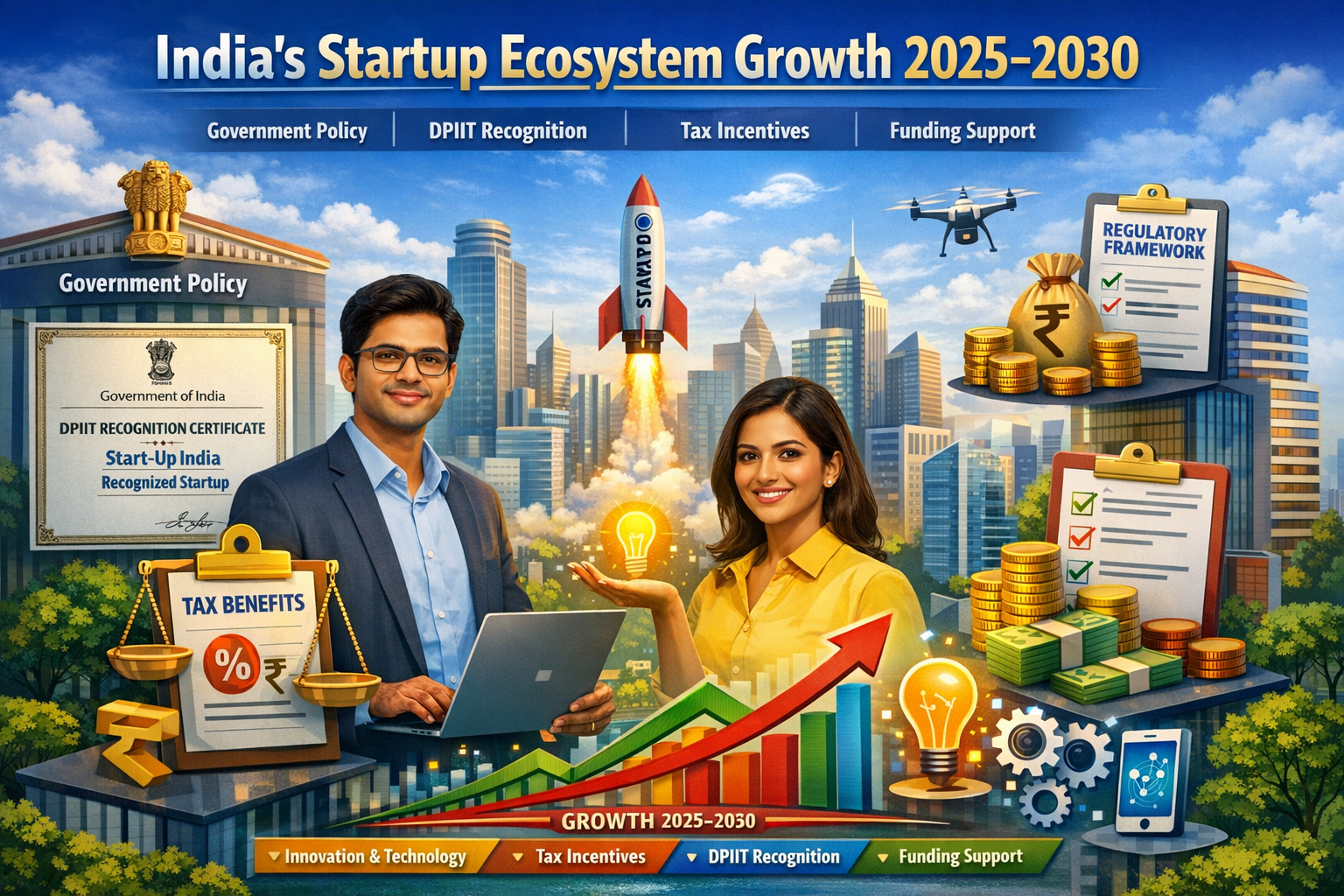
The transformation of India into a global entrepreneurial powerhouse is not an accidental phenomenon but the result of a deliberate, structured intervention by the Government of India through the Startup India initiative. Launched in January 2016, this flagship program was designed to catalyze a culture of innovation, support sustainable economic growth, and generate large-scale employment opportunities. By January 2025, the ecosystem had matured significantly, moving from a few hundred startups to over 1.59 lakh DPIIT-recognized entities. This growth signifies a fundamental shift in the Indian economy—from a nation of job seekers to a nation of job creators. The Department for Promotion of Industry and Internal Trade (DPIIT) serves as the core institutional architect, providing a formal recognition framework that unlocks a comprehensive suite of benefits, including tax holidays, intellectual property support, and relaxed public procurement norms.
The strategic importance of DPIIT recognition lies in its ability to reduce the regulatory burden on emerging businesses, allowing founders to focus on their core operations while keeping compliance costs low. As the initiative enters its next phase, defined by the extension of tax incentives until 2030 and the launch of the BHASKAR portal, the government’s focus has sharpened on fostering innovation in Tier 2 and Tier 3 cities, which now contribute approximately 48% of all recognized startups. For professional stakeholders and entrepreneurs, navigating this framework requires a nuanced understanding of eligibility, fiscal strategy, and the evolving digital infrastructure of the Indian state.
The Genesis and Objective of Startup India Recognition
The Startup India Action Plan was conceived as a response to the traditional hurdles faced by Indian entrepreneurs: complex registration processes, high compliance costs, and limited access to capital. The initiative aims to build a robust and inclusive ecosystem where innovative ideas can scale without being stifled by bureaucracy. The core mechanism of this ecosystem is the DPIIT Recognition, a formal certification that validates an entity as a “Startup” according to government standards. This recognition is the primary gateway to sovereign support, transforming a standard private limited company or LLP into a beneficiary of specific policy incentives designed to bridge the “valley of death”—the critical early stage where many ventures fail due to lack of resources.
The primary motivation for the government to provide these incentives is the potential for startups to solve complex local problems while creating wealth and employment. By 2025, recognized startups had self-reported the creation of over 1.59 lakh jobs, with sectors like IT Services and Healthcare leading the way in employment generation. The government recognizes that innovation is the primary driver of modern economic competitiveness, and the DPIIT framework is the tool used to identify and nurture the most promising players in this field.
The Architecture of Eligibility: Defining the Modern Startup
To ensure that government resources are directed toward genuine innovators rather than established corporate entities, the DPIIT maintains a strict definition of a “Startup.” This definition is governed by Gazette Notification G.S.R. 127(E), which establishes five mandatory criteria. A startup is not merely a new business; it is an entity designed for high growth through innovation, development, or improvement of products, processes, or services.
| Eligibility Criterion | Requirement Details | Strategic Implication |
| Entity Age | Up to 10 years from the date of incorporation or registration. | Focuses support on the most vulnerable growth phase of a business. |
| Entity Type | Must be a Private Limited Company, LLP, or Registered Partnership. | Ensures a formalized governance structure suitable for investment. |
| Annual Turnover | Must not exceed INR 100 crore in any financial year since incorporation. | Prevents established large-scale corporations from accessing benefits. |
| Originality | Must not be formed by splitting up or reconstructing an existing business. | Targets “genuinely new” ventures rather than corporate spinoffs. |
| Nature of Work | Must involve innovation, improvement, or a scalable business model. | Distinguishes startups from traditional trading or service firms. |
While the standard age limit for recognition is 10 years, the government provides an extension for startups in the biotechnology sector, recognizing the significantly longer lead times required for research, clinical trials, and regulatory approvals in that field; for these entities, the eligibility period is extended up to 15 years. Furthermore, the turnover limit of INR 100 crore is a “per year” threshold—if a company exceeds this amount in even one financial year, it permanently loses its status as a startup under the DPIIT guidelines.
Specific Insights into Legal Structures
The choice of legal structure is critical for founders seeking DPIIT recognition. While three types of entities are eligible, their utility for future growth varies. Private Limited Companies are generally preferred by venture capital firms because they allow for easy equity dilution and the issuance of Employee Stock Options (ESOPs). Limited Liability Partnerships (LLPs) offer a more flexible, lower-compliance alternative, making them popular for service-based startups or those not intending to raise significant external equity.
One Person Companies (OPCs) were a significant addition to the Companies Act, allowing solo entrepreneurs to enjoy limited liability while maintaining full control. The government has officially clarified that OPCs are eligible for Startup India benefits, recognizing their role in encouraging individual initiative in the digital economy. However, solo founders should note that if an OPC’s revenue exceeds INR 2 crore or its paid-up capital exceeds INR 50 lakh, it must convert into a Private Limited Company, though this conversion does not necessarily void its DPIIT recognition.
The Innovation Mandate: Subjective Criteria and Grading
The most challenging aspect of the recognition process is demonstrating “innovation” or “scalability.” The Inter-Ministerial Board (IMB) and DPIIT evaluators look for more than just a new business; they seek evidence that the startup is solving a real-world problem in a unique way. Traditional businesses, such as retail traders, standard consultancy firms, or real estate agencies, are typically excluded unless they can demonstrate a fundamental process innovation that differentiates them from the market.
Innovation does not necessarily mean the invention of new technology; it can manifest as a new approach to service delivery, a significant improvement in an existing manufacturing process, or a market innovation that makes a solution accessible to a new demographic. During the application process, founders must provide a detailed write-up (200-400 words) articulating their uniqueness. Rejections often occur when this summary is vague, marketing-oriented, or copied from the internet.
Fiscal Advantage: The Strategic Use of Tax Holidays
Direct tax benefits represent the most lucrative aspect of DPIIT recognition, particularly for high-margin technology startups. These incentives are governed by the Income Tax Act, 1961, and involve a multi-step approval process that goes beyond simple recognition.
Section 80-IAC: The Three-Year Tax Holiday
Section 80-IAC provides a 100% deduction on profits for any three consecutive financial years within the first ten years of a startup’s incorporation. This “tax holiday” is designed to allow startups to reinvest their earnings into growth and product development during their most critical expansion phase. In the 2024-2025 period, the government extended the eligibility window for this benefit, allowing startups incorporated until March 31, 2030, to avail of the deduction.
| Benefit Component | Detail for Section 80-IAC | Requirement for Founders |
| Tax Relief | 100% deduction of profits for 3 consecutive years. | Must apply to the Inter-Ministerial Board (IMB) separately. |
| Incorporation Date | Must be incorporated between April 1, 2016, and March 31, 2030. | Must be a Private Limited Company or an LLP. |
| Innovation Grading | Approval based on IP creation, awards, and research personnel. | Documentation of patents, M.Tech/PhD employees, and revenue growth. |
| Turnover Limit | Annual turnover must remain below INR 100 crore. | Audited financials for the past 1-3 years must be submitted. |
The IMB evaluation for 80-IAC is rigorous. Startups are graded on parameters such as intellectual property creation (patents or copyrights), the stage of the product (validation vs. scaling), and the diversity of their workforce (employment of women, SC/ST, and people with disabilities). Professional tax advisors often suggest that startups should wait until they are generating significant profits before choosing the three-year block for the exemption to maximize its financial impact.
The Abolition of Angel Tax (Section 56)
For over a decade, the “Angel Tax” (Section 56(2)(viib)) was a contentious issue for Indian startups, as it taxed the premium received on shares issued above the Fair Market Value (FMV) as income. This created a significant burden for early-stage companies raising capital based on high-growth potential rather than tangible assets.
In a landmark decision in the Union Budget 2024-25, the government announced the total abolition of the Angel Tax for all categories of investors, effective from April 1, 2025 (Financial Year 2025-26). This move significantly simplifies the fundraising process, removing the need for startups to constantly defend their valuations before tax authorities. However, for investments received during the Financial Year 2024-25, startups still require DPIIT recognition and a specific declaration (Form 2) to claim exemption from this tax.
Operational Ease: Regulatory Relaxation and Self-Certification
Startups often cite “compliance burden” as a major obstacle to innovation. The Startup India initiative addresses this through a self-certification framework that allows founders to focus on their core business while maintaining high standards of governance and environmental responsibility.
Labor and Environmental Law Exemptions
Recognized startups can self-certify compliance with nine major labor laws and three environmental laws for a period of three to five years. This means that no routine inspections will be conducted during this period, unless there is a credible and verifiable written complaint of a violation.
Key Labor Laws covered under Self-Certification:
- The Employees’ Provident Funds and Miscellaneous Provisions Act, 1952.
- The Payment of Gratuity Act, 1972.
- The Contract Labour (Regulation and Abolition) Act, 1970.
- The Industrial Disputes Act, 1947.
On the environmental front, startups falling under the “White Category” of industries—those with negligible pollution potential—can self-certify compliance under the Water (Prevention & Control of Pollution) Act and the Air Act. The Central Pollution Control Board (CPCB) has identified 36 sectors as “White,” including activities like software development, assembly of air coolers, and manufacturing of solar modules.
| Industry Category | Pollution Potential | Regulatory Requirement for Startups |
| Red | High | Mandatory Consent to Establish (CTE) and Consent to Operate (CTO). |
| Orange | Moderate | Periodic review and mandatory consent. |
| Green | Low | Simplified consent procedures. |
| White | Negligible | Exempt from CTE/CTO; only simple intimation to State Board required. |
Intellectual Property Rights (IPR) Support
To foster a culture of proprietary innovation, the government introduced the Scheme for Intellectual Property Protection (SIPP). Intellectual property is often the most valuable asset of a startup, but the high costs of filing and the long wait times for examination were traditional barriers for early-stage ventures.
Recognized startups benefit from:
- Fee Rebates: An 80% rebate on patent filing fees and a 50% rebate on trademark registration fees compared to large companies.
- Fast-Track Examination: Startups can apply for expedited examination of patent applications, reducing the time to grant from the typical 4-6 years to as little as 12-24 months.
- Facilitator Panel: The government maintains a panel of experts who provide free legal assistance in filing applications; the government bears the professional fees of these facilitators, while the startup only pays the statutory filing fees.
Public Procurement: Accessing the Government Market
Government procurement represents a massive market that was historically dominated by large, established firms due to strict eligibility requirements regarding “prior turnover” and “prior experience”. The Startup India initiative has dismantled these barriers to allow innovative ventures to compete for government contracts.
Startups recognized by the DPIIT enjoy:
- Exemption from Earnest Money Deposit (EMD): Startups do not need to submit bid security while filing for government tenders, which preserves their working capital.
- Relaxed Norms: Government departments are encouraged to waive “prior turnover” and “prior experience” requirements for startups in the manufacturing sector, provided they meet quality standards and have their own manufacturing facility in India.
- GeM Portal Listing: Startups can register on the Government e-Marketplace (GeM) as sellers, where they can receive trial orders and sell directly to various ministries and public sector units.
BHASKAR Portal: The Digital Ecosystem for 2025
The launch of the Bharat Startup Knowledge Access Registry (BHASKAR) represents the next stage in the digitization of India’s startup ecosystem. BHASKAR is envisioned as a one-stop digital platform that centralizes stakeholders, resources, and mentorship under a single digital identity: the BHASKAR ID.
As of early 2025, the BHASKAR platform serves as the primary gateway for founders to:
- Generate a Personal Profile: Every founder, mentor, and investor receives a personalized ID that enhances their visibility within the national and global startup network.
- Access Support Services: The platform integrates access to the Startup India Seed Fund, MAARG mentorship, and international bridge programs.
- Networking and Discovery: Investors use BHASKAR to discover high-potential startups based on specific industry filters, while founders use it to find mentors and service providers.
While BHASKAR is becoming the central hub, the actual application for DPIIT recognition is often processed through the National Single Window System (NSWS), which allows startups to apply for multiple central and state approvals through a single dashboard.
Funding Channels: Seed Fund and Fund of Funds
Access to capital is the lifeblood of any startup. The government supports this through three primary schemes that address different stages of the funding lifecycle: the Startup India Seed Fund Scheme (SISFS), the Fund of Funds for Startups (FFS), and the Credit Guarantee Scheme for Startups (CGSS).
Startup India Seed Fund Scheme (SISFS)
The SISFS provides financial assistance to early-stage startups for proof of concept, prototype development, product trials, and market entry. This scheme is implemented through incubators, who are responsible for selecting and disbursing the funds.
- Grants: Up to INR 20 lakhs for prototype development.
- Investment: Up to INR 50 lakhs for market access, commercialization, and scaling.
Fund of Funds for Startups (FFS)
Managed by SIDBI, the FFS does not invest directly in startups but rather in SEBI-registered Venture Capital (VC) funds. These VC funds, in turn, are required to invest a portion of their corpus in DPIIT-recognized startups. This indirect model ensures that capital is allocated by professional fund managers while boosting the overall availability of domestic VC capital.
Credit Guarantee Scheme for Startups (CGSS)
The CGSS provides collateral-free debt funding to startups through scheduled commercial banks and NBFCs. By providing a government guarantee against defaults, the scheme encourages lenders to offer loans to startups that lack traditional assets or collateral.
Practical Application Guidance: Navigating the Process
The application for DPIIT recognition is entirely online and free of government fees. However, the quality of the application determines the speed of approval.
Key Steps for Founders:
- Incorporation: Ensure the business is incorporated as a Private Limited Company, LLP, or Registered Partnership.
- PAN and Bank Account: Obtain the entity’s Permanent Account Number (PAN) and open a corporate bank account.
- Startup India Registration: Create an account on the Startup India portal and the BHASKAR platform to generate a BHASKAR ID.
- DPIIT Recognition Form: Fill out the recognition form via the NSWS or Startup India dashboard. This requires details of the directors, the business model, and the innovation summary.
- Documentation: Upload the Certificate of Incorporation, PAN card, and a pitch deck or website link showcasing the product/service.
- IMB Application (Optional): Once recognition is received, apply separately for Section 80-IAC tax exemption if the startup meets the higher innovation criteria.
Common Pitfalls and Rejection Reasons
Despite the streamlined process, many startups face rejection. Analyzing these common errors can help founders avoid significant delays.
Entity and Eligibility Mistakes
Applying as a sole proprietorship is a major cause of rejection. Additionally, applying with an entity that is older than 10 years or has a turnover exceeding INR 100 crore leads to automatic disqualification. Founders must also ensure that their entity is “original”—any startup formed by the reconstruction or splitting of an existing business will be rejected to prevent misuse of tax benefits.
Incomplete or Mismatched Documentation
Government systems verify details against MCA (Ministry of Corporate Affairs) records. Any spelling mismatch in the company name, incorrect CIN (Corporate Identity Number), or unreadable scanned documents can lead to the application being returned for clarification or rejected. The registered address must exactly match the proof of address provided, which should be less than two months old.
Weak Innovation Description
The DPIIT does not grant recognition to businesses that appear to be standard service providers. If a startup’s description sounds like a traditional agency (e.g., “We build websites for clients”), it will likely be rejected for “lack of innovation”. The description must highlight how the business is “different”—whether through a unique technology, a disruptive pricing model, or an improved operational process.
Ecosystem Statistics: A Decade of Growth
By 2025, the impact of the Startup India initiative was evident in the national statistics. The growth has been particularly robust in sectors that address fundamental human needs, such as healthcare and education.
| Metric | Achievement (as of 2025) | Growth Trend |
| Total Recognized Startups | Over 1.59 lakh entities. | Exponential growth from ~500 in 2016. |
| Tier 2/3 Representation | 48% of total recognized startups. | Significant decentralization of innovation. |
| Women-led Startups | 73,151+ startups with at least one woman director. | Increasing gender diversity in entrepreneurship. |
| Jobs Created | 1.59 lakh+ (self-reported). | Major contributor to new-age employment. |
| District Coverage | 763 districts. | Nationwide reach of the entrepreneurial spirit. |
The IT Services industry remains the top employer among startups, accounting for approximately 2.04 lakh jobs, followed by Healthcare & Lifesciences with 1.47 lakh jobs. This indicates that while innovation is occurring across all 56 industrial sectors, technology and life sciences remain the dual engines of the Indian startup economy.
Conclusion: The Path to 2030
The Startup India recognition framework has evolved into a sophisticated mechanism for sovereign support of innovation. For founders, the strategic value of DPIIT recognition extends far beyond simple tax exemptions; it provides a credible “stamp of approval” that enhances trust with investors, corporate partners, and the global market. The extension of tax holidays until 2030 and the abolition of the Angel Tax signify a government that is listening to the needs of the startup community and is committed to long-term stability.
However, the increasing rigor of the Inter-Ministerial Board and the integration of the BHASKAR registry suggest that the government is also moving toward a more qualitative evaluation of innovation. Founders who can demonstrate clear differentiation, scalability, and impact will find the most support. As India aims to become a USD 5 trillion economy, the startups recognized under this initiative will be the primary drivers of that growth, transforming the country into a global hub for technological excellence and entrepreneurial resilience.
For the most up-to-date information and to begin the application process, founders are encouraged to visit the official Startup India and the Startup News. These platforms serve as the definitive sources for policy updates, eligibility checks, and ecosystem collaboration.
Read More Blog–Top 10 AI Tools You Must Use in 2026
Eligibility Criteria
Private Limited, LLP, Partnership (< 10 yrs)
🚀 Ready to Scale Up?
Don't miss this opportunity! Visit the official portal to check your eligibility and apply today.
Apply Now on Official Website →








Comments are closed