Subtotal $0.00




Email : 26
Running a startup is not easy. Founders work with small teams, limited budgets, and very little time. Every day, startups repeat many tasks like replying to emails, posting on social media, managing leads, handling customers, and tracking data. This is where smart AI workflows become very important.
Smart AI workflows help startups automate daily tasks using artificial intelligence. Instead of doing everything manually, AI tools work together to complete tasks faster and more accurately. This allows founders and teams to focus on growth, strategy, and customers.
Many startups fail not because their idea is bad, but because they waste time on repetitive work. This article explains smart AI workflows every startup should implement in very simple language. You do not need technical knowledge to understand this guide. By the end of this article, you will know how AI workflows can save time, reduce costs, and help your startup grow faster in a genuine and practical way.
What Are Smart AI Workflows?
Before learning about specific workflows, it is important to understand what smart AI workflows are.
Smart AI workflows are automated processes where artificial intelligence tools work together to complete tasks with minimal human effort. These workflows connect different tools like chatbots, email systems, CRM software, content tools, and analytics platforms.
In simple words, an AI workflow:
- Takes input
- Processes it using AI
- Produces output automatically
For example, when a customer fills a form, AI can capture the lead, reply instantly, store the data, and notify the team without manual work.
Why Startups Should Use Smart AI Workflows
Startups need to move fast. Manual work slows growth and increases errors.
Smart AI workflows help startups because they:
- Save time
- Reduce costs
- Improve accuracy
- Increase productivity
- Allow small teams to do big work
Using AI workflows is not luxury anymore. In 2026, it is becoming a necessity for startups.
Smart AI Workflows Every Startup Should Implement
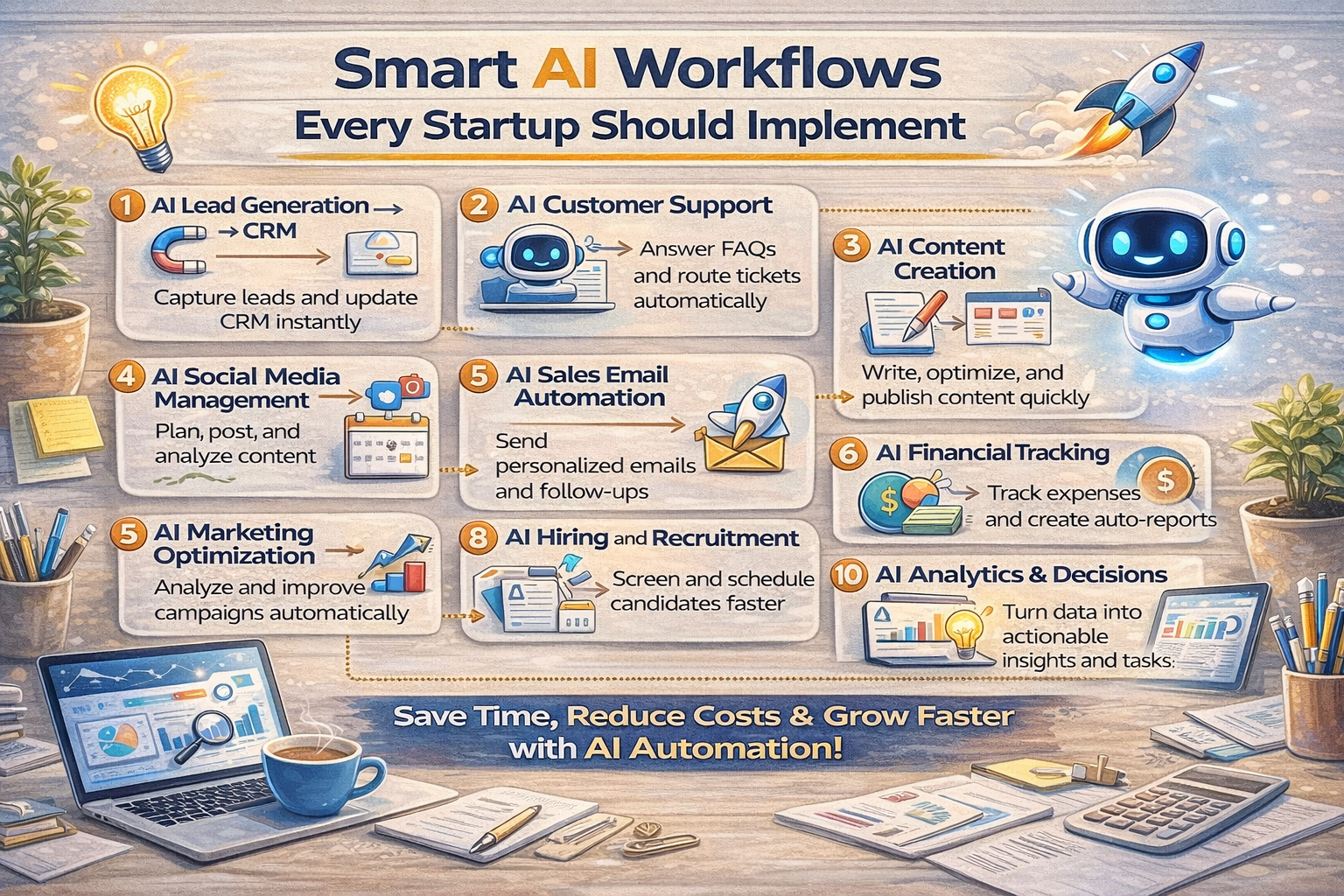
Below are the most important smart AI workflows that every startup should use. Each workflow is explained clearly before listing its benefits.
1. AI Lead Generation and CRM Workflow
Lead generation is the heart of any startup. Without leads, there are no sales.
This workflow automatically captures leads from websites, ads, and social media, and stores them in a CRM system.
How This Workflow Works
First, AI captures leads from forms or chatbots. Then it analyzes the lead and stores details in a CRM.
This workflow helps by:
- Capturing leads automatically
- Reducing manual data entry
- Improving follow-up speed
2. AI Customer Support Workflow
Customer support takes a lot of time, especially for startups with limited staff.
AI chatbots handle common questions and forward complex issues to human agents.
How This Workflow Works
AI answers frequently asked questions and creates support tickets when needed.
This workflow helps by:
- Providing 24/7 support
- Reducing support costs
- Improving customer satisfaction
3. AI Content Creation and Publishing Workflow
Content marketing is important but time-consuming.
AI tools can write, optimize, and publish content automatically.
How This Workflow Works
AI generates content, optimizes it for SEO, and schedules it for publishing.
This workflow helps by:
- Saving writing time
- Maintaining content consistency
- Improving SEO performance
4. AI Social Media Management Workflow
Managing multiple social platforms manually is difficult.
AI workflows plan, design, schedule, and analyze social media posts.
How This Workflow Works
AI suggests post ideas, creates captions, schedules posts, and tracks engagement.
This workflow helps by:
- Maintaining regular posting
- Increasing engagement
- Saving daily effort
5. AI Sales Email Automation Workflow
Sales emails need personalization to work well.
AI creates personalized emails and sends follow-ups automatically.
How This Workflow Works
AI analyzes customer data and writes emails based on behavior.
This workflow helps by:
- Increasing reply rates
- Reducing manual outreach
- Improving sales efficiency
6. AI Marketing Campaign Optimization Workflow
Marketing campaigns require constant monitoring.
AI analyzes campaign data and improves performance automatically.
How This Workflow Works
AI tracks ads, keywords, and conversions and adjusts campaigns.
This workflow helps by:
- Improving ad performance
- Reducing wasted spend
- Increasing ROI
7. AI Financial Tracking and Reporting Workflow
Finance management is critical for startup survival.
AI tracks expenses, categorizes transactions, and creates reports.
How This Workflow Works
AI connects bank data and generates real-time financial insights.
This workflow helps by:
- Monitoring cash flow
- Reducing accounting errors
- Supporting better decisions
8. AI Hiring and Recruitment Workflow
Hiring takes time and effort.
AI screens resumes, shortlists candidates, and schedules interviews.
How This Workflow Works
AI matches resumes with job criteria and automates scheduling.
This workflow helps by:
- Speeding up hiring
- Reducing bias
- Saving HR time
9. AI Product Feedback Analysis Workflow
Customer feedback is valuable but difficult to analyze manually.
AI analyzes reviews, surveys, and feedback messages.
How This Workflow Works
AI groups feedback into themes and highlights issues.
This workflow helps by:
- Understanding customer needs
- Improving product features
- Increasing retention
10. AI Analytics and Decision-Making Workflow
Data is useless without insights.
AI converts raw data into clear action steps.
How This Workflow Works
AI reads dashboards and summarizes performance reports.
This workflow helps by:
- Simplifying data
- Supporting faster decisions
- Reducing confusion
Benefits of Implementing Smart AI Workflows
Smart AI workflows provide real business value.
Key Benefits Include:
- Time savings
- Cost reduction
- Faster growth
- Better accuracy
- Improved team productivity
Startups using AI workflows gain a strong competitive advantage.
How Startups Can Start with AI Workflows
Many founders think AI is complex. It is not.
Startups should:
- Identify repetitive tasks
- Choose one workflow
- Use simple AI tools
- Test and improve
- Expand gradually
Starting small is the best approach.
Common Mistakes Startups Make with AI Workflows
AI workflows must be used wisely.
Common mistakes include:
- Automating without planning
- Using too many tools at once
- Ignoring human review
- Not measuring results
AI works best with human guidance.
Future of AI Workflows in Startups
AI workflows will become smarter and more connected.
Future trends include:
- Voice-based automation
- Predictive decision-making
- Fully autonomous workflows
Startups that adopt AI early will grow faster and stronger.
Frequently Asked Questions (FAQs)
1. What are smart AI workflows?
Smart AI workflows are automated processes where AI tools work together to complete tasks efficiently.
2. Are AI workflows expensive for startups?
Many AI tools are affordable and offer free plans for startups.
3. Do startups need technical skills to use AI workflows?
No. Most AI tools are user-friendly and require no coding.
4. Can AI workflows replace employees?
No. AI supports employees and improves productivity.
5. Which startup tasks should be automated first?
Lead generation, customer support, and content creation.
6. Are AI workflows safe for business data?
Yes, if trusted tools and security practices are used.
7. How much time can AI workflows save?
AI workflows can save 10 to 40 hours per week for startups.
Final Conclusion
Smart AI workflows every startup should implement are no longer optional. They help startups work faster, reduce stress, and focus on growth. From lead generation to customer support and analytics, AI workflows simplify business operations.
Startups that adopt AI workflows early gain efficiency, scalability, and long-term success. You do not need to automate everything at once. Start small, learn, and grow step by step.
The future of startups belongs to those who work smart — and smart AI workflows make that possible.
Read More Blog-AI Tools That Replace Manual Business Operations