Subtotal $0.00




Email : 9
Artificial Intelligence is no longer just a buzzword. It is part of our daily life. From the way we search on Google, scroll on social media, use voice assistants, shop online, or even drive cars — AI is working silently in the background. But today, AI is entering a deeper and more powerful phase. We are moving beyond simple automation into advanced innovation.
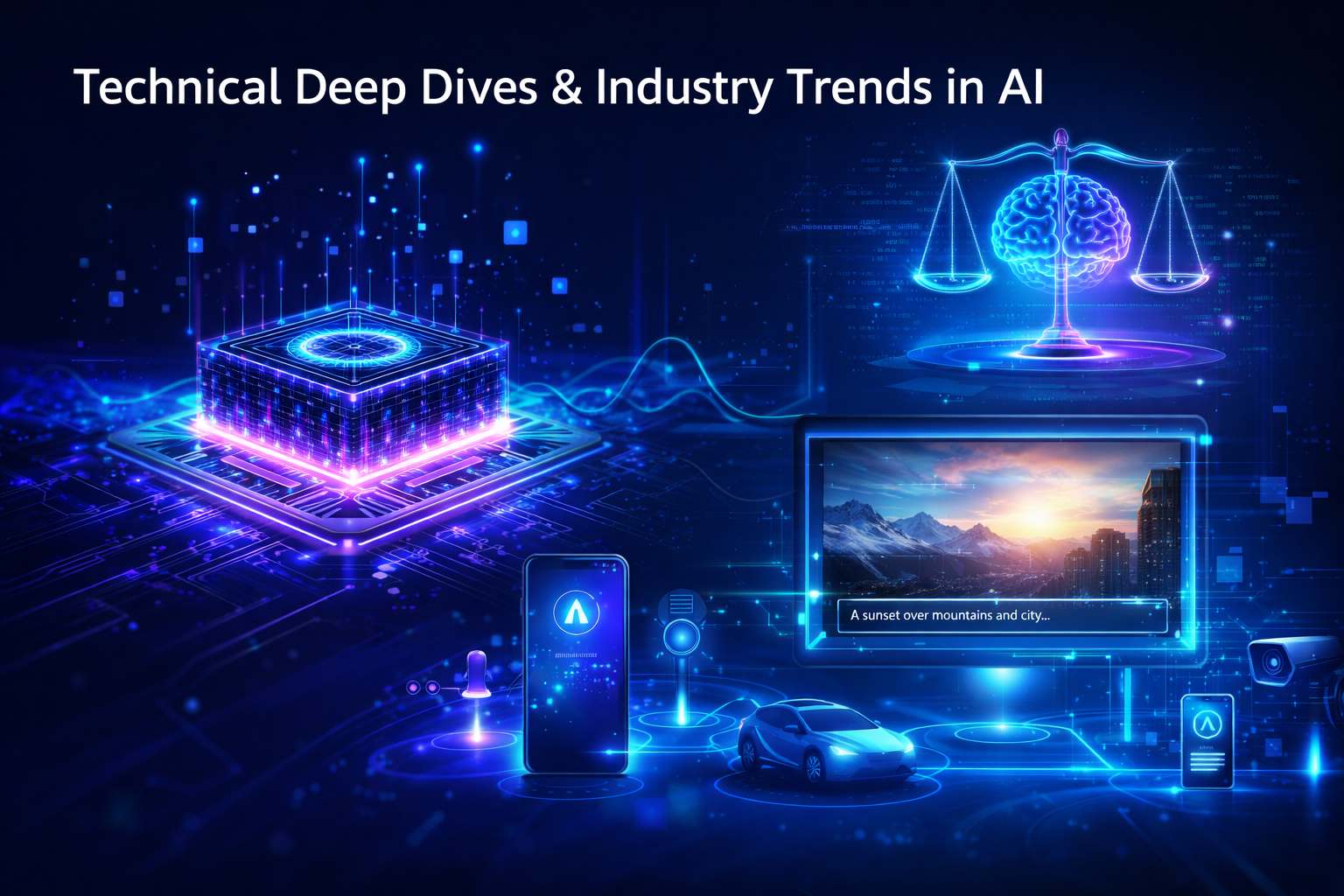
For developers, data scientists, startup founders, and industry analysts, understanding technical deep dives and industry trends in AI is no longer optional. It is necessary. Technologies like Quantum Computing & AI, Mitigating Bias in AI, Generative Video, and Edge AI are shaping the next decade of digital transformation. These are not future dreams. They are happening right now.
This article explains these powerful trends in very simple language. You will understand how they work, why they matter, and how they will impact businesses and careers. Whether you are a beginner or an expert, this guide will give you clarity and direction.
Why Understanding Technical Deep Dives in AI Matters
Before we explore each trend, let us understand why deep knowledge is important.
AI is growing very fast. New models, new tools, and new frameworks are released almost every month. Businesses are investing heavily in AI-driven systems. Governments are creating AI policies and regulations. Startups are building products completely based on artificial intelligence.
If you only understand surface-level AI, you may miss opportunities.
Technical deep dives help you:
- Understand how AI systems actually work
- Build better and more efficient AI models
- Avoid ethical and legal mistakes
- Improve system performance
- Stay competitive in your industry
- Identify new innovation opportunities
AI is not just about using tools. It is about understanding the foundation behind those tools.
Now let us explore the most important AI industry trends.
Quantum Computing & AI: Redefining Computational Power
Understanding Quantum Computing in Simple Words
Traditional computers use bits. A bit can be either 0 or 1.
Quantum computers use qubits. A qubit can be 0 and 1 at the same time. This property is called superposition. Another important property is entanglement, where qubits can be connected in ways that make them work together in powerful combinations.
Because of these properties, quantum computers can process complex problems much faster than normal computers.
Now imagine combining this power with Artificial Intelligence.
That is Quantum Computing & AI.
Why Quantum AI Is Important
AI models require huge computing power. Training large machine learning models takes time and resources. Some problems like protein folding, climate modeling, or financial risk analysis require massive calculations.
Quantum AI can:
- Speed up machine learning algorithms
- Solve optimization problems faster
- Improve pattern recognition
- Enhance data clustering
- Support advanced simulations
For example:
In healthcare, quantum AI may help in faster drug discovery.
In finance, it may improve portfolio optimization.
In logistics, it can reduce delivery time through better route planning.
In energy, it can optimize grid management.
Challenges of Quantum AI
However, quantum computing is still developing. It requires:
- Extremely cold temperatures
- High maintenance cost
- Specialized hardware
- Complex programming
But many technology giants and research institutions are investing heavily in it.
Quantum AI may not replace classical AI completely. But it will support it in solving highly complex problems.
The future of AI computing may be hybrid — a mix of classical and quantum systems.
Mitigating Bias in AI: Building Fair and Responsible Systems
The Human Side of Artificial Intelligence
AI is created by humans. It learns from data created by humans. That means AI can also inherit human bias.
Bias in AI happens when a system produces unfair results for certain groups of people.
For example:
- A hiring algorithm may prefer male candidates if past hiring data favored men.
- A loan approval system may reject certain communities unfairly.
- Facial recognition systems may perform poorly for certain ethnic groups.
This is not just a technical issue. It is a social and ethical issue.
Where Bias Comes From
Before solving bias, we must understand its source:
- Historical data imbalance
- Lack of diversity in datasets
- Human labeling errors
- Algorithm design flaws
- Lack of transparency
If AI systems are trained on incomplete or biased data, the output will also be biased.
How to Mitigate Bias in AI
Mitigating bias in AI requires effort at multiple levels.
First, collect diverse and representative data.
Second, regularly audit models for fairness.
Third, use explainable AI techniques.
Fourth, involve multidisciplinary teams in development.
Fifth, maintain transparency in algorithm design.
Explainable AI (XAI) helps users understand why a decision was made. This builds trust.
Governments are also introducing AI ethics regulations. Companies must now focus on responsible AI.
Mitigating bias is not just about compliance. It is about building trustworthy systems.
In the long term, companies that prioritize fairness will build stronger brands and customer loyalty.
Generative Video: Transforming Creativity and Media
What Is Generative Video?
Generative Video uses artificial intelligence to create video content automatically.
It works similar to text-to-image AI, but instead of images, it creates full motion video scenes.
A user provides a text prompt like:
“A sunrise over mountains with birds flying.”
The AI generates a realistic video based on that prompt.
How Generative Video Works
Generative video models are trained on large datasets of videos. They learn:
- Motion patterns
- Lighting changes
- Object interaction
- Scene transitions
- Human movement
Using deep learning techniques like diffusion models and transformer architecture, these systems predict and generate video frames.
Impact on Film and Content Industry
Generative video is changing the creative industry.
Film production can become cheaper and faster.
Small creators can produce cinematic content.
Marketing teams can create personalized ads.
Education platforms can create animated lessons.
Gaming industries can build dynamic environments.
Earlier, video production required expensive equipment, actors, studios, and editing software.
Now, AI reduces cost and time.
Ethical Concerns
Generative video also raises concerns:
- Deepfake misuse
- Fake news
- Identity manipulation
- Copyright violations
That is why ethical regulation and watermarking technologies are being developed.
Generative video is powerful. But like every technology, it must be used responsibly.
Edge AI: The Privacy-First Revolution
What Is Edge AI?
Traditional AI systems send data to cloud servers for processing.
Edge AI processes data locally on devices like:
- Smartphones
- Smart cameras
- IoT devices
- Autonomous vehicles
- Wearable devices
This means data does not need to travel to the cloud.
Why Edge AI Is Growing Fast
Edge AI offers many benefits:
Improved privacy
Lower latency
Real-time processing
Reduced internet dependency
Better energy efficiency
For example:
Face recognition on your phone works without sending data to servers.
Smart security cameras detect motion instantly.
Autonomous cars make immediate driving decisions.
In industries like healthcare and finance, privacy is very important. Edge AI helps protect sensitive data.
Edge AI and Business Impact
Businesses using Edge AI can:
- Reduce cloud costs
- Improve system speed
- Enhance user experience
- Meet data privacy regulations
With the growth of 5G and IoT devices, Edge AI adoption will increase even more.
How These AI Trends Connect Together
Quantum Computing & AI increases processing power.
Mitigating Bias ensures fairness and trust.
Generative Video transforms creative industries.
Edge AI improves privacy and real-time decision making.
Together, these trends represent the next stage of digital transformation.
AI is becoming:
More powerful
More ethical
More creative
More decentralized
This combination will shape industries in the next decade.
Industry Applications Across Sectors
Healthcare
- Quantum AI for drug discovery
- Edge AI for patient monitoring
- Bias mitigation for fair diagnosis
Finance
- Risk prediction models
- Fraud detection systems
- Transparent credit scoring
Education
- AI-generated learning videos
- Personalized tutoring systems
- Fair assessment algorithms
Manufacturing
- Predictive maintenance
- Smart robotics
- Edge-based quality inspection
Media & Entertainment
- AI-generated movies
- Personalized content streaming
- Automated editing
AI is not replacing industries. It is enhancing them.
Career Opportunities in These AI Trends
For developers:
- Quantum algorithm programming
- AI fairness auditing
- Edge device optimization
For data scientists:
- Bias detection modeling
- Generative AI training
- Advanced machine learning systems
For entrepreneurs:
- AI-powered startups
- Ethical AI consulting
- Edge computing solutions
Learning these technical deep dives can open global career opportunities.
The Human Responsibility in AI Innovation
Technology is powerful. But humans decide how to use it.
We must ensure:
- AI remains ethical
- Privacy is respected
- Innovation is inclusive
- Systems are transparent
AI should empower humanity, not control it.
Responsible AI development is the key to long-term success.
The Future of AI Industry Trends
In the coming years:
- Hybrid quantum-classical AI systems may emerge
- AI regulation will increase globally
- Generative content will dominate marketing
- Edge AI will power smart cities
- Fairness and transparency will become mandatory
Organizations that understand these trends early will lead the market.
Conclusion
Technical Deep Dives & Industry Trends in AI are shaping the future of technology, business, and society. Quantum Computing & AI promise unmatched computational speed. Mitigating Bias ensures fairness and trust. Generative Video is revolutionizing content creation. Edge AI is driving privacy-first innovation.
For developers, analysts, and business leaders, staying informed is critical. AI is not slowing down. It is accelerating.
Those who adapt, learn, and innovate responsibly will thrive in this AI-driven world.
The future is intelligent. The future is ethical. The future is now.
Read More Blog–Why AI Startup Edge Is the Growth Partner for Modern Startups
Frequently Asked Questions (FAQs)
1. What are technical deep dives in AI?
They are advanced topics that explore how AI systems work internally and how new technologies are shaping the industry.
2. Is Quantum Computing & AI available today?
It is still developing but research and pilot projects are already active.
3. Why is mitigating bias in AI important?
It ensures fairness, reduces discrimination, and builds public trust.
4. How does Generative Video impact businesses?
It reduces production costs and allows faster content creation.
5. What is the main benefit of Edge AI?
It improves privacy and enables real-time processing.
6. Which industries benefit most from these AI trends?
Healthcare, finance, education, manufacturing, and media benefit significantly.
7. Is AI replacing human jobs?
AI is transforming jobs, not fully replacing them. It creates new opportunities.



Comments are closed