Subtotal $0.00




Email : 39
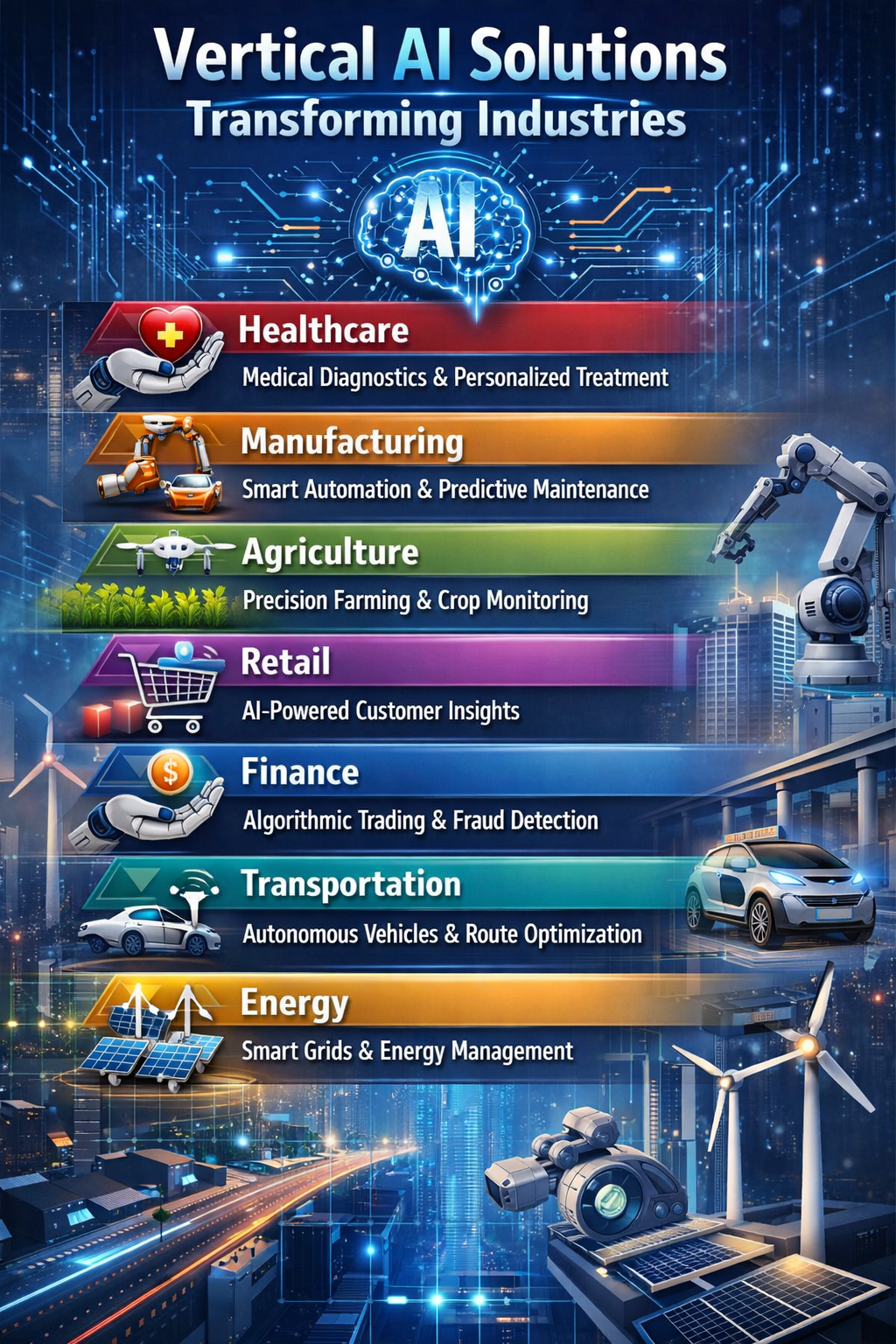
Artificial Intelligence is no longer just a general tool used for writing text or answering questions. Today, AI is becoming smarter and more focused. This is where Vertical AI Solutions come into the picture. These are AI systems designed to solve problems in specific industries like healthcare, finance, retail, education, agriculture, and manufacturing.
This article is important because many people still think AI is one-size-fits-all. In reality, businesses now need industry-specific AI that understands their rules, data, customers, and challenges. Vertical AI does exactly that. It helps companies save time, reduce cost, improve accuracy, and make better decisions.
If you are a startup founder, business owner, student, or simply curious about AI, this article will help you understand how vertical AI works, why it is growing so fast, and how it is changing different industries in real and practical ways.
What Are Vertical AI Solutions?
Before understanding why vertical AI solutions are dominating industries, it is important to know what they really are.
Vertical AI solutions are AI systems built for a specific industry or niche. Unlike general AI tools, these systems are trained using industry-related data, rules, and workflows.
For example, an AI tool built for healthcare understands medical terms, patient records, diagnosis patterns, and health regulations. On the other hand, an AI tool built for finance understands transactions, risk analysis, fraud detection, and compliance laws.
This focused approach makes vertical AI more accurate, reliable, and useful.
Vertical AI vs General AI
To better understand the value of vertical AI solutions, let us compare them with general AI.
General AI tools are designed to perform many tasks for many users. They are flexible but often lack deep industry knowledge.
Vertical AI tools are designed to solve specific problems in one industry. They may not work for other industries, but they work extremely well in their own domain.
This is why businesses are moving towards industry-focused AI instead of generic AI platforms.
Why Vertical AI Solutions Are Growing Rapidly
There are several reasons why vertical AI solutions are becoming popular across industries.
First, industries have complex problems that general AI cannot fully solve. Vertical AI is trained on real industry data, making it more practical.
Second, businesses want faster results. Vertical AI reduces training time and setup because it is already optimized for the industry.
Third, regulations and compliance requirements are increasing. Industry-specific AI systems are designed to follow these rules.
Finally, investors and startups see vertical AI as a strong business model because it offers clear value and higher customer retention.
Vertical AI Solutions in Healthcare
Healthcare is one of the biggest industries benefiting from vertical AI solutions.
Healthcare AI systems are built to understand medical language, patient data, and clinical workflows.
These systems help doctors diagnose diseases, predict health risks, manage patient records, and improve treatment plans.
AI in healthcare also helps hospitals reduce paperwork, avoid errors, and improve patient care.
Vertical AI solutions in healthcare are especially important because accuracy and safety are critical in this industry.
Vertical AI Solutions in Finance and Banking
Finance is another industry where vertical AI is making a huge impact.
AI in finance is used for fraud detection, credit scoring, risk management, and customer support.
These systems analyze financial data in real time and identify unusual patterns that humans may miss.
Vertical AI solutions in banking also help companies follow strict financial regulations and compliance standards.
This makes financial services safer, faster, and more reliable for customers.
Vertical AI Solutions in Retail and E-commerce
Retail and e-commerce companies are using vertical AI to understand customer behavior better.
AI systems analyze purchase history, browsing habits, and preferences to offer personalized recommendations.
Vertical AI also helps manage inventory, predict demand, and optimize pricing.
These AI solutions improve customer experience while helping businesses increase sales and reduce waste.
Retail-focused AI is more effective because it understands shopping patterns and market trends.
Vertical AI Solutions in Manufacturing
Manufacturing industries use vertical AI solutions to improve efficiency and reduce downtime.
AI systems monitor machines, detect faults, and predict maintenance needs.
This helps companies avoid expensive breakdowns and improve product quality.
Vertical AI also supports supply chain management and production planning.
Manufacturing-focused AI systems understand equipment data, production cycles, and safety standards.
Vertical AI Solutions in Agriculture
Agriculture is another industry being transformed by vertical AI solutions.
AI systems analyze soil quality, weather data, crop health, and pest patterns.
Farmers use AI to decide when to plant, irrigate, or harvest crops.
Vertical AI in agriculture helps increase yield, reduce water usage, and improve food quality.
This is especially important as the global demand for food continues to grow.
Vertical AI Solutions in Education
Education-focused AI systems are designed to improve learning experiences.
These AI tools help personalize lessons, track student progress, and identify learning gaps.
Vertical AI solutions in education also help teachers manage administrative tasks and improve engagement.
By understanding education systems and student behavior, AI makes learning more effective and accessible.
Benefits of Vertical AI Solutions
Vertical AI solutions offer many advantages for businesses and organizations.
They provide higher accuracy because they are trained on industry-specific data.
They save time by automating complex processes.
They reduce operational costs by improving efficiency.
They improve decision-making with better insights.
Most importantly, they solve real problems in a practical and reliable way.
Challenges of Vertical AI Solutions
While vertical AI offers many benefits, it also comes with challenges.
Developing industry-specific AI requires deep domain knowledge.
Data privacy and security are major concerns, especially in healthcare and finance.
Implementation can be costly for small businesses.
Continuous updates are needed to keep AI systems aligned with industry changes.
Despite these challenges, the long-term benefits outweigh the difficulties.
Why Startups Are Focusing on Vertical AI
Startups are increasingly choosing vertical AI because it allows them to focus on a specific market.
This focus helps startups build better products and stand out from competitors.
Vertical AI startups can scale faster by solving real industry problems.
Investors also prefer vertical AI startups because they have clear use cases and revenue models.
This trend is expected to grow even more in the coming years.
Future of Vertical AI Solutions
The future of vertical AI solutions looks very promising.
More industries will adopt industry-focused AI systems.
AI models will become more specialized and intelligent.
Integration with other technologies like IoT and blockchain will increase.
Regulations will shape how vertical AI is developed and used.
Overall, vertical AI will become a core part of business operations across industries.
How Businesses Can Adopt Vertical AI Solutions
Businesses should first identify their biggest problems.
Then, they should look for AI solutions designed for their specific industry.
It is important to start small and scale gradually.
Training employees and ensuring data security are also key steps.
With the right approach, vertical AI can bring long-term success.
Frequently Asked Questions (FAQs)
What are vertical AI solutions?
Vertical AI solutions are AI systems designed for specific industries, such as healthcare, finance, or retail.
How is vertical AI different from general AI?
Vertical AI focuses on one industry and understands its rules and data, while general AI is designed for many tasks.
Why are vertical AI solutions important?
They solve industry-specific problems more accurately and efficiently than general AI tools.
Which industries use vertical AI the most?
Healthcare, finance, retail, manufacturing, agriculture, and education are major users of vertical AI.
Are vertical AI solutions expensive?
Costs vary, but many businesses find that the long-term benefits justify the investment.
Can small businesses use vertical AI?
Yes, many vertical AI tools are designed for small and medium-sized businesses.
Is vertical AI the future of artificial intelligence?
Yes, vertical AI is expected to dominate as businesses demand more specialized solutions.
Read More Blog– AI Agents for Automating Business Tasks