Subtotal $0.00




Email : 21
Artificial Intelligence is changing the world very fast. You may have heard about chatbots, automation tools, and smart assistants. But now, a new powerful technology is growing quickly. It is called AI agents. Many experts believe that AI agents will become the digital workers of the future. They can think, decide, act, and even improve themselves over time.
In 2026, AI agents are not just a technical topic for engineers. They are important for business owners, students, marketers, and even normal users. If you want to grow your business, improve productivity, or understand the future of jobs, you must understand what AI agents are.
This complete beginner’s guide will explain everything in very simple language. You will learn what AI agents are, how they work, their types, examples, benefits, risks, and future trends. By the end, all your doubts will be clear.
What Are AI Agents?
AI agents are intelligent software programs that can observe their environment, make decisions, and take actions to achieve specific goals.
In simple words, an AI agent is like a digital employee. It can think, plan, and perform tasks without continuous human instructions.
Unlike normal software that only follows fixed rules, artificial intelligence agents can learn from data and improve their performance.
For example, a simple calculator follows fixed rules. But an AI agent can decide what action to take based on a situation.
Simple Definition of AI Agents
Before going into technical details, let us understand this concept clearly.
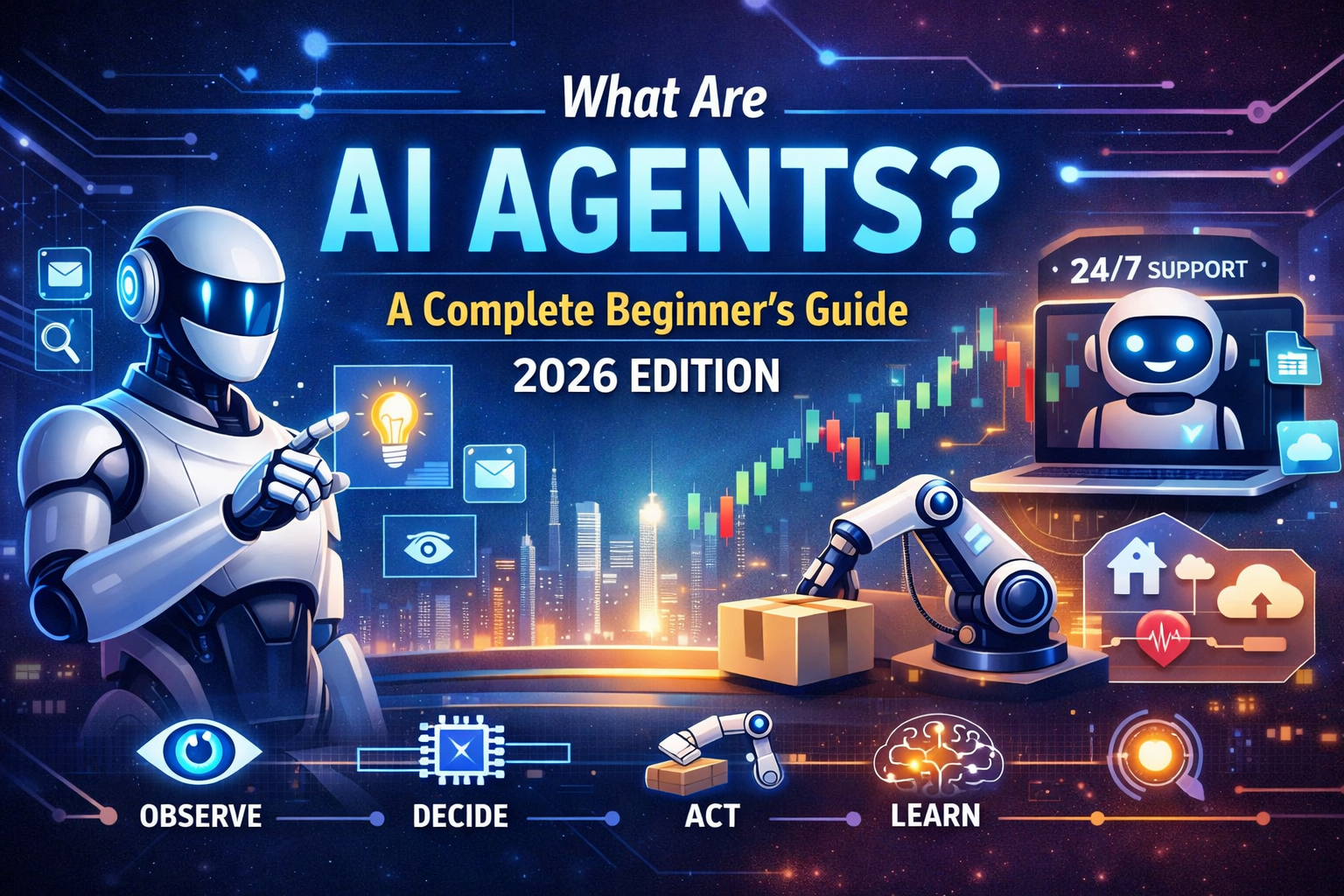
AI agents are systems that:
Observe the environment
Process information
Make decisions
Take action
Learn from results
This makes them different from traditional automation tools.
How AI Agents Work
To understand how AI agents work, we must understand their basic structure. Every intelligent agent follows a simple process.
An AI agent works in a loop. It sees what is happening, thinks about it, and then acts.
Below are the main steps that explain how AI agents function.
1. Perception
In this stage, the AI agent collects data from the environment. This can be:
User input
Sensors
Database
Internet data
For example, a customer support AI agent reads a user’s message.
2. Decision Making
In this stage, the AI agent processes the information. It uses:
Machine learning models
Rules
Large language models
Past memory
Then it decides what action is best.
3. Action
After deciding, the AI agent takes action. This action can be:
Sending a reply
Placing an order
Sending an email
Updating a system
4. Learning
Modern AI agents learn from feedback. If the result is good, they improve. If the result is wrong, they adjust.
This learning process makes autonomous AI agents smarter over time.
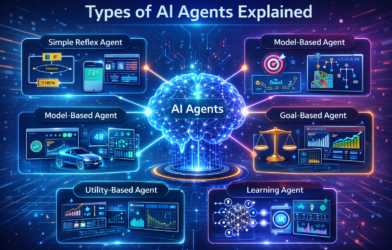
Types of AI Agents
There are different types of AI agents. Each type works in a different way depending on its intelligence level.
Below are the main types of artificial intelligence agents explained in simple language.
1. Simple Reflex Agents
These agents follow simple rules. They react directly to a situation.
They do not think about the past. They only respond to current input.
Example:
A thermostat that turns on AC when temperature increases.
2. Model-Based Agents
These agents remember past information. They build a small internal model of the world.
They use this memory to make better decisions.
Example:
A smart navigation system that remembers traffic patterns.
3. Goal-Based Agents
These agents work toward specific goals. They compare different options and choose the best one.
Example:
An AI agent that finds the cheapest flight ticket.
4. Utility-Based Agents
These agents calculate which option gives the highest benefit.
They choose actions that maximize success.
Example:
Stock trading AI agents.
5. Learning Agents
Learning agents improve with experience. They analyze feedback and update themselves.
Most modern AI agents in 2026 are learning agents.
AI Agents vs Chatbots
Many people confuse AI agents with chatbots. But they are not the same.
Chatbots mainly reply to messages. AI agents can do much more than replying.
Here is the difference explained clearly.
Chatbots usually:
Answer questions
Follow scripts
Work with limited tasks
AI agents:
Make decisions
Take independent actions
Connect with multiple tools
Learn over time
For example, a chatbot may tell you order status. But an AI agent can check inventory, process refund, and send confirmation email automatically.
Real-World AI Agent Examples
AI agents are already used in many industries. Let us look at real AI agent examples that are used in daily life.
1. Customer Support AI Agents
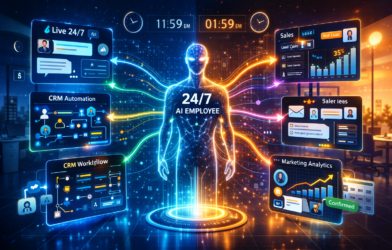
These agents handle customer queries 24/7. They solve problems, issue refunds, and escalate cases if needed.
2. AI Sales Agents
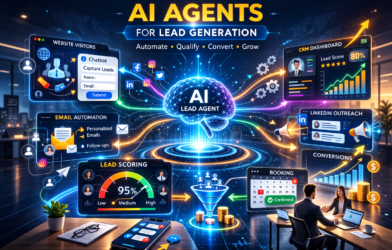
They follow up leads, send emails, schedule meetings, and update CRM systems automatically.
3. Personal Assistants
Digital assistants manage calendars, reminders, and tasks.
4. AI Trading Agents
These agents analyze market data and execute trades.
5. AI Marketing Agents
They run ad campaigns, optimize keywords, and generate reports.
Benefits of AI Agents
AI agents offer many advantages for businesses and individuals. Let us understand the key benefits.
AI agents help in saving time.
They reduce human errors.
They work 24/7 without breaks.
They improve productivity.
They reduce operational cost.
They make data-driven decisions.
For startups and entrepreneurs, AI agent for business operations can become a big competitive advantage.
AI Agents in Business (2026 Trend)
In 2026, AI agents are becoming digital team members in companies.
Businesses are using AI agents for:
Lead generation
Customer service
Sales automation
HR screening
Data analysis
Content creation
Small businesses can now afford AI agents because many no-code platforms are available.
This is creating a new digital workforce revolution.
AI Agent Architecture (Simple Explanation)
To understand artificial intelligence agents deeply, we must understand their basic components.
An AI agent usually includes:
Input system
Decision engine
Memory
Action system
Learning module
These components work together.
Large language models often power modern AI agents. They help the agent understand and generate human-like text.
Autonomous AI Agents
Autonomous AI agents are advanced agents that can operate without human supervision.
They can:
Plan tasks
Break goals into steps
Use tools
Monitor results
Self-correct
In 2026, many companies are building autonomous AI agents that act like digital managers.
Risks and Challenges of AI Agents
While AI agents are powerful, there are also risks.
Before adopting AI agents, it is important to understand possible challenges.
Data privacy concerns
Wrong decision-making
Over-dependence on automation
Security risks
Ethical issues
Proper monitoring and human supervision are still important.
How to Start Using AI Agents
If you are a beginner, you may wonder how to start.
You do not need to be a programmer to use AI agents today.
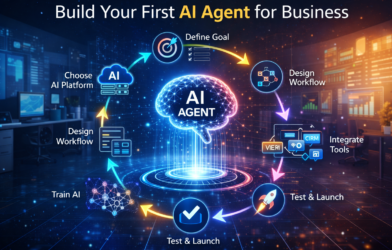
You can start by:
Using AI-powered CRM tools
Using AI marketing automation tools
Using AI chat automation platforms
Exploring no-code AI agent builders
Start small. Automate one process. Then expand gradually.
Future of AI Agents (2026 and Beyond)
The future of AI agents looks very powerful.
Experts predict that AI agents will:
Replace repetitive jobs
Create new job opportunities
Work as personal AI assistants
Manage business operations
Collaborate with humans
In coming years, every business may have multiple AI agents working as digital employees.
Why AI Agents Matter for You
AI agents are not just for big tech companies. They are useful for:
Students who want to learn future skills
Entrepreneurs who want automation
Digital marketers who want growth
Freelancers who want productivity
Corporate leaders who want efficiency
Understanding what AI agents are gives you an early advantage.
Conclusion
AI agents are intelligent systems that can observe, decide, act, and learn. They are more advanced than traditional automation tools and chatbots. In 2026, they are becoming essential for businesses and individuals.
From customer support to marketing, from trading to HR, AI agents are transforming industries. They save time, reduce costs, and increase productivity.
However, they must be used responsibly with proper monitoring.
If you start learning and using AI agents today, you will be ready for the future digital economy.
Read More Blog-Ethics & Societal Impact of AI
Frequently Asked Questions (FAQs)
1. What are AI agents in simple words?
AI agents are smart software programs that can think, decide, and take action automatically to achieve a goal.
2. Are AI agents the same as chatbots?
No. Chatbots mainly reply to messages. AI agents can perform tasks, make decisions, and learn from experience.
3. Can beginners use AI agents?
Yes. Many no-code tools allow beginners to use AI agents without programming.
4. Are AI agents safe?
AI agents are generally safe, but they must be monitored to avoid mistakes and security risks.
5. Will AI agents replace human jobs?
AI agents may replace repetitive tasks, but they will also create new job opportunities.
6. What industries use AI agents?
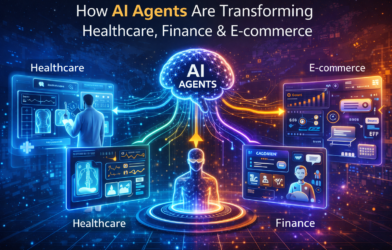
Healthcare, finance, marketing, e-commerce, HR, education, and many more industries use AI agents.
7. How do AI agents learn?
AI agents learn from data and feedback using machine learning techniques.