Subtotal $0.00




Email : 20
Every year, thousands of startups shut down. Many founders believe startups fail because of lack of funding, strong competition, or bad timing. While these factors matter, they are not the real root cause. Most startups fail because they make decisions without data.
When founders rely only on intuition, assumptions, or incomplete information, small mistakes grow into big problems. Wrong marketing strategies, poor pricing, ignored customer feedback, and delayed decisions slowly drain money and confidence. By the time founders realise something is wrong, it is often too late.
Data helps startups understand what is actually happening inside their business. But data alone is not enough. Raw data is complex, scattered, and hard to interpret. This is where Artificial Intelligence (AI) plays a critical role.
AI helps startups convert data into clarity. It shows patterns, predicts outcomes, and guides decisions in real time. This article explains why startups fail without data and how AI fixes these failures, in a practical and honest way, so founders can avoid common mistakes and build sustainable businesses.
The Real Reasons Startups Fail
Startup failure rarely happens suddenly. It is usually the result of repeated wrong decisions.
Most of these decisions happen because:
- Founders do not have clear data
- Data exists but is not understood
- Decisions are delayed or emotional
- Problems are noticed too late
Without data, startups operate in the dark.
Why Making Decisions Without Data Is Dangerous
Running a startup without data is like driving without a dashboard.
Without data:
- Founders cannot measure progress
- Problems remain hidden
- Money is spent blindly
- Growth decisions become risky
Data provides visibility, and visibility enables control.
Common Startup Failures Caused by Lack of Data
When startups do not use data properly, the same problems appear again and again.
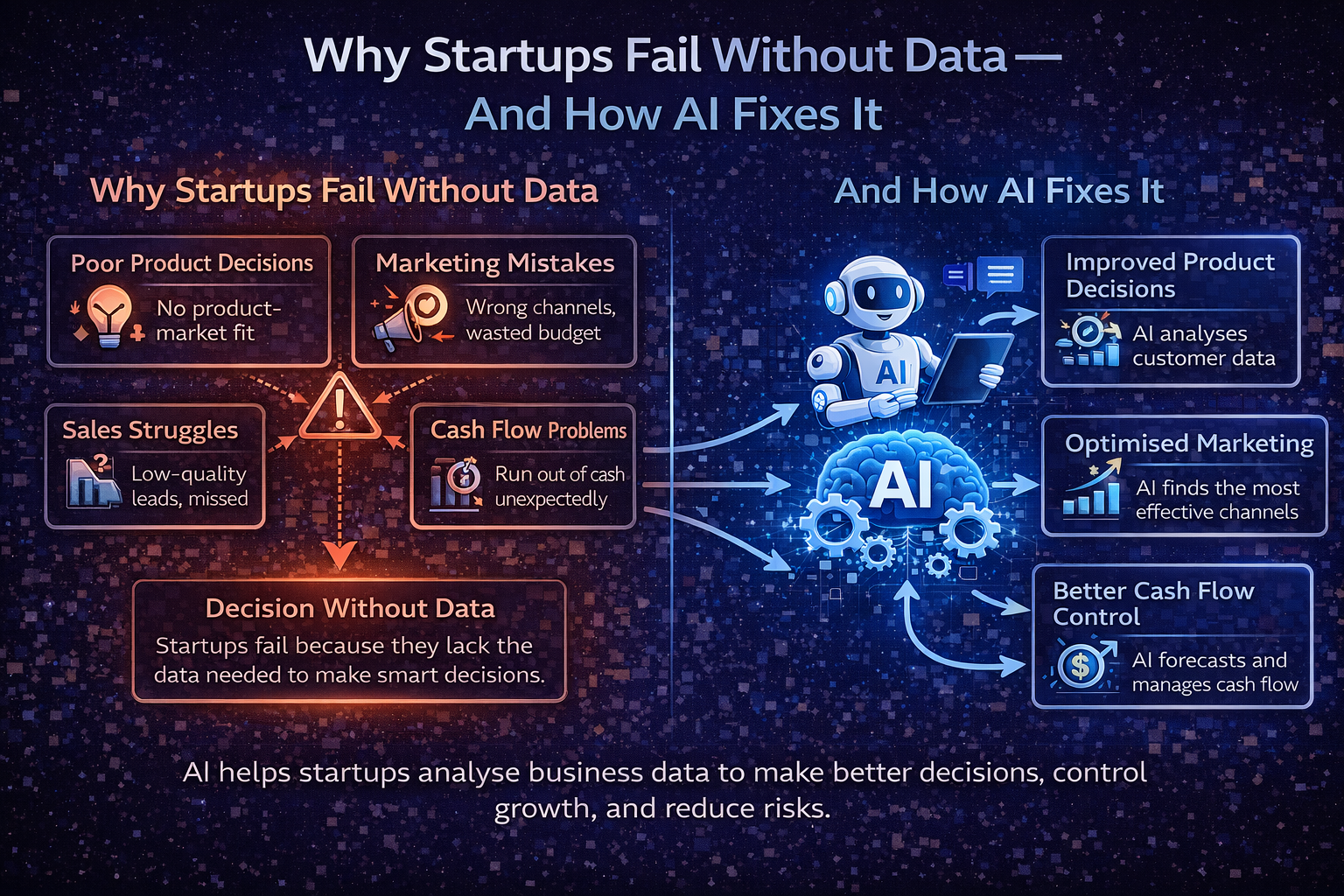
Poor Product-Market Fit
Many startups build products that nobody truly needs.
This happens because:
- Customer feedback is ignored
- Usage data is not analysed
- Founders rely on personal assumptions
Without data, startups build for themselves, not customers.
Wrong Marketing Decisions
Marketing is often one of the biggest expenses.
Without data:
- Founders choose the wrong channels
- Ads are not optimised
- Customer acquisition cost increases
- Budget is wasted
Data helps identify what works and what does not.
Sales Without Insights
Sales teams often chase the wrong leads.
Without data:
- Low-quality leads waste time
- Sales cycles become long
- Conversion rates stay low
Sales data helps focus on the right opportunities.
Cash Flow Problems
Many startups fail even after getting customers.
This happens because:
- Cash flow is not tracked properly
- Burn rate is misunderstood
- Expenses grow faster than revenue
Financial data is critical for survival.
Ignoring Customer Churn
Losing customers silently kills startups.
Without data:
- Founders do not notice churn early
- Feedback is missed
- Retention strategies fail
Customer data helps detect warning signs early.
Delayed Decision-Making
Manual data analysis is slow.
As a result:
- Decisions are delayed
- Opportunities are missed
- Competitors move faster
Speed matters in startups.
Why Traditional Data Analysis Is Not Enough
Some startups try to use data but still fail.
This happens because:
- Data is scattered across tools
- Reports are manual and slow
- Insights are unclear
- Analysis requires technical skills
This creates data overload instead of clarity.
The Role of AI in Fixing Data Problems
AI solves the biggest challenges of data usage.
AI helps startups by:
- Collecting data automatically
- Analysing large datasets quickly
- Identifying hidden patterns
- Predicting future outcomes
- Suggesting actions
AI turns data into decision support.
How AI Fixes Startup Failures Step by Step
AI does not magically save startups. It fixes problems systematically.
AI Centralises Scattered Data
Startups use many tools.
AI connects data from:
- Marketing platforms
- Sales and CRM tools
- Product analytics
- Finance systems
- Customer support tools
This creates a single source of truth.
AI Cleans and Organises Data
Raw data is messy.
AI improves data quality by:
- Removing duplicates
- Correcting errors
- Filling gaps
- Standardising formats
Clean data leads to reliable insights.
AI Identifies Patterns Humans Miss
Humans struggle with large datasets.
AI detects:
- Behaviour trends
- Performance drops
- Growth signals
- Risk patterns
These insights prevent surprises.
AI Predicts Problems Before They Happen
Prediction is where AI becomes powerful.
AI predicts:
- Customer churn
- Revenue slowdowns
- Cash flow shortages
- Campaign failures
This allows early action.
AI Suggests What to Do Next
AI does more than show data.
It helps by:
- Highlighting priorities
- Suggesting optimisations
- Recommending actions
- Reducing guesswork
Founders move from confusion to clarity.
How AI Prevents Common Startup Failures
AI directly addresses major failure points.
AI Improves Product Decisions
AI analyses product usage to:
- Identify popular features
- Detect friction points
- Understand user behaviour
Products improve based on real data.
AI Optimises Marketing Spend
AI helps marketing by:
- Tracking campaign performance
- Optimising ads in real time
- Reducing acquisition cost
Marketing becomes profitable and scalable.
AI Strengthens Sales Strategy
AI supports sales by:
- Scoring leads automatically
- Predicting deal success
- Improving follow-up timing
Sales teams focus on high-impact leads.
AI Protects Cash Flow
AI helps finance by:
- Forecasting revenue
- Tracking burn rate
- Identifying cost leaks
Founders avoid sudden cash crises.
AI Reduces Customer Churn
AI predicts churn by:
- Analysing engagement data
- Detecting dissatisfaction signals
Retention actions happen early.
AI Speeds Up Decision-Making
AI provides:
- Real-time dashboards
- Automated insights
- Predictive alerts
Decisions are faster and smarter.
Benefits of Using AI Instead of Guesswork
AI-driven startups gain strong advantages.
Better Accuracy
Decisions are based on facts, not feelings.
Faster Growth
Opportunities are identified early.
Lower Risk
Problems are detected before damage occurs.
Efficient Resource Use
Time and money are spent wisely.
Competitive Advantage
AI-powered startups move faster than competitors.
Why Some Startups Still Fail with AI
AI is not a magic button.
Failures happen when:
- Data quality is poor
- AI insights are ignored
- Tools are used without strategy
- Founders expect instant results
AI supports decisions, it does not replace leadership.
How Startups Should Start Using Data and AI
A simple and practical approach works best.
Startups should:
- Identify key business questions
- Track important metrics
- Use AI analytics tools
- Review insights regularly
- Act consistently on data
Small steps lead to big improvements.
Data-Driven Startups vs Intuition-Driven Startups
Intuition-driven startups:
- React late
- Take higher risks
- Waste resources
Data-driven startups:
- Act early
- Reduce uncertainty
- Scale sustainably
AI makes data-driven execution possible.
The Future of Startups Without Data
Startups that ignore data will struggle.
In the future:
- Competition will increase
- Margins will shrink
- Decisions will need to be faster
Without AI-driven data insights, survival becomes difficult.
Final Thoughts
Startups do not fail because founders are lazy or inexperienced. They fail because decisions are made without enough information. Data provides truth, and AI provides clarity.
AI helps startups:
- Understand customers
- Control finances
- Optimise growth
- Reduce risk
Without data, startups operate blindly. With AI, startups see clearly. The difference between failure and success often comes down to how well data is used.
Read More Blog–AI-Based Financial Planning for Startup Owners
Frequently Asked Questions (FAQs)
1. Why do startups fail without data?
Because they make decisions based on assumptions instead of facts.
2. Can early-stage startups use AI?
Yes. Many AI tools are affordable and easy to use.
3. Does AI replace founders’ judgment?
No. AI supports better decision-making.
4. Is AI only for tech startups?
No. Any startup can benefit from AI-driven data insights.
5. How quickly can AI improve decision-making?
Some insights appear immediately, others improve over time.