Subtotal $0.00




Email : 8
Introduction
Artificial intelligence is advancing rapidly, and one of the most discussed topics today is whether AI agents will replace human employees. Businesses are increasingly using AI systems to automate tasks such as customer support, marketing, data analysis, and administrative work. These technologies can work faster, analyze large amounts of data, and operate continuously without rest.
Because of these capabilities, many people worry that AI agents might replace human workers completely. Employees fear losing their jobs, while businesses wonder how automation will reshape the workplace.
However, the reality is more complex than simply replacing humans with machines.
AI agents are designed to assist humans, automate repetitive tasks, and improve productivity, not necessarily eliminate the need for human workers.
In this article, we will explore whether AI agents will replace human employees, how AI is changing the job market, and what the future of work may look like in an AI-powered world.



What Are AI Agents?
Before discussing their impact on jobs, it is important to understand what AI agents are.
AI agents are intelligent software systems that can perform tasks automatically using artificial intelligence technologies such as machine learning, natural language processing, and data analysis.
These systems can analyze information, interact with users, and make decisions to complete tasks.
AI agents are commonly used in:
- customer support automation
- marketing and sales automation
- data analysis
- workflow management
- research and information gathering
Unlike simple software programs, AI agents can learn from data and improve their performance over time.
Why Businesses Are Using AI Agents
Many companies are adopting AI agents because they improve efficiency and productivity.
Businesses use AI agents to automate tasks that require large amounts of time and manual effort.
Several factors are driving this adoption.
Increased Productivity
AI agents can complete tasks much faster than humans.
Examples include:
- processing large datasets
- generating reports
- responding to customer queries
This improves operational efficiency.
Cost Reduction
Automation can reduce operational costs.
AI systems can perform certain tasks without requiring large teams.
24/7 Availability
Unlike human workers, AI agents can operate continuously without breaks.
This is particularly useful for customer support and online services.
Better Data Analysis
AI agents can analyze large amounts of data and provide insights that help businesses make better decisions.
Jobs Most Likely to Be Affected by AI Agents
AI agents are most effective at automating repetitive tasks.
As a result, certain types of jobs are more likely to be affected by automation.
1. Customer Support Jobs
AI chatbots and support agents can answer many customer questions automatically.
These systems can handle tasks such as:
- answering common questions
- providing product information
- tracking orders
However, complex customer issues still require human support agents.
2. Data Entry Jobs
Data entry tasks are repetitive and rule-based.
AI systems can automate data processing and reduce the need for manual entry.
3. Basic Administrative Tasks
Administrative tasks such as scheduling meetings and managing calendars can be automated using AI assistants.
4. Content Generation and Marketing
AI tools can generate content ideas, write marketing copy, and analyze campaign performance.
However, human creativity remains important in marketing strategies.
Jobs That AI Cannot Easily Replace
While AI agents can automate many tasks, some jobs require skills that AI cannot easily replicate.
Human abilities such as creativity, empathy, and complex problem-solving remain difficult for machines.
Creative Professions
Creative fields require imagination and originality.
Examples include:
- writers
- designers
- filmmakers
- artists
AI can assist these professionals but cannot fully replace human creativity.
Leadership Roles
Leadership involves decision-making, emotional intelligence, and strategic thinking.
These qualities are difficult for AI systems to replicate.
Healthcare and Human Services
Jobs that require empathy and human interaction are less likely to be replaced.
Examples include:
- doctors
- therapists
- social workers
AI can assist these professionals but cannot replace human care.
How AI Agents Will Change Jobs Instead of Replacing Them
Instead of completely replacing workers, AI agents are more likely to transform jobs.
Many roles will evolve to include collaboration between humans and AI systems.
Below are several ways AI will change the workplace.
1. Humans Will Focus on Strategic Work
When repetitive tasks are automated, employees can focus on high-value activities such as:
- innovation
- strategic planning
- problem-solving
2. New AI-Related Jobs Will Be Created
The growth of AI technology is also creating new job opportunities.
Examples include:
- AI engineers
- AI trainers
- data scientists
- AI ethics specialists
3. Human-AI Collaboration Will Become Common
Future workplaces will likely involve collaboration between humans and AI agents.
AI systems will handle data processing, while humans provide judgment and creativity.
Benefits of AI Agents in the Workplace
AI agents can bring many advantages to organizations and employees.
Improved Productivity
Automation allows businesses to complete tasks faster and more efficiently.
Reduced Repetitive Work
Employees no longer need to spend time on repetitive tasks.
Better Decision Making
AI systems analyze data and provide insights that help leaders make informed decisions.
Innovation Opportunities
Automation frees up time for employees to focus on innovation and new ideas.
Challenges of AI in the Workplace
Despite the benefits, AI adoption also presents challenges.
Job Displacement Concerns
Some roles may disappear as automation increases.
Workers may need to learn new skills to stay relevant.
Skill Gaps
Many employees may need training to work effectively with AI technologies.
Ethical Concerns
AI systems must be used responsibly to avoid bias and unfair outcomes.
Preparing for the AI-Powered Workforce
Both businesses and employees must prepare for the changing job landscape.
Several strategies can help individuals adapt to the future workplace.
Learn New Skills
Workers should focus on developing skills that AI cannot easily replace, such as:
- creativity
- leadership
- communication
Understand AI Tools
Learning how to work with AI technologies will become increasingly valuable.
Focus on Lifelong Learning
Continuous learning will be essential as technology evolves.
The Future of Work with AI Agents
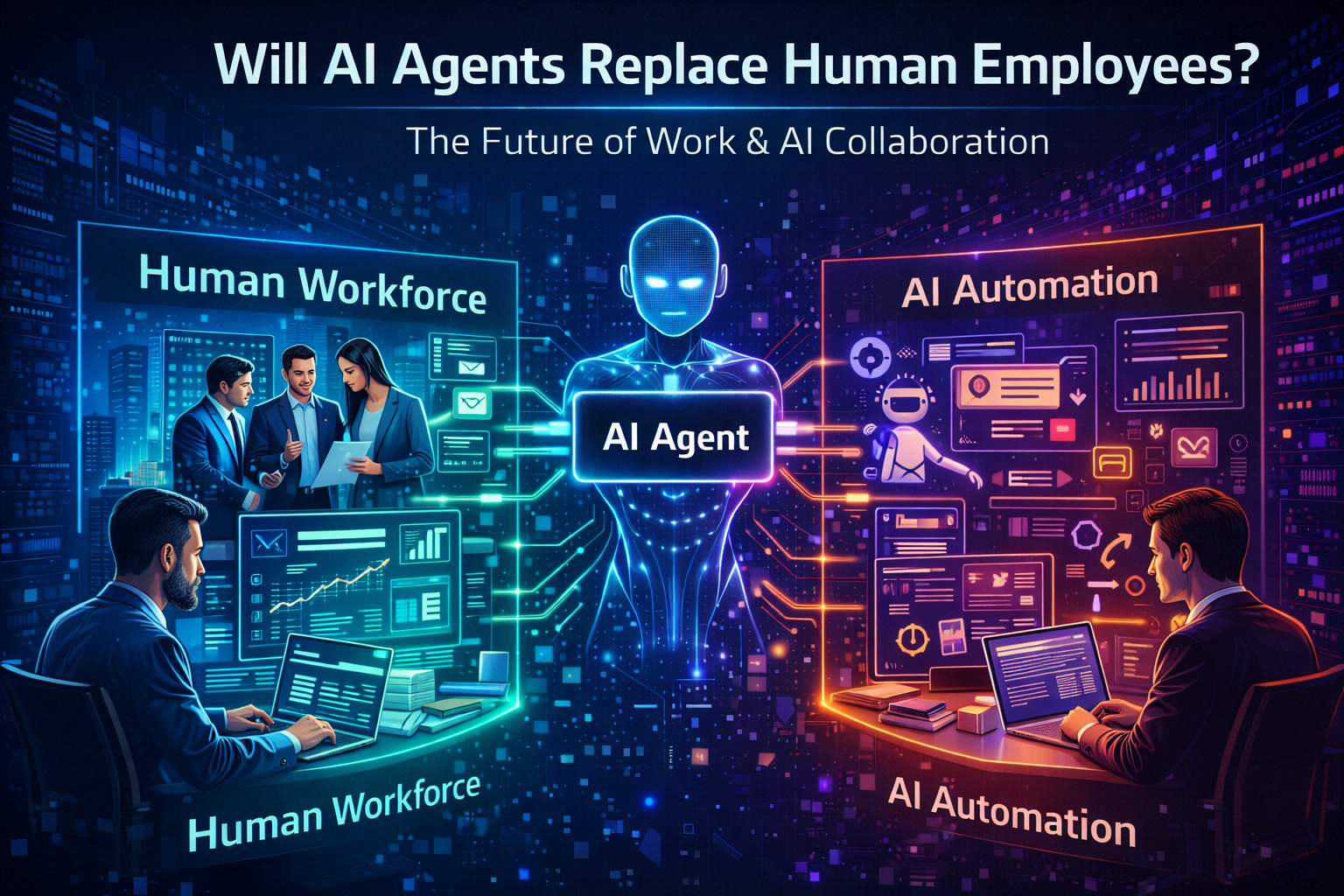
The future workplace will likely be a combination of human intelligence and artificial intelligence.
AI agents will automate routine tasks while humans focus on creativity, strategy, and complex problem-solving.
Rather than eliminating jobs entirely, AI will reshape industries and create new opportunities.
Companies that successfully combine human talent with AI technology will have a competitive advantage.
Conclusion
The question of whether AI agents will replace human employees is complex. While AI technology can automate many repetitive tasks, it is unlikely to completely replace human workers.
Instead, AI agents will change the nature of work by automating routine activities and allowing employees to focus on more meaningful and creative tasks.
The future workplace will likely involve collaboration between humans and AI systems.
Workers who adapt, learn new skills, and embrace technology will benefit from the opportunities created by AI innovation.
FAQs
1. Will AI agents completely replace human employees?
No. AI agents mainly automate repetitive tasks, but many jobs still require human creativity, judgment, and emotional intelligence.
2. Which jobs are most at risk from AI?
Jobs involving repetitive tasks such as data entry, basic customer support, and administrative work are more likely to be automated.
3. Will AI create new jobs?
Yes. AI technology is creating new roles in areas such as AI development, data science, and AI ethics.
4. How can employees prepare for AI automation?
Workers can prepare by learning new skills, understanding AI tools, and focusing on creativity and problem-solving abilities.
5. Is AI a threat to the workforce?
AI is not necessarily a threat but a transformation. It will change how people work rather than completely replacing human workers.