

Introduction
Artificial Intelligence is changing software development faster than ever before. Developers no longer use AI only for writing small code snippets or fixing syntax errors. Modern AI coding systems are becoming intelligent development partners capable of handling complex workflows, parallel processing, security validation, debugging, testing, and project management. One of the biggest advancements in this space is the latest evolution of Anthropic Claude Code desktop, which introduces major improvements in parallel agent processing, quality reporting systems, and auto-mode security.
These updates are important because software teams today face growing pressure to build applications faster while maintaining high security and code quality standards. Claude Code aims to solve these problems by allowing multiple AI coding agents to work together simultaneously while improving workflow automation and development safety. The platform is becoming more than just an AI coding assistant. It is evolving into a complete AI-powered development ecosystem.
In this article, you will learn everything about Claude Code Evolution, parallel AI agent processing, postmortem quality reports, auto-mode security improvements, benefits, use cases, developer productivity, enterprise adoption, challenges, future AI coding trends, and how these innovations may transform software engineering in 2026 and beyond.
What Is Claude Code?
Claude Code is an AI-powered coding and development environment created by Anthropic. It is designed to help developers automate software engineering tasks using advanced AI models.
Claude Code can assist with:
- Writing code
- Debugging applications
- Explaining programming concepts
- Reviewing codebases
- Generating documentation
- Testing software
- Managing workflows
- Automating development operations
The latest evolution focuses heavily on intelligent workflow management and multi-agent collaboration.
Why Claude Code Evolution Matters
Software development is becoming increasingly complex.
Modern engineering teams manage:
- Large codebases
- Security requirements
- Cloud infrastructure
- Continuous deployment
- Multi-platform applications
- API integrations
- AI workflows
Traditional coding tools often slow teams down because developers spend too much time switching between tasks, debugging errors, reviewing pull requests, and coordinating with team members.
Claude Code Evolution aims to simplify these workflows through AI automation and parallel intelligence systems.
Understanding Parallel Agent Processing
One of the biggest new features is parallel agent processing.
Traditional AI coding assistants usually operate sequentially. They process one task at a time.
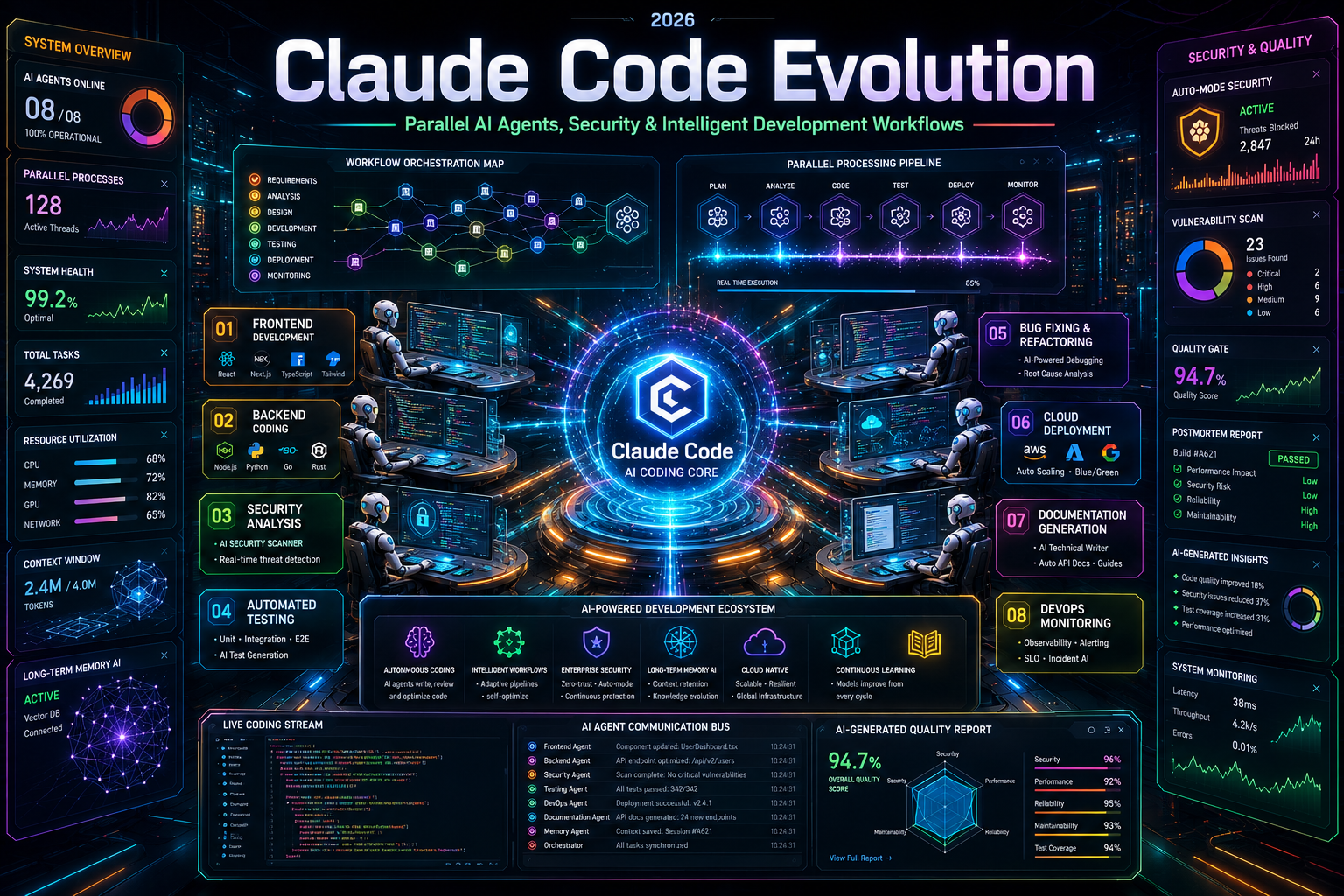
Claude Code introduces multiple specialized AI agents that can work simultaneously on different parts of a project.
This dramatically increases development speed and productivity.
How Parallel AI Agents Work
Parallel agent systems divide development tasks across multiple AI workers.
For example:
A web application project may include:
- Frontend Agent
Handles UI development. - Backend Agent
Builds APIs and server logic. - Security Agent
Checks vulnerabilities. - Testing Agent
Runs automated testing. - Documentation Agent
Creates technical documentation. - Deployment Agent
Prepares cloud deployment.
Instead of waiting for one task to finish before starting another, all agents collaborate at the same time.
This creates faster and more efficient development pipelines.
Benefits of Parallel Agent Processing
Parallel processing provides major advantages for developers and companies.
Faster development cycles
Projects move from idea to deployment more quickly.
Reduced bottlenecks
Teams no longer depend on sequential workflows.
Better specialization
Each AI agent focuses on a specific task.
Improved scalability
Large projects become easier to manage.
Increased productivity
Developers spend less time on repetitive tasks.
Claude Code Desktop Improvements
The new Claude Code desktop updates focus on making AI development smoother and more professional.
Key improvements include:
- Multi-agent orchestration
- Smarter context handling
- Faster code generation
- Improved debugging
- Better security validation
- Workflow automation
- Advanced project memory
- Quality report systems
These updates help developers build production-ready applications more efficiently.
What Are Postmortem Quality Reports?
Postmortem quality reports are advanced AI-generated analysis reports that review software development processes after tasks are completed.
These reports identify:
- Errors
- Workflow inefficiencies
- Security vulnerabilities
- Failed deployments
- Performance issues
- Testing gaps
- Optimization opportunities
This helps developers continuously improve software quality.
Why Quality Reports Are Important
Modern software projects are highly complex.
Small coding mistakes can create:
- Security breaches
- Downtime
- User experience problems
- Financial losses
- System crashes
Postmortem quality reporting helps development teams identify problems before they become major failures.
Features of AI-Powered Quality Reports
Claude Code quality reports may include:
Error analysis
Identifies coding mistakes and system failures.
Performance monitoring
Measures application speed and resource usage.
Security auditing
Detects vulnerabilities and risky code patterns.
Workflow evaluation
Reviews development efficiency.
Recommendation systems
Suggests improvements automatically.
How AI Improves Software Debugging
Debugging is one of the most time-consuming tasks in software engineering.
Claude Code uses AI agents to:
- Detect bugs faster
- Analyze logs
- Trace errors
- Suggest fixes
- Simulate environments
- Review dependencies
Parallel processing allows multiple debugging operations to happen simultaneously.
Auto-Mode Security Improvements
Security is one of the most important updates in Claude Code Evolution.
Auto-mode refers to AI systems performing development tasks autonomously.
However, autonomous coding systems can create risks if security controls are weak.
Claude Code introduces stronger protections to reduce these risks.
Key Security Enhancements in Auto-Mode
Permission controls
Users can define AI access levels.
Sandboxed execution
AI-generated code runs in controlled environments.
Vulnerability scanning
Security agents monitor code continuously.
Risk detection systems
Potential threats are flagged automatically.
Human approval checkpoints
Critical operations may require user confirmation.
Why AI Coding Security Matters
AI-generated code can sometimes include vulnerabilities.
Common risks include:
- Insecure APIs
- Weak authentication
- Exposed credentials
- Dependency risks
- Injection vulnerabilities
Improved auto-mode security helps reduce these dangers.
The Rise of Autonomous Software Development
AI coding systems are becoming more autonomous every year.
Future systems may:
- Build applications independently
- Deploy cloud infrastructure
- Monitor production systems
- Fix bugs automatically
- Update security patches
- Optimize performance continuously
Claude Code Evolution represents an early step toward this future.
How Claude Code Helps Developers
Claude Code acts as a productivity multiplier.
Instead of replacing developers, it helps them work faster and smarter.
Developers can use it for:
- Rapid prototyping
- Learning programming
- Debugging applications
- Automating repetitive coding tasks
- Reviewing large codebases
- Generating documentation
- Writing tests
AI Pair Programming and Collaboration
AI pair programming is becoming common in modern development.
Claude Code can function like an intelligent programming partner.
It helps developers by:
- Explaining logic
- Suggesting solutions
- Reviewing architecture
- Identifying errors
- Recommending optimizations
This improves coding efficiency and learning speed.
Claude Code for Enterprise Development
Large organizations are adopting AI coding platforms rapidly.
Enterprise benefits include:
Faster software delivery
AI reduces development timelines.
Better code consistency
Standardized coding practices improve quality.
Reduced operational costs
Automation decreases manual workload.
Enhanced security monitoring
AI scans systems continuously.
Improved scalability
Teams manage larger projects more effectively.
Multi-Agent AI Systems in Coding
The concept of multi-agent AI is becoming central to modern development platforms.
Instead of using one AI model, systems now deploy multiple intelligent agents working together.
These agents can specialize in:
- Backend systems
- Frontend design
- Security analysis
- Database optimization
- Testing automation
- Cloud deployment
This mirrors how human engineering teams operate.
Long-Term Memory in AI Coding Systems
Memory systems are becoming increasingly important.
Claude Code can retain contextual understanding across sessions.
Benefits include:
- Remembering project structure
- Tracking coding patterns
- Understanding developer preferences
- Maintaining workflow continuity
- Improving future recommendations
This reduces repetitive instructions.
AI Workflow Automation in Development
Workflow automation is one of the biggest advantages of AI coding systems.
Claude Code can automate:
- Pull request reviews
- Bug tracking
- Code formatting
- Documentation generation
- Test creation
- CI/CD pipeline management
This saves valuable developer time.
Real-World Use Cases of Claude Code
Many industries can benefit from these updates.
SaaS Product Development
Startups can rapidly build MVPs and scalable applications.
Enterprise Software Engineering
Large organizations can automate development pipelines.
Cybersecurity Operations
Security teams can analyze vulnerabilities faster.
Cloud Infrastructure Automation
AI agents can manage deployments and server configurations.
Mobile App Development
Developers can accelerate Android and iOS development workflows.
DevOps and CI/CD Management
AI agents can optimize deployment pipelines and monitoring systems.
Benefits for Startups
Startups often operate with limited teams and resources.
Claude Code can help startups:
- Reduce development costs
- Build products faster
- Improve product quality
- Scale engineering operations
- Automate repetitive coding tasks
This creates competitive advantages.
Challenges of AI Coding Systems
Despite rapid improvements, AI coding still has limitations.
Hallucinated code
AI may generate incorrect logic.
Security vulnerabilities
Some generated code may contain risks.
Overreliance on automation
Developers still need human oversight.
Infrastructure costs
Advanced AI systems require powerful computing resources.
Ethical concerns
Questions remain about AI-generated intellectual property.
Human Developers Still Matter
AI coding tools are powerful, but human developers remain essential.
Humans provide:
- Creativity
- Strategic architecture decisions
- Ethical judgment
- User empathy
- Business understanding
- Innovation
AI works best as a collaborative assistant rather than a complete replacement.
Future of AI-Powered Development
The future of software engineering is moving toward intelligent automation.
Expected trends include:
- Fully autonomous debugging
- AI-generated software architecture
- Self-healing applications
- Continuous optimization systems
- Intelligent cloud orchestration
- AI-driven cybersecurity
Claude Code Evolution is part of this broader transformation.
AI Coding Trends in 2026
Several major trends are shaping the future.
Autonomous development environments
AI systems handling complete workflows.
Multi-agent engineering
Teams of AI agents collaborating together.
AI-native software companies
Businesses built around AI development.
Security-first AI coding
Stronger protections for autonomous systems.
Context-aware development systems
AI remembering long-term project history.
Claude Code vs Traditional IDEs
Traditional IDEs mainly provide tools for human developers.
Claude Code adds intelligence and automation.
| Traditional IDE | Claude Code |
|---|---|
| Manual coding | AI-assisted development |
| Limited automation | Autonomous workflows |
| Basic debugging | AI-powered debugging |
| Static tools | Adaptive AI systems |
| Human-only workflows | Human + AI collaboration |
How Developers Can Prepare for AI Coding
Developers should adapt to AI-assisted workflows.
Important skills include:
- AI collaboration
- Prompt engineering
- System architecture
- Security analysis
- Workflow automation
- Cloud development
- AI governance
Learning how to work with AI will become a critical career skill.
Impact on Software Engineering Careers
AI is changing engineering roles rather than eliminating them.
Future developers may focus more on:
- AI supervision
- Strategic planning
- System design
- Security validation
- AI workflow management
Routine coding tasks may become increasingly automated.
Ethical Questions Around AI Coding
As AI systems become more autonomous, ethical concerns continue growing.
Important discussions include:
- Ownership of AI-generated code
- Developer accountability
- Security responsibilities
- Transparency in automation
- Responsible AI deployment
Companies must create clear governance policies.
Claude Code Evolution and Enterprise Security
Security remains one of the strongest priorities in enterprise AI adoption.
Claude Code’s improved auto-mode security aims to provide:
- Safer autonomous execution
- Better permission management
- Controlled AI behavior
- Reduced vulnerability risks
- Stronger compliance support
These improvements are critical for enterprise trust.
The Future of Human and AI Collaboration in Coding
The future is not developers versus AI.
The future is developers working with intelligent AI systems.
AI agents can manage:
- Repetitive coding
- Testing
- Monitoring
- Documentation
- Workflow coordination
Humans will focus on:
- Product vision
- Architecture
- Innovation
- Strategy
- Creativity
This partnership may dramatically increase software development speed worldwide.
Why Claude Code Evolution Matters in 2026
The latest updates are important because they represent a shift toward fully intelligent development environments.
The combination of:
- Parallel AI agents
- Workflow automation
- Long-term memory
- Security-first auto-mode
- Quality reporting systems
creates a more advanced AI coding ecosystem.
Businesses adopting these tools early may gain significant advantages in productivity and innovation.
Conclusion
Claude Code Evolution represents one of the most important developments in AI-powered software engineering in 2026. The platform is moving beyond simple AI code assistance into a fully intelligent development environment capable of parallel agent processing, autonomous workflow coordination, advanced debugging, quality analysis, and security-focused automation.
The introduction of postmortem quality reports helps developers improve software reliability, while enhanced auto-mode security creates safer autonomous coding workflows. Multi-agent collaboration enables faster development cycles, better scalability, and improved productivity for both startups and enterprises.
Although AI coding systems still face challenges related to hallucinations, security, and governance, their potential is enormous. Developers who learn how to work alongside AI agents will likely become more productive and competitive in the future software industry.
Claude Code Evolution is not just another coding update. It represents the beginning of a new era where intelligent AI systems become active collaborators in the software development lifecycle.
Frequently Asked Questions (FAQs)
1. What is Claude Code?
Claude Code is an AI-powered software development platform created by Anthropic that helps automate coding, debugging, testing, and workflow management.
2. What is parallel agent processing?
Parallel agent processing allows multiple AI agents to work simultaneously on different development tasks.
3. Why is parallel processing important in coding?
It speeds up software development, reduces bottlenecks, and improves productivity.
4. What are postmortem quality reports?
These are AI-generated reports that analyze completed workflows, identify problems, and recommend improvements.
5. What is auto-mode security in Claude Code?
Auto-mode security includes protections that reduce risks during autonomous AI coding operations.
6. Can Claude Code replace developers?
No. Claude Code helps developers work faster, but human creativity and decision-making remain essential.
7. How does AI improve debugging?
AI can analyze logs, detect errors, trace bugs, and recommend fixes much faster than manual debugging.
8. Which industries can benefit from Claude Code?
Industries including SaaS, cybersecurity, cloud computing, mobile development, and enterprise software can benefit.
9. What are the risks of AI coding systems?
Risks include hallucinated code, security vulnerabilities, overreliance on automation, and infrastructure costs.
10. How does long-term memory help AI coding?
It helps AI remember project structures, developer preferences, and workflow history across sessions.
11. What skills are important for future developers?
Important skills include AI collaboration, security analysis, prompt engineering, and workflow automation.
12. Why is Claude Code Evolution important in 2026?
It represents a major step toward intelligent autonomous software development powered by multi-agent AI systems.