


Introduction
Artificial Intelligence is rapidly becoming part of everyday business operations. Companies now use AI for financial analysis, customer support, automation, software development, research, analytics, cybersecurity, and decision-making. However, as AI becomes more powerful, businesses are asking an important question: Can AI systems be trusted in high-stakes industries like finance and enterprise operations?
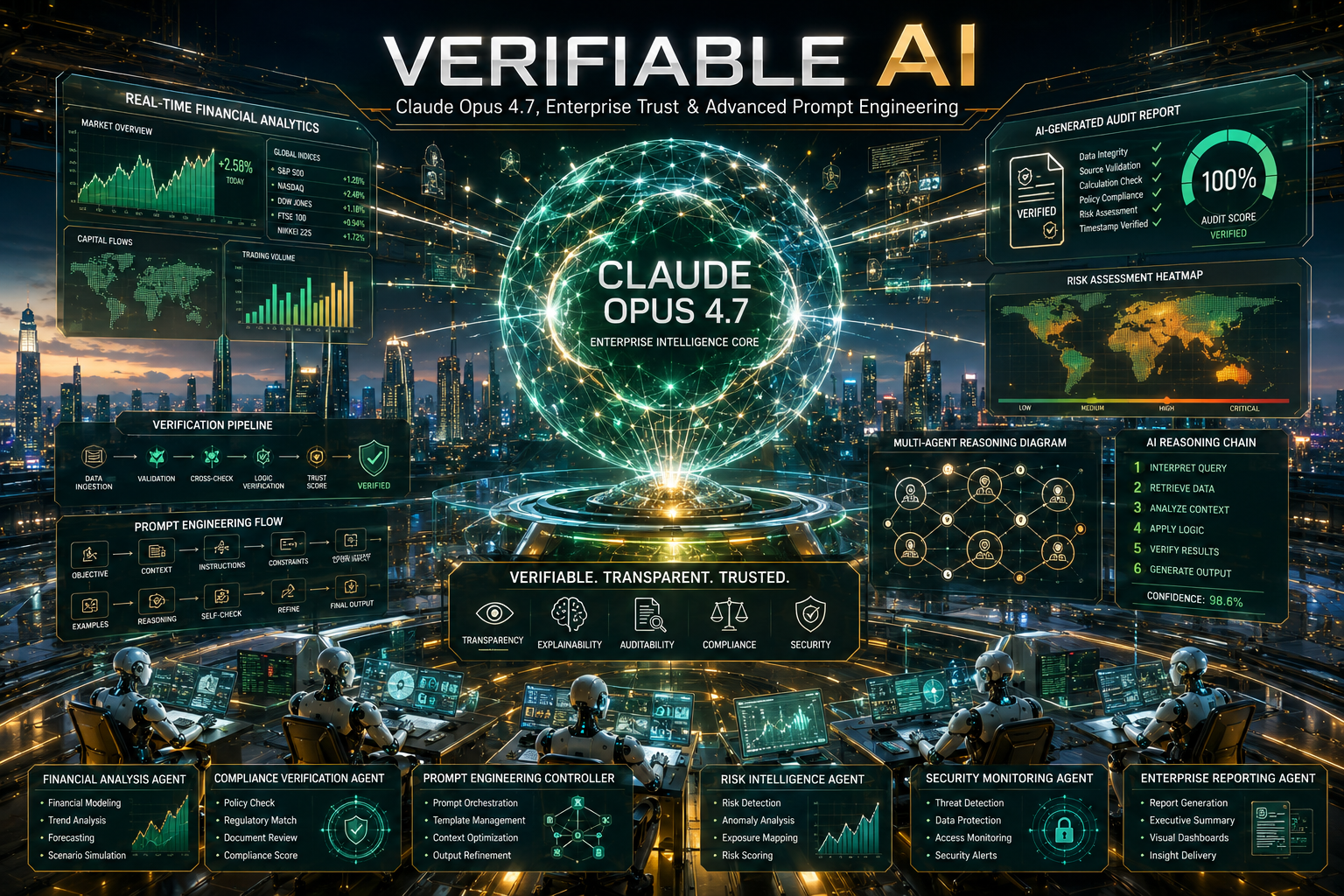
This is where the concept of verifiable AI becomes extremely important. Businesses want AI systems that are not only intelligent but also transparent, reliable, explainable, and secure. Recent case studies involving Anthropic Claude show how organizations are using Claude for verifiable AI workflows in finance and advanced prompt engineering with powerful models like Claude Opus 4.7.
These developments matter because companies need AI systems that reduce errors, improve productivity, and provide trustworthy outputs for sensitive business environments. In this article, you will learn everything about Claude verifiable AI case studies, finance automation, prompt engineering, enterprise AI trust systems, Claude Opus 4.7 workflows, advanced prompting techniques, business adoption, security, future AI trends, and how organizations are building more reliable AI-powered operations in 2026.
What Is Verifiable AI?
Verifiable AI refers to artificial intelligence systems designed to produce outputs that can be checked, validated, traced, and trusted.
Traditional AI systems sometimes generate:
- Hallucinations
- Inaccurate information
- Unverified claims
- Inconsistent outputs
Verifiable AI focuses on improving:
- Transparency
- Reliability
- Accuracy
- Explainability
- Auditability
- Trustworthiness
This is especially important in regulated industries like finance and healthcare.
Why Verifiable AI Matters
Businesses increasingly depend on AI for important decisions.
If AI produces incorrect results in areas like:
- Finance
- Banking
- Legal analysis
- Risk management
- Healthcare
- Compliance
the consequences can be serious.
Verifiable AI helps organizations reduce these risks.
Understanding Claude AI in Enterprise Environments
Anthropic Claude is becoming popular among enterprises because of its focus on:
- AI safety
- Long-context understanding
- Reliable reasoning
- Enterprise workflows
- Security-focused AI systems
Claude models are increasingly used for business-critical operations where trust and consistency matter.
What Makes Claude Different for Enterprise AI
Many businesses choose Claude because it focuses heavily on responsible AI behavior.
Important strengths include:
Long-context processing
Claude can analyze large amounts of information.
Safer responses
The system is designed to reduce harmful outputs.
Strong reasoning abilities
Claude performs well in analytical tasks.
Enterprise workflow integration
Businesses can integrate Claude into operational systems.
Better explainability
Outputs can be structured more transparently.
Claude Opus 4.7 and Advanced AI Workflows
Claude Opus 4.7 represents one of the most advanced enterprise AI models.
The model is designed for:
- Complex reasoning
- Large-scale analysis
- Multi-step workflows
- Enterprise automation
- Advanced prompt engineering
- High-context operations
This makes it suitable for professional and enterprise environments.
What Is Prompt Engineering?
Prompt engineering is the process of designing instructions that guide AI systems toward better outputs.
A prompt is the input given to an AI model.
Advanced prompt engineering improves:
- Accuracy
- Consistency
- Reliability
- Context understanding
- Task execution
Good prompting can dramatically improve AI performance.
Why Prompt Engineering Is Important
AI systems depend heavily on instructions.
Poor prompts may produce:
- Incomplete answers
- Confusing outputs
- Hallucinations
- Weak reasoning
Advanced prompts help AI systems perform more effectively.
Types of Advanced Prompt Engineering Techniques
Businesses use many advanced prompting methods.
Chain-of-Thought Prompting
This technique encourages AI to think step-by-step before answering.
Benefits include:
- Better reasoning
- Improved calculations
- Reduced mistakes
- More transparent logic
Role-Based Prompting
The AI is assigned a professional role.
Examples include:
- Financial analyst
- Legal advisor
- Security auditor
- Data scientist
This improves response relevance.
Structured Prompting
Prompts define:
- Output format
- Rules
- Workflow steps
- Constraints
This creates more predictable results.
Multi-Agent Prompting
Different AI agents handle different tasks.
For example:
- Research agent
- Verification agent
- Analysis agent
- Reporting agent
This improves workflow quality.
Retrieval-Augmented Generation (RAG)
RAG systems connect AI models to verified data sources.
This helps:
- Reduce hallucinations
- Improve factual accuracy
- Provide grounded responses
RAG is becoming central to enterprise AI systems.
How Financial Companies Use Claude for Verifiable AI
Finance is one of the most sensitive industries for AI adoption.
Financial organizations require:
- Accuracy
- Compliance
- Security
- Auditability
- Transparency
Claude is increasingly used to support these needs.
Financial Use Cases for Claude AI
Financial Analysis
Claude helps analyze:
- Revenue reports
- Market trends
- Investment risks
- Economic forecasts
- Financial statements
Regulatory Compliance
Financial firms use AI to review:
- Compliance policies
- Legal documents
- Reporting standards
- Risk exposure
Fraud Detection Support
AI systems help identify suspicious patterns and anomalies.
Client Reporting
Claude can generate structured financial summaries and reports.
Investment Research
Analysts use AI to process large volumes of market information faster.
Why Finance Needs Verifiable AI
Financial industries cannot rely on unchecked AI outputs.
Incorrect financial information may cause:
- Regulatory penalties
- Financial losses
- Compliance violations
- Reputation damage
Verifiable AI reduces these risks through transparency and validation.
AI Auditability in Enterprise Systems
Auditability means organizations can review and trace AI outputs.
Claude-based enterprise workflows may include:
- Source validation
- Workflow logging
- Prompt tracking
- Human review checkpoints
- Decision documentation
This improves enterprise trust.
Human-in-the-Loop AI Systems
Many organizations combine AI automation with human oversight.
This approach is called Human-in-the-Loop (HITL).
Humans verify:
- Financial calculations
- Risk assessments
- Compliance reports
- Strategic recommendations
This reduces critical errors.
Claude AI and Risk Management
Risk management is one of the biggest enterprise AI priorities.
Claude can help organizations:
- Analyze operational risks
- Monitor compliance issues
- Review financial exposure
- Identify anomalies
- Improve reporting accuracy
AI supports decision-making rather than replacing experts completely.
Enterprise AI Governance
Governance frameworks help businesses control AI usage responsibly.
Important governance areas include:
- Security policies
- Compliance standards
- AI accountability
- Access controls
- Workflow transparency
Strong governance improves enterprise AI adoption.
AI Hallucination Reduction Strategies
Hallucinations remain a major AI challenge.
Businesses reduce hallucinations using:
Verified datasets
AI systems access trusted information sources.
Structured prompts
Clear instructions reduce ambiguity.
Multi-step verification
Outputs are validated before final use.
Human review
Critical responses are checked manually.
Advanced Claude Opus 4.7 Prompting Strategies
Claude Opus 4.7 supports sophisticated enterprise prompting methods.
Layered Prompting
Large tasks are divided into stages.
For example:
- Research phase
- Analysis phase
- Verification phase
- Reporting phase
This improves workflow quality.
Context Injection
Businesses provide detailed organizational context.
Examples include:
- Company policies
- Internal documentation
- Compliance rules
- Historical data
This improves output relevance.
Constraint-Based Prompting
AI systems receive strict operational boundaries.
Examples:
- Only use approved sources
- Avoid speculation
- Follow regulatory rules
- Use predefined templates
This increases reliability.
Prompt Chaining
Outputs from one prompt become inputs for another workflow step.
This supports complex automation systems.
Multi-Agent Enterprise AI Systems
Modern enterprise AI systems increasingly use multiple AI agents.
Different agents specialize in:
- Verification
- Analysis
- Compliance
- Reporting
- Data retrieval
- Summarization
This creates more scalable workflows.
Claude AI in Banking Operations
Banks may use Claude for:
- Customer communication
- Loan analysis
- Fraud monitoring
- Document review
- Financial forecasting
Security and verification remain critical in these workflows.
AI Transparency and Explainability
Explainable AI helps users understand how decisions are made.
Transparency improves:
- Enterprise trust
- Regulatory compliance
- User confidence
- Audit readiness
This is especially important in finance.
Enterprise Security for AI Workflows
AI systems handling financial information require strong security.
Important protections include:
- Encryption
- Role-based access
- Data monitoring
- Secure APIs
- Compliance frameworks
Security is essential for enterprise AI adoption.
Benefits of Verifiable AI for Businesses
Verifiable AI provides major enterprise advantages.
Improved trust
Businesses feel safer using AI systems.
Better compliance
Organizations reduce regulatory risks.
Higher accuracy
Verification systems improve reliability.
Faster workflows
AI automates complex operations efficiently.
Stronger decision-making
AI supports analytical processes.
Challenges of Enterprise AI Verification
Despite progress, challenges remain.
Complex AI reasoning
Some outputs remain difficult to explain.
Infrastructure costs
Enterprise AI systems require investment.
Regulatory uncertainty
AI regulations continue evolving.
Security risks
Sensitive business data requires protection.
Workflow integration complexity
Organizations must adapt existing systems.
Future of Prompt Engineering
Prompt engineering is becoming a major professional skill.
Future trends include:
- AI workflow orchestration
- Autonomous prompting systems
- Self-improving prompts
- AI reasoning optimization
- Enterprise prompt libraries
Businesses increasingly rely on advanced prompting expertise.
AI and the Future of Financial Workflows
Financial operations are becoming increasingly AI-assisted.
Future systems may include:
- Autonomous reporting
- Intelligent auditing
- Real-time compliance monitoring
- AI investment analysis
- Predictive financial intelligence
Human oversight will still remain important.
Claude AI for Enterprise Productivity
Claude improves productivity by helping teams:
- Analyze information faster
- Automate repetitive workflows
- Summarize documents
- Generate reports
- Improve operational efficiency
This supports enterprise scalability.
AI Safety and Responsible Deployment
Responsible AI deployment is becoming critical.
Organizations should focus on:
- Ethical AI usage
- Transparent workflows
- Human oversight
- Data privacy
- Compliance readiness
AI trust systems are essential for long-term adoption.
AI Adoption in Highly Regulated Industries
Highly regulated industries require stronger verification systems.
Examples include:
- Banking
- Healthcare
- Insurance
- Legal services
- Government operations
Verifiable AI becomes especially valuable in these sectors.
Human Expertise Still Matters
AI systems are powerful, but human expertise remains essential.
Humans provide:
- Strategic thinking
- Ethical judgment
- Industry expertise
- Regulatory understanding
- Relationship management
AI works best as an intelligent assistant.
Claude AI and the Future of Enterprise Intelligence
Enterprise AI systems are evolving toward:
- Multi-agent orchestration
- Long-context reasoning
- Verifiable outputs
- Autonomous workflows
- Intelligent decision support
Claude Opus 4.7 is part of this larger transformation.
Why Claude Verifiable AI Case Studies Matter in 2026
These case studies highlight an important shift in enterprise AI adoption.
Businesses no longer want only powerful AI systems.
They want AI that is:
- Reliable
- Transparent
- Explainable
- Secure
- Auditable
Verifiable AI may become the foundation of enterprise AI trust.
Conclusion
Claude verifiable AI case studies demonstrate how enterprises are moving toward more trustworthy, transparent, and reliable artificial intelligence systems. Financial institutions and enterprise organizations increasingly require AI solutions that not only improve productivity but also provide explainable outputs, strong governance, auditability, and security-focused workflows.
Advanced prompt engineering techniques for Claude Opus 4.7 are helping businesses improve AI reliability through structured prompting, layered workflows, retrieval systems, and multi-agent collaboration. These techniques reduce hallucinations, improve accuracy, and create more scalable enterprise automation systems.
As AI adoption expands across finance, banking, analytics, compliance, and enterprise operations, verifiable AI will likely become a critical requirement for responsible business deployment. Organizations that successfully combine AI automation with human oversight, governance, and verification systems may gain major competitive advantages in the evolving AI economy.
The future of enterprise AI is not only about intelligence. It is about building AI systems that businesses can genuinely trust.
Read More Blog– AI Startup Edge
Frequently Asked Questions (FAQs)
1. What is verifiable AI?
Verifiable AI refers to AI systems designed to produce transparent, explainable, and trustworthy outputs that can be validated and audited.
2. Why is verifiable AI important in finance?
Finance requires accurate, compliant, and auditable information because mistakes may cause major financial and legal risks.
3. What is Claude Opus 4.7?
Claude Opus 4.7 is an advanced enterprise AI model designed for reasoning, analysis, workflow automation, and complex prompt engineering.
4. What is prompt engineering?
Prompt engineering is the process of designing AI instructions to improve response quality, accuracy, and consistency.
5. How does chain-of-thought prompting help AI?
It encourages AI to reason step-by-step, improving analytical accuracy and transparency.
6. What is retrieval-augmented generation (RAG)?
RAG connects AI systems to verified external data sources to improve factual accuracy and reduce hallucinations.
7. How do companies use Claude in finance?
Companies use Claude for financial analysis, reporting, compliance reviews, fraud monitoring, and investment research.
8. What are AI hallucinations?
Hallucinations are incorrect or fabricated AI-generated outputs that may appear convincing but contain inaccurate information.
9. Why is AI transparency important?
Transparency helps businesses understand, trust, audit, and validate AI decisions and outputs.
10. Can AI fully replace financial professionals?
No. Human expertise, ethics, regulatory understanding, and strategic decision-making remain essential.
11. What are multi-agent AI systems?
Multi-agent systems use multiple specialized AI agents working together on different workflow tasks.
12. Why are Claude AI case studies important in 2026?
They demonstrate how enterprises are building safer, more reliable, and verifiable AI systems for high-stakes business environments.