Subtotal $0.00



Email : 61
Introduction
Artificial Intelligence is transforming businesses at an incredible speed. Companies are using AI for customer support, software development, automation, analytics, marketing, healthcare, finance, and cybersecurity. While AI creates many opportunities, it also introduces a new generation of cyber threats that are faster, smarter, and more dangerous than traditional attacks. Hackers are now using AI tools to automate phishing campaigns, generate malicious code, bypass security systems, and launch large-scale cyberattacks with very little effort. This has created a major challenge for enterprises worldwide.
Traditional cybersecurity systems are no longer enough to handle AI-accelerated threats. Organizations must redesign their security programs to defend against intelligent and automated attacks. Enterprise AI security is becoming one of the most important priorities for businesses in 2026 and beyond.
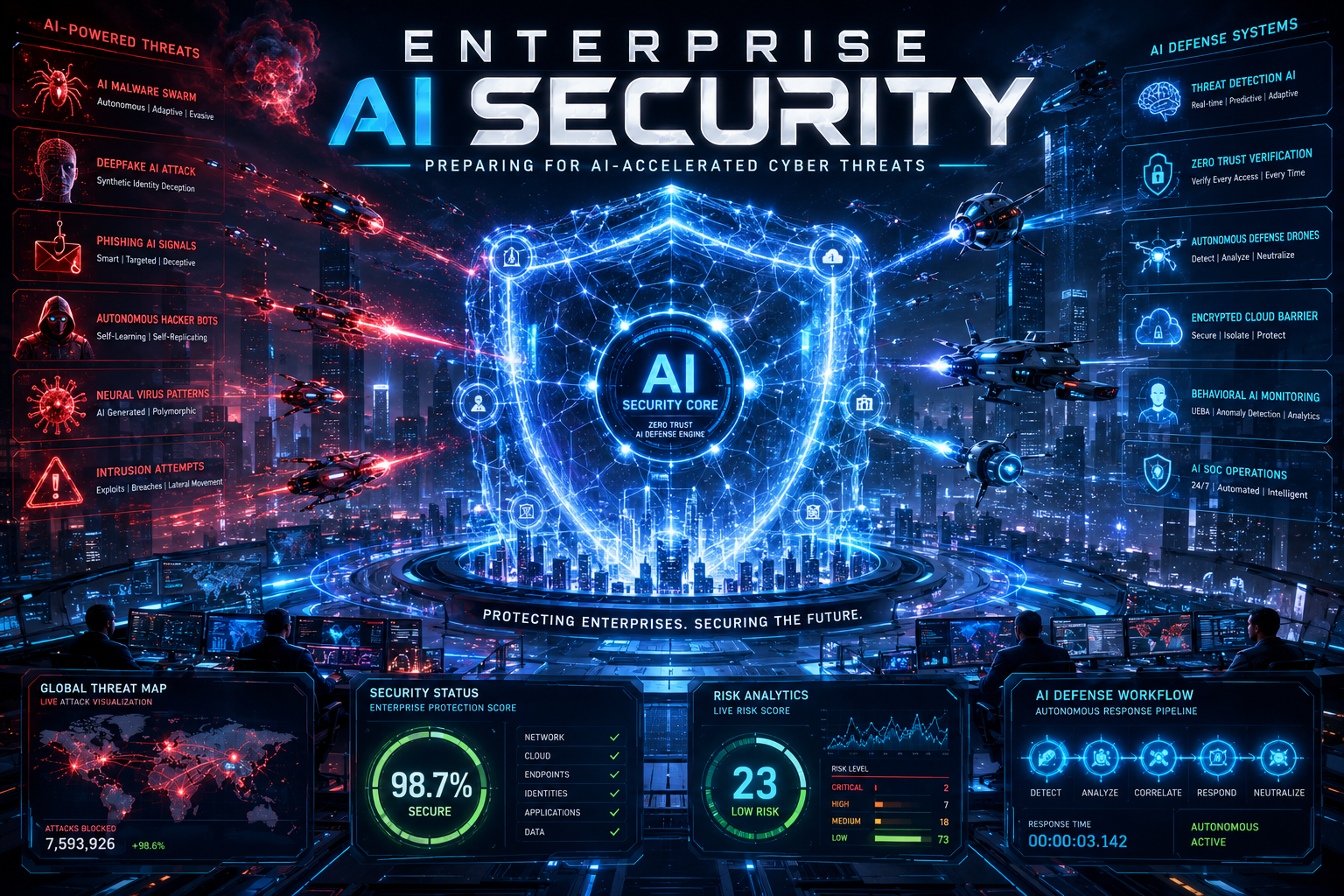
This article explains everything you need to know about enterprise AI security, AI-powered cyber threats, risk management, security frameworks, AI governance, data protection, workforce readiness, compliance, and how businesses can prepare for the future of AI-driven cybersecurity in a simple and easy-to-understand way.
What Is Enterprise AI Security?
Enterprise AI security refers to the strategies, technologies, policies, and systems businesses use to protect their AI infrastructure, data, applications, networks, and digital operations from cyber threats.
AI security is not only about protecting AI systems. It is also about protecting organizations from attackers who use AI-powered tools.
Enterprise AI security includes:
- AI risk management
- Data protection
- Threat detection
- Identity management
- Cloud security
- AI governance
- Security automation
- Compliance management
- Cyber resilience
The goal is to create a strong defense system capable of handling intelligent cyberattacks.
Why AI Security Is Important in 2026
AI technology is becoming deeply connected with business operations.
Organizations now depend on AI for:
- Customer service
- Financial analysis
- Healthcare systems
- Cloud operations
- Software development
- Supply chain management
- Security monitoring
- Marketing automation
If these systems are attacked, businesses may face:
- Data breaches
- Financial losses
- Operational downtime
- Reputation damage
- Legal penalties
- Customer trust issues
AI security has become essential for business survival.
Understanding AI-Accelerated Threats
AI-accelerated threats are cyberattacks enhanced or automated using artificial intelligence.
Traditional cyberattacks often require human effort and time. AI allows attackers to automate these processes at massive scale.
Examples include:
- AI-generated phishing emails
- Deepfake scams
- Automated malware creation
- AI-driven password attacks
- Intelligent social engineering
- Autonomous hacking tools
- AI-powered vulnerability scanning
These threats evolve quickly and adapt faster than traditional security systems.
How Cybercriminals Use AI
Hackers are increasingly using AI because it improves attack speed and efficiency.
AI helps cybercriminals:
Automate attacks
AI systems can launch attacks continuously without human involvement.
Analyze vulnerabilities
AI can scan networks and identify weak points quickly.
Create convincing scams
AI-generated emails and voice cloning improve phishing success rates.
Evade detection
AI malware can adapt its behavior to bypass security systems.
Generate malicious code
AI tools can help create ransomware and exploit scripts faster.
The Rise of AI-Powered Phishing Attacks
Phishing attacks are becoming more dangerous because of AI.
Traditional phishing emails often contain grammar mistakes and obvious warning signs.
AI-generated phishing campaigns are:
- More personalized
- Grammatically accurate
- Context-aware
- Emotionally convincing
- Harder to detect
Attackers can now generate thousands of highly realistic phishing messages within minutes.
Deepfake Technology and Enterprise Risks
Deepfake technology uses AI to create fake audio, video, or images.
Cybercriminals can impersonate:
- CEOs
- Managers
- Employees
- Customers
- Government officials
This creates major security risks for businesses.
Examples include:
- Fake voice authorization
- Fraudulent financial requests
- Fake video meetings
- Social engineering scams
Deepfakes are becoming a serious enterprise threat.
AI-Generated Malware
AI is also changing malware development.
AI-generated malware can:
- Adapt to environments
- Change behavior dynamically
- Avoid antivirus detection
- Learn from security responses
- Spread automatically
This makes traditional cybersecurity defenses less effective.
Why Traditional Security Programs Are Struggling
Many existing security programs were designed for older cyber threats.
Traditional systems often rely on:
- Static rules
- Signature-based detection
- Manual analysis
- Reactive responses
AI-powered attacks move too fast for these approaches.
Organizations now need adaptive and intelligent security systems.
Building an AI-Ready Security Program
Businesses must redesign cybersecurity strategies for the AI era.
An AI-ready security program should focus on:
- Prevention
- Detection
- Automation
- Response speed
- Risk management
- Workforce awareness
- Continuous monitoring
Security must become proactive instead of reactive.
Core Components of Enterprise AI Security
Several important elements are necessary for strong AI security.
AI Governance
AI governance creates rules and policies for responsible AI usage.
It helps organizations:
- Control AI systems
- Define responsibilities
- Reduce risks
- Ensure compliance
- Maintain transparency
Strong governance improves security and accountability.
Identity and Access Management
Access control is critical in AI environments.
Organizations should implement:
- Multi-factor authentication
- Role-based access
- Zero trust security
- Privileged account monitoring
This reduces unauthorized access risks.
Data Protection and Privacy
AI systems rely heavily on data.
Sensitive business information must be protected through:
- Encryption
- Data masking
- Secure storage
- Access restrictions
- Backup systems
Data security is one of the most important parts of enterprise AI security.
AI Threat Detection Systems
Modern businesses need intelligent threat detection.
AI-powered security tools can:
- Analyze behavior patterns
- Detect anomalies
- Identify suspicious activity
- Monitor networks in real time
- Predict potential threats
These systems improve detection speed.
Security Automation
Automation is becoming essential because cyberattacks happen rapidly.
Security automation can:
- Respond to incidents faster
- Reduce manual workload
- Improve consistency
- Handle repetitive tasks
- Isolate threats automatically
This strengthens enterprise defenses.
Zero Trust Security Architecture
Zero trust is one of the most important cybersecurity models today.
The idea is simple:
Never trust automatically. Always verify.
Zero trust systems continuously validate:
- User identities
- Device security
- Application behavior
- Network activity
This reduces attack surfaces significantly.
Cloud Security in the AI Era
Many AI systems operate in cloud environments.
Cloud security is critical because businesses store:
- Customer data
- AI models
- Business applications
- Analytics systems
- Operational workflows
Organizations should secure cloud environments through:
- Strong authentication
- Secure APIs
- Continuous monitoring
- Encryption
- Compliance management
AI Supply Chain Security
AI systems depend on third-party tools, APIs, datasets, and software libraries.
Attackers may target these supply chains.
Businesses must monitor:
- External vendors
- Open-source dependencies
- AI plugins
- Cloud providers
- Software integrations
Supply chain security reduces hidden vulnerabilities.
Security Risks in Generative AI
Generative AI tools create unique security challenges.
Potential risks include:
- Data leakage
- Prompt injection attacks
- Sensitive information exposure
- AI hallucinations
- Model manipulation
Organizations must define safe AI usage policies.
AI Governance Policies for Enterprises
Clear AI policies are essential.
Organizations should define rules for:
- Employee AI usage
- Data handling
- AI development
- Security testing
- Compliance requirements
- Ethical AI practices
Governance reduces confusion and improves accountability.
Employee Awareness and Security Training
Humans remain one of the biggest cybersecurity risks.
Employees must learn how to recognize:
- AI phishing scams
- Deepfake attacks
- Suspicious AI-generated messages
- Social engineering attempts
Regular training improves enterprise security posture.
Incident Response for AI Threats
Organizations need strong incident response plans.
AI-focused response plans should include:
Threat identification
Detect suspicious activity quickly.
Containment procedures
Prevent attacks from spreading.
Investigation processes
Analyze attack origins and impact.
Recovery strategies
Restore systems safely.
Post-incident analysis
Improve future security defenses.
AI Security Monitoring and Analytics
Continuous monitoring is critical in modern cybersecurity.
Security analytics systems help businesses:
- Track threats
- Detect unusual behavior
- Monitor AI systems
- Analyze attack patterns
- Improve visibility
Real-time monitoring improves response speed.
Compliance and Regulatory Challenges
Governments worldwide are introducing AI regulations.
Businesses may need to comply with:
- Data protection laws
- AI transparency requirements
- Industry cybersecurity standards
- Privacy regulations
Failure to comply can result in penalties and legal risks.
Industries Most Affected by AI Threats
Some industries face especially high risks.
Financial Services
Banks and fintech companies face fraud and data theft risks.
Healthcare
Hospitals manage sensitive patient information.
Government Organizations
Government systems are major targets for cyberattacks.
E-Commerce Platforms
Online businesses handle customer payment data.
SaaS and Technology Companies
Technology firms often store valuable digital assets.
Manufacturing and Supply Chains
Industrial systems increasingly rely on connected AI technologies.
Role of AI in Cybersecurity Defense
Interestingly, AI is also helping defenders.
AI security systems can:
- Detect attacks faster
- Analyze large datasets
- Predict vulnerabilities
- Automate responses
- Improve monitoring
The future of cybersecurity will involve AI versus AI competition.
AI-Powered Security Operations Centers
Modern Security Operations Centers (SOCs) are evolving with AI.
AI-powered SOCs can:
- Monitor threats continuously
- Prioritize incidents
- Reduce alert fatigue
- Automate investigations
- Improve analyst efficiency
This helps enterprises handle large-scale threats.
Cybersecurity Workforce Challenges
There is a global shortage of cybersecurity professionals.
AI helps organizations:
- Automate repetitive tasks
- Improve analyst productivity
- Reduce manual workloads
- Support smaller security teams
However, skilled human experts are still essential.
Ethical Concerns in AI Security
AI security raises important ethical questions.
Concerns include:
- Privacy protection
- Surveillance risks
- Algorithm bias
- Automated decision-making
- Data ownership
Businesses must use AI responsibly.
AI Security Best Practices for Enterprises
Organizations should follow strong security practices.
Conduct regular risk assessments
Identify vulnerabilities early.
Implement zero trust architecture
Verify all users and systems continuously.
Monitor AI systems constantly
Detect abnormal behavior quickly.
Train employees regularly
Human awareness is critical.
Protect sensitive data
Use encryption and access controls.
Test incident response plans
Prepare for emergencies before attacks happen.
Future of Enterprise AI Security
The future of cybersecurity will become increasingly intelligent.
Expected developments include:
- Autonomous security systems
- Self-healing networks
- AI-driven threat hunting
- Predictive cybersecurity
- Advanced behavioral analytics
- Real-time adaptive defenses
AI security will continue evolving rapidly.
AI Security Trends in 2026
Several major trends are shaping enterprise security.
AI vs AI cybersecurity
Defensive AI fighting offensive AI systems.
Autonomous threat detection
AI systems identifying attacks independently.
Intelligent risk scoring
AI predicting business risks automatically.
Security automation growth
Reduced dependency on manual operations.
Regulatory expansion
Governments increasing AI compliance requirements.
Challenges Businesses Face During AI Adoption
AI adoption is not simple.
Organizations may struggle with:
- Budget limitations
- Security complexity
- Skill shortages
- Legacy infrastructure
- Governance confusion
- Compliance requirements
Proper planning is essential.
How Small Businesses Can Improve AI Security
Small businesses are also vulnerable to AI threats.
Important steps include:
- Using strong passwords
- Enabling multi-factor authentication
- Training employees
- Updating software regularly
- Backing up data
- Using trusted AI tools
Even basic protections can significantly reduce risks.
Importance of Cyber Resilience
Cyber resilience means continuing operations even during attacks.
Businesses should prepare for:
- System failures
- Data breaches
- Service disruptions
- AI-based attacks
Resilient organizations recover faster and reduce damage.
Human and AI Collaboration in Cybersecurity
AI is not replacing cybersecurity professionals completely.
Instead, AI helps humans:
- Process information faster
- Detect threats earlier
- Automate repetitive work
- Improve decision-making
Human expertise remains essential for strategy and oversight.
Why Enterprise AI Security Matters More Than Ever
The digital world is changing rapidly.
AI is creating:
- Faster innovation
- Greater automation
- More connected systems
At the same time, it is creating:
- Smarter cyberattacks
- Larger attack surfaces
- More advanced threats
Organizations that fail to prepare may face serious security risks.
Enterprise AI security is no longer optional. It is becoming a business necessity.
Conclusion
Enterprise AI security is becoming one of the most important challenges for businesses in 2026 and beyond. As artificial intelligence continues transforming industries, cybercriminals are also using AI to launch faster, smarter, and more dangerous attacks. Traditional cybersecurity methods are no longer enough to protect modern organizations from AI-accelerated threats.
Businesses must build intelligent security programs focused on automation, threat detection, zero trust architecture, governance, cloud security, employee awareness, and continuous monitoring. Organizations should also prepare for future risks involving deepfakes, AI-generated malware, autonomous attacks, and generative AI vulnerabilities.
At the same time, AI is also helping defenders improve cybersecurity through automated monitoring, predictive analytics, and intelligent threat response systems. The future of cybersecurity will involve continuous competition between offensive and defensive AI technologies.
Companies that invest early in enterprise AI security will be better prepared to protect their operations, customers, data, and reputation in the rapidly evolving digital landscape.
Frequently Asked Questions (FAQs)
1. What is enterprise AI security?
Enterprise AI security refers to the protection of AI systems, business data, applications, and digital infrastructure from AI-powered cyber threats.
2. What are AI-accelerated threats?
AI-accelerated threats are cyberattacks enhanced through artificial intelligence, automation, and machine learning technologies.
3. Why is AI security important?
AI security is important because businesses increasingly rely on AI systems that may become targets for advanced cyberattacks.
4. How do hackers use AI?
Hackers use AI for phishing, malware generation, social engineering, password attacks, and vulnerability scanning.
5. What is zero trust security?
Zero trust security is a cybersecurity model that continuously verifies users, devices, and systems before granting access.
6. What are deepfake cybersecurity risks?
Deepfakes can impersonate executives, employees, or customers to commit fraud and social engineering attacks.
7. How does AI help cybersecurity teams?
AI helps detect threats faster, automate monitoring, analyze behavior patterns, and improve incident response.
8. What industries face the highest AI security risks?
Industries including finance, healthcare, government, e-commerce, and technology face major AI security risks.
9. What are the biggest risks in generative AI?
Risks include data leakage, prompt injection attacks, hallucinations, and sensitive information exposure.
10. Can small businesses improve AI security?
Yes. Small businesses can improve security using strong passwords, employee training, MFA, backups, and trusted tools.
11. What is AI governance?
AI governance refers to policies and frameworks that ensure responsible, secure, and compliant AI usage.
12. Why is enterprise AI security critical in 2026?
It is critical because AI-powered cyber threats are becoming more advanced, automated, and difficult to stop using traditional cybersecurity methods.