Subtotal $0.00



Email : 37
Introduction
Artificial Intelligence is no longer a future concept. It is already changing the global economy, workplaces, industries, and daily life. Businesses across the world are using AI tools for automation, customer service, software development, marketing, analytics, cybersecurity, healthcare, finance, and many other operations. As AI adoption increases, people are asking an important question: Will AI improve human productivity or replace human jobs?
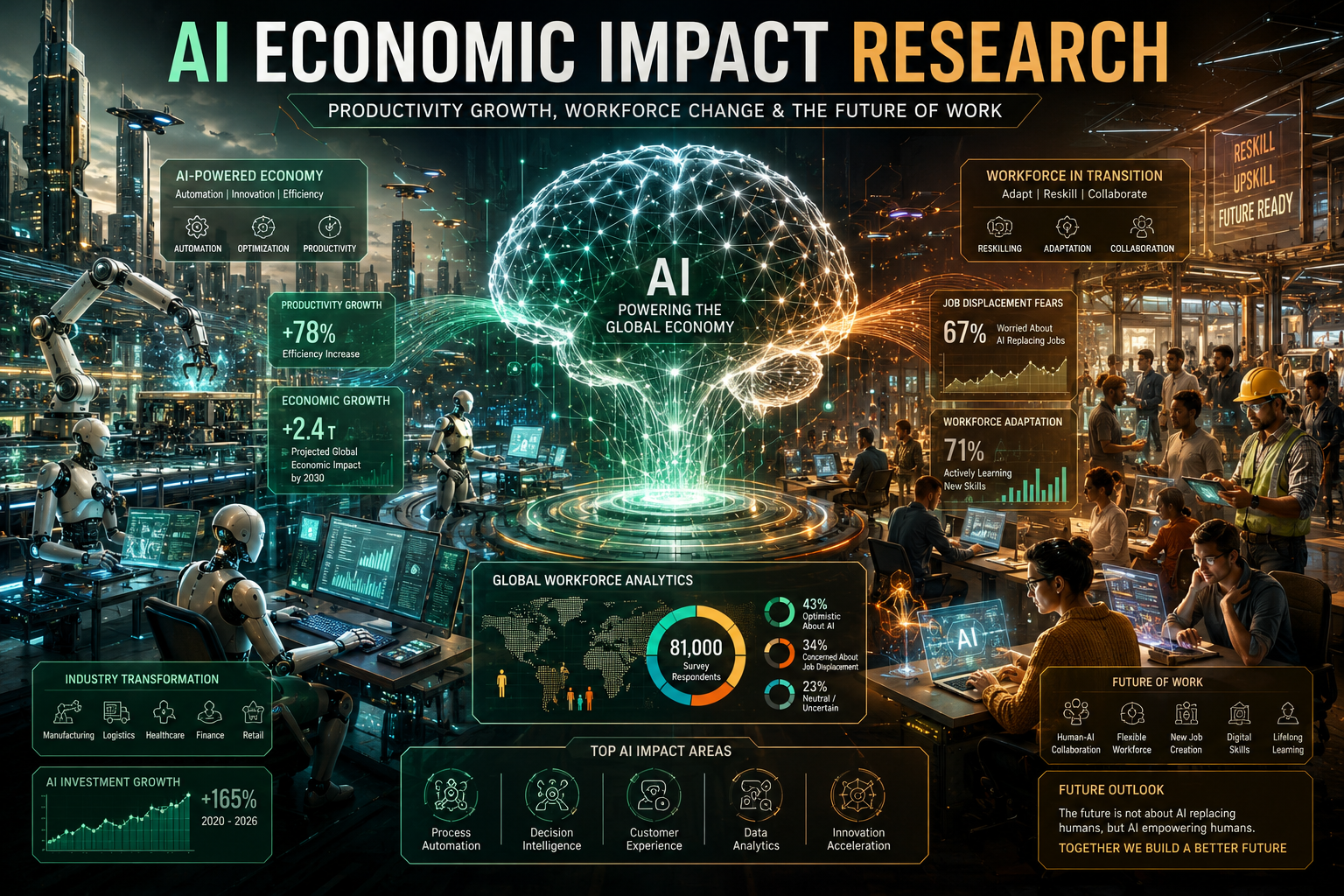
A recent economic impact research survey involving 81,000 users provides valuable insights into this debate. The findings show a complex reality. Many workers fear AI-induced job displacement, while at the same time businesses and professionals report major productivity improvements from AI-powered systems. This creates both excitement and uncertainty about the future of work.
Understanding these trends is important for employees, business owners, students, governments, startups, and enterprises because AI is rapidly reshaping labor markets and economic structures worldwide. In this article, you will learn everything about AI economic impact research, job displacement concerns, productivity growth, workforce transformation, automation, future job trends, enterprise AI adoption, risks, opportunities, and how society may adapt to the AI-powered economy in 2026 and beyond.
What Is AI Economic Impact Research?
AI economic impact research studies how artificial intelligence affects:
- Jobs
- Businesses
- Productivity
- Wages
- Industries
- Workforce behavior
- Economic growth
- Employment trends
Researchers analyze how AI changes labor markets and business performance.
The recent survey of 81,000 users provides one of the largest insight datasets regarding AI adoption and workforce concerns.
Why AI Economic Research Matters
AI is becoming deeply integrated into modern economies.
Organizations now use AI for:
- Workflow automation
- Customer support
- Data analytics
- Marketing
- Software development
- Security operations
- Content generation
- Financial forecasting
As AI capabilities expand, governments and businesses must understand how these technologies affect workers and industries.
Understanding AI-Induced Job Displacement Fears
One of the biggest concerns around AI is job displacement.
Many workers fear that AI systems may automate tasks previously handled by humans.
This concern is growing because AI tools can now:
- Write content
- Analyze data
- Generate code
- Automate workflows
- Handle customer service
- Create reports
- Process documents
People worry that increasing automation may reduce employment opportunities.
Why Workers Fear AI Replacement
Several factors contribute to workforce anxiety.
Rapid automation growth
AI systems are improving quickly.
Cost reduction pressure
Businesses often automate operations to reduce expenses.
Faster AI capabilities
AI now performs tasks once considered uniquely human.
Uncertain future job markets
Many employees are unsure which careers will remain stable.
Media narratives
Public discussions sometimes exaggerate AI replacement fears.
Survey Insights From 81,000 Users
The large-scale survey highlights two major realities happening simultaneously.
Rising productivity
Many users report that AI helps them complete tasks faster and more efficiently.
Growing concerns
At the same time, workers worry about long-term job security.
This creates a mixed emotional and economic environment.
How AI Improves Productivity
AI productivity improvements are one of the strongest arguments for AI adoption.
AI tools help users:
- Save time
- Reduce repetitive work
- Improve efficiency
- Analyze information faster
- Automate workflows
- Generate ideas quickly
- Increase operational speed
Businesses see measurable performance gains.
Productivity Benefits Across Industries
AI productivity improvements are visible in many sectors.
Software Development
Developers use AI for:
- Code generation
- Debugging
- Documentation
- Testing automation
This speeds up software delivery.
Marketing and Content Creation
AI helps marketers:
- Create content
- Analyze SEO data
- Manage campaigns
- Generate reports
- Personalize communication
This improves workflow efficiency.
Customer Support
AI chat systems reduce response times and automate support operations.
Businesses can handle more customer requests with smaller teams.
Healthcare
Healthcare professionals use AI for:
- Medical documentation
- Research analysis
- Scheduling
- Workflow optimization
This improves operational efficiency.
Finance and Analytics
Financial teams use AI for:
- Risk analysis
- Fraud detection
- Forecasting
- Reporting automation
This speeds up decision-making.
The Relationship Between Automation and Jobs
Automation has existed for decades.
Past technologies also changed industries, including:
- Computers
- Industrial machines
- Internet platforms
- Robotics
AI is another major technological shift, but it affects more knowledge-based work than previous automation waves.
Jobs Most Vulnerable to AI Automation
Some roles face higher automation risk.
Tasks most vulnerable include:
- Repetitive data entry
- Basic customer support
- Simple reporting
- Administrative processing
- Routine analysis
- Basic content generation
AI performs repetitive tasks very efficiently.
Jobs Likely to Grow in the AI Era
At the same time, AI also creates new opportunities.
Growing career areas include:
- AI engineering
- Cybersecurity
- Data science
- AI governance
- Human-AI collaboration
- Automation management
- Prompt engineering
- AI ethics
Technology shifts often create new industries.
AI as a Productivity Multiplier
Many experts believe AI will function more as a productivity tool rather than a complete human replacement.
AI helps workers:
- Complete tasks faster
- Improve creativity
- Reduce repetitive workloads
- Analyze information better
- Focus on strategic work
This may increase overall workforce efficiency.
Human Skills That AI Cannot Easily Replace
Certain human abilities remain difficult for AI systems.
These include:
- Emotional intelligence
- Leadership
- Creativity
- Strategic thinking
- Human relationships
- Ethical judgment
- Negotiation
- Cultural understanding
Human-centered skills will remain highly valuable.
Economic Benefits of AI Adoption
AI may provide large economic benefits worldwide.
Potential advantages include:
Higher productivity
Businesses produce more with fewer resources.
Faster innovation
AI accelerates research and development.
Improved operational efficiency
Automation reduces delays and errors.
Economic growth
AI may contribute trillions to global GDP.
Better scalability
Businesses can grow operations faster.
Risks of AI-Driven Economic Transformation
Despite the opportunities, risks still exist.
Workforce disruption
Some jobs may disappear or change rapidly.
Income inequality
Technology benefits may concentrate among certain groups.
Skill gaps
Workers may struggle to adapt quickly.
Economic uncertainty
Industries may experience transition instability.
Regional impacts
Certain regions may face stronger disruption.
AI and the Future of White-Collar Work
Unlike previous automation waves, AI impacts white-collar professions heavily.
AI now assists with:
- Writing
- Coding
- Legal research
- Financial analysis
- Design workflows
- Data interpretation
This changes how professional work operates.
Enterprise AI Adoption and Workforce Changes
Large companies are rapidly integrating AI into operations.
Businesses adopt AI to:
- Reduce costs
- Improve efficiency
- Scale operations
- Increase competitiveness
- Automate repetitive workflows
This changes workforce structures.
How Businesses Can Prepare Employees for AI
Organizations should support workers during AI transitions.
Important strategies include:
Employee reskilling
Teach workers AI-related skills.
AI collaboration training
Help teams work effectively with AI systems.
Transparent communication
Reduce fear through honest discussions.
Workforce planning
Identify future skill requirements.
Ethical AI policies
Create responsible automation strategies.
AI and Workplace Productivity Culture
AI may change workplace culture significantly.
Employees may spend less time on:
- Repetitive administration
- Data processing
- Manual reporting
This could allow more focus on:
- Creativity
- Innovation
- Strategic thinking
- Problem-solving
Psychological Impact of AI Job Fears
AI discussions often create emotional stress.
Common concerns include:
- Career uncertainty
- Skill relevance fears
- Economic instability
- Competition anxiety
Businesses and governments must address these concerns carefully.
Role of Governments in AI Workforce Transition
Governments may need to support workforce adaptation.
Potential actions include:
- Education reform
- Reskilling programs
- AI regulations
- Social support systems
- Workforce development initiatives
Public policy will play an important role.
Education Systems and AI Readiness
Schools and universities must adapt to AI-driven economies.
Important focus areas include:
- Digital literacy
- AI understanding
- Critical thinking
- Creativity
- Human collaboration skills
Education systems may shift significantly in the coming years.
AI Productivity Gains vs Employment Risks
The debate around AI often focuses on balance.
Some experts believe:
- Productivity gains will create new industries and jobs.
Others worry:
- Automation may outpace workforce adaptation.
The final outcome may depend on how societies manage the transition.
Small Businesses and AI Productivity
AI tools are not only for large enterprises.
Small businesses can use AI for:
- Marketing automation
- Customer service
- Data analytics
- Content creation
- Workflow management
This helps smaller companies compete more effectively.
Startups and the AI Economy
AI is creating major startup opportunities.
New AI-driven businesses focus on:
- Automation platforms
- AI analytics
- Workflow orchestration
- AI cybersecurity
- Generative AI applications
The AI economy is expanding rapidly.
Human and AI Collaboration Models
The future workplace may involve collaborative intelligence.
AI handles:
- Repetitive processing
- Large-scale analysis
- Automation tasks
Humans focus on:
- Creativity
- Leadership
- Relationships
- Innovation
- Strategic decisions
This partnership model is becoming increasingly common.
AI and Global Economic Competition
Countries are competing aggressively in AI development.
AI leadership may influence:
- Economic power
- Innovation leadership
- Workforce competitiveness
- National productivity
Governments worldwide are investing heavily in AI infrastructure.
Ethical Questions Around AI Employment
AI workforce transformation raises ethical concerns.
Important discussions include:
- Fair automation practices
- Worker protection
- Economic equality
- AI transparency
- Responsible adoption
Society must balance innovation with social stability.
Industries Most Likely to Transform
Several industries may experience major changes.
Technology
AI-native software development is growing rapidly.
Healthcare
Automation and analytics are improving medical operations.
Finance
AI improves fraud detection, forecasting, and analytics.
Retail and E-Commerce
AI personalizes shopping experiences and automates logistics.
Media and Marketing
Content creation and analytics are increasingly AI-assisted.
Manufacturing
Smart factories use automation and AI robotics.
Future Skills for the AI Economy
Workers should prepare for evolving job markets.
Important future skills include:
- AI literacy
- Data analysis
- Creativity
- Emotional intelligence
- Strategic thinking
- Cybersecurity awareness
- Human-AI collaboration
Adaptability will become one of the most valuable career traits.
AI Productivity and Economic Growth
Many economists believe AI could significantly increase global productivity.
Potential outcomes include:
- Faster innovation
- Lower business costs
- Improved efficiency
- Greater scalability
- Expanded digital economies
This may reshape global economic systems.
Challenges Businesses Face During AI Adoption
AI implementation is not always simple.
Common challenges include:
- Employee resistance
- Security risks
- Integration complexity
- Compliance concerns
- Infrastructure costs
- Skill shortages
Careful planning is necessary.
AI and Workplace Inequality Concerns
Some experts worry AI could widen inequality.
Highly skilled workers may benefit more from AI adoption.
Meanwhile, workers performing repetitive tasks may face greater disruption risks.
Governments and businesses may need policies that support inclusive growth.
The Future of Work in 2030 and Beyond
The future workplace will likely look very different.
Expected trends include:
- AI-assisted workflows
- Hybrid human-AI teams
- Intelligent automation
- Flexible digital work environments
- Personalized productivity systems
AI may become deeply integrated into daily professional life.
Why AI Economic Impact Research Matters in 2026
The survey of 81,000 users highlights an important reality:
AI creates both opportunity and uncertainty.
The combination of:
- Productivity growth
- Workforce transformation
- Automation fears
- Economic innovation
is shaping the future global economy.
Organizations and governments that understand these trends early may adapt more successfully.
Conclusion
AI economic impact research is becoming increasingly important as artificial intelligence transforms industries, businesses, and labor markets worldwide. The survey of 81,000 users reveals a balanced but complex picture. On one side, AI is dramatically improving productivity, helping businesses automate workflows, accelerate operations, and increase efficiency. On the other side, many workers remain concerned about job displacement, economic uncertainty, and the future relevance of human labor.
The reality is likely somewhere in the middle. AI will automate many repetitive tasks, but it will also create new industries, career paths, and opportunities for innovation. The future of work will probably involve deeper collaboration between humans and intelligent AI systems rather than complete replacement.
Businesses, governments, educational institutions, and workers must prepare for this transition carefully through reskilling, workforce planning, ethical AI adoption, and long-term economic strategies. Organizations that adapt successfully to the AI economy may gain major advantages in productivity, innovation, and competitiveness in the years ahead.
Frequently Asked Questions (FAQs)
1. What is AI economic impact research?
AI economic impact research studies how artificial intelligence affects jobs, productivity, industries, businesses, and economic growth.
2. Why are people worried about AI job displacement?
Many workers fear automation because AI can now perform repetitive and knowledge-based tasks previously done by humans.
3. How does AI improve productivity?
AI automates workflows, analyzes information faster, reduces repetitive work, and helps businesses operate more efficiently.
4. Which jobs are most vulnerable to AI automation?
Repetitive administrative, data entry, basic support, and routine analysis jobs face higher automation risks.
5. Will AI replace all human jobs?
No. Human creativity, leadership, emotional intelligence, and strategic thinking remain highly valuable.
6. What industries benefit most from AI productivity?
Industries including technology, healthcare, finance, marketing, cybersecurity, and manufacturing benefit greatly.
7. What skills are important in the AI economy?
Important skills include AI literacy, creativity, strategic thinking, cybersecurity awareness, and human-AI collaboration.
8. How can businesses prepare workers for AI?
Businesses can invest in reskilling, AI training, workforce planning, and transparent communication.
9. What role do governments play in AI workforce transition?
Governments may support education reform, reskilling programs, AI regulation, and workforce development policies.
10. Can small businesses benefit from AI?
Yes. Small businesses can use AI for automation, marketing, analytics, customer service, and productivity improvements.
11. What are the risks of AI economic transformation?
Risks include workforce disruption, inequality, skill gaps, and economic instability during transitions.
12. Why is AI economic impact research important in 2026?
It helps businesses, governments, and workers understand how AI is reshaping productivity, employment, and the future economy.