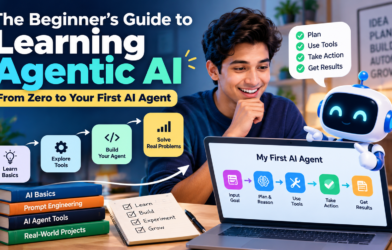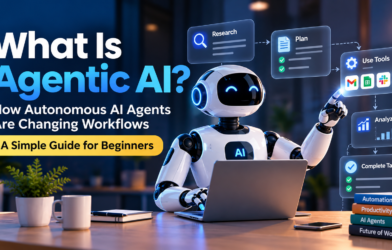


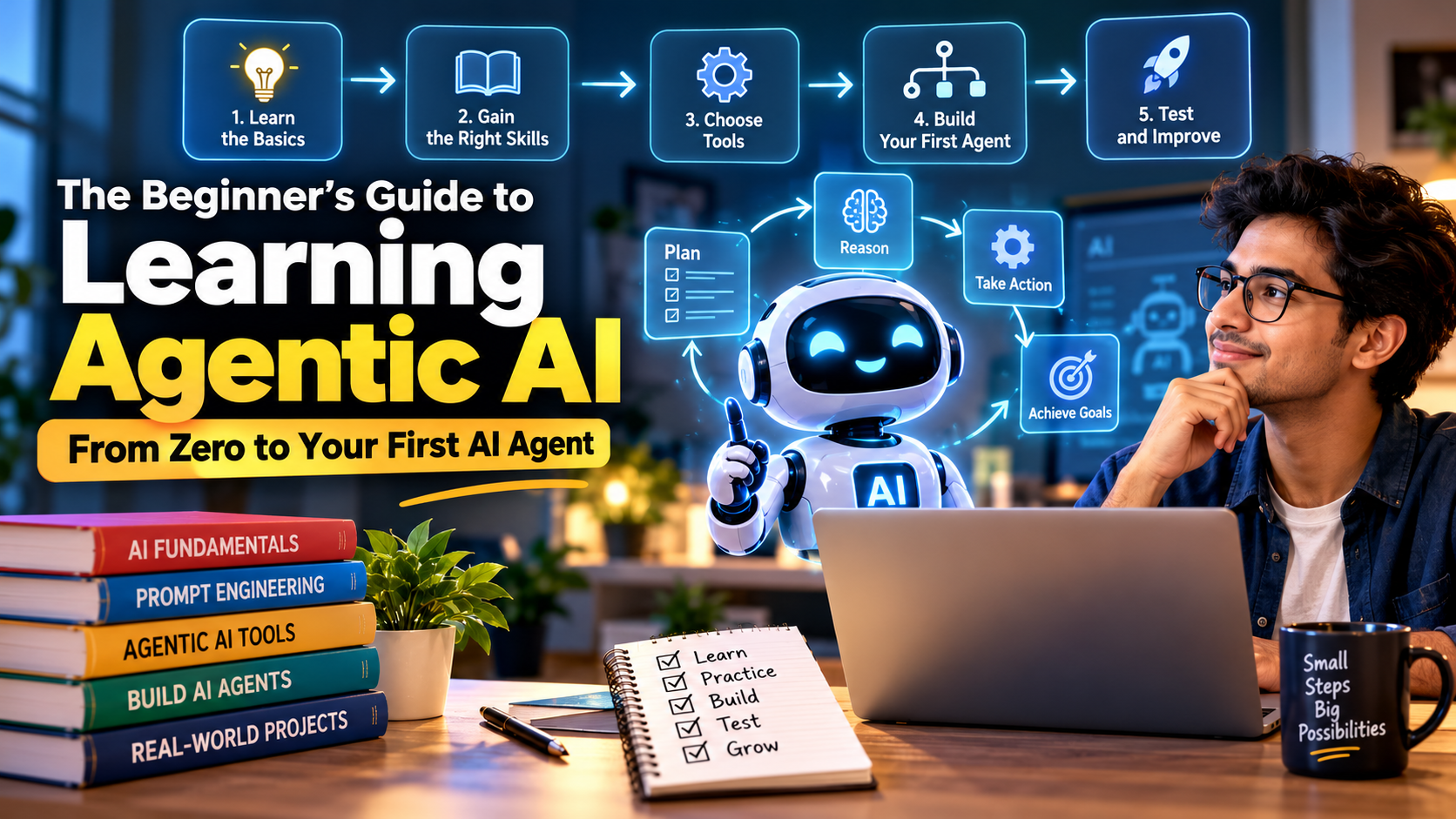
Artificial intelligence is changing how people work, learn, and run businesses. Today, AI can do much more than answer questions or write content. With agentic AI, you can build systems that understand a goal, plan the steps, use tools, and complete tasks with less human involvement. For example, an AI agent can research a topic, organize information, prepare a report, or help manage customer enquiries. The good news is that you do not need to be an expert programmer to start learning this technology. You can begin with basic concepts, free learning resources, and simple projects. This beginner’s guide to learning agentic AI will explain everything in easy language, from understanding AI agents to building your first working project. You will discover useful tools, practical examples, common mistakes, and a step-by-step learning plan. By the end, you will know how to start learning agentic AI and apply it to real-world problems.
What Is Agentic AI?
Agentic AI is a type of artificial intelligence that can work toward a goal by deciding what steps to take, using available tools, and adjusting its actions based on results.
Traditional AI systems often respond to a direct instruction. For example, you ask a chatbot to write an email, and it produces the email. An AI agent can go further by helping gather the information needed for that email, preparing a draft, checking details, and presenting the result for your approval.
The exact abilities depend on how the agent is designed. Some agents can only perform a few predefined actions, while others can choose between different tools and steps.
To understand agentic AI more clearly, consider a simple example.
Imagine you want to research five competitors for your business. A basic chatbot can suggest how to research competitors. An AI agent connected to suitable research tools may gather public information, organize findings, compare services, and prepare a summary.
This makes agentic AI useful for people who want to automate repetitive work, improve productivity, and create smarter applications.
What Makes AI Agentic?
An AI system becomes more agent-like when it can do more than generate a single response. It may have the ability to:
- Understand goals: Identify the result a user wants.
- Plan tasks: Break a larger goal into smaller steps.
- Use tools: Work with APIs, databases, search systems, or other software.
- Remember context: Use relevant information from earlier steps in a task.
- Evaluate results: Check whether an action produced the expected outcome.
- Adjust its approach: Try a different step when the first approach fails.
Not every AI agent has all these capabilities. The design depends on the task, the available tools, and the level of autonomy allowed.
What Is an AI Agent?
An AI agent is a software system that uses artificial intelligence to perform tasks toward a specific goal. It receives information, decides what to do, and may take actions through connected tools.
An AI agent can be simple or advanced. A basic agent might classify incoming customer emails. A more advanced agent might review an email, identify the customer’s request, search a knowledge base, draft a response, and ask a human to approve it.
Here are some common examples of AI agents and their uses.
- Research agent: Collects and organizes information from approved sources.
- Customer support agent: Answers questions using company information.
- Marketing agent: Helps research keywords, outline campaigns, and prepare content.
- Sales agent: Organizes leads and drafts follow-up messages.
- Data analysis agent: Examines data and produces summaries.
- Personal productivity agent: Helps organize tasks, notes, and schedules.
The most important point is that an AI agent should be designed around a clear task. Giving it too many responsibilities at the beginning can make it harder to test and control.
Agentic AI vs. Traditional AI: What Is the Difference?
Understanding this difference will help you learn agentic AI faster.
Traditional AI can classify information, make predictions, or generate content in response to an instruction. Generative AI tools, for example, can create text, images, and code.
Agentic AI focuses on working toward a goal through multiple steps. It may use a generative AI model as its reasoning or language component, but it also needs a process for deciding what to do next and interacting with tools.
| Feature | Traditional AI or chatbot | Agentic AI system |
|---|---|---|
| Main purpose | Answer, predict, or generate | Work toward a goal |
| Typical process | Input and response | Input, planning, actions, and evaluation |
| Tool usage | May be limited or absent | Can use connected tools |
| Multi-step tasks | Often require repeated instructions | Can coordinate multiple steps |
| Human involvement | Depends on the application | Depends on the permitted autonomy |
| Example | Drafting a product description | Researching products and preparing a comparison report |
These categories can overlap. A chatbot can also have tools, and an AI agent can use the same language model as a chatbot. The difference is often in the workflow and the ability to take goal-directed actions.
Why Should Beginners Learn Agentic AI?
Learning agentic AI can help you understand one of the important directions in modern AI development. It is useful for students, business owners, developers, marketers, freelancers, and professionals who want to automate practical tasks.
You do not need to begin by creating a complicated system. Learning how an agent works and building one small project can give you useful experience.
1. Automate Repetitive Tasks
Many people spend hours collecting information, sorting emails, preparing reports, and updating records. An AI agent can help automate parts of these workflows.
For example, an agent might categorize customer enquiries and prepare suggested replies. A human can then review the replies before they are sent.
2. Improve Work Productivity
AI agents can help organize multi-step tasks that would otherwise require switching between several applications.
A research agent might collect information, organize it into a table, and prepare a summary. This can reduce manual work, although the output still needs to be checked for accuracy.
3. Build New Technical Skills
Learning agentic AI introduces you to useful skills such as prompt design, API integration, workflow automation, data handling, testing, and AI safety.
These skills can support future projects in software development, digital marketing, customer service, and business operations.
4. Explore Business Opportunities
Businesses need practical ways to reduce repetitive work and improve customer experiences. People who understand AI agents can explore solutions for lead management, customer support, reporting, and internal operations.
However, learning agentic AI does not guarantee a job, clients, or business income. Results depend on your skills, the quality of your solutions, and whether you solve a real problem.
5. Start Without Advanced Coding
Some agent-building platforms provide visual workflow editors and ready-made integrations. These tools let beginners connect AI models with other applications without writing every line of code.
You can start with no-code tools and learn Python later when you need more control.
What Skills Do You Need to Learn Agentic AI?
You do not need to master every AI technology before building your first agent. The best approach is to learn the basics and apply each new concept to a small project.
Here are the main skills worth learning as a beginner.
1. Basic Understanding of AI and LLMs
Start by understanding artificial intelligence, machine learning, generative AI, and large language models (LLMs).
An LLM is an AI model trained to process and generate language. It can help an agent understand instructions, summarize information, generate responses, and select actions when the system is designed to support them.
You should understand what LLMs can do, where they make mistakes, and why their answers sometimes contain incorrect information.
2. Prompt Engineering
Prompt engineering means writing clear instructions that guide an AI model toward a useful result.
For example, instead of writing, “Research AI tools,” you could write, “Compare five AI tools for small businesses. Include their main features, intended users, limitations, and official websites.”
A good prompt explains the task, provides relevant context, and describes the expected output.
3. Basic Programming
Python is a useful language for AI agent development because it has many libraries for working with language models, APIs, files, and data.
Beginners should gradually learn variables, functions, lists, dictionaries, conditions, loops, and error handling.
You do not need to learn advanced programming before starting. Basic Python becomes more valuable as your projects grow.
4. APIs and Integrations
An API allows different software applications to communicate with each other.
For example, an agent might use a search API to retrieve information or a spreadsheet API to read approved business data.
Learn what an API request is, how authentication works, and how to protect API keys. Never place private API keys in public code or share them in prompts.
5. Workflow Design
A workflow is a sequence of steps that moves a task from beginning to end.
For example, a content research workflow could receive a topic, collect relevant information, organize the findings, create an outline, and prepare a report for review.
Learning to design these steps is just as important as learning the AI tools themselves.
How to Start Learning Agentic AI From Zero
The easiest way to learn agentic AI is to follow a structured process. Do not try to learn every framework or build a complex multi-agent system on your first day.
Use the following steps to build your knowledge gradually.
Step 1: Understand the Fundamentals of AI
Start with basic AI concepts before moving into advanced agent development.
Learn the difference between artificial intelligence, machine learning, generative AI, large language models, and AI agents. Understand how an AI model receives input and produces output.
You should also learn about hallucinations, bias, privacy, and the limitations of AI-generated information.
Your first task: Ask an AI assistant to explain how a chatbot differs from an AI agent. Then write three examples of tasks where an agent could be useful.
Step 2: Learn How AI Models Work With Instructions
Practice writing prompts that produce clear and structured answers.
Start with everyday tasks such as summarizing documents, extracting information, classifying messages, and preparing reports.
Try giving the same task different instructions and compare the results. This helps you understand how context and output requirements affect an AI model’s response.
Your first task: Give an AI model five sample customer enquiries and ask it to classify each one as a sales enquiry, support request, complaint, or general question.
Step 3: Choose Your First AI Agent Tool
You do not need to use every available platform. Choose one tool based on your current skills and the kind of project you want to build.
The following tools are useful starting points.

n8n
A visual workflow automation platform that can connect applications, APIs, and AI models. It is useful for building automation workflows and AI-powered processes.
Best for: Beginners interested in workflow automation.

LangChain and LangGraph
Developer tools for building LLM applications and agent workflows. LangGraph is particularly useful when you need more control over workflow state, branching, and repeated steps.
Best for: Learners who want to develop more controlled AI applications.

CrewAI
A framework for creating AI workflows that can involve multiple agents with different roles and responsibilities.
Best for: Learners exploring coordinated multi-agent tasks.

OpenAI API
An API platform for integrating language models and supported tools into applications. It is useful when you want to write code that controls an agent’s behavior.
Best for: Learners interested in API-based agent development.
Features, pricing, access limits, and integration options can change. Check each platform’s official documentation before choosing a tool.
Step 4: Build a Simple AI Workflow
Before creating an advanced autonomous agent, build a basic workflow with a few steps.
For example, you can create a system that takes a topic, asks an AI model to summarize it, and produces a structured report.
Start with a fixed sequence of actions. Once it works reliably, add features such as checking the output, choosing between different actions, or requesting missing information.
This approach makes it easier to identify errors and understand how each component works.
Step 5: Connect the Agent to a Tool
An agent becomes more useful when it can access information or perform permitted actions through tools.
You might connect an agent to a document, a spreadsheet, a search service, or a test database.
Start with read-only access whenever possible. Add permission to change records or send messages only after you have tested the workflow carefully.
Step 6: Test the Agent With Realistic Examples
Do not assume that an agent works correctly just because it succeeds once.
Test it with normal requests, unclear instructions, missing information, unexpected data, and tasks that it should refuse or send to a human.
Record the errors you find and improve the instructions or workflow.
Step 7: Improve Your Project Gradually
After the basic version works, add useful features such as structured outputs, error handling, logging, and a human approval step.
Only introduce more advanced features when they solve a real problem.
Your first goal is not to build the smartest agent. It is to build a small system that works reliably and safely.
How to Build Your First AI Agent: A Practical Beginner Project
One of the best ways to learn agentic AI is to create a project that solves a problem you understand.
For this guide, let’s build a simple AI Research Assistant. Its job is to take a topic and prepare a useful research brief.

What Will This AI Agent Do?
The research assistant will take a topic, identify what information is needed, organize supplied research material, and prepare a summary.
For a first version, you can use documents or sample text that you provide. This avoids the extra complexity of web search integrations and reduces the risk of relying on unverified sources.
The project will include the following steps.
- Receive the topic. The user enters a subject such as AI automation for small businesses.
- Identify the research questions. The AI creates a list of questions that the brief should answer.
- Review the available information. The system examines the documents or research notes supplied by the user.
- Prepare a summary. The AI organizes relevant findings into clear sections.
- Check the output. The system identifies missing information, unsupported claims, or unanswered questions.
- Produce the final report. The agent presents its findings and highlights anything that needs further verification.
This is a controlled starting project. It becomes more agentic when you add tool selection, conditional steps, and the ability to revise its approach based on the results.
Tools Required for the Project
You can create this project with a visual automation platform or with Python and an AI model API.
For a no-code version, use a workflow tool such as n8n, connect it to an AI model, and provide a sample document as the input. For a coding version, use Python to manage the task steps and call an available model API.
You may need an API key, and API usage can involve costs. Review the provider’s current pricing before running the project.
A Simple Workflow Design
The following workflow shows the basic structure of your first project.
1. Enter research topic
Receive the user’s goal
2. Plan research questions
Break the topic into smaller tasks
3. Review supplied sources
Extract relevant facts and evidence
4. Check the research
Identify gaps and unsupported claims
5. Generate the research brief
Return an organized report for review
Example Instructions for Your First Agent
Use the following prompt as a starting point when configuring your research assistant.
You are a beginner-friendly AI research assistant.
Your goal is to prepare a clear and useful research brief about the topic provided by the user.
Follow these steps:
- Understand the topic and identify the main questions that need answers.
- Review only the research notes and documents provided to you.
- Extract relevant information and organize it into clear sections.
- Separate supported facts from assumptions and opinions.
- Identify missing information and claims that need additional verification.
- Prepare a concise research brief using simple English.
- Include the source names supplied in the research material where relevant.
- Do not invent statistics, quotations, sources, or facts.
- If the available information is insufficient, clearly explain what is missing.
- Return the report for human review before it is published or used to make decisions.
Output format:
- Research topic
- Main questions
- Key findings
- Evidence and source notes
- Information gaps
- Final summary
This prompt defines the agent’s role and expected behavior. However, a prompt alone does not create a complete agent. You still need to connect the model to the input, documents, workflow steps, and output mechanism.
How to Check Whether Your First Agent Works
Test the research assistant using three different topics and different sets of research notes.
First, provide complete information and check whether the agent produces a clear summary. Next, provide incomplete information and see whether it identifies the gaps. Finally, give it notes containing contradictory claims and check whether it reports the conflict instead of presenting one claim as unquestionably correct.
Your first agent is ready for further development when it consistently follows the requested format, avoids inventing unsupported information, and handles missing data appropriately.
Best Agentic AI Projects for Beginners
Once you understand the basics, you can try other beginner AI agent projects. Choose a project that solves a problem you face regularly instead of building something complicated just to experiment with AI.
Here are several ideas worth exploring.

1. AI Email Assistant
Build an agent that classifies incoming emails, summarizes long messages, and drafts suggested replies. Begin with sample emails before connecting a real inbox.
Skills: Text classification, prompts, workflow automation.

2. AI SEO Research Assistant
Create an agent that organizes keywords, groups related search topics, and prepares article outlines. Verify search volume, competition, and other live SEO data using reliable tools.
Skills: SEO research, structured output, data analysis.

3. AI Customer Support Agent
Build a system that answers common questions using an approved knowledge base. It can direct complex questions to a human instead of guessing.
Skills: Document retrieval, customer support, escalation rules.

4. AI Report Generator
Create an agent that reads a sample spreadsheet, summarizes trends, and prepares a report. Check calculations independently before using the results.
Skills: Data handling, reporting, validation.

5. AI Lead Management Assistant
Build a system that categorizes sample leads, summarizes customer needs, and suggests a next step. Require approval before contacting customers or changing CRM records.
Skills: Workflow design, CRM integration, permissions.
For your first project, the SEO research assistant or email assistant is a good choice if you want to apply agentic AI to everyday business tasks. Both can start with sample data and become more advanced as your skills improve.
No-Code vs. Coding: Which Is Better for Learning Agentic AI?
Beginners often wonder whether they should learn programming before using AI agent tools. The answer depends on your goals.
No-code tools are useful for quickly creating visual workflows. Coding gives you more control over the logic, testing, data handling, and integration of an application.
| Factor | No-code approach | Coding approach |
|---|---|---|
| Starting difficulty | Often lower | Requires programming basics |
| Setup | Visual configuration | Code and development environment |
| Customization | Depends on the platform | Often more flexible |
| Debugging | Workflow and integration tools | Code-level debugging and tests |
| Best use | Prototypes and standard automations | Custom applications and advanced control |
My recommendation: Start with no-code if your primary goal is business automation. Start learning Python if you want to develop AI applications or become an AI engineer.
You can also combine both approaches. Build a working prototype with a visual tool, then learn coding to improve its reliability and flexibility.
A 30-Day Learning Plan for Agentic AI Beginners
A simple learning schedule can help you move from theory to a working project without becoming overwhelmed.
The following plan assumes you can spend around 30–60 minutes per day. Adjust it to fit your schedule.
Your learning checklist
0/16 tasks
Week 1: Learn the basics
Days 1–7Understand AI, LLMs, and AI agentsPractice writing clear promptsLearn about hallucinations and AI limitationsIdentify three repetitive tasks you could automate
Week 2: Explore tools
Days 8–14Choose one agent or workflow platformLearn basic workflow stepsConnect a model to a simple taskCreate a workflow using sample information
Week 3: Build your first agent
Days 15–21Choose one practical projectDefine the agent’s goal and limitsConnect the required toolsTest different inputs and failure cases
Week 4: Improve and document
Days 22–30Add output checks and error handlingTest privacy and permission controlsImprove the workflow using test resultsDocument the project and share a demonstration
At the end of 30 days, aim to have one working beginner project, a record of the tests you performed, and a clear explanation of what your agent can and cannot do. You do not need to master every framework in one month.
How to Learn Agentic AI for Free
You can begin learning without purchasing an expensive course. Many official documentation pages and educational resources are available online.
Use the following resources as a starting point.
- OpenAI Developer Documentation: Learn about model APIs, tool calling, and building AI applications. Visit the official documentation.
- Python documentation: Learn programming basics and practice with small examples. Visit the Python tutorial.
- n8n documentation: Explore workflow automation, integrations, and AI-related workflow examples at the official n8n documentation.
- LangChain documentation: Learn about LLM applications, tools, and agent development at the official documentation.
- Hugging Face learning resources: Explore machine learning and natural language processing through Hugging Face Learn.
Some services offer free tutorials or limited usage, while others may require paid API access or computing resources. Always check current terms and pricing.
A good learning strategy is to read a short tutorial, try the example, change one part of it, and observe the result. Practical experiments are usually more useful than watching hours of videos without building anything.
Common Mistakes Beginners Should Avoid
Learning agentic AI becomes easier when you avoid common mistakes early.
1. Starting With a Complicated Project
A multi-agent system that manages an entire business may sound exciting, but it introduces many moving parts.
Start with one agent and one clear task. Add complexity only when you understand the basic workflow.
2. Believing Every AI Response
AI models can produce incorrect statements, misunderstand instructions, and use outdated information.
For tasks involving facts, money, customers, or business decisions, include verification steps and human review where needed.
3. Giving Agents Too Much Access
An agent connected to email, databases, or business accounts may create problems if it has more permissions than it needs.
Use limited permissions, test environments, and approval steps. Do not allow an experimental agent to delete records, send bulk messages, or make purchases without suitable safeguards.
4. Ignoring Costs
AI models, API calls, external services, and workflow platforms can all involve costs.
Set usage limits where available, monitor requests, and test with small examples before running a workflow at scale.
5. Skipping Testing
A workflow that succeeds with one example may fail with missing information or unexpected inputs.
Create a small test set and check accuracy, reliability, response time, and cost before depending on the system.
6. Learning Too Many Tools at Once
Switching between several frameworks can make it difficult to develop a clear understanding of agent design.
Choose one primary tool, build a complete project, and then explore alternatives when you have a reason to do so.
Safety, Privacy, and Responsible AI Agent Development
Agentic AI can be powerful because it can take actions, but that also creates risks. A well-designed agent needs boundaries, monitoring, and a clear way to stop or correct its behavior.
Before using an agent in a real business, consider these important safeguards.
- Protect sensitive data: Do not upload confidential customer records or private company documents to a service unless its data practices and your permissions allow it.
- Limit tool permissions: Give the agent access only to the information and actions it needs.
- Use human approval: Require review for important actions such as sending external messages, publishing content, changing financial records, or deleting data.
- Validate outputs: Check important facts, calculations, and generated reports against reliable sources.
- Monitor activity: Keep appropriate logs so you can investigate failures and understand what the agent did.
- Set clear limits: Define which tasks the agent may perform and when it must stop or ask for help.
For example, a marketing agent may be allowed to draft a social media post, but it should not automatically publish a sensitive announcement without approval.
The goal is not to remove humans from every workflow. It is to use AI where it adds value while keeping people responsible for important decisions.
Future of Agentic AI: What Should Beginners Expect?
Agentic AI is an evolving area of artificial intelligence. As models, tools, and integrations improve, AI systems may become better at coordinating complex tasks, using software, and working with people.
Businesses are exploring agent-based systems for customer support, research, software development, operations, marketing, and data analysis. However, practical results depend on the task, available data, reliability requirements, and the cost of operating the system.
For beginners, this creates an opportunity to learn skills that combine AI knowledge with real problem-solving.
The most valuable abilities are not simply knowing how to use a particular tool. They include understanding business needs, designing workflows, testing results, managing permissions, and knowing when human judgment is necessary.
You do not need to predict every future AI trend. Focus on learning the fundamentals, building practical projects, and improving your skills as the technology develops.
Building Dynamic Workflows: A New Agentic System
Conclusion
Learning agentic AI from zero may seem difficult at first, but you can make steady progress by following a simple learning path. Begin with the basics of AI and large language models, practice writing effective prompts, and choose one tool for building your first workflow. Then create a small project, test it with different examples, and improve it based on the results.
Your first AI agent does not need to be complicated. A research assistant, email classifier, SEO research helper, or customer support assistant can teach you important concepts such as planning, tool use, conditional workflows, and output validation.
Remember that an AI agent is not automatically accurate or fully autonomous. It needs suitable instructions, reliable tools, clear permissions, and regular testing.
The best way to learn agentic AI is to build something useful, understand how it works, and improve it step by step. Start with one real problem today, and use your first project as the foundation for more advanced AI applications.
Frequently Asked Questions (FAQs)
1. What is agentic AI in simple words?
Agentic AI is an AI system that works toward a goal by planning steps, using available tools, and adjusting its actions based on results. It can perform multiple connected tasks instead of only generating a single response.
2. Can I learn agentic AI without coding?
Yes. You can start with no-code workflow automation platforms such as n8n. These tools let you connect AI models and applications visually. Learning basic programming later can help you build more customized systems.
3. How long does it take to learn agentic AI?
You can understand the basic concepts in a few days and build a simple project within a few weeks, depending on your experience and available time. Developing reliable, production-ready AI agents usually requires much more practice.
4. Which programming language is best for agentic AI?
Python is a useful choice for beginners because it has extensive libraries, learning resources, and integrations for AI development. You can begin without coding, but Python is helpful for more advanced projects.
5. Which tool is best for building AI agents?
The best tool depends on your goals. n8n is useful for visual workflow automation, LangGraph supports controlled agent workflows, and CrewAI helps explore systems involving multiple agents. Compare their current features and requirements before choosing.
6. Can beginners build an AI agent for free?
Yes. You can learn from free documentation and build basic prototypes using tools with free access or local software. However, some AI model APIs, integrations, and hosting services may charge fees.
7. What is the difference between agentic AI and generative AI?
Generative AI creates content such as text, images, and code. Agentic AI focuses on achieving goals through steps and actions. An AI agent may use a generative model to understand instructions, create plans, and select suitable actions.
8. What are the best AI agent projects for beginners?
Good beginner projects include an AI research assistant, email classifier, SEO research helper, report generator, and customer support assistant. Start with a small task and use sample data before connecting real business systems.
9. Do AI agents work without human involvement?
Some agents can complete limited tasks independently, while others require human approval. The appropriate level of autonomy depends on the risks, complexity, and permissions involved. Important actions should have suitable safeguards.
10. Is agentic AI a good skill to learn in 2026?
Agentic AI is a useful area to explore because organizations are investigating ways to automate multi-step tasks. Learning AI workflows, tool integration, evaluation, and responsible system design can help you prepare for related technical and business projects. Career outcomes are not guaranteed.
11. What is the difference between an AI agent and an AI chatbot?
A basic chatbot primarily responds to user messages. An AI agent can also use tools, manage task steps, and take permitted actions toward a goal. Some modern chatbots have agent-like features, so the distinction depends on their capabilities and design.
12. How can I use agentic AI in digital marketing?
You can use agentic AI to help research keywords, organize competitor information, prepare content briefs, classify leads, summarize campaign results, and draft social media posts. Verify factual claims and SEO data, and review content before publishing.
13. What should I learn first to become an AI agent developer?
Start with AI and LLM fundamentals, prompt engineering, and basic workflow design. Then learn APIs and Python, build a simple project, and practice testing, error handling, security, and tool integration.
14. Can AI agents replace human workers?
AI agents can automate certain repetitive tasks, but they do not reliably replace all human responsibilities. Human judgment, communication, creativity, accountability, and oversight remain important, particularly for complex or high-impact decisions.
15. What is the easiest way to build my first AI agent?
Choose one simple goal, such as summarizing supplied research notes. Connect an AI model to a basic workflow, define the expected output, test it with different inputs, and add checks for missing or incorrect information. Expand the project only after the basic version works reliably.