



Introduction
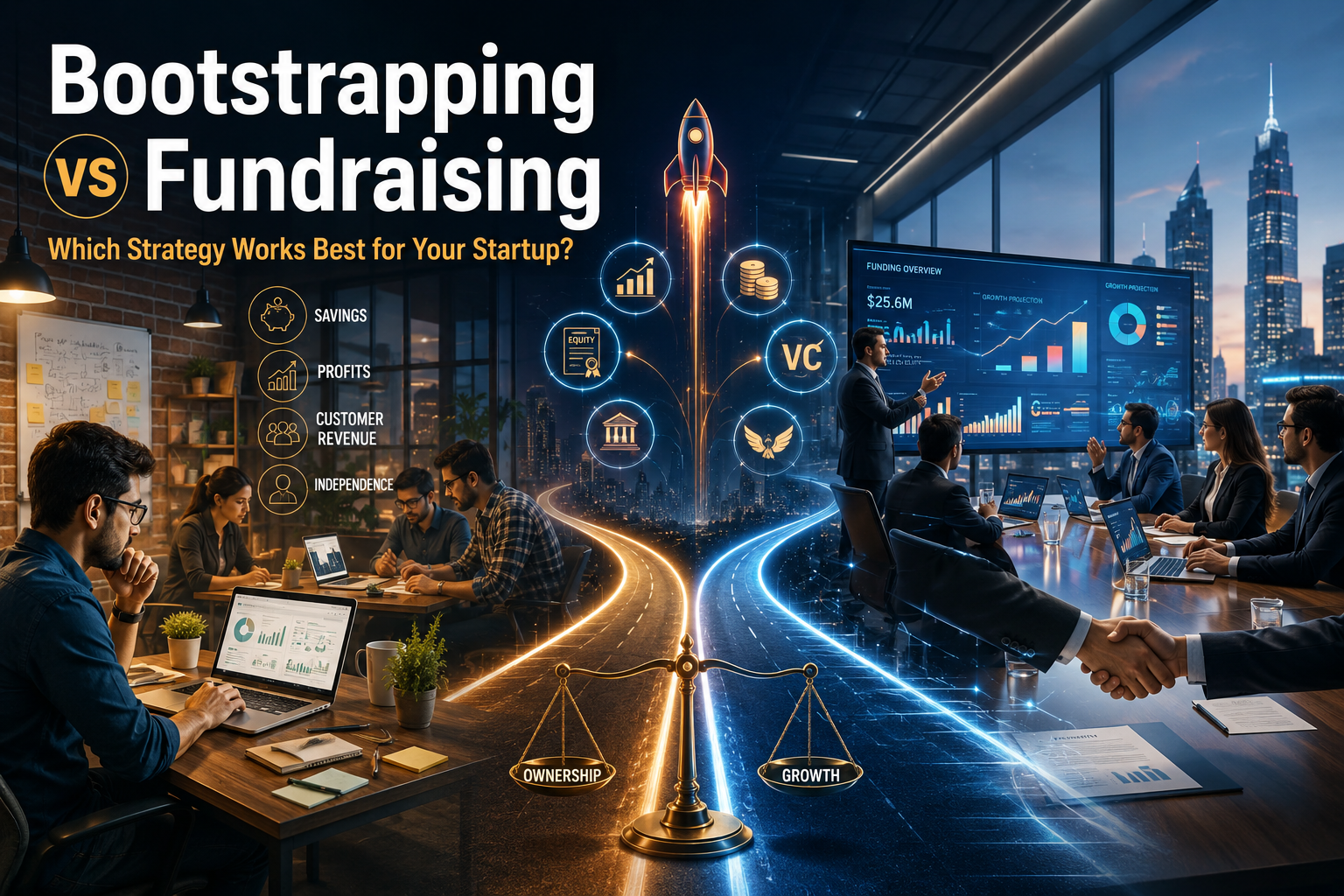
Bootstrapping vs Fundraising is the first major decision every startup founder must make before building a business. Every startup begins with a dream, but turning that dream into a successful business requires money. One of the biggest questions every entrepreneur faces is whether to build the business using personal funds or raise money from investors. This decision can shape your company’s future, growth speed, ownership, and even the way you make business decisions. Many startups fail not because they have a bad idea, but because they choose the wrong funding strategy at the wrong time.
If you are planning to start a business or already running a startup, understanding Bootstrapping vs Fundraising is extremely important. Both options have their own benefits and challenges. Some businesses become profitable by using their own money, while others grow into billion-dollar companies with the help of investors. In this guide, you will learn everything about bootstrap funding, fundraising for startups, pre-seed funding for startups, government loans for startup businesses, and the best funding options for new businesses. By the end of this article, you will have a clear understanding of which strategy is best for your startup.
What is Bootstrapping? (Bootstrapping vs Fundraising Basics)
Bootstrapping means starting and growing a business using your own money instead of taking investment from outside investors. The funds usually come from personal savings, business profits, or support from friends and family.
A bootstrapped startup focuses on generating revenue as early as possible because there is no external funding available. Every expense is carefully managed, and growth happens gradually.
Many successful global companies like Mailchimp, Zoho, and Basecamp started as bootstrapped businesses before becoming industry leaders.
Bootstrapping vs Fundraising: How Each Approach Works
Before choosing bootstrap funding, it is important to understand how this approach works.
- The founder invests personal savings.
- Business revenue is reinvested.
- Expenses are kept as low as possible.
- Growth happens step by step.
- No outside investors own shares in the company.
Advantages of Bootstrapping Over Fundraising
Bootstrapping offers many benefits, especially for entrepreneurs who want complete control over their business.
Complete Ownership
You remain the sole owner of your business. No investor can interfere with your decisions.
Full Decision-Making Power
You can make business decisions without getting approval from investors or board members.
No Equity Dilution
Since there are no investors, you do not have to give away company shares.
Strong Financial Discipline
Limited funds force founders to spend wisely and focus only on activities that generate value.
Long-Term Vision
Bootstrapped founders can build sustainable businesses instead of chasing rapid growth.
Disadvantages of Bootstrapping Compared to Fundraising
Although bootstrapping offers independence, it also comes with challenges.
Limited Capital
Growth may be slower because funding is restricted.
Personal Financial Risk
Founders invest their own money, which increases financial pressure.
Slower Expansion
Hiring employees, marketing, and product development may take more time.
Higher Stress
Managing cash flow becomes a daily challenge.
What is Fundraising? (Bootstrapping vs Fundraising Basics)
Fundraising means raising money from external investors to support business growth. Instead of relying on personal savings, founders receive investment from angel investors, venture capital firms, incubators, crowdfunding platforms, or government schemes.
Fundraising allows startups to grow much faster than bootstrapped businesses.
Most startups begin fundraising after validating their business idea and building a Minimum Viable Product (MVP).
Types of Startup Funding: Fundraising vs Bootstrapping Options
Understanding different funding stages helps founders choose the right investment at the right time.
Pre-Seed Funding
Pre-seed funding for startups is the earliest stage of investment.
This funding is mainly used for:
- Market research
- Product validation
- Building MVP
- Initial team
- Business registration
The money usually comes from:
- Personal savings
- Friends and family
- Angel investors
- Startup incubators
Seed Funding
Seed funding helps startups launch products and enter the market.
The investment supports:
- Product development
- Marketing
- Customer acquisition
- Hiring employees
Series A Funding
Series A funding is meant for startups with proven business models.
The investment is used for:
- Scaling operations
- Expanding teams
- Technology improvement
- Market expansion
Series B and Beyond
Later funding rounds support:
- International expansion
- Large marketing campaigns
- New product launches
- Business acquisitions
Advantages of Fundraising Over Bootstrapping
External funding provides several growth opportunities.
Faster Growth
Investment allows startups to expand quickly.
Better Talent
Companies can hire experienced professionals.
Bigger Marketing Budget
More money means stronger branding and customer acquisition.
Investor Guidance
Experienced investors provide mentorship and industry connections.
Competitive Advantage
Well-funded startups can outperform competitors.
Challenges of Fundraising Compared to Bootstrapping
Fundraising also comes with risks.
Ownership Dilution
Founders must give investors company shares.
Less Control
Major decisions often require investor approval.
High Expectations
Investors expect rapid growth and high returns.
Reporting Requirements
Regular financial reports and business updates become necessary.
Bootstrapping vs Fundraising Comparison
Choosing between Bootstrapping vs Venture Capital depends on your startup goals.
| Feature | Bootstrapping | Fundraising |
|---|---|---|
| Ownership | 100% Founder | Shared with Investors |
| Growth Speed | Slow | Fast |
| Financial Risk | Founder | Shared |
| Decision Making | Independent | Investor Influence |
| Capital Availability | Limited | High |
| Pressure | Moderate | High |
| Profit Focus | Immediate | Long-Term Growth |
| Business Control | Full | Partial |
Bootstrapping vs Venture Capital Fundraising
Many founders compare Bootstrapping vs Venture Capital because both represent opposite growth strategies.
Bootstrapping focuses on sustainable profits and complete ownership.
Venture capital focuses on rapid scaling, high growth, and market dominance.
The right choice depends on:
- Industry
- Product
- Competition
- Capital requirements
- Founder goals
Which Businesses Should Bootstrap Instead of Fundraising?
Bootstrapping is ideal for businesses that require low investment.
Examples include:
- Freelancing
- Digital marketing agencies
- SaaS products
- Software development
- Consulting firms
- Content businesses
- Blogging
- Online education
These businesses can generate revenue without heavy infrastructure costs.
Which Businesses Should Raise Funds Instead of Bootstrapping?
Some startups need significant investment from the beginning.
Examples include:
- Electric Vehicles
- AI Startups
- Healthcare Technology
- FinTech
- Manufacturing
- Biotechnology
- E-commerce marketplaces
- Logistics platforms
These businesses require technology, infrastructure, marketing, and skilled teams.
Best Funding Options for New Businesses: Bootstrapping vs Fundraising Choices
If you decide to raise funds, several financing options are available today.
Understanding these funding sources helps entrepreneurs make better decisions.
Angel Investors
Angel investors are experienced entrepreneurs who invest personal money into startups.
Benefits include:
- Early-stage funding
- Business guidance
- Industry connections
- Flexible investment
Venture Capital
Venture capital firms invest in startups with high growth potential.
Benefits include:
- Large investments
- Strategic mentoring
- Business networking
- Global expansion support
Crowdfunding
Crowdfunding allows entrepreneurs to raise money from the public.
Popular for:
- Consumer products
- Creative businesses
- Hardware startups
Startup Accelerators
Accelerators help startups through:
- Seed funding
- Mentorship
- Networking
- Office space
- Business development
Incubators
Incubators support early-stage entrepreneurs by offering resources and guidance before large-scale growth.
Government Loans for Startup Business: A Bootstrapping vs Fundraising Alternative
Government support has become one of the best funding options for new businesses in India.
Unlike venture capital, government loans usually allow founders to retain ownership.
Popular government schemes include:
Startup India Seed Fund Scheme
This Startup India Seed Fund Scheme supports innovative startups with early-stage funding.
It helps businesses develop prototypes, validate products, and commercialise innovations.
Credit Guarantee Scheme for Startups
This scheme improves access to loans without requiring heavy collateral.
MUDRA Loans
Suitable for micro and small businesses looking for affordable financing through MUDRA loans.
SIDBI Startup Assistance
SIDBI provides funding and financial support to eligible startups.
Stand-Up India Scheme
Supports women entrepreneurs and entrepreneurs from underrepresented communities through the Stand-Up India Scheme.
Government loans for startup businesses are excellent options for founders who want funding without giving away equity.
Hybrid Funding Strategy: Combining Bootstrapping and Fundraising
Many successful entrepreneurs combine both funding approaches.
A hybrid strategy usually works like this:
Stage 1
Bootstrap the startup.
Stage 2
Build an MVP.
Stage 3
Gain customers.
Stage 4
Generate revenue.
Stage 5
Raise external investment.
This approach reduces investor risk and improves startup valuation.
Factors to Consider Before Choosing Bootstrapping vs Fundraising
Every startup is different.
Before deciding, consider the following factors.
Capital Requirement
Businesses requiring expensive infrastructure may need fundraising.
Market Competition
Highly competitive industries often require rapid expansion.
Growth Goals
Fast-growing startups usually benefit from investment.
Founder Personality
Some entrepreneurs prefer independence, while others value investor support.
Revenue Model
Businesses capable of early profitability often succeed with bootstrap funding.
Common Mistakes Founders Make in Bootstrapping vs Fundraising
Many entrepreneurs make avoidable funding mistakes.
Some common ones include:
- Raising money too early.
- Raising more money than necessary.
- Ignoring cash flow.
- Depending completely on investors.
- Giving away too much equity.
- Choosing investors without proper research.
- Scaling before product-market fit.
Avoiding these mistakes increases long-term success.
How to Decide Between Bootstrapping and Fundraising
Instead of following trends, founders should answer these questions.
- Does your startup require significant capital?
- Can your business generate revenue quickly?
- Are you comfortable sharing ownership?
- Do you want complete control?
- How fast do you want to grow?
- Is your product already validated?
Your answers will help determine the right funding strategy.
Future of Startup Funding: Bootstrapping vs Fundraising Trends
Startup funding is evolving rapidly.
Entrepreneurs now have access to:
- AI-powered investment platforms
- Equity crowdfunding
- Revenue-based financing
- Government innovation grants
- Startup accelerators
- Corporate venture funds
These new opportunities provide founders with greater flexibility than ever before.
Final Thoughts on Bootstrapping vs Fundraising
The debate around Bootstrapping vs Fundraising has no universal winner because every startup follows a different journey. The right strategy depends on your industry, financial needs, business goals, and personal vision as a founder.
If you value independence, long-term sustainability, and complete ownership, bootstrap funding can be an excellent choice. On the other hand, if your business requires rapid expansion, significant infrastructure, or aggressive marketing, fundraising for startups may be the better option.
Many successful companies adopt a balanced approach by starting with bootstrapping, validating their product, building customer trust, and later raising investment through pre-seed funding for startups, angel investors, venture capital, or government loans for startup businesses. This allows founders to negotiate better valuations while maintaining greater control.
Ultimately, the best funding strategy is the one that aligns with your startup’s mission and long-term goals. Carefully evaluate all the best funding options for new businesses, plan your finances wisely, and choose a path that helps you build a sustainable and successful company.
FAQs About Bootstrapping vs Fundraising
What is bootstrapping in a startup?
Bootstrapping means building and growing a startup using personal savings, business revenue, or support from family and friends without taking external investment.
What is fundraising for startups?
Fundraising is the process of raising money from investors such as angel investors, venture capital firms, crowdfunding platforms, or government funding schemes.
Which is better: bootstrapping or fundraising?
Neither option is universally better. Bootstrapping is suitable for businesses with low capital requirements, while fundraising is ideal for startups that need rapid growth and significant investment.
What is pre-seed funding for startups?
Pre-seed funding is the earliest stage of startup investment used to validate an idea, build a prototype, and develop a minimum viable product (MVP).
Can I bootstrap first and raise funding later?
Yes. Many successful startups begin with bootstrap funding, validate their business model, generate revenue, and then raise external investment to scale faster.
Are government loans better than venture capital?
Government loans for startup businesses allow founders to retain ownership, while venture capital provides larger investments but requires giving away equity. The better option depends on your funding needs and business goals.
What are the best funding options for new businesses?
Some of the best funding options include personal savings, angel investors, venture capital, crowdfunding, startup incubators, accelerators, government grants, and startup loan schemes.
Does fundraising guarantee startup success?
No. Funding only provides resources. Success depends on product quality, market demand, customer satisfaction, execution, and effective financial management.
Is bootstrapping suitable for SaaS startups?
Yes. Many SaaS startups bootstrap successfully because they usually require lower initial investment and can generate recurring revenue quickly.
When should a startup raise funding?
A startup should consider raising funds after validating its product, acquiring early customers, demonstrating market demand, and developing a clear growth strategy.