



Most first-time founders underestimate what it actually takes to get a business off the ground. More than half of small business owners say their real first-year expenses caught them off guard. Learning how to calculate startup costs before you spend a dollar is the single best way to avoid that surprise. This guide breaks the process into clear categories, walks through a simple step-by-step method, and shares real 2026 benchmarks so you know what to expect.
What Are Startup Costs?
Startup costs are every expense you take on to launch and run your business before it becomes self-sustaining. They fall into two broad groups. One-time costs cover things you pay for once, like incorporation fees or your first equipment purchase. Recurring costs repeat every month, like rent, payroll, and software subscriptions.
Getting this split right matters. It lets you separate what you need upfront from what you need to keep the lights on. Most founders who calculate startup costs accurately build both numbers into their budget from day one.
One-Time vs Recurring Startup Costs
One-time startup costs include business registration, licenses and permits, initial equipment, and your first round of branding and website work. You pay these once, before or right at launch.
Recurring startup costs include rent, utilities, payroll, insurance, marketing, and inventory replenishment. These show up every month whether you sell anything or not. A home-based consulting business might run $500 to $2,000 a month. A retail shop with employees can run $10,000 to $30,000 a month or more.
Startup Cost Categories to Calculate
Before you can calculate startup costs accurately, you need a full list of categories. Skipping even one can throw off your entire budget.
- Business registration and licenses: typically $50 to $725, depending on your state and business structure.
- Legal and professional fees: often $500 to $10,000 a year for an attorney or accountant.
- Equipment and technology: ranges widely, from $1,000 for a laptop-based service business to $120,000 for manufacturing equipment.
- Office or retail space: deposits and build-out can run $2,000 to $50,000 or more before you factor in monthly rent.
- Inventory: usually 15% to 30% of your total starting budget for product-based businesses.
- Marketing and branding: website, logo, and initial campaigns typically cost $500 to $10,000.
- Insurance: general liability coverage often runs $500 to $1,500 a year.
- Payroll: can consume 20% to 50% of your budget once you hire your first employees.
- Utilities: budget roughly $2 per square foot if you lease physical space.
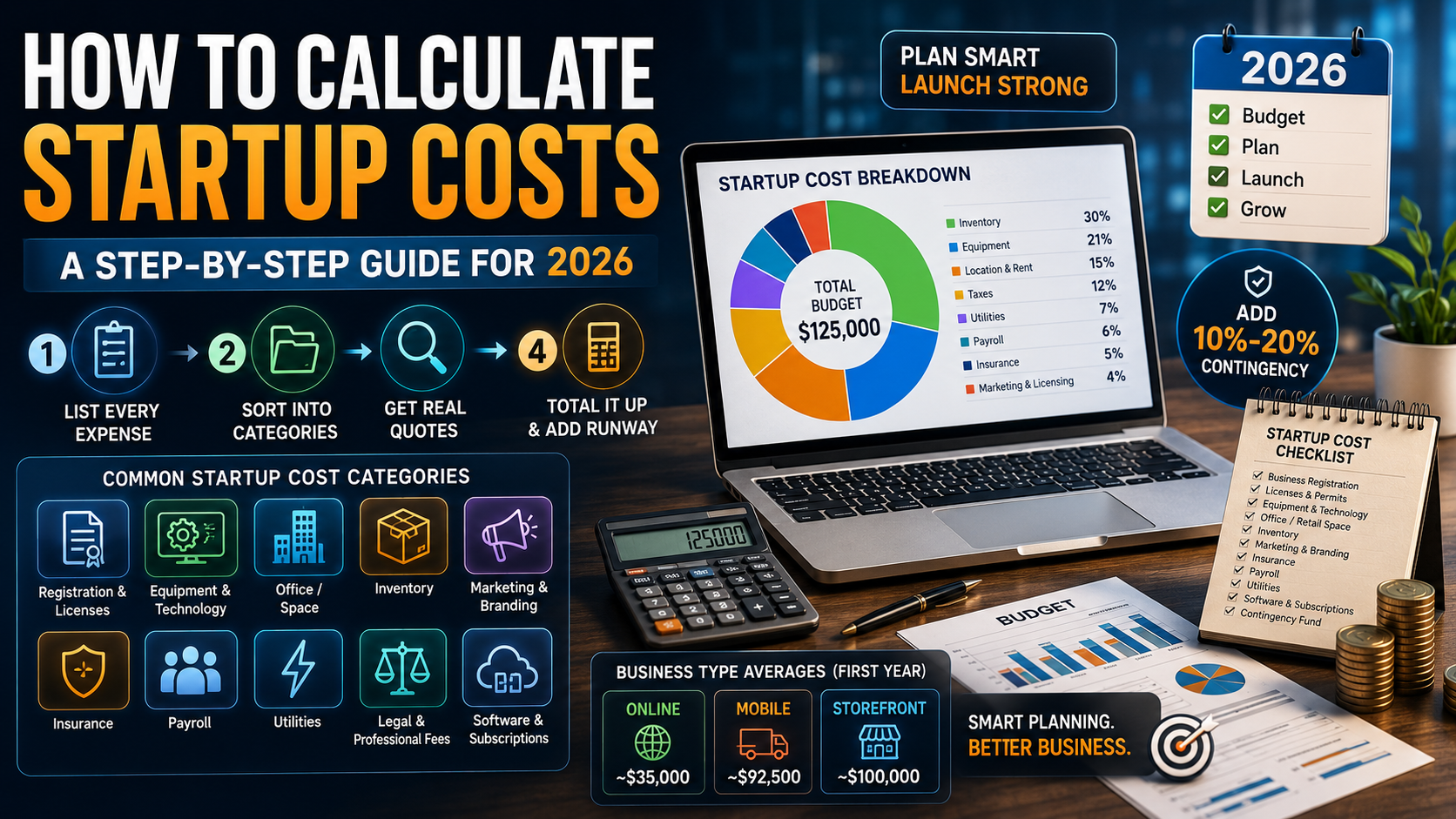
Once you have a full number, the next step is deciding how to fund your startup. Add a contingency line on top of all of this. Most advisors recommend setting aside 10% to 20% of your total budget for costs you did not see coming, like equipment repairs or a sudden regulatory change.
Average Cost to Start a Business in 2026
How much you spend depends heavily on your business model. Recent surveys of small business owners break the numbers down by type.
- Online-only businesses spend around $35,000 in their first year on average.
- Mobile businesses, like food trucks or mobile repair services, spend closer to $92,500.
- Storefront businesses require the most upfront investment, averaging $100,000.
Across all business types, inventory tends to eat the largest share of first-year spending at around 30%. Equipment follows at 21%, then location and rent at 15%, taxes at 12%, utilities at 7%, and payroll at 6%. Insurance, marketing, and licensing round out the rest. Most small businesses overall land somewhere between $3,000 and $200,000, with service businesses at the low end and restaurants or manufacturing operations at the high end.
How to Calculate Your Startup Costs Step by Step
Use this four-step method to build a realistic number instead of guessing.
Step 1: List Every Expense
For example, write down everything you will need to pay for before launch and during your first three to six months. Do not filter anything out yet. You can trim the list later.
Step 2: Sort Into One-Time, Recurring, and Variable
Group each item as a one-time cost, a fixed recurring cost, or a variable cost that changes with sales volume. This structure makes the rest of the calculation much easier.
Step 3: Get Real Quotes
Instead, replace guesses with actual numbers. For instance, get two or three quotes for major expenses like equipment, insurance, and office space before you commit to a figure.
Step 4: Total It Up and Add a Runway
Add your one-time costs to your monthly recurring costs multiplied by your target runway, usually six to twelve months. Then add your 10% to 20% contingency buffer on top. That final number is your real startup cost.
Common Mistakes When Calculating Startup Costs
Founders repeat the same mistakes when they calculate startup costs. Knowing them in advance helps you avoid each one.
- Underestimating taxes: nearly half of business owners say tax costs surprised them more than any other expense.
- Ignoring the ramp-up period: revenue rarely covers expenses in month one. Budget for a runway, not just a launch.
- Skipping the contingency buffer: unexpected costs are the rule, not the exception.
- Forgetting your own salary: many founders pay everyone but themselves in year one, which is not sustainable long term.
- Using outdated quotes: prices for equipment, rent, and software shift quickly. Refresh your numbers before you finalize a budget.
Startup Cost Tax Deductions in 2026
Tax rules changed recently in a way that helps new founders. Legislation passed in 2025 raised the deduction for qualifying startup expenses to $50,000 in year one. Any remaining costs amortize over the following 15 years. Talk to a tax professional before you file, since eligibility depends on your specific expenses and business structure. If you are still weighing bootstrapping versus outside investment, your startup cost total is often the number that tips the decision.
Tools That Help You Calculate Startup Costs
However, you do not have to build your budget from scratch. Spreadsheet templates, dedicated startup cost calculators, and the worksheet tools built into platforms like the Small Business Administration’s planning guide all speed up the process. Either way, plug in real vendor quotes rather than placeholder numbers. The output is only as accurate as what you put in.
Frequently Asked Questions About Calculating Startup Costs
What is the average cost to start a small business?
Most small businesses spend between $3,000 and $200,000, depending on the industry. Online businesses average around $35,000 in year one, while storefront businesses average closer to $100,000.
What is the difference between one-time and recurring startup costs?
One-time costs are expenses you pay once, like registration fees or equipment purchases. Recurring costs repeat every month, like rent, payroll, and software subscriptions.
How much contingency should I budget for startup costs?
Most advisors recommend setting aside 10% to 20% of your total startup budget for unexpected expenses.
Can I deduct startup costs on my taxes?
Yes. As of 2025 legislation, you can deduct up to $50,000 in qualifying startup expenses in your first year, with any remaining amount amortized over 15 years.
What is the biggest mistake founders make when calculating startup costs?
Underestimating taxes and skipping a contingency buffer are the two most common mistakes. Both catch new founders off guard in year one.
Key Takeaways
Calculating startup costs accurately comes down to breaking expenses into clear categories, gathering real quotes instead of estimates, and building in a runway plus a contingency buffer. For most founders, that means budgeting well beyond the number that feels comfortable at first. The businesses that survive their first year are usually the ones that planned for it honestly from the start.
This guide reflects startup cost benchmarks and tax rules as of August 2026. Costs vary by industry, location, and business structure, so confirm current figures with a financial or tax professional before finalizing your budget.