



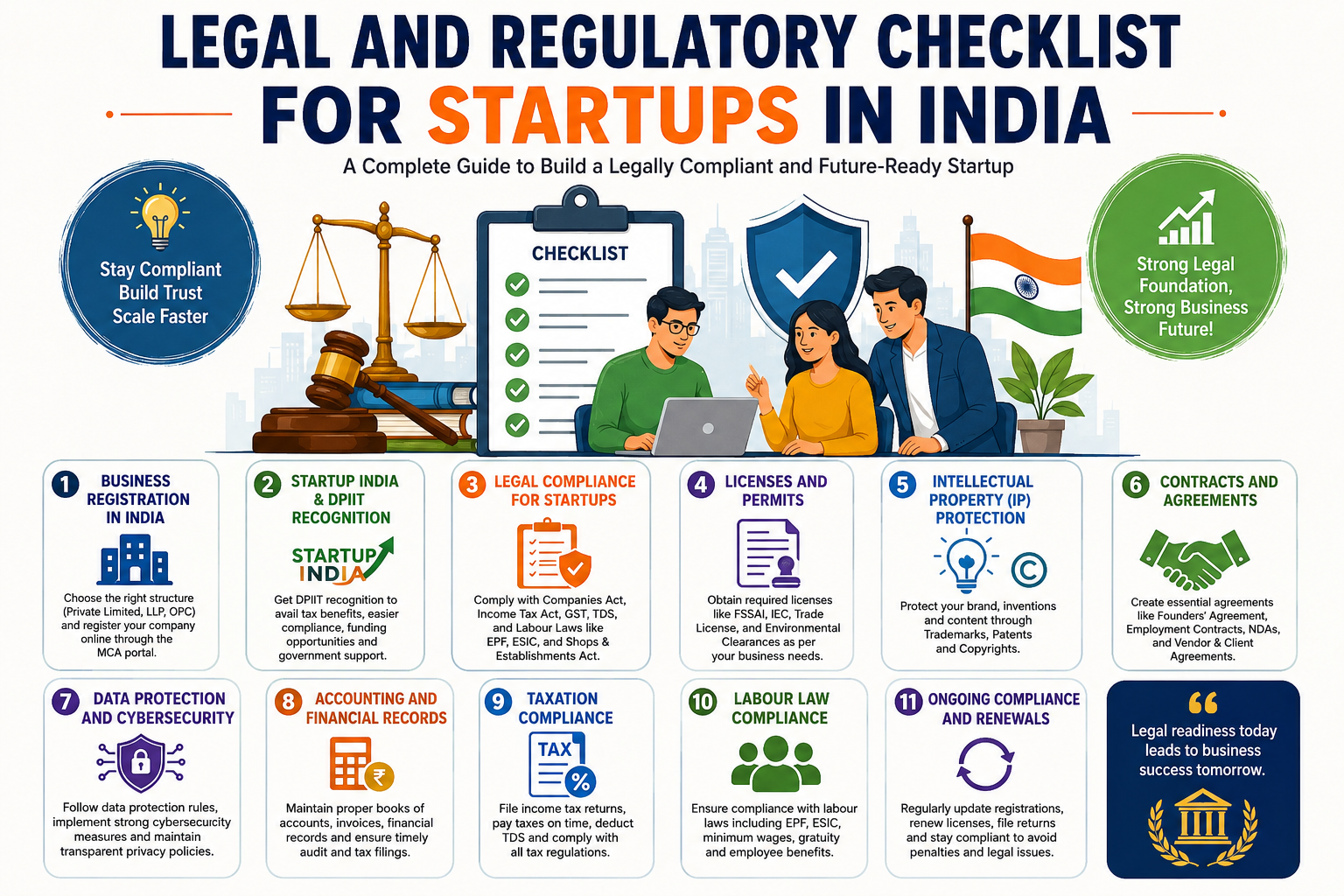
Introduction to This Legal Checklist for Startups in India
India has become one of the fastest-growing startup ecosystems in the world. Every year, thousands of entrepreneurs launch innovative businesses across technology, healthcare, education, finance, manufacturing, and e-commerce. While building a product and attracting customers are important, legal compliance is equally essential for long-term success. Many startups face unnecessary penalties, legal disputes, funding delays, or operational challenges simply because they overlook important legal requirements during the early stages. A proper legal checklist for startups in India helps your business stay compliant, gain investor confidence, and build a strong reputation in the market.
This guide explains every important legal requirement in simple language so that even first-time entrepreneurs can understand the complete process without confusion. Whether you are planning to bootstrap your startup or raise venture capital, this article covers business registration in India, Startup India Recognition, DPIIT Recognition, GST registration, intellectual property protection, legal agreements, licenses, taxation, labour laws, and many other important topics that every startup founder should know.
Why a Legal Checklist for Startups in India Matters
Naturally, starting a business is exciting, but every startup has legal responsibilities that cannot be ignored. A strong legal foundation protects your company from future risks and helps you grow with confidence.
Certainly, legal compliance is not just about avoiding penalties. It also improves your company’s credibility among customers, investors, banks, government authorities, and business partners.
Following the legal checklist for startups in India offers several advantages.
- Builds trust among investors.
- Helps in raising funds easily.
- Prevents unnecessary legal disputes.
- Protects your intellectual property.
- Improves business credibility.
- Ensures smooth business operations.
- Helps qualify for government schemes.
- Avoids penalties and fines.
Indeed, every successful startup invests time in building a legally compliant business from the beginning.
Step 1: Legal Checklist for Startups in India – Business Structure
First, before registering your startup, you must choose the right legal structure. Your business structure affects taxation, fundraising opportunities, ownership, compliance requirements, and personal liability.
Overall, there are several business structures available in India. The best option depends on your business goals and future expansion plans.
Private Limited Company
Generally, a Private Limited Company is the most popular choice for startups looking for investment or rapid growth.
Also, it offers several important benefits.
- Limited liability for shareholders.
- Separate legal identity.
- Easy fundraising from investors.
- Better credibility in the market.
- Suitable for venture capital and angel investment.
Additionally, most technology startups prefer this structure because investors usually prefer investing in Private Limited Companies.
Limited Liability Partnership (LLP)
Also, an LLP combines the flexibility of a partnership with the protection of limited liability.
Then, it is suitable for professional firms and service-based businesses.
Naturally, its benefits include:
- Lower compliance requirements.
- Flexible management.
- Limited liability protection.
- Cost-effective business structure.
One Person Company (OPC)
Similarly, a One Person Company is designed for entrepreneurs who want to start a business alone.
Naturally, this structure provides the advantages of a company while allowing a single individual to own the business.
Similarly, key benefits include:
- Single ownership.
- Limited liability.
- Separate legal identity.
- Easier business management.
Partnership Firm
Generally, a traditional partnership firm is easy to establish and suitable for small businesses.
However, partners have unlimited liability, making it less suitable for startups planning rapid expansion.
Overall, selecting the right structure at the beginning can save significant costs and compliance issues later.
Step 2: Legal Checklist for Startups in India – Business Registration
Then, after selecting the business structure, the next step is business registration in India. Today, entrepreneurs can register a company online in India through the Ministry of Corporate Affairs (MCA) portal. This step is a core part of any legal checklist for startups in India.
Certainly, the registration process has become much faster because most steps are completed digitally.
First, before beginning registration, you should prepare the required documents.
Generally, the commonly required documents include:
- PAN Card
- Aadhaar Card
- Passport-size photographs
- Address proof
- Registered office address proof
- Mobile number
- Email address
Overall, the registration process generally includes the following steps.
- Apply for Digital Signature Certificate (DSC).
- Obtain Director Identification Number (DIN).
- Reserve a unique company name.
- Submit incorporation documents through the MCA portal.
- Receive the Certificate of Incorporation.
- Obtain PAN and TAN.
Then, once the Certificate of Incorporation is issued, your startup becomes a legally registered business entity.
Naturally, a registered company enjoys greater trust among customers, financial institutions, suppliers, and investors.
Step 3: Legal Checklist for Startups in India – Startup India & DPIIT Recognition
Indeed, many startups miss valuable government benefits because they do not apply for Startup India Recognition.
Additionally, if your startup is innovative and has growth potential, obtaining DPIIT Recognition can provide significant advantages.
Notably, the Government of India introduced Startup India to encourage innovation, entrepreneurship, and employment generation.
Generally, to qualify for DPIIT Recognition, your startup should generally meet the following eligibility conditions.
- The startup should be less than 10 years old.
- It must be registered as a Private Limited Company, LLP, or Partnership Firm.
- Annual turnover should be less than ₹100 crore in any previous financial year.
- The startup should focus on innovation, development, or improvement of products, services, or processes.
- It should have the potential to create employment or wealth.
- It should not be formed by splitting or reconstructing an existing business.
Then, after receiving DPIIT Recognition, startups become eligible for several government benefits.
Additionally, these benefits include:
- Income tax exemptions (subject to eligibility).
- Easier compliance procedures.
- Self-certification under selected labour and environmental laws.
- Faster patent examination.
- Reduced patent filing fees.
- Government procurement benefits.
- Access to startup networking opportunities.
- Better visibility among investors.
Also, for startups planning future fundraising, Startup India Recognition strengthens their overall credibility.
Step 4: Legal Checklist for Startups in India: Compliance Guide
Certainly, company registration is only the beginning. Every startup must continue meeting legal obligations throughout its business journey.
Overall, regular compliance helps avoid penalties and ensures smooth business operations.
Specifically, the major legal compliance requirements include company law, taxation, labour law, and financial reporting.
Additionally, some of the most important legal compliance areas are explained below.
Companies Act, 2013
Then, every registered company must comply with the Companies Act, 2013.
Naturally, the law ensures proper corporate governance and transparency.
Overall, important compliance activities include:
- Annual Return Filing.
- Financial Statement Filing.
- Conducting Board Meetings.
- Holding Annual General Meetings where applicable.
- Maintaining statutory registers.
- Director disclosures.
- Updating company records.
Notably, failure to complete MCA filings may result in penalties and additional fees.
Income Tax Compliance
Then, every startup is responsible for paying applicable taxes and maintaining proper financial records.
Naturally, good accounting practices also improve your chances of obtaining loans and investments.
Specifically, income tax compliance usually includes:
- Filing Income Tax Returns.
- Maintaining books of accounts.
- Deducting Tax Deducted at Source (TDS).
- Paying advance tax where applicable.
- Completing tax audits if required.
Overall, working with a Chartered Accountant helps ensure accurate tax compliance and reduces the risk of errors.
GST Registration
Naturally, Goods and Services Tax (GST) is an important compliance requirement for many startups.
Then, businesses must understand whether GST registration is mandatory based on turnover and business activities.
Generally, GST registration becomes mandatory in the following situations.
- Annual turnover exceeds ₹20 lakh in most states.
- Annual turnover exceeds ₹10 lakh in special category states.
- Interstate supply of goods or services.
- E-commerce businesses.
- Certain notified business categories.
Also, GST registration provides several benefits.
- Input tax credit.
- Improved business credibility.
- Easier expansion across India.
- Better compliance with tax laws.
Overall, registering under GST at the appropriate time helps avoid unnecessary penalties and tax notices.
Step 5: Legal Checklist for Startups in India – Labour Law Compliance
Eventually, as your startup grows and begins hiring employees, labour law compliance becomes increasingly important. Indian labour laws protect employee rights while ensuring businesses operate responsibly.
Naturally, the exact legal requirements depend on your company size, industry, and state regulations.
Additionally, every startup should understand the labour laws that apply to its workforce and ensure timely registration wherever required.
Generally, some common labour law registrations include:
- Employees’ Provident Fund (EPF)
- Employees’ State Insurance Corporation (ESIC)
- Shops and Establishments Registration
- Professional Tax (where applicable)
- Payment of Bonus compliance
- Gratuity compliance
- Minimum wage compliance
- Employee leave policies
Overall, proper labour law compliance not only avoids legal disputes but also creates a positive work environment that attracts and retains talented employees.
Step 6: Legal Checklist for Startups in India – Licenses and Permits
Naturally, every startup does not require the same licenses. The licenses you need depend on your industry, business activities, and location. Before starting operations, identify all the approvals required for your business. Having the correct licenses from the beginning helps avoid penalties, business interruptions, and legal issues.
Overall, some of the most common licenses and permits required by startups in India are listed below.
FSSAI License
Then, if your startup is involved in manufacturing, processing, packaging, storing, distributing, or selling food products, obtaining an FSSAI License is mandatory.
Generally, businesses that usually require this license include:
- Restaurants
- Cloud kitchens
- Cafes
- Food delivery startups
- Grocery stores
- Food manufacturers
- Catering businesses
Import Export Code (IEC)
Additionally, businesses involved in international trade must obtain an Import Export Code from the Directorate General of Foreign Trade (DGFT).
Naturally, an IEC is generally required for:
- Importing goods
- Exporting products
- International online businesses
- Cross-border trade
Trade License
Also, many local municipal authorities require businesses to obtain a Trade License before starting operations.
Similarly, it is commonly required for:
- Shops
- Offices
- Retail businesses
- Warehouses
- Commercial establishments
Environmental Clearance
Similarly, certain industries require environmental approvals before starting production.
Additionally, these may include:
- Manufacturing units
- Chemical industries
- Waste management businesses
- Mining operations
- Large industrial projects
Industry-Specific Licenses
Additionally, some businesses require additional approvals from sector-specific regulators.
Specifically, examples include:
- RBI approval for certain fintech businesses
- IRDAI approval for insurance businesses
- SEBI regulations for investment-related businesses
- Drug License for pharmaceutical businesses
- Telecom licenses for communication services
Overall, obtaining all required licenses before starting operations helps your startup avoid unnecessary legal complications and business disruptions.
Step 7: Legal Checklist for Startups in India – Intellectual Property (IP)
Naturally, your ideas, brand name, technology, software, and creative work are valuable business assets. Intellectual Property (IP) protection prevents others from copying your innovations and strengthens your business during fundraising. IP protection is another essential part of the legal checklist for startups in India.
Certainly, investors often consider intellectual property as one of the most valuable assets of a startup.
Specifically, the three most common types of intellectual property protection are explained below.
Trademark Registration
First, a trademark protects your business identity.
Naturally, it can protect:
- Business name
- Brand name
- Company logo
- Product names
- Taglines
Additionally, trademark registration helps prevent competitors from using similar names or logos.
Patent Registration
Then, a patent protects unique inventions and innovative technologies.
Generally, patents may be suitable for:
- New products
- Manufacturing processes
- Software-based innovations (where applicable)
- Technical inventions
Also, patents give inventors exclusive rights for a specified period.
Copyright Registration
Similarly, copyright protects original creative work.
Additionally, this includes:
- Software code
- Website content
- Blogs
- Videos
- Books
- Marketing material
- Graphic designs
Overall, protecting intellectual property increases your startup’s market value and creates long-term competitive advantages.
Step 8: Legal Checklist for Startups in India – Essential Legal Agreements
Indeed, many startup disputes arise because founders fail to prepare proper legal agreements. Clear documentation protects the interests of founders, employees, customers, and business partners.
Naturally, every startup should prepare legally valid agreements before beginning business operations.
Founders’ Agreement
Generally, a Founders’ Agreement clearly defines the relationship between co-founders.
Naturally, it usually includes:
- Equity ownership
- Roles and responsibilities
- Decision-making process
- Profit sharing
- Exit clauses
- Dispute resolution
Overall, preparing this agreement early helps avoid future misunderstandings.
Employment Agreement
Naturally, every employee should receive a written employment contract.
Also, it generally covers:
- Job responsibilities
- Salary and benefits
- Working hours
- Leave policy
- Confidentiality obligations
- Termination conditions
Non-Disclosure Agreement (NDA)
Then, an NDA protects confidential business information.
Similarly, it can cover:
- Business ideas
- Customer information
- Source code
- Trade secrets
- Product designs
- Marketing strategies
Additionally, NDAs are particularly useful when discussing your business with employees, consultants, vendors, or investors.
Vendor Agreement
Similarly, vendor agreements define the responsibilities of suppliers.
Additionally, they generally include:
- Payment terms
- Delivery schedules
- Product quality
- Penalties
- Liability clauses
Client Agreement
Also, client agreements protect both the startup and its customers.
Naturally, they generally define:
- Scope of work
- Pricing
- Payment schedule
- Project timelines
- Ownership of deliverables
- Dispute resolution
Overall, professional agreements reduce legal risks and build stronger business relationships.
Step 9: Legal Checklist for Startups in India – Accounting and Financial Records
Certainly, accurate accounting is essential for every startup, regardless of its size. Good financial management helps in tax filing, fundraising, business planning, and regulatory compliance.
Naturally, maintaining proper financial records also improves transparency and investor confidence.
Specifically, important accounting records include:
- Sales invoices
- Purchase invoices
- Expense records
- Payroll records
- GST records
- Bank statements
- Profit and loss statements
- Balance sheets
Generally, using accounting software or hiring a Chartered Accountant can make financial compliance much easier.
Step 10: Legal Checklist for Startups in India – Data Protection and Cybersecurity
Additionally, most startups collect customer information through websites, mobile applications, payment gateways, or digital platforms. Protecting this information is important for maintaining customer trust.
Notably, India’s data protection framework continues to evolve, making it essential for startups to follow responsible data management practices.
Then, every startup should implement basic cybersecurity measures.
Generally, some recommended practices include:
- Strong passwords
- Two-factor authentication
- Data encryption
- Secure cloud storage
- Regular data backups
- Firewall protection
- Employee cybersecurity training
- Regular software updates
Naturally, your website should also include:
- Privacy Policy
- Terms and Conditions
- Cookie Policy (where applicable)
- Refund Policy (if applicable)
Naturally, these documents improve transparency and demonstrate your commitment to customer privacy.
Step 11: Legal Checklist for Startups in India – Annual Compliance
Certainly, legal compliance is not a one-time activity. Every startup must complete several annual filings and renewals to remain compliant with Indian laws.
Then, a simple annual compliance checklist helps ensure that no important deadlines are missed.
Overall, important annual compliance activities include:
- Filing Income Tax Return
- Filing GST Returns
- MCA Annual Return Filing
- Financial Statement Filing
- Conducting Board Meetings
- Updating Statutory Registers
- TDS Return Filing
- Labour Law Compliance
- Professional Tax Compliance
- Business License Renewal
- Accounting Record Maintenance
- Audit (if applicable)
Additionally, maintaining a compliance calendar is one of the easiest ways to avoid penalties.
Common Mistakes to Avoid in Your Legal Checklist for Startups in India
Indeed, many startups make mistakes because they focus only on business growth and ignore legal compliance. Avoiding these mistakes can save significant time and money.
Generally, some of the most common legal mistakes include:
- Choosing the wrong business structure.
- Delaying company registration.
- Not applying for Startup India Recognition.
- Ignoring GST registration requirements.
- Failing to register trademarks.
- Using online content without permission.
- Mixing personal and business finances.
- Not maintaining proper accounting records.
- Missing annual filing deadlines.
- Operating without required licenses.
- Not signing Founders’ Agreements.
- Ignoring employee compliance requirements.
- Not protecting customer data.
Overall, being proactive with compliance reduces legal risks and supports sustainable business growth.
Final Thoughts on This Legal Checklist for Startups in India
Ultimately, building a successful startup requires much more than a great idea. Legal compliance creates the foundation for sustainable growth and long-term success. From business registration in India to Startup India Recognition, DPIIT Recognition, GST registration, intellectual property protection, labour law compliance, and cybersecurity, every legal step strengthens your startup’s credibility.
Naturally, a legally compliant startup is more attractive to investors, customers, lenders, and strategic partners. It also reduces operational risks and allows founders to focus on innovation instead of legal disputes. A well-structured legal checklist for startups in India keeps every founder prepared for growth, audits, and fundraising.
Whether you are funding your business through bootstrapping, angel investment, venture capital, or government schemes, following this Legal Checklist for Startups in India will help you build a trusted, investment-ready, and future-proof business. Starting with the right legal foundation today can save your startup from costly mistakes tomorrow and position it for long-term success.
Frequently Asked Questions (FAQs)
1. What is the best business structure for a startup in India?
Certainly, a Private Limited Company is generally considered the best option for startups seeking investment because it offers limited liability, better credibility, and easier fundraising opportunities.
2. Is Startup India Recognition mandatory?
No. However, Startup India Recognition is not mandatory, but it offers valuable benefits such as tax exemptions (subject to eligibility), government support, faster patent processing, and access to startup programs.
3. Who is eligible for DPIIT Recognition?
Generally, a startup can apply for DPIIT Recognition if it is less than 10 years old, registered as a Private Limited Company, LLP, or Partnership Firm, has an annual turnover below ₹100 crore in any previous financial year, and is working on innovation or scalable business solutions.
4. Is GST registration compulsory for every startup?
No. However, GST registration is generally mandatory when the prescribed turnover limit is crossed or when the business falls under categories that require compulsory registration, such as certain interstate or e-commerce activities.
5. Why is trademark registration important?
Certainly, trademark registration protects your business name, logo, and brand identity from unauthorized use and helps build customer trust.
6. What legal agreements should every startup prepare?
Generally, every startup should have a Founders’ Agreement, Employment Agreement, Non-Disclosure Agreement (NDA), Vendor Agreement, and Client Agreement to protect business interests.
7. Can I register a company online in India?
Yes. Indeed, The Ministry of Corporate Affairs (MCA) provides an online process for company registration in India.
8. What happens if a startup ignores this legal checklist for startups in India?
Naturally, non-compliance can result in penalties, legal notices, cancellation of licenses, tax issues, funding delays, and damage to the company’s reputation.
9. Does every startup need intellectual property protection?
However, not every startup needs a patent, but trademarks and copyrights are strongly recommended to protect branding, software, content, and other original business assets.
10. How often should startups review their legal compliance?
Overall, startups should monitor compliance throughout the year and conduct a comprehensive legal review at least once annually to ensure all registrations, filings, taxes, and licenses remain up to date.