

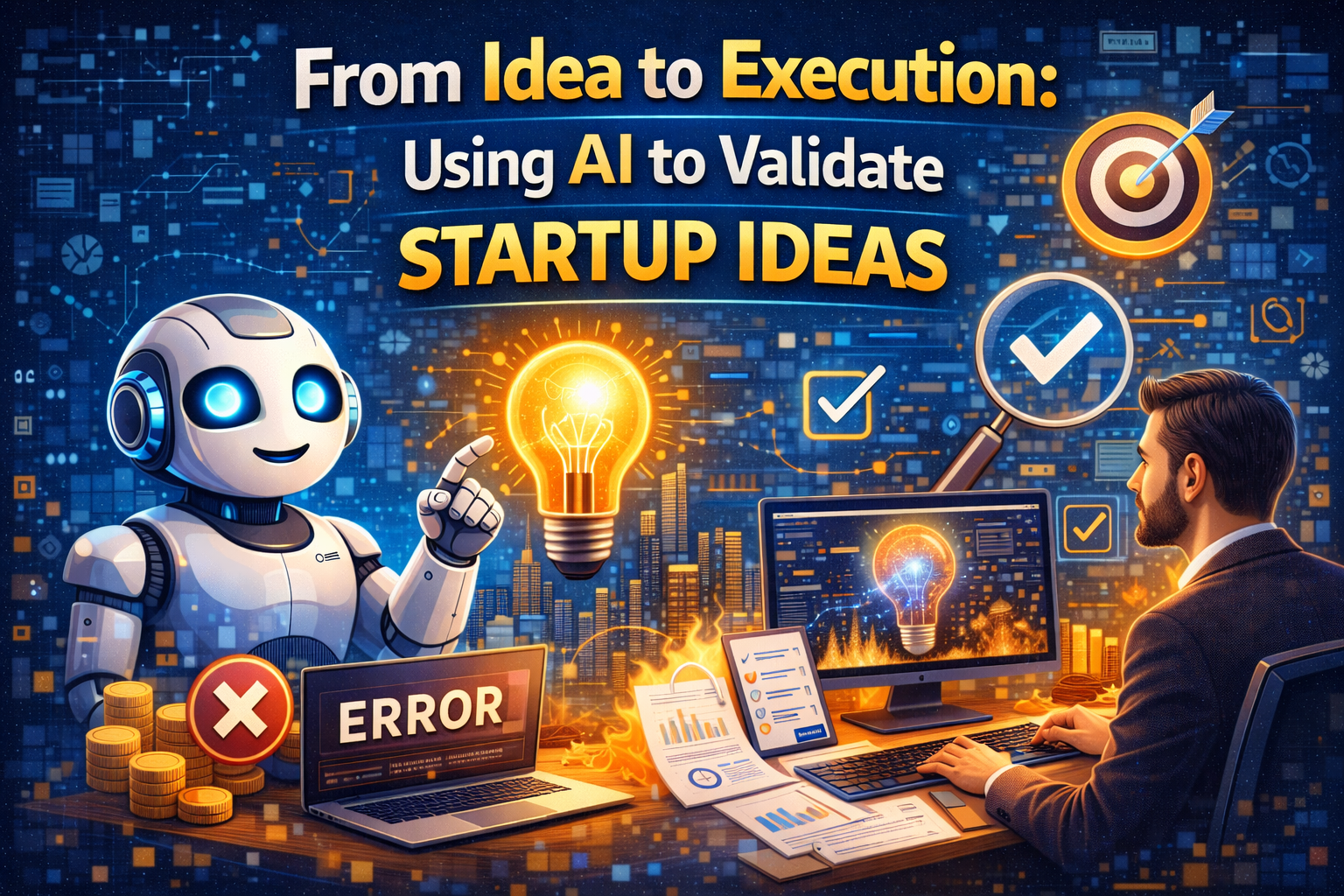
Every successful startup begins with an idea. But the hard truth is that most startup ideas fail not because they are bad, but because they are never properly validated. Founders often fall in love with their ideas, invest time and money, and only later discover that customers do not want the product.
This is where Artificial Intelligence (AI) is becoming a powerful advantage for modern startups.
AI helps founders move from idea to execution with confidence. It allows startups to test ideas faster, understand real customer needs, analyse market demand, study competitors, and reduce risks before spending heavily. Instead of guessing, AI enables data-driven validation.
This article explains how startups can use AI to validate ideas step by step, in very simple language. If you are a founder, aspiring entrepreneur, or early-stage startup team member, this guide will help you avoid costly mistakes and turn ideas into scalable businesses the smart way.
Why Idea Validation Is Critical for Startups
Before building a product or service, startups must answer one important question:
Does anyone actually need this idea?
Many startups fail because they:
- Build products without real demand
- Assume customers will come automatically
- Ignore market research
- Spend money too early
- Rely only on intuition
Validating an idea means testing it against real data and real user behaviour. AI makes this process faster, cheaper, and more accurate.
What Does Idea Validation Really Mean?
Idea validation is the process of checking whether:
- The problem is real
- People are willing to pay for a solution
- The market is large enough
- The idea is better than existing options
AI helps validate these points before execution, reducing risk.
How AI Helps Startups Validate Ideas Faster
AI acts like a research assistant that works 24/7. It can process huge amounts of data that humans cannot.
AI helps startups by:
- Analysing market trends
- Studying customer behaviour
- Identifying pain points
- Testing assumptions quickly
- Reducing guesswork
This makes idea validation smarter and more reliable.
Step 1: Using AI to Identify Real Problems
Every startup idea should solve a real problem. AI helps founders discover problems people are actively facing.
AI tools analyse:
- Online discussions
- Search queries
- Reviews and feedback
- Social media conversations
This data shows what people complain about and what they are searching for.
Before building anything, founders should ensure the problem is genuine and frequent.
Step 2: Market Research Using AI
Traditional market research is slow and expensive. AI makes it faster and more detailed.
AI helps market research by:
- Analysing industry trends
- Studying customer segments
- Predicting market growth
- Identifying gaps in the market
This helps startups understand whether the idea fits the market.
Good ideas exist where demand is high and supply is weak.
Step 3: Understanding Your Target Customer with AI
Many founders think they know their customer, but assumptions are often wrong.
AI helps create accurate customer profiles by:
- Analysing demographics
- Studying online behaviour
- Tracking interests and needs
- Predicting buying intent
This ensures startups build for the right audience, not an imaginary one.
Step 4: Competitor Analysis Using AI
Ignoring competitors is a big mistake. AI helps startups analyse competitors deeply.
AI tools can:
- Track competitor products
- Analyse pricing strategies
- Study customer reviews
- Identify strengths and weaknesses
This helps founders answer:
- What already exists?
- Why do customers like or dislike competitors?
- How can my idea be better?
Smart startups compete on value, not ego.
Step 5: Validating Demand Using AI Search Data
Search data reveals what people actually want.
AI analyses:
- Search volume trends
- Keyword demand
- Seasonal interest
- Emerging topics
If people are searching for solutions related to your idea, demand exists.
If there is no search interest, the idea may need improvement.
Step 6: Using AI to Test Idea Messaging
Sometimes the idea is good, but messaging is wrong.
AI helps test:
- Startup name ideas
- Taglines
- Value propositions
- Marketing messages
By analysing engagement data, AI shows what messaging resonates most with users.
Clear communication improves validation accuracy.
Step 7: AI-Powered Surveys and Feedback Analysis
Customer feedback is essential, but analysing it manually is slow.
AI helps by:
- Creating smart surveys
- Analysing responses instantly
- Identifying patterns in feedback
- Highlighting common objections
This allows startups to refine ideas based on real opinions, not assumptions.
Step 8: Using AI to Build and Test MVPs
An MVP (Minimum Viable Product) is a simple version of the idea.
AI supports MVP testing by:
- Generating prototypes faster
- Analysing user interaction
- Tracking drop-off points
- Measuring engagement
This helps founders understand what users like and dislike before full development.
Step 9: Pricing Validation Using AI
Pricing is often guessed. AI makes it data-driven.
AI helps validate pricing by:
- Analysing competitor pricing
- Studying customer willingness to pay
- Testing multiple price points
- Predicting revenue impact
This reduces pricing mistakes and increases conversion chances.
Step 10: Predicting Success Using AI Insights
While no tool guarantees success, AI improves probability.
AI predicts:
- Market response
- Customer adoption trends
- Growth potential
- Risk factors
This helps founders decide whether to proceed, pivot, or pause.
Common Mistakes Founders Make While Validating Ideas
Even with AI, mistakes happen.
Common errors include:
- Ignoring negative data
- Falling in love with the idea
- Over-trusting AI without judgment
- Not testing assumptions properly
AI should guide decisions, not control them.
How to Balance AI and Human Judgment
AI provides data. Humans provide direction.
Founders should:
- Use AI for research and analysis
- Use human insight for vision and creativity
- Combine logic with intuition
This balance leads to strong execution.
From Validation to Execution: What Comes Next
Once an idea is validated:
- Build a clear roadmap
- Develop a strong MVP
- Prepare a go-to-market plan
- Continue using AI for optimisation
Validation is not the end — it is the foundation.
The Future of Idea Validation with AI
AI will make idea validation:
- Faster
- Cheaper
- More accurate
- Accessible to everyone
Founders who use AI early will move faster than competitors.
Final Thoughts from AI Startup Edge
Ideas are powerful, but validated ideas build businesses.
AI helps founders:
- Reduce risk
- Save money
- Gain clarity
- Execute with confidence
At AI Startup Edge, we believe AI should support founders from idea to execution — not just at scale, but from day one.
Frequently Asked Questions (FAQs)
1. Can AI really validate startup ideas?
Yes. AI analyses real data, trends, and behaviour to reduce guesswork.
2. Do early-stage founders need AI?
Yes. Early validation saves time, money, and effort.
3. Is AI expensive for idea validation?
Many AI tools are affordable or offer free versions.
4. Can AI replace customer interviews?
No. AI supports research, but human conversations are still important.
5. How does AI Startup Edge help founders?
AI Startup Edge helps founders validate ideas, choose tools, and move from idea to execution confidently.