Subtotal $0.00


Email : 49
Introduction
Artificial Intelligence is changing the way businesses operate. Companies today are looking for faster, smarter, and more efficient ways to manage their daily work. AI agents, automation tools, and intelligent systems are becoming an important part of business operations. As technology continues to evolve, two business models are gaining significant attention: Agentic Workflow and No Human in the Loop (NHITL).
Many entrepreneurs, startup founders, and business owners are asking an important question: Should AI work alongside humans, or should AI handle everything independently?
The answer is not always simple. Both models offer unique advantages and challenges. While Agentic Workflow combines human intelligence with AI automation, No Human in the Loop aims for complete autonomy with minimal or no human involvement.
Understanding the differences between these two approaches is essential for making the right business decisions. In this article, you will learn what Agentic Workflow and No Human in the Loop mean, how they work, their benefits, limitations, real-world applications, future potential, and which model may be best for your business. By the end, you will have a clear understanding of where AI-driven businesses are heading and how you can prepare for the future.
Understanding Agentic Workflow
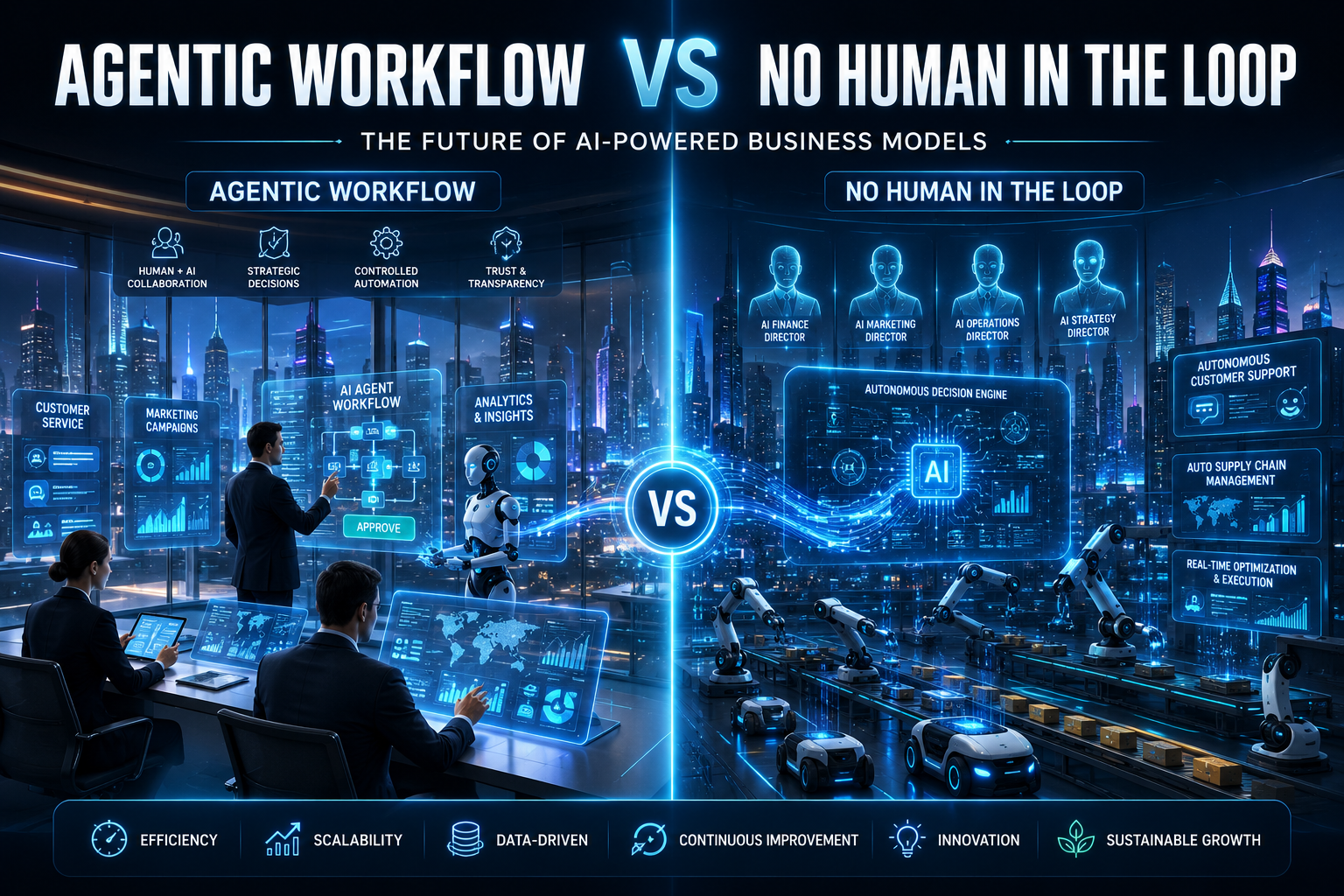
Agentic Workflow refers to a system where AI agents perform tasks, make recommendations, and automate processes while humans remain involved in critical decisions.
In this model, AI acts as an intelligent assistant rather than a complete replacement for human workers.
The workflow typically follows a collaborative approach where AI handles repetitive and data-driven tasks while humans oversee strategy, approval, and exceptions.
How Agentic Workflow Works
Before understanding its advantages, it is important to know how the process functions.
- AI receives a task.
- AI analyzes available data.
- AI performs actions or generates recommendations.
- Human reviews important decisions.
- Human approves, rejects, or modifies outputs.
- AI continues execution based on feedback.
This creates a balance between automation and human control.
What Is No Human in the Loop (NHITL)?
No Human in the Loop is an advanced automation model where AI systems perform tasks entirely without human intervention.
The system independently gathers information, makes decisions, executes actions, and monitors outcomes.
In this model, humans only set initial goals or configurations. After deployment, the AI system operates autonomously.
How NHITL Works
The process is designed for complete automation.
- AI receives objectives.
- AI collects required data.
- AI analyzes situations.
- AI makes decisions.
- AI executes actions.
- AI evaluates results.
- AI continuously improves performance.
This creates a fully autonomous business operation.
Why Businesses Are Moving Toward AI Automation
Businesses face increasing pressure to reduce costs, improve efficiency, and remain competitive.
AI-powered automation helps organizations achieve these goals faster than traditional methods.
Several factors are driving this shift.
- Rising operational costs.
- Labor shortages.
- Demand for faster services.
- Need for 24/7 operations.
- Increasing data complexity.
- Global competition.
- Customer expectations for instant responses.
These factors are encouraging companies to adopt Agentic Workflows and NHITL systems.
Key Features of Agentic Workflow
Agentic Workflow focuses on collaboration between humans and AI.
Its major features include:
- Human oversight.
- AI-assisted decision-making.
- Continuous feedback loops.
- Risk management.
- Flexible workflows.
- Improved accountability.
- Better compliance control.
These features make it suitable for industries where accuracy and trust are essential.
Key Features of No Human in the Loop
NHITL focuses on maximum automation and independence.
Its main characteristics include:
- Fully autonomous operations.
- Continuous learning.
- Real-time decision-making.
- Minimal human involvement.
- High scalability.
- Faster execution speed.
- Reduced labor requirements.
This approach is attractive for businesses seeking extreme efficiency.
Benefits of Agentic Workflow
Many organizations prefer Agentic Workflow because it combines technology with human expertise.
Better Decision Quality
Human oversight helps prevent costly mistakes.
Increased Trust
Customers often trust decisions that include human review.
Improved Compliance
Regulated industries require human accountability.
Reduced Risk
Humans can intervene when unusual situations occur.
Continuous Learning
AI improves through human feedback.
Higher Accuracy
Human verification helps maintain quality standards.
Easier Adoption
Employees often accept collaborative AI systems more easily.
Benefits of No Human in the Loop
NHITL provides significant operational advantages.
Maximum Efficiency
Tasks are completed faster than human-managed processes.
Lower Operating Costs
Businesses reduce staffing expenses.
24/7 Operations
AI never needs breaks or vacations.
Faster Decision-Making
AI can process large datasets instantly.
Unlimited Scalability
Systems can handle increasing workloads without hiring additional staff.
Consistent Performance
AI follows the same standards continuously.
Greater Productivity
Organizations can achieve higher output levels.
Challenges of Agentic Workflow
Although beneficial, Agentic Workflow has limitations.
Slower Processes
Human approvals can delay execution.
Higher Costs
Businesses must maintain both AI systems and human teams.
Training Requirements
Employees need AI-related skills.
Communication Gaps
Humans and AI may sometimes misunderstand goals.
Dependence on Human Availability
Critical decisions may wait for human input.
Challenges of No Human in the Loop
Fully autonomous systems also present risks.
Lack of Human Judgment
AI may miss context or emotional factors.
Ethical Concerns
Autonomous decisions can raise accountability issues.
Security Risks
Errors can spread rapidly without human intervention.
Regulatory Challenges
Many industries require human oversight.
Customer Trust Issues
Some customers prefer human involvement.
Unexpected Failures
AI may struggle in unfamiliar situations.
Agentic Workflow vs No Human in the Loop: Major Differences
Understanding the differences helps businesses choose the right model.
Human Involvement
Agentic Workflow includes humans.
NHITL eliminates humans from daily operations.
Decision Authority
Agentic Workflow shares decision-making.
NHITL gives AI complete authority.
Risk Management
Agentic Workflow offers better control.
NHITL depends entirely on AI systems.
Cost Structure
Agentic Workflow has higher labor costs.
NHITL reduces workforce expenses significantly.
Speed
NHITL operates faster.
Agentic Workflow may slow down due to approvals.
Flexibility
Agentic Workflow handles exceptions better.
NHITL performs best in predictable environments.
Industries Best Suited for Agentic Workflow
Certain sectors benefit from maintaining human oversight.
Healthcare
Doctors can review AI-generated diagnoses.
Finance
Human approval helps manage investment risks.
Legal Services
Lawyers validate AI-generated recommendations.
Education
Teachers supervise AI-assisted learning.
Human Resources
Recruiters verify candidate assessments.
Government Operations
Officials review AI-driven decisions.
Industries Best Suited for NHITL
Some industries can benefit from complete automation.
Manufacturing
Robotic production lines operate autonomously.
Logistics
AI manages routing and inventory.
Data Processing
Large datasets can be handled automatically.
Digital Advertising
AI optimizes campaigns in real time.
Cybersecurity Monitoring
AI detects threats continuously.
Smart Infrastructure
Autonomous systems manage utilities and traffic.
Real-World Examples of Agentic Workflow
Many businesses already use this approach.
Customer Support
AI answers common questions while humans handle complex issues.
Marketing
AI generates content suggestions while marketers approve campaigns.
Financial Analysis
AI identifies opportunities while analysts make final decisions.
Recruitment
AI screens candidates before recruiter evaluation.
Real-World Examples of NHITL
Several autonomous systems already operate successfully.
Algorithmic Trading
AI executes trades automatically.
Autonomous Warehouses
Robots manage inventory independently.
Dynamic Pricing Systems
AI adjusts prices without human approval.
Fraud Detection
AI blocks suspicious transactions instantly.
Which Model Is Better for Startups?
For most startups, Agentic Workflow is currently the safer choice.
Startups often face uncertainty and changing market conditions. Human oversight helps reduce risks while still benefiting from automation.
Advantages for startups include:
- Better control.
- Lower risk.
- Easier implementation.
- Improved customer trust.
- More flexibility.
However, startups with highly repetitive digital processes may eventually transition toward NHITL.
The Future of Autonomous Businesses
The future will likely combine elements of both models.
Businesses are expected to move through stages:
- Manual operations.
- Basic automation.
- Agentic Workflows.
- Semi-autonomous systems.
- Fully autonomous businesses.
Rather than an immediate shift to NHITL, most organizations will gradually increase automation levels.
AI Agents and the Rise of Autonomous Enterprises
AI agents are becoming increasingly sophisticated.
Future AI agents may:
- Manage projects.
- Handle customer relationships.
- Negotiate contracts.
- Optimize supply chains.
- Generate business strategies.
- Monitor financial performance.
- Launch marketing campaigns.
This evolution will push businesses closer to autonomous operations.
Risks Businesses Must Consider
Before adopting either model, organizations should evaluate potential risks.
Important considerations include:
- Data privacy.
- Cybersecurity.
- Regulatory compliance.
- Ethical concerns.
- AI bias.
- Transparency.
- Accountability.
Ignoring these factors can create serious business problems.
How to Choose the Right Model
The best choice depends on business goals, industry requirements, and risk tolerance.
Ask these questions:
- Does your industry require human oversight?
- Are decisions highly sensitive?
- Is customer trust important?
- Can errors cause major damage?
- Are processes repetitive and predictable?
- Is scalability a priority?
Your answers will help determine whether Agentic Workflow or NHITL is more suitable.
Why Agentic Workflow May Dominate the Near Future
Many experts believe Agentic Workflow will become the preferred model during the next several years.
Reasons include:
- Better governance.
- Improved trust.
- Easier regulation.
- Reduced risk.
- Human accountability.
- Stronger adaptability.
This makes it a practical bridge between traditional businesses and fully autonomous enterprises.
Why NHITL May Eventually Become Mainstream
As AI technology advances, complete autonomy may become more common.
Several developments support this trend.
- More advanced AI agents.
- Improved reasoning capabilities.
- Better security systems.
- Enhanced reliability.
- Lower operating costs.
- Greater computational power.
Over time, businesses may increasingly trust autonomous systems.
Conclusion
The debate between Agentic Workflow and No Human in the Loop is shaping the future of business automation. Both models offer significant advantages, but they serve different purposes.
Agentic Workflow combines the strengths of human intelligence and AI efficiency. It provides better control, accountability, and trust while reducing operational risks. This makes it ideal for industries where human judgment remains important.
No Human in the Loop represents the next stage of automation. It offers maximum efficiency, scalability, and cost reduction by allowing AI systems to operate independently. However, it also introduces challenges related to trust, ethics, compliance, and risk management.
For most businesses today, Agentic Workflow is the more practical and safer option. It allows organizations to benefit from AI while maintaining human oversight. As technology continues to improve, many companies may gradually move toward fully autonomous operations.
The future will not be about choosing humans or AI. Instead, it will be about finding the right balance between both. Businesses that understand this balance and adopt AI strategically will be the ones that thrive in the coming decade.
Read More Blogs- AI Startup Edge
Frequently Asked Questions (FAQs)
1. What is an Agentic Workflow?
An Agentic Workflow is a system where AI agents perform tasks and assist decision-making while humans remain involved in supervision, approval, and strategic control.
2. What does No Human in the Loop mean?
No Human in the Loop (NHITL) is a fully autonomous system where AI performs tasks, makes decisions, and executes actions without human intervention.
3. Which model is safer for businesses?
Agentic Workflow is generally safer because humans can monitor and correct AI decisions when necessary.
4. Can startups use NHITL systems?
Yes, but only when business processes are highly repetitive, predictable, and low risk.
5. Is NHITL the future of business?
Many experts believe autonomous AI systems will become more common, but widespread adoption will take time due to regulatory and trust concerns.
6. What industries benefit most from Agentic Workflow?
Healthcare, finance, legal services, education, government, and human resources benefit greatly because human oversight remains important.
7. What industries benefit most from NHITL?
Manufacturing, logistics, cybersecurity monitoring, data processing, and digital advertising can gain significant advantages from full automation.
8. Does Agentic Workflow reduce jobs?
Agentic Workflow typically changes job roles rather than eliminating them completely. Employees focus more on supervision, strategy, and higher-value tasks.
9. What are the biggest risks of NHITL?
Major risks include lack of human judgment, ethical concerns, compliance issues, security threats, and unexpected AI failures.
10. Which model should businesses adopt in 2026?
For most businesses in 2026, Agentic Workflow offers the best balance of automation, safety, flexibility, and customer trust while preparing for a future of greater AI autonomy.