


Introduction
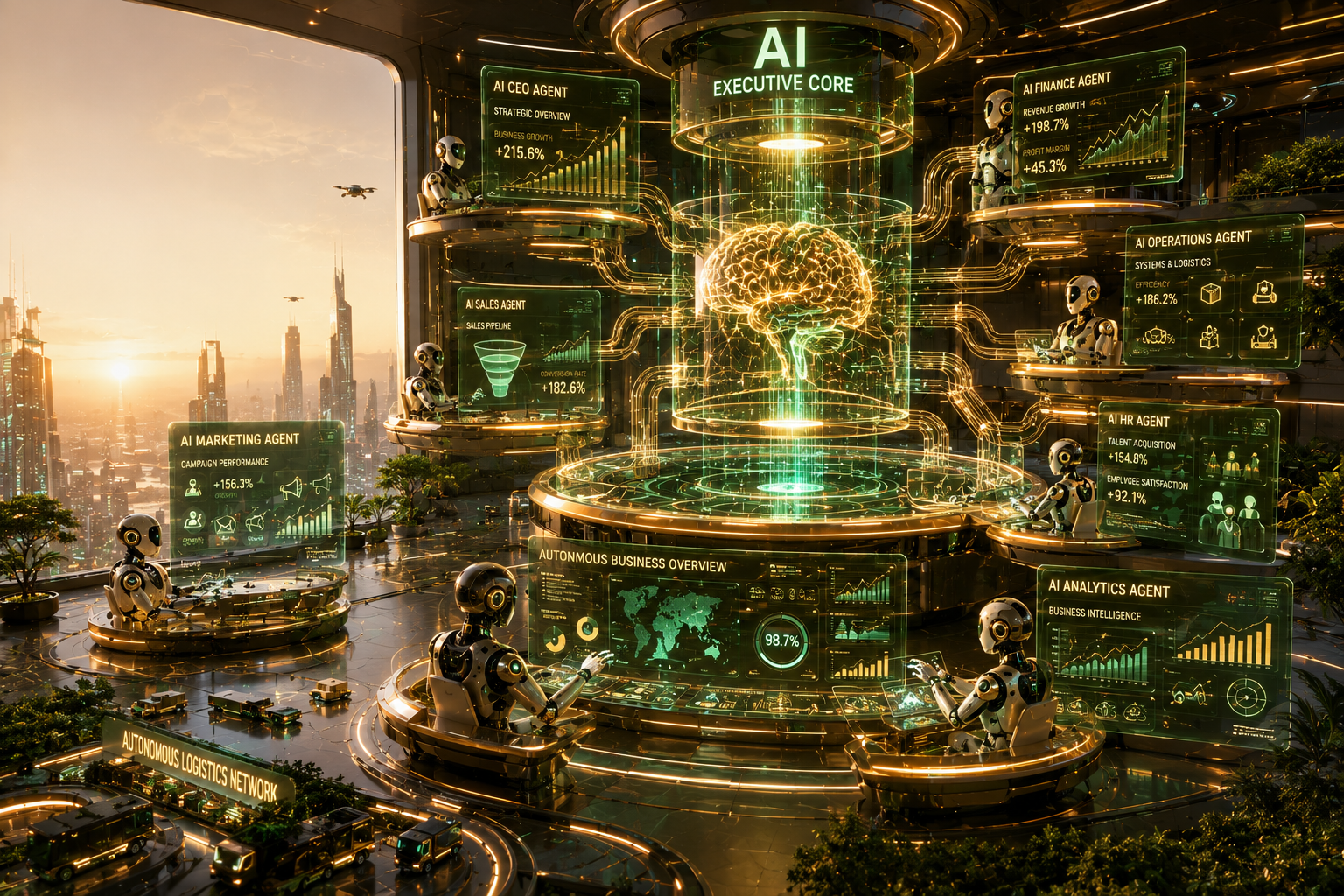
The business world is entering a new era where Artificial Intelligence is no longer just a tool that helps people work faster. In 2026, AI agents are becoming capable of handling entire business operations with minimal human involvement. These intelligent systems can research, make decisions, communicate with customers, generate content, manage marketing campaigns, analyze data, process transactions, and even improve workflows automatically. This new model is known as a fully autonomous business powered by AI agents.
Many entrepreneurs, startups, business owners, and digital marketers are exploring how AI can reduce operational costs while increasing productivity and scalability. The rise of agentic AI workflows and autonomous business systems is changing the way companies operate across industries. Understanding this trend is important because it may define the future of entrepreneurship and digital transformation. In this article, you will learn how fully autonomous businesses work, their benefits, challenges, technologies, real-world applications, future opportunities, and why AI-powered business automation is becoming one of the most significant trends of 2026.
What Are Fully Autonomous Businesses?
A fully autonomous business is a company where most business operations are managed and executed by AI systems instead of human employees.
In a traditional company, humans handle daily operations such as customer support, sales, marketing, accounting, and administration. In an autonomous business, AI agents perform these responsibilities automatically.
These businesses use advanced technologies including:
- AI agents
- Large Language Models
- Workflow automation platforms
- AI orchestration systems
- Cloud computing
- Machine learning
- Data analytics
The goal is to create a business that can operate continuously with minimal human supervision.
Understanding AI Agents
AI agents are intelligent software systems designed to complete specific tasks.
Unlike traditional software, AI agents can:
- Understand instructions
- Analyze information
- Make decisions
- Learn from data
- Interact with tools
- Complete workflows
Think of AI agents as digital employees that specialize in different departments.
For example:
- Marketing AI agent
- Customer support AI agent
- Sales AI agent
- Content creation AI agent
- Finance AI agent
- Analytics AI agent
When these agents work together, they can operate an entire business ecosystem.
Why Fully Autonomous Businesses Are Rising in 2026
The rise of autonomous businesses is driven by several factors.
Businesses today face challenges such as rising operational costs, increasing competition, talent shortages, and growing customer expectations.
AI agents help solve these challenges by providing:
- Faster operations
- Lower costs
- Better scalability
- Continuous productivity
- Real-time decision-making
Companies are realizing that AI can manage many repetitive and data-driven tasks more efficiently than traditional methods.
How Fully Autonomous Businesses Work
Fully autonomous businesses operate through interconnected AI systems that coordinate tasks and workflows.
The process generally follows a structured framework.
Business Goal Identification
The business defines objectives such as:
- Generate sales
- Support customers
- Create content
- Manage operations
Task Distribution
An orchestration system assigns tasks to specialized AI agents.
Execution
Each AI agent completes its assigned responsibilities.
Monitoring
The system continuously evaluates results and performance.
Optimization
AI agents improve workflows based on new data and outcomes.
Core Components of an Autonomous Business
Several technologies work together to create a fully autonomous organization.
AI Agents
These are the workers of the system.
Examples include:
- Writing agents
- Sales agents
- Analytics agents
- Support agents
AI Orchestration Platforms
Orchestration systems coordinate communication and collaboration between agents.
Large Language Models
Language models enable understanding, reasoning, and communication.
Automation Platforms
Workflow automation tools connect software applications and processes.
Cloud Infrastructure
Cloud systems provide storage, processing power, and scalability.
Data Systems
Data platforms collect and manage business information.
Departments That AI Can Automate
Modern AI systems can automate almost every department within a business.
Marketing Department
Marketing automation is one of the most advanced areas of AI adoption.
AI can manage:
- Content creation
- SEO optimization
- Social media posting
- Email campaigns
- Ad management
- Performance tracking
Sales Department
AI sales agents can:
- Generate leads
- Qualify prospects
- Schedule meetings
- Send follow-up messages
- Analyze customer behavior
Customer Support Department
Customer service AI systems can:
- Answer inquiries
- Process requests
- Manage tickets
- Schedule appointments
- Provide recommendations
Finance Department
Finance automation includes:
- Expense tracking
- Invoice generation
- Financial forecasting
- Fraud detection
- Budget management
Human Resources Department
AI can assist with:
- Recruitment
- Resume screening
- Employee onboarding
- Training recommendations
- Performance analysis
Operations Department
Operations automation includes:
- Workflow management
- Inventory tracking
- Vendor communication
- Process optimization
Agentic AI Workflows and Autonomous Businesses
Agentic AI workflows are the foundation of autonomous businesses.
These workflows allow AI agents to:
- Collaborate
- Share information
- Complete multi-step tasks
- Make decisions independently
For example, an autonomous marketing workflow may involve:
Research Agent
Identifies trending topics and keywords.
Content Agent
Creates blog posts and marketing materials.
SEO Agent
Optimizes content for search engines.
Publishing Agent
Uploads content to websites and social media.
Analytics Agent
Measures performance and generates reports.
This entire workflow can operate without manual intervention.
Examples of Fully Autonomous Business Models
Several business models are already moving toward autonomous operations.
AI Content Agencies
AI-powered content agencies can:
- Research topics
- Write articles
- Optimize SEO
- Publish content
- Analyze performance
AI Marketing Agencies
Marketing agencies use AI to:
- Create campaigns
- Manage ads
- Generate reports
- Automate social media
AI Customer Support Services
Businesses use autonomous support systems to handle customer interactions.
AI SaaS Companies
Software-as-a-Service platforms increasingly rely on AI for operations and customer support.
AI E-commerce Stores
Online stores automate:
- Product descriptions
- Inventory management
- Marketing
- Customer support
Benefits of Fully Autonomous Businesses
Autonomous businesses provide significant advantages.
Lower Operational Costs
AI reduces dependency on large teams and repetitive manual labor.
24/7 Operations
AI systems never sleep and can operate continuously.
Faster Growth
Businesses can scale operations more quickly.
Improved Productivity
AI agents complete tasks rapidly and consistently.
Better Data Analysis
AI processes large amounts of information efficiently.
Reduced Human Error
Automation improves consistency and accuracy.
Global Reach
AI-powered businesses can serve customers worldwide.
Faster Decision-Making
Real-time data allows AI systems to make quick decisions.
Technologies Powering Autonomous Businesses
Several technologies make autonomous businesses possible.
Large Language Models
These systems enable natural language understanding and generation.
Machine Learning
Machine learning helps systems improve over time.
Robotic Process Automation
RPA automates repetitive digital tasks.
Cloud Computing
Cloud infrastructure provides scalability and reliability.
APIs and Integrations
APIs connect AI agents with software applications.
Data Analytics
Analytics systems provide insights for decision-making.
Popular Tools Used in Autonomous Businesses
Several platforms help businesses build autonomous operations.
Popular solutions include:
- LangChain
- CrewAI
- AutoGen
- n8n
- Zapier
- OpenAI APIs
- Microsoft Semantic Kernel
These platforms help organizations build AI-powered workflows and multi-agent systems.
No Human in the Loop Businesses
A major trend in 2026 is No Human in the Loop (NHITL) operations.
This means AI systems can perform workflows without requiring human approval at every step.
Examples include:
- Automated content publishing
- Autonomous customer support
- AI lead generation
- Automated reporting
However, many businesses still maintain human oversight for critical decisions.
Human in the Loop vs Fully Autonomous Systems
Not every process should be completely automated.
Human in the Loop
Humans supervise and approve AI actions.
Best for:
- Healthcare
- Legal services
- Financial compliance
- Sensitive operations
Fully Autonomous Systems
AI manages workflows independently.
Best for:
- Content marketing
- Data analysis
- Customer support
- Routine business processes
Challenges of Fully Autonomous Businesses
Despite their advantages, autonomous businesses face challenges.
AI Hallucinations
AI systems may sometimes generate incorrect information.
Security Risks
Automated systems can become targets for cyberattacks.
Privacy Concerns
AI often processes sensitive customer data.
Dependence on Technology
Businesses rely heavily on cloud providers and AI platforms.
Integration Complexity
Connecting multiple systems can be challenging.
Ethical Concerns
Autonomous operations raise questions about accountability and transparency.
Security Requirements for Autonomous Businesses
Security is essential when implementing AI automation.
Businesses should:
- Use strong authentication
- Encrypt sensitive data
- Monitor AI activities
- Conduct regular audits
- Implement access controls
These practices reduce operational risks.
Industries Leading the Autonomous Business Revolution
Several industries are rapidly adopting AI-powered business models.
Digital Marketing
Marketing agencies are among the earliest adopters.
E-commerce
Online retailers use AI for operations and customer engagement.
Finance
Financial institutions automate analysis and risk management.
Healthcare
Healthcare organizations automate administrative processes.
Software Development
Developers use AI coding assistants and automation systems.
Logistics
Supply chain operations increasingly rely on intelligent automation.
Future Trends in Autonomous Businesses
The future of autonomous businesses is evolving rapidly.
Autonomous AI Teams
Organizations may deploy complete AI departments.
AI-to-AI Communication
AI systems will collaborate directly with each other.
Hyperautomation
Entire business operations may become automated.
Self-Improving Businesses
AI systems may continuously optimize themselves.
Personalized Business Ecosystems
Companies will build customized AI environments tailored to their needs.
AI Digital Employees
AI agents may function as permanent digital workers.
How Startups Can Benefit From Autonomous Business Models
Startups often have limited resources.
AI automation helps startups:
- Reduce hiring costs
- Launch faster
- Scale operations
- Improve productivity
- Compete with larger companies
This makes autonomous business models highly attractive for entrepreneurs.
Skills Needed in the Age of Autonomous Businesses
As AI adoption increases, professionals need new skills.
Important skills include:
- AI literacy
- Workflow automation
- Prompt engineering
- Data analysis
- AI orchestration
- Cloud computing
- Strategic decision-making
Human roles will increasingly focus on creativity, leadership, and innovation.
Will AI Replace Business Owners?
AI can automate many tasks, but business owners still provide critical value.
Humans remain important for:
- Strategic vision
- Leadership
- Innovation
- Relationship building
- Ethical decision-making
The future is likely to involve collaboration between humans and AI rather than complete replacement.
Why Fully Autonomous Businesses Will Continue Growing
Several factors support the growth of autonomous businesses.
These include:
- Rising labor costs
- Increasing automation capabilities
- Better AI models
- Improved cloud infrastructure
- Demand for efficiency
As AI technology improves, autonomous business operations will become more accessible to organizations of all sizes.
The Future of Entrepreneurship in an AI-Driven World
Entrepreneurship is changing dramatically.
Future entrepreneurs may launch businesses with:
- Small teams
- AI agents
- Automated workflows
- Cloud infrastructure
This creates opportunities for faster innovation and global scalability.
The ability to build and manage AI-powered systems may become one of the most valuable business skills of the future.
Conclusion
The rise of fully autonomous businesses powered by AI agents represents one of the most important business transformations of the modern era. AI systems are moving beyond simple automation and becoming capable of managing complete workflows, departments, and business operations.
From marketing and customer support to finance and operations, AI agents are helping organizations reduce costs, increase productivity, and scale faster than ever before. While challenges related to security, ethics, and governance remain important, the potential benefits are enormous.
Businesses that understand and adopt autonomous AI systems early may gain significant competitive advantages. As technology continues to evolve, fully autonomous businesses are likely to become a major part of the global economy, shaping the future of entrepreneurship, innovation, and digital transformation.
Read More Blog- AI Startup Edge
FAQs
1. What is a fully autonomous business?
A fully autonomous business uses AI agents and automation systems to manage most operations with minimal human involvement.
2. What are AI agents?
AI agents are intelligent software systems that can perform tasks, make decisions, and interact with tools automatically.
3. How do autonomous businesses work?
They use AI agents, orchestration platforms, automation tools, and cloud systems to manage workflows and operations.
4. What industries use autonomous business models?
Industries such as marketing, e-commerce, finance, healthcare, software development, and logistics are adopting these models.
5. What are the benefits of autonomous businesses?
Benefits include lower costs, 24/7 operations, scalability, productivity improvements, and faster decision-making.
6. What are the risks of autonomous businesses?
Risks include cybersecurity threats, privacy concerns, AI errors, and technology dependence.
7. Can AI completely replace employees?
AI can automate many repetitive tasks, but humans remain important for strategy, creativity, leadership, and ethics.
8. What tools help build autonomous businesses?
Popular tools include LangChain, CrewAI, AutoGen, Zapier, n8n, and AI APIs.
9. What is No Human in the Loop?
It refers to workflows where AI systems operate without requiring human approval for every action.
10. What is the future of autonomous businesses?
The future includes autonomous AI teams, hyperautomation, self-improving systems, AI digital employees, and highly scalable AI-powered organizations.