

Modern startups are under constant pressure to respond faster, sell better, and serve customers without increasing costs. In this situation, many founders face an important question: Should we use AI chatbots or rely on human sales teams?
Some startups rush to use AI chatbots everywhere, hoping automation will solve all sales problems. Others completely depend on sales teams and avoid AI due to fear or confusion. The truth is, both AI chatbots and sales teams are powerful—but they work best in different situations.
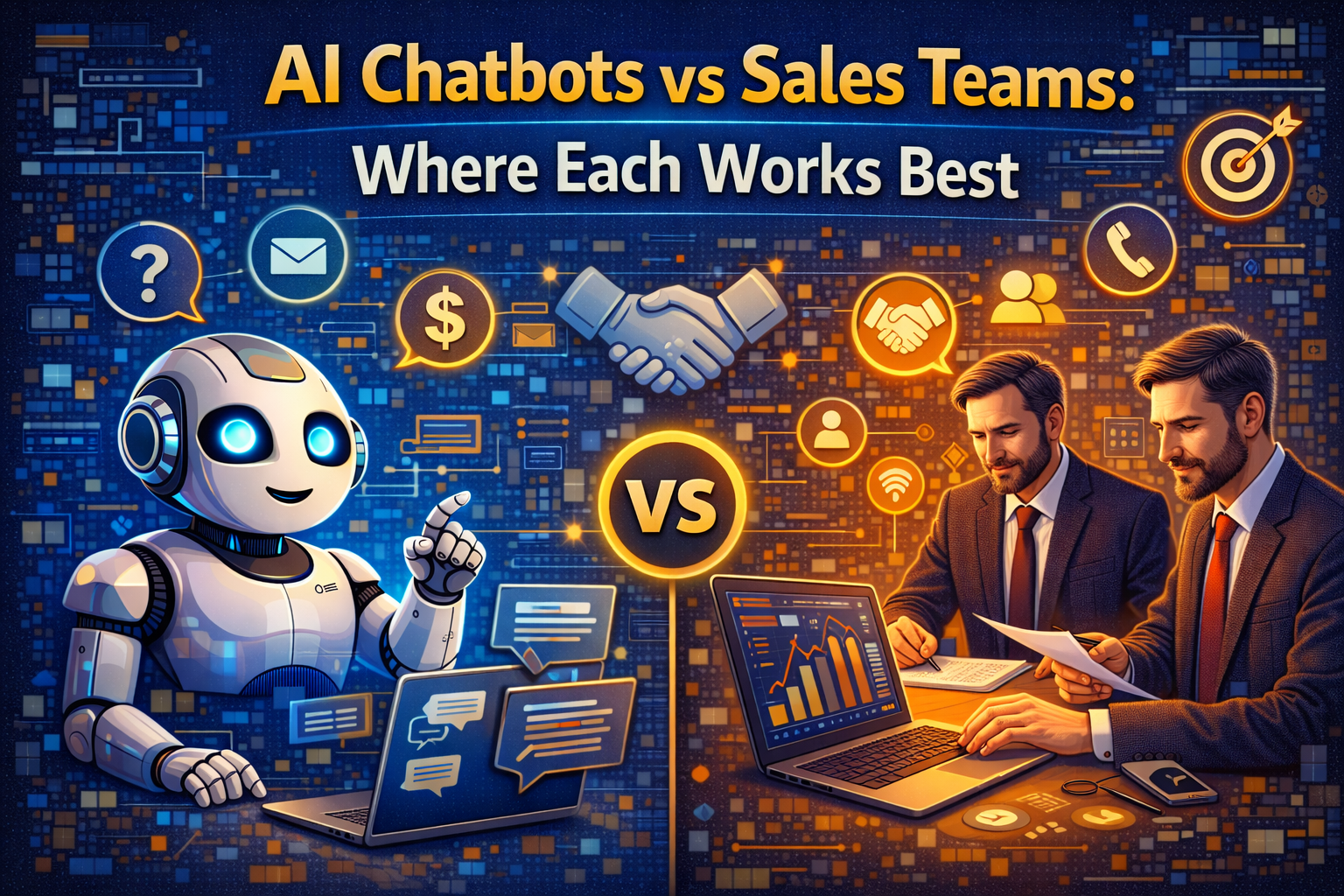
AI chatbots are excellent at speed, automation, and handling large volumes of conversations. Sales teams are best at trust-building, negotiation, and closing complex deals. Startups fail when they replace one with the other instead of using both smartly.
This article explains where AI chatbots work best, where sales teams work best, and how startups should balance both. If you want higher conversions, better customer experience, and efficient growth, this guide will give you clear answers.
Understanding AI Chatbots in Simple Terms
AI chatbots are software systems that use artificial intelligence to communicate with users automatically. They can chat with website visitors, answer questions, qualify leads, and even schedule meetings.
AI chatbots work well because they:
- Respond instantly
- Handle many users at the same time
- Follow rules consistently
- Never get tired
However, they still lack emotional intelligence and deep human understanding.
Understanding Sales Teams in Simple Terms
Sales teams are humans who interact directly with customers. They listen, understand emotions, negotiate, and build trust over time.
Sales teams are powerful because they:
- Understand context deeply
- Build personal relationships
- Handle objections creatively
- Close complex deals
But sales teams are limited by time, energy, and scale.
Why Startups Should Not Choose One Over the Other
The biggest mistake startups make is treating this as AI chatbots vs sales teams. The smarter approach is AI chatbots with sales teams.
Each has strengths and weaknesses. Growth happens when startups use both in the right places.
Where AI Chatbots Work Best
AI chatbots perform best in situations that are repetitive, fast, and high-volume.
1. First Interaction with Website Visitors
The first few seconds matter when a visitor lands on a website. AI chatbots are perfect for this stage.
AI chatbots work best here because:
- They respond instantly
- They greet visitors automatically
- They reduce bounce rate
- They capture basic information
This ensures no visitor is ignored.
2. Answering Frequently Asked Questions
Most customer questions are repetitive. AI chatbots handle them efficiently.
AI chatbots are ideal for:
- Pricing questions
- Feature explanations
- Service details
- Basic onboarding queries
This reduces workload on sales teams.
3. Lead Qualification and Data Collection
Before sales teams get involved, leads must be filtered.
AI chatbots work best for:
- Asking qualification questions
- Collecting contact details
- Understanding user needs
- Assigning lead scores
Only serious leads move forward.
4. 24/7 Availability and Global Reach
Sales teams cannot work all the time. AI chatbots can.
AI chatbots are best for:
- Night-time inquiries
- International visitors
- Weekend support
- High traffic periods
This ensures constant engagement.
5. Automating Follow-Ups and Reminders
Missed follow-ups cost sales.
AI chatbots help by:
- Sending reminders
- Re-engaging inactive leads
- Sharing content automatically
- Nudging prospects gently
Automation keeps leads warm.
Where Sales Teams Work Best
Sales teams are essential where human understanding and trust matter most.
1. Complex and High-Value Sales
Some deals need explanation, negotiation, and trust.
Sales teams work best when:
- Pricing is customised
- Solutions are complex
- Decision-makers are involved
- Long-term relationships matter
AI cannot replace human judgment here.
2. Handling Objections and Concerns
Customers often have doubts and fears.
Sales teams are best at:
- Listening carefully
- Understanding emotions
- Addressing unique concerns
- Building confidence
AI struggles with emotional nuance.
3. Relationship Building and Trust Creation
Trust drives conversions.
Sales teams excel at:
- Personal communication
- Building rapport
- Long-term engagement
- Customer loyalty
Human connection matters.
4. Closing Deals and Negotiation
Closing requires timing, persuasion, and flexibility.
Sales teams are best at:
- Negotiating terms
- Adjusting offers
- Reading signals
- Sealing the deal
AI supports but does not replace this.
5. Strategic Account Management
Key accounts need attention.
Sales teams handle:
- Upselling and cross-selling
- Long-term value creation
- Client retention
- Strategic partnerships
This requires human insight.
AI Chatbots vs Sales Teams: Key Differences
Understanding the difference helps in better allocation.
AI chatbots are:
- Fast
- Scalable
- Consistent
- Cost-efficient
Sales teams are:
- Empathetic
- Strategic
- Flexible
- Relationship-driven
Both are essential.
How AI Chatbots and Sales Teams Work Best Together
The real power lies in collaboration.
A smart workflow looks like this:
- AI chatbot engages visitors
- AI qualifies and scores leads
- Sales team handles high-quality leads
- AI supports follow-ups
- Sales team closes deals
This balance maximises efficiency and conversions.
Benefits of Using Both AI Chatbots and Sales Teams
Startups that combine both see:
- Higher conversion rates
- Lower customer acquisition cost
- Faster response times
- Better customer experience
- Reduced sales team burnout
Efficiency and empathy work together.
Common Mistakes Startups Make
Many startups struggle due to wrong implementation.
Common mistakes include:
- Replacing sales teams completely
- Using chatbots everywhere
- Ignoring human touch
- Poor chatbot design
Balanced use is the key.
How Startups Should Decide What to Use and When
A simple rule works well.
Use AI chatbots when:
- Speed matters
- Volume is high
- Tasks are repetitive
Use sales teams when:
- Trust matters
- Decisions are complex
- Revenue impact is high
This clarity improves results.
The Future of Sales: AI and Humans Together
Sales is not becoming fully automated. It is becoming AI-assisted.
In the future:
- AI will handle routine work
- Sales teams will focus on relationships
- Decisions will be data-driven
- Experiences will be personalised
Startups that adapt early will win.
Final Thoughts from AI Startup Edge
AI chatbots and sales teams are not competitors. They are partners.
AI chatbots bring speed and efficiency. Sales teams bring trust and strategy. Together, they create a powerful sales system.
At AI Startup Edge, we help startups design balanced sales systems where AI handles scale and humans handle impact.
Frequently Asked Questions (FAQs)
1. Can AI chatbots replace sales teams?
No. They support sales teams but cannot replace human trust and negotiation.
2. Are AI chatbots useful for early-stage startups?
Yes. They save time, reduce costs, and improve lead handling.
3. Do customers prefer chatbots or humans?
Customers prefer chatbots for quick answers and humans for serious decisions.
4. Is chatbot implementation expensive?
Many chatbot tools are affordable and startup-friendly.
5. How does AI Startup Edge help?
AI Startup Edge helps startups balance AI automation with human sales strategy.