


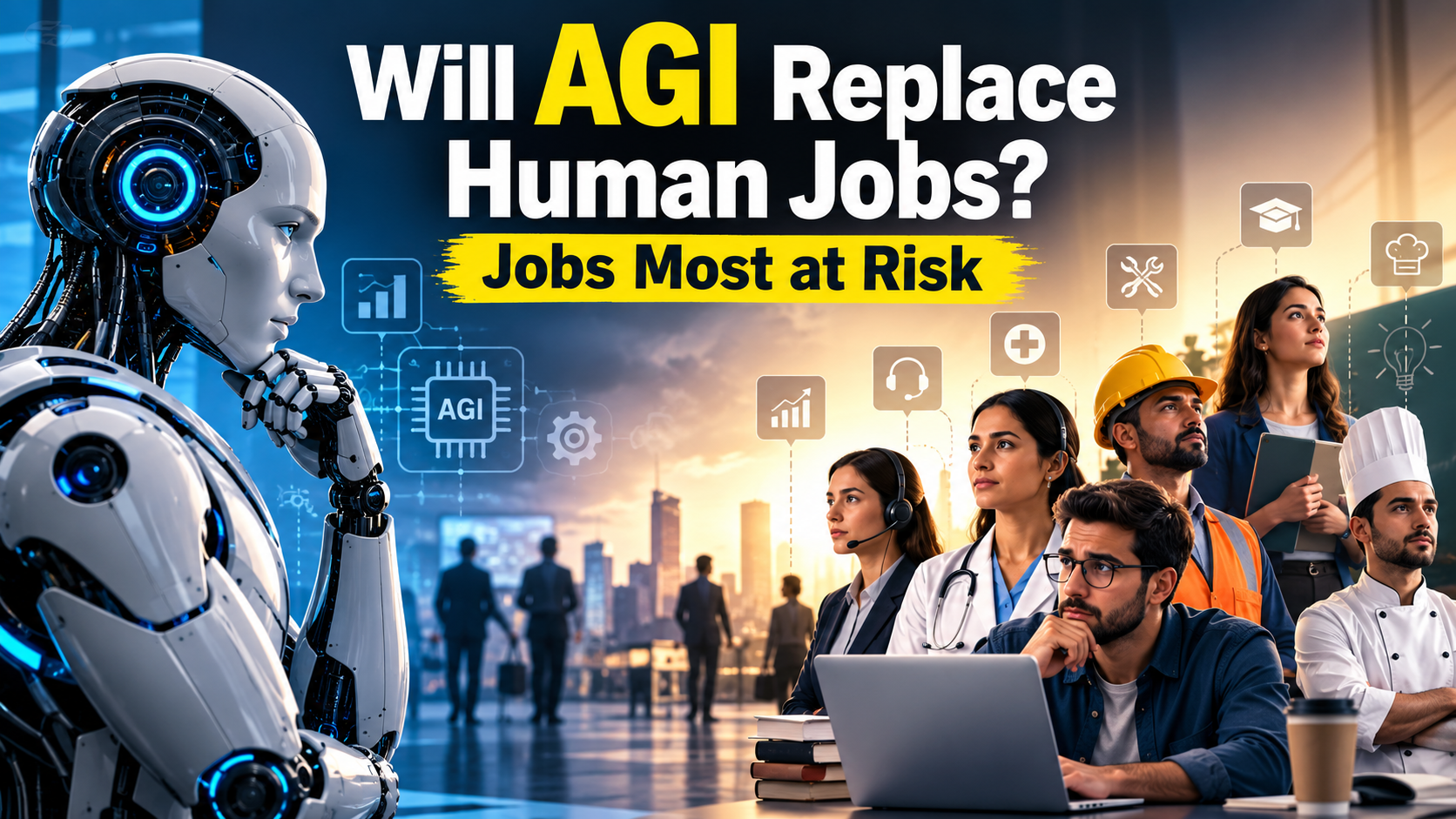
Imagine waking up one morning and discovering that artificial intelligence can perform many tasks faster than humans. It can write reports, answer customer questions, analyze data, create designs, and even help develop software. Now imagine a more advanced technology called Artificial General Intelligence (AGI) that can learn and solve problems across many different fields. Will AGI replace human jobs, or will it create new opportunities for workers?
This question matters because the future of work could affect almost everyone, including students, office employees, business owners, programmers, teachers, and freelancers. Some jobs may face major changes, while others may continue to need human skills such as creativity, empathy, leadership, and practical judgment.
In this article, we will explore the jobs most at risk from AGI, careers that may remain valuable, and the skills you can develop today. You will also learn how to prepare for an uncertain but potentially exciting future.
1. What Is AGI and Why Is It Important for Human Jobs?
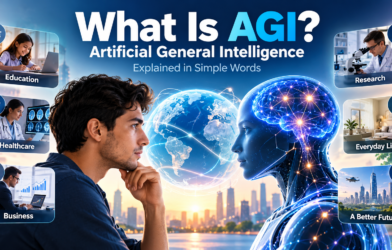
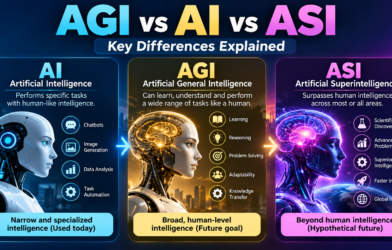
Artificial General Intelligence, or AGI, is a type of artificial intelligence designed to learn, understand, and solve many different kinds of problems at a human-like level. Unlike an AI tool made for one particular task, AGI would aim to work across different fields without needing a completely separate system for every task.
For example, today’s AI tools can help people write emails, generate images, summarize documents, and write computer code. A more capable AGI system might be able to understand a business goal, plan the work, use different software, solve unexpected problems, and complete a project with limited human guidance.
However, there is an important difference between what AGI might eventually do and what current AI systems can reliably do. AGI has not been universally established as an achieved technology, and nobody knows exactly when it will arrive or how powerful it will become.
AGI matters for jobs because many careers involve thinking, learning, making decisions, and completing tasks with information. If future AI systems become capable of performing these activities at a low cost, companies may change the way they hire and organize their employees.
The International Labour Organization has found that generative AI is more likely to transform many existing jobs than completely eliminate them. Its research also shows that exposure to AI does not automatically mean a job will disappear.
2. Will AGI Replace Human Jobs in the Future?
The short answer is that AGI could replace some human jobs, change many others, and create new types of work. The final result will depend on the capabilities of AI, business decisions, economic conditions, government policies, and people’s ability to adapt.
Imagine a company with 20 employees who spend most of their working hours entering information, preparing reports, answering common questions, and updating records. If an advanced AI system can perform these tasks accurately, the company may need fewer employees for routine work.
Now imagine a hospital. AI might help doctors review medical information, identify possible problems, and organize patient records. However, doctors and nurses would still be needed for many tasks involving physical examinations, patient care, difficult decisions, and human communication.
The same technology can therefore have different effects in different industries.
Three possible outcomes of AGI for employment
1. Some jobs may disappear.
Jobs made up mainly of repetitive, predictable tasks could face significant pressure. Businesses may automate these tasks to reduce costs and improve speed.
2. Many jobs may change.
Workers may continue doing their jobs but use AI to complete tasks faster. For example, a marketing professional may use AI to research keywords, prepare content drafts, analyze campaign results, and generate reports.
3. New jobs may develop.
Businesses may need people to manage AI systems, check their output, protect data, design automated workflows, and solve problems that technology cannot handle reliably.
The World Economic Forum’s Future of Jobs Report 2025 identifies technological change as a major force reshaping employment through 2030. It also highlights growing demand for AI, big data, cybersecurity, and technological literacy skills.
This means workers should prepare for change rather than assume that every job will disappear.
3. Jobs Most at Risk From AGI
Not every profession faces the same level of risk. Jobs that involve digital information, repetitive processes, predictable decisions, or standardized communication may be easier to automate than jobs requiring complex physical work, personal trust, or responsibility in unpredictable situations.
The following list describes occupations that could face greater pressure as AI systems become more capable. It is a risk assessment, not a prediction that all these jobs will disappear.

1. Data Entry Operators
Higher exposure
Data entry operators enter, update, and organize information in digital systems. AI and automation tools can already extract information from documents, recognize text, and transfer data between applications.
As these systems improve, businesses may need fewer workers for basic data entry. Workers can prepare by learning spreadsheet analysis, data quality control, database management, and AI-assisted reporting.

2. Basic Customer Support Agents
Higher exposure
Many customer service questions follow predictable patterns. AI chatbots and voice assistants can answer common questions, explain policies, track orders, and guide customers through simple processes.
Human agents will still be valuable for angry customers, unusual cases, sensitive discussions, and complicated problems. Customer service workers can develop conflict resolution, communication, and technical support skills.

3. Administrative Assistants
Higher exposure
Routine administrative work includes scheduling meetings, preparing standard documents, organizing emails, and updating records. AI assistants can help automate many of these activities.
Employees who learn project coordination, business operations, client management, and AI workflow tools may become more valuable because they can manage several processes instead of performing only routine tasks.

4. Basic Content Writers
AI can generate product descriptions, simple blog drafts, social media captions, email messages, and summaries. This could reduce demand for some low-cost content production work.
However, original reporting, expert analysis, interviews, brand strategy, fact-checking, and first-hand experience remain important. Writers can focus on research-based content, editing, storytelling, and subject expertise.

5. Bookkeepers and Basic Accounting Clerks
AI-powered software can categorize transactions, match invoices, prepare preliminary reports, and identify unusual entries. Routine accounting work may become more automated.
Professional judgment, tax compliance, auditing, financial planning, and responsibility for accurate records will remain important. Accountants who understand AI tools and financial analysis can adapt more effectively.

6. Basic Translation Workers
AI translation systems can convert common text between many languages quickly. This may put pressure on simple translation work, especially where the text is repetitive and mistakes have low consequences.
Legal, medical, literary, and culturally sensitive translation still requires careful human review and specialist knowledge. Translators can develop expertise in specific industries and quality assurance.

7. Junior Programmers Performing Routine Coding
AI coding tools can generate standard code, explain errors, write simple tests, and assist with routine development tasks. This may change how companies hire for entry-level programming work.
However, software development includes much more than writing code. Understanding requirements, designing reliable systems, securing applications, debugging complex problems, and maintaining software require deeper skills.

8. Basic Digital Marketing Executives
AI can help with keyword research, ad variations, campaign summaries, content ideas, and routine social media posts. Businesses may automate some repetitive marketing tasks.
Strategy, customer research, creative direction, conversion optimization, brand positioning, and business judgment will remain valuable. Marketers should learn to use AI while improving their understanding of real customers and measurable results.

9. Routine Insurance and Claims Processing Staff
Standard claims may involve checking documents, matching information, applying predefined rules, and preparing summaries. These tasks are potential targets for automation.
Complex claims, fraud investigations, disputed cases, customer support, and decisions requiring accountability may still need human professionals.

10. Routine Banking and Office Clerks
Basic document processing, account information updates, standard customer queries, and routine checks can increasingly be supported by automation.
Banking professionals who develop financial knowledge, relationship management, compliance skills, fraud detection expertise, and complex problem-solving abilities may be better positioned for changing roles.
These examples reflect the nature of the tasks involved, not a definitive ranking of future job losses. The ILO’s research shows that AI exposure varies within occupations and that many jobs contain important tasks that still require human involvement.
4. Why Are Some Jobs More at Risk Than Others?
To understand the effect of AGI, it is important to look beyond job titles. Two people with the same job title may perform very different tasks, and their risks can therefore be different.
Some types of work are easier to automate because they follow clear rules and use information that is already available digitally.
Main factors that increase automation risk
1. Repetitive tasks: Work that follows the same steps every day is often easier to automate than work involving changing situations.
2. Digital information: AI can work directly with emails, spreadsheets, documents, databases, images, and software. Jobs based heavily on these materials may face greater exposure.
3. Standardized decisions: If a task follows a fixed set of rules and requires little judgment, software may perform it more efficiently.
4. Predictable results: Tasks that have clear inputs and measurable outputs are often easier to automate and check.
5. Low-cost automation: Businesses are more likely to adopt technology when it is affordable, reliable, secure, and cheaper than the existing process.
6. Limited need for human interaction: Work that requires little trust, emotional understanding, or personal communication may be easier to automate completely.
However, high AI exposure does not guarantee job losses. Technology adoption depends on cost, regulation, customer expectations, reliability, and the need for human oversight. A task that AI can perform in a demonstration may still be unsuitable for full automation in a real business.
5. Which Jobs Are Less Likely to Be Replaced by AGI?
No profession is guaranteed to remain unchanged forever. Nevertheless, jobs involving physical work in unpredictable environments, personal care, strong human relationships, or complex responsibility may be harder to automate completely.
The following careers may be relatively more resilient, although AI could still change their daily responsibilities.
1. Healthcare Professionals
Doctors, nurses, physiotherapists, and other healthcare professionals work directly with people. They must understand patient needs, interpret complex situations, provide treatment, and respond to unexpected changes.
AI may support diagnosis, documentation, and research, but safe healthcare also requires clinical judgment, physical care, communication, and accountability.
2. Electricians and Plumbers
Electricians and plumbers work in homes, offices, factories, and construction sites. Each location may have different wiring, pipe layouts, equipment, and safety problems.
Robots may eventually handle more physical tasks, but operating reliably in varied real-world environments is difficult. Technical training and practical experience can help workers remain valuable.
3. Teachers and Trainers
AI can explain concepts, generate quizzes, and provide personalized practice. However, teachers also motivate students, manage classrooms, understand emotional needs, and build relationships.
Teachers who combine strong teaching skills with AI-powered learning tools may improve their effectiveness.
4. Mental Health Professionals and Counselors
Counselors and mental health professionals need to build trust, understand personal circumstances, and respond carefully to emotional needs. AI may support administrative work and provide limited informational assistance, but professional care involves important safety and ethical responsibilities.
5. Skilled Construction Workers
Carpenters, masons, repair technicians, and many construction professionals work in changing physical environments. They must adjust to different materials, measurements, weather conditions, and unexpected problems.
Automation may become more common on construction sites, but many practical tasks will remain challenging for machines.
6. Managers and Business Leaders
AI can analyze data, prepare reports, and recommend actions. Business leaders must also set goals, manage people, negotiate, handle conflicts, and accept responsibility for decisions.
Managers who understand technology and human behavior may be better prepared for an AI-driven workplace.
7. Creative Directors and Brand Strategists
AI can generate images, designs, videos, and written content. However, effective creative work requires understanding audiences, business objectives, cultural context, brand identity, and the reasons people make decisions.
Creative professionals who develop original ideas and use AI as a production tool may have an advantage over those who rely only on repetitive content creation.
8. Cybersecurity and AI Safety Specialists
As businesses depend more on AI and digital systems, protecting information and preventing misuse become increasingly important. Cybersecurity professionals investigate threats, manage risks, and respond to attacks.
AI may automate some security tasks, but it can also create new challenges that require skilled human oversight.
The important lesson is not that these careers are completely safe. It is that combining practical expertise, human judgment, and AI skills may provide stronger career resilience than relying on routine tasks alone.
6. Will AGI Replace Jobs in India?
India could experience both opportunities and challenges as AI technology develops. The impact will vary across industries, cities, education levels, and types of employment.
India has a large workforce in information technology, business services, customer support, finance, marketing, education, manufacturing, and other sectors. Many businesses already use digital tools to handle routine work, and more capable AI systems could accelerate this change.
Research from the Ashoka University’s Isaac Centre for Public Policy highlights the importance of understanding how AI exposure interacts with employment patterns and skills in India. It points to the need for industry-relevant skills that help workers adapt to technological change.
Indian jobs that may face greater AI pressure
1. BPO and call centre jobs: Basic customer queries, scripted calls, and routine support tasks could increasingly be handled by AI chatbots and voice systems.
2. Data entry and back-office jobs: Document processing, record updates, and routine data checking may require fewer manual steps.
3. Basic IT services: Standard coding, software testing, documentation, and simple troubleshooting could become more automated.
4. Digital content production: Basic blog drafts, product descriptions, captions, and repetitive promotional content may be produced faster with AI.
5. Routine accounting work: Invoice processing, transaction categorization, and standard financial reports may require less manual effort.
These changes will not happen at the same speed everywhere. Small businesses may adopt AI differently from large companies, and some employers may need years to update their systems and train their workers.
How Indian workers can prepare
Workers can improve their future opportunities by learning practical AI tools, improving communication skills, developing specialist knowledge, and understanding how their industries operate.
For example, a digital marketing professional can learn AI-assisted keyword research, analytics, conversion optimization, and campaign strategy. An accountant can combine accounting knowledge with automation and financial analysis. A customer support employee can develop technical support, complaint resolution, and customer relationship skills.
The aim is to become more capable with AI rather than competing with it on repetitive work alone.
7. Will AGI Replace Software Engineers and Programmers?
Software engineers are often part of discussions about AGI because AI systems can already assist with code generation, debugging, documentation, and testing.
More advanced systems may automate a larger share of routine software development. This could change the number of people needed for some projects and the skills expected from entry-level developers.
However, software engineering involves more than producing lines of code. Developers must understand what users need, choose appropriate architectures, manage security risks, integrate systems, and ensure that software behaves correctly under real conditions.
Skills programmers should develop
Programmers can prepare for future changes by learning:
- System design and software architecture.
- Cybersecurity and secure coding practices.
- AI-assisted development and code review.
- Database design and data engineering.
- Cloud computing and deployment.
- Testing, debugging, and reliability engineering.
- Communication with clients and product teams.
The strongest developers may be those who can use AI to build software more efficiently while understanding how to evaluate and improve the results.
8. Will AGI Replace Digital Marketing Jobs?
Digital marketing is another field that could change significantly. AI can support SEO research, social media planning, ad copy generation, content creation, email campaigns, and performance reporting.
This does not mean digital marketing will disappear. Businesses will continue to need customers, and they will need people who understand how to reach those customers effectively.
The biggest risk may be for professionals whose entire service consists of producing large amounts of generic content without adding original research, strategy, or measurable business value.
How digital marketers can stay competitive
1. Learn AI marketing tools. Use them to speed up research, content production, reporting, and repetitive tasks.
2. Develop stronger SEO skills. Understand search intent, website structure, technical SEO, helpful content, and conversion optimization.
3. Focus on real business results. Learn to measure leads, sales, customer acquisition costs, and return on marketing investment.
4. Improve creative strategy. Understand customer psychology, brand positioning, storytelling, and campaign planning.
5. Build automation workflows. Learn how to connect marketing platforms, organize leads, automate follow-ups, and improve reporting.
6. Develop industry expertise. Marketing for a healthcare provider, a property business, and an online store requires different knowledge and approaches.
Professionals who combine marketing judgment with AI-powered execution may be able to serve more clients and deliver better results.
9. What New Jobs Could AGI Create?
Technology does not only remove tasks. It can also make new products, services, and businesses possible.
Although nobody can reliably list every job that future AGI will create, several areas may offer opportunities as AI adoption expands.
1. AI Workflow Specialists: These professionals design systems that connect AI tools with business software and everyday processes.
2. AI Operations Managers: They monitor AI performance, coordinate human oversight, and improve how organizations use AI.
3. AI Security Specialists: They help protect AI systems, business information, and digital infrastructure against misuse and attacks.
4. AI Auditors and Evaluators: They test AI systems for accuracy, reliability, fairness, security, and compliance with relevant requirements.
5. Robotics Technicians: They install, maintain, and repair robotic equipment used in manufacturing, logistics, healthcare, and other industries.
6. AI Product Managers: They identify customer problems, plan AI-powered products, and coordinate the people responsible for developing them.
7. Human-AI Training Specialists: They help employees learn new tools and adapt existing business processes.
8. AI-Powered Business Consultants: They help companies identify useful automation opportunities, implement suitable tools, and evaluate business results.
These are possible growth areas, not guaranteed future careers. Their demand will depend on how AI develops and how businesses choose to use it.
10. How to Prepare for AGI and Protect Your Career
You do not need to wait for AGI to arrive before preparing. You can begin developing useful skills with the AI tools available today.
The goal is not to predict the exact future. It is to become flexible enough to adapt when your industry changes.
A practical six-step career plan
Step 1: Understand your current job.
Write down your main daily tasks. Identify which tasks are repetitive, which require judgment, and which depend on personal interaction or practical experience.
This will help you understand where AI might affect your work.
Step 2: Learn one useful AI tool.
Choose a tool relevant to your profession. For example, a marketer might learn AI-assisted research, while an accountant might explore automated document processing.
Focus on solving real problems instead of collecting tools without a clear purpose.
Step 3: Automate a small task.
Try using AI to prepare a first draft, summarize a report, organize information, or generate a checklist. Check the output carefully before using it.
Practical experience will help you understand both the benefits and limitations of AI.
Step 4: Develop skills AI cannot easily handle alone.
Improve communication, critical thinking, negotiation, creativity, problem-solving, leadership, and professional judgment.
These skills can complement AI and help you take responsibility for more complex work.
Step 5: Build a portfolio of results.
Keep examples of projects where you used AI to improve speed, accuracy, quality, or business performance. A portfolio can demonstrate your ability to apply technology in a useful way.
Step 6: Keep learning.
AI tools and employer expectations will continue to evolve. Set aside regular time to learn new techniques, understand changes in your industry, and update your professional skills.
The World Economic Forum identifies analytical thinking, resilience, flexibility, creative thinking, and technological literacy among the skills that employers value as work changes.
11. What Should Students Study for the AGI Era?
Students may face a changing job market by the time they graduate. Choosing a course based only on current job titles may therefore be less useful than developing a combination of technical knowledge, practical experience, and transferable skills.
There is no single degree that guarantees a successful career in an AI-driven world.
Useful fields and skills for students
- Computer science: Learn programming, algorithms, software engineering, and AI fundamentals.
- Data analysis: Develop skills in statistics, spreadsheets, databases, and data visualization.
- Cybersecurity: Study network security, digital protection, risk management, and incident response.
- Healthcare: Build clinical knowledge, practical care skills, and strong communication.
- Engineering and skilled trades: Learn how to design, install, operate, and repair physical systems.
- Business and management: Develop financial knowledge, leadership, decision-making, and customer understanding.
- Creative fields: Build original thinking, visual communication, storytelling, and creative direction.
Students should also learn how to evaluate AI-generated information. AI can produce incorrect answers, misleading explanations, or unreliable sources. Understanding a subject remains important even when a tool can generate an answer quickly.
A good strategy is to develop one strong professional skill and learn how AI can improve it.
12. Will AGI Cause Mass Unemployment?
Mass unemployment is a possible concern, but it is not an inevitable result of AGI.
If AI systems become capable of performing many tasks at a lower cost, some businesses may reduce hiring or restructure their workforce. Workers whose tasks are automated could struggle to find new positions, especially if they lack access to training or suitable job opportunities.
At the same time, businesses may expand because AI reduces operating costs, creates new services, and allows employees to do more work. These effects could support new employment in some sectors.
The final result will depend on how quickly automation develops, how many new opportunities emerge, whether workers can move into those opportunities, and how the economic benefits are distributed.
Research published by the International Labour Organization in June 2026 reviewed evidence from experiments, businesses, and worker surveys. It found productivity benefits from generative AI but noted that large-scale job displacement had remained limited in the evidence reviewed, while warning about unequal effects and reduced opportunities for younger workers.
Governments, employers, educational institutions, and workers will all have a role in managing the transition. Training programs, fair employment practices, and support for displaced workers could help reduce the harm caused by rapid changes.
13. When Will AGI Start Replacing Human Jobs?
There is no confirmed date when AGI will arrive or begin replacing workers at a large scale.
AI-related job changes are already happening, but current AI automation should not be confused with the arrival of AGI. Companies can automate individual tasks without having a system that matches broad human abilities across different environments.
The speed of future changes will depend on several factors:
- How capable and reliable AI systems become.
- How much it costs to operate them.
- Whether businesses can safely integrate them into their workflows.
- Whether customers and regulators accept their use.
- How quickly workers can retrain and move into changing roles.
Some routine tasks may become automated much sooner than entire professions. Other tasks may remain under human supervision for a long time.
For this reason, workers should focus on developments in their own industries rather than relying on a single prediction about when AGI will arrive.
14. Final Verdict: Will AGI Replace Human Jobs?
AGI could bring major changes to the global workforce. Jobs that depend heavily on routine digital tasks may face greater automation pressure, while roles involving practical skills, personal care, complex judgment, and responsibility may be harder to replace completely.
However, no career is guaranteed to remain unchanged, and no reliable forecast can identify every future job that will disappear or emerge.
The most useful response is to prepare for change. Learn how AI works, develop skills that solve real problems, strengthen your professional expertise, and become comfortable using technology responsibly.
The future may not belong only to people who compete with AI or people who build it. It may offer the greatest opportunities to those who know how to combine AI capabilities with human judgment, creativity, and experience.
For students, employees, freelancers, and business owners, preparation can begin today.
8 Crazy Things Claude AI Can Do (That ChatGPT Can’t)
Frequently Asked Questions (FAQs)
1. Will AGI replace human jobs completely?
No one can say that with certainty. AGI could automate many tasks and eliminate some roles, but other jobs may change or emerge. The overall impact will depend on technology, business adoption, and economic conditions.
2. Which jobs are most at risk from AGI?
Data entry operators, routine administrative workers, basic customer support agents, some accounting clerks, and workers producing repetitive digital content may face greater automation pressure.
3. Will AGI replace software engineers?
AGI could automate more coding, testing, and debugging tasks. However, software architecture, cybersecurity, system reliability, and understanding customer needs may continue to require skilled professionals.
4. Can AGI replace teachers?
AI may automate some lesson preparation, grading, and tutoring tasks. Human teachers can continue to provide classroom management, motivation, personal guidance, and support for students’ social and emotional development.
5. Which jobs are safer from AGI?
Jobs involving skilled physical work, healthcare, personal care, complex human relationships, and responsibility may be more difficult to automate completely. However, no profession is entirely guaranteed protection.
6. Will AGI increase unemployment?
It could increase unemployment in some occupations if jobs disappear faster than new opportunities develop. However, AI may also create new businesses and roles. The final effect is uncertain.
7. What skills should I learn to survive in the AGI era?
Learn AI literacy, critical thinking, communication, problem-solving, data analysis, creativity, and skills specific to your profession. The best combination depends on your career goals.
8. Will AGI replace digital marketing professionals?
AGI could automate keyword research, basic content generation, campaign reporting, and repetitive social media tasks. Professionals with expertise in strategy, customer behavior, branding, analytics, and conversion optimization may remain valuable.
9. Will AGI replace jobs in India?
AGI could change employment across India’s IT, BPO, finance, marketing, and administrative sectors. The impact will vary by industry, company, and skill level. Workers who develop relevant skills and adapt to new tools may be better positioned to benefit.
10. When will AGI replace human workers?
There is no confirmed timeline. Some AI-driven job changes are already occurring, but the arrival of AGI and its eventual impact on employment remain uncertain.
11. Should students avoid careers that AI can automate?
Not necessarily. Students should understand how their chosen field may change and develop skills that complement AI. Combining professional knowledge, practical experience, and technological literacy can improve career flexibility.
12. How can I protect my job from AI and AGI?
Understand your daily responsibilities, learn relevant AI tools, strengthen skills that require human judgment, and keep updating your knowledge. Focus on delivering results that go beyond repetitive tasks.