

Every startup and growing business wants to know one thing: What will happen next?
Will sales increase next month? Will customers leave? Will marketing efforts work? Will revenue grow or slow down?
Traditionally, businesses answered these questions using past experience, gut feeling, or basic reports. But in today’s fast-changing market, guesswork is risky. Decisions based only on past data often come too late.
This is where predictive analytics powered by AI becomes extremely valuable.
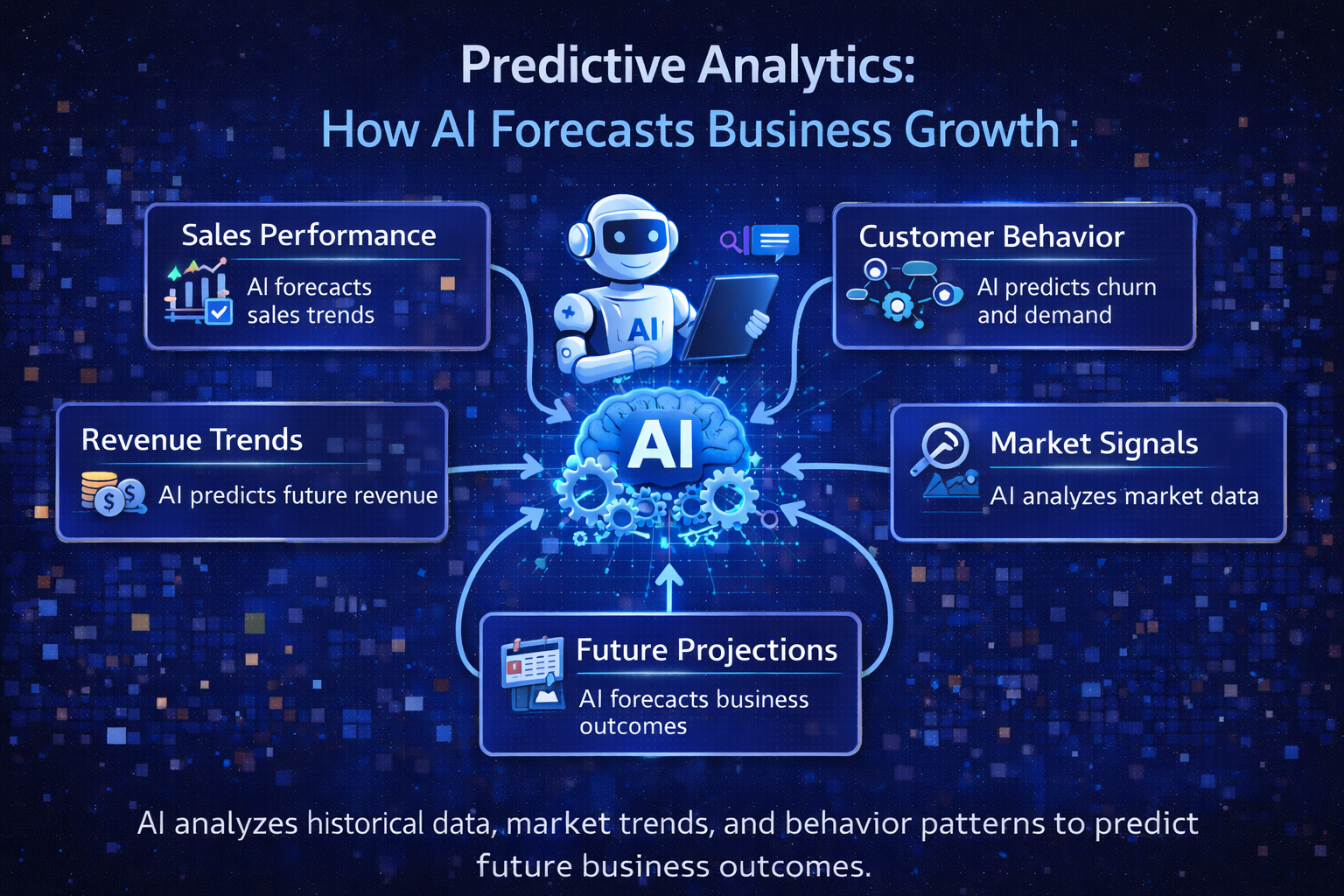
Predictive analytics uses artificial intelligence to study historical data, identify patterns, and forecast future outcomes. Instead of reacting to problems after they happen, businesses can prepare in advance. AI helps startups predict growth, demand, revenue, customer behaviour, and risks with much higher accuracy.
This article explains what predictive analytics is, how AI forecasts business growth, and why it gives startups a strong advantage, using very simple language. If you want smarter planning and confident decision-making, this guide will answer all your questions.
What Is Predictive Analytics?
Predictive analytics is the process of using data to predict future outcomes.
Instead of only asking:
“What happened?”
Predictive analytics asks:
“What is likely to happen next?”
It uses:
- Historical data
- Current trends
- Statistical models
- Artificial intelligence
The goal is to forecast future behaviour and performance.
Why Predictive Analytics Matters for Business Growth
Growth decisions affect every part of a business.
Without prediction, businesses:
- React too late
- Miss opportunities
- Waste money
- Face sudden risks
Predictive analytics helps businesses:
- Plan ahead
- Reduce uncertainty
- Improve decision accuracy
- Grow in a controlled way
AI makes predictive analytics faster and more reliable.
The Role of AI in Predictive Analytics
AI is the engine behind modern predictive analytics.
AI helps by:
- Analysing large amounts of data quickly
- Identifying complex patterns
- Learning from new data continuously
- Improving predictions over time
Traditional tools cannot match this speed and accuracy.
How AI Forecasts Business Growth
AI forecasts growth by connecting data, patterns, and probabilities.
AI Collects Data from Multiple Sources
Businesses generate data everywhere.
AI collects data from:
- Sales systems
- Marketing platforms
- Websites and apps
- Customer interactions
- Finance and operations
This creates a complete picture of the business.
AI Identifies Patterns and Trends
Raw data alone is not useful.
AI analyses data to:
- Identify growth patterns
- Detect seasonal trends
- Spot correlations
- Understand cause-and-effect relationships
These patterns form the base of predictions.
AI Uses Machine Learning Models
Machine learning helps AI improve predictions.
These models:
- Learn from past results
- Adjust predictions automatically
- Improve accuracy with time
The more data AI gets, the smarter it becomes.
AI Predicts Future Outcomes
Based on patterns, AI predicts:
- Revenue growth
- Customer demand
- Sales performance
- Market changes
These forecasts help businesses plan confidently.
Key Areas Where AI Predicts Business Growth
Predictive analytics supports multiple business functions.
Sales Growth Forecasting
Sales forecasting is critical for planning.
AI predicts sales by:
- Analysing past sales data
- Studying customer buying behaviour
- Identifying high-value leads
- Forecasting deal success
Sales teams focus on realistic targets.
Revenue Forecasting
Revenue planning requires accuracy.
AI forecasts revenue by:
- Tracking conversion rates
- Analysing pricing impact
- Studying customer lifetime value
- Predicting upsell and renewal chances
This helps manage cash flow and investments.
Customer Demand Prediction
Understanding demand prevents shortages or waste.
AI predicts demand by:
- Analysing purchase history
- Studying market trends
- Tracking customer behaviour
- Identifying demand cycles
Businesses stock and plan better.
Customer Churn Prediction
Losing customers slows growth.
AI predicts churn by:
- Analysing usage patterns
- Tracking engagement levels
- Identifying dissatisfaction signals
Businesses act before customers leave.
Marketing Performance Forecasting
Marketing success is hard to predict manually.
AI forecasts marketing results by:
- Analysing past campaign performance
- Predicting response rates
- Optimising budget allocation
- Forecasting lead generation
Marketing becomes more efficient.
Product Growth Prediction
Product decisions shape future growth.
AI predicts product success by:
- Analysing feature usage
- Studying user feedback
- Identifying adoption trends
This helps prioritise the right features.
Financial Risk Prediction
Growth involves risk.
AI predicts risks by:
- Detecting unusual patterns
- Forecasting cash shortages
- Identifying cost leaks
Problems are solved early.
Benefits of Predictive Analytics for Startups
Predictive analytics gives startups a strong advantage.
Smarter Growth Planning
AI forecasts allow realistic planning.
Faster Decision-Making
Predictions reduce hesitation and delays.
Reduced Risk
Early warnings prevent major losses.
Better Resource Allocation
Money and effort go where growth is likely.
Competitive Advantage
Startups act before competitors react.
Predictive Analytics vs Traditional Reporting
Traditional reporting:
- Shows past performance
- Is reactive
- Offers limited insight
Predictive analytics:
- Forecasts future outcomes
- Is proactive
- Guides strategy
This difference is crucial for growth.
Common Mistakes with Predictive Analytics
Predictive analytics must be used correctly.
Common mistakes include:
- Using poor-quality data
- Expecting perfect predictions
- Ignoring human judgment
- Over-relying on tools
AI supports decisions, not replaces leadership.
How Startups Should Start Using Predictive Analytics
A simple approach works best.
Startups should:
- Identify key growth questions
- Collect clean data
- Use AI analytics tools
- Review predictions regularly
- Combine insights with experience
Small steps create strong results.
The Future of Predictive Analytics in Business
Predictive analytics will become standard.
In the future:
- AI will forecast growth in real time
- Decisions will be data-first
- Businesses will be more resilient
Early adopters will lead the market.
Final Thoughts
Predictive analytics powered by AI is no longer a luxury. It is a necessity for businesses that want to grow smartly and sustainably. By forecasting sales, revenue, demand, and risks, AI helps startups plan ahead and avoid surprises.
Business growth becomes predictable, not accidental. With AI-driven predictive analytics, startups gain clarity, confidence, and a competitive edge in uncertain markets.
Read More Blog–Budget 2026 – India’s Economic Vision and Growth Plan
Frequently Asked Questions (FAQs)
1. What is predictive analytics?
Predictive analytics uses data and AI to forecast future outcomes.
2. Can small startups use predictive analytics?
Yes. Many AI tools are affordable and easy to use.
3. Is predictive analytics always accurate?
Predictions improve with better data, but they are not 100% exact.
4. Does predictive analytics replace business strategy?
No. It supports strategy with data insights.
5. What business areas benefit most from predictive analytics?
Sales, marketing, finance, customer retention, and growth planning.