
Subtotal $0.00



Email : 71
Financial planning is one of the biggest challenges for startup owners. In the early stages, money is limited, income is uncertain, and expenses often change every month. Many startup founders manage finances using spreadsheets, basic accounting tools, or simple assumptions. While this may work at the beginning, it quickly becomes risky as the business grows.
Poor financial planning can lead to cash flow problems, wrong hiring decisions, overspending, or even startup failure. The biggest issue is not effort, but lack of accurate forecasting and real-time insights.
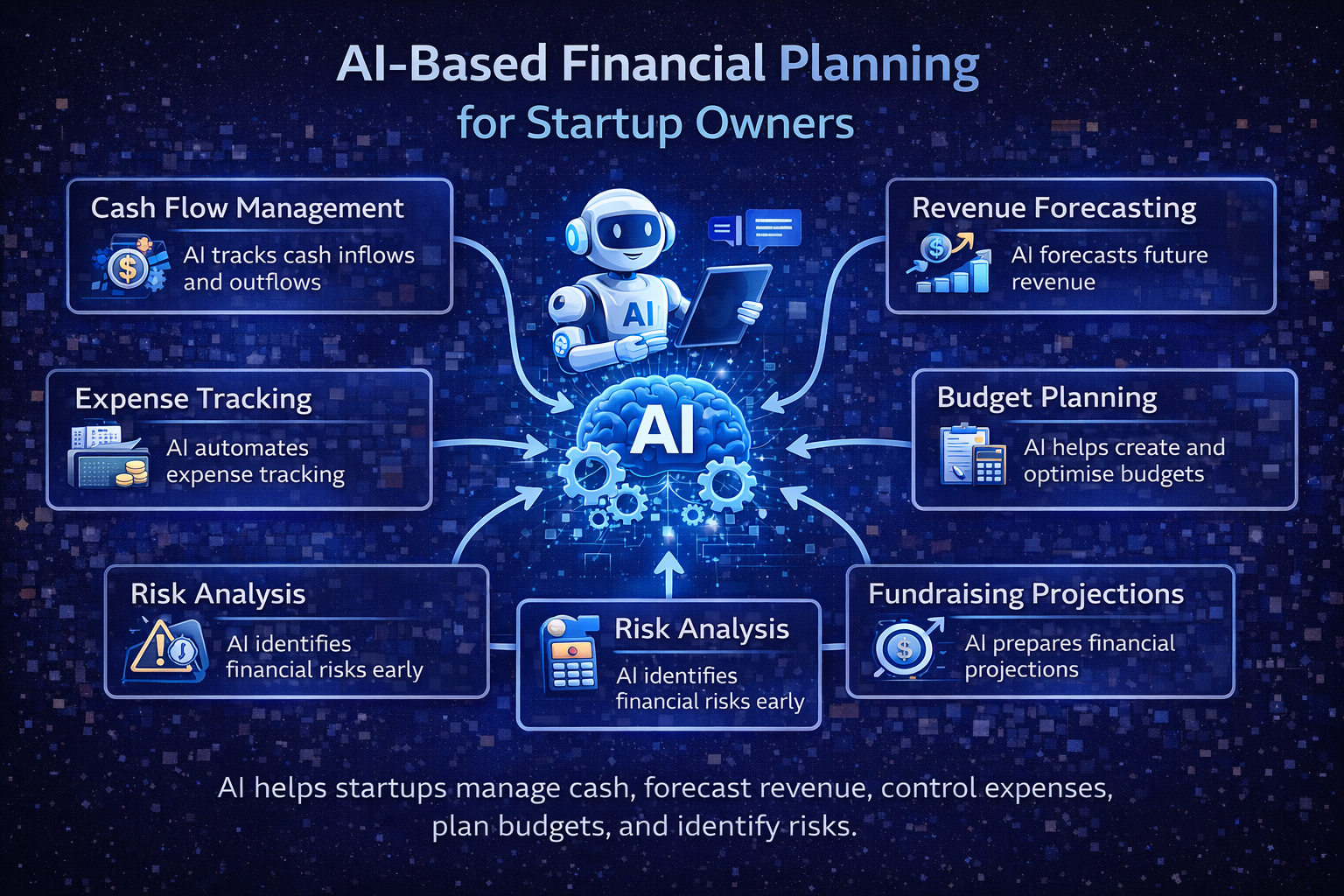
This is where AI-based financial planning becomes extremely valuable for startup owners. AI helps analyse financial data, predict future outcomes, track expenses, forecast revenue, and identify risks early. Instead of reacting to financial problems, founders can plan ahead with confidence.
This article explains how AI-based financial planning works, why it matters for startup owners, and how it helps manage money smarter, using very simple language and practical explanations.
What Is AI-Based Financial Planning?
AI-based financial planning means using artificial intelligence to plan, manage, and forecast business finances.
Instead of manual calculations, AI tools:
- Analyse historical financial data
- Track real-time income and expenses
- Predict future cash flow
- Identify risks and opportunities
AI turns financial data into clear insights that support better decisions.
Why Financial Planning Is Critical for Startup Owners
Startups operate with limited margin for error.
Without strong financial planning:
- Cash can run out unexpectedly
- Expenses can exceed revenue
- Growth decisions become risky
- Investors lose confidence
Good financial planning helps startup owners:
- Control cash flow
- Plan growth safely
- Avoid financial stress
- Build long-term stability
AI makes this planning more accurate and less time-consuming.
Problems with Traditional Financial Planning Methods
Traditional methods rely heavily on manual work.
This creates problems such as:
- Inaccurate forecasts
- Delayed financial insights
- Human errors
- Difficulty handling complex data
AI solves these problems by automating analysis and improving accuracy.
How AI Improves Financial Planning for Startups
AI improves financial planning by combining automation, analytics, and forecasting.
AI helps by:
- Analysing large financial datasets
- Detecting patterns and trends
- Predicting future outcomes
- Providing real-time insights
This helps founders stay in control of finances.
How AI Collects and Analyses Financial Data
AI connects with financial systems and tools.
It collects data from:
- Accounting software
- Bank transactions
- Sales platforms
- Expense tracking tools
AI cleans and organises this data automatically.
AI-Based Cash Flow Management
Cash flow is the lifeline of a startup.
AI helps manage cash flow by:
- Tracking money coming in and going out
- Predicting future cash shortages
- Highlighting high-expense areas
- Suggesting better payment timing
This helps founders avoid sudden cash problems.
AI-Based Revenue Forecasting
Revenue prediction is often uncertain for startups.
AI forecasts revenue by:
- Analysing past sales data
- Studying customer behaviour
- Tracking conversion rates
- Identifying growth patterns
Accurate forecasts help founders plan confidently.
AI-Based Expense Tracking and Control
Uncontrolled expenses reduce runway.
AI tracks expenses by:
- Categorising spending automatically
- Identifying unnecessary costs
- Detecting unusual transactions
- Suggesting cost-saving opportunities
This improves financial discipline.
AI Helps Plan Startup Runway
Runway planning is critical for survival.
AI calculates runway by:
- Analysing burn rate
- Forecasting future expenses
- Estimating time before funds run out
Founders get early warnings and time to act.
AI-Based Budget Planning
Manual budgeting is often outdated.
AI improves budgeting by:
- Adjusting budgets in real time
- Comparing planned vs actual spending
- Predicting future budget needs
Budgets remain realistic and flexible.
AI Helps with Financial Decision-Making
Financial decisions affect growth.
AI supports decisions by:
- Providing data-backed insights
- Simulating different scenarios
- Showing best and worst outcomes
Founders make smarter financial choices.
AI-Based Risk Detection in Finance
Financial risks can damage startups.
AI detects risks by:
- Identifying cash flow gaps
- Detecting overspending trends
- Highlighting delayed payments
- Predicting financial stress
Problems are solved before they escalate.
AI Helps with Pricing and Profitability Analysis
Pricing affects revenue and margins.
AI helps by:
- Analysing cost structures
- Studying customer price sensitivity
- Predicting profit impact of pricing changes
This improves profitability planning.
AI-Based Financial Planning for Fundraising
Investors expect solid financial planning.
AI helps fundraising by:
- Creating accurate financial projections
- Improving revenue forecasts
- Supporting data-backed pitches
This increases investor confidence.
Benefits of AI-Based Financial Planning for Startup Owners
AI-based financial planning delivers clear advantages.
Better Financial Visibility
Founders always know their financial position.
Improved Accuracy
AI reduces human errors and guesswork.
Faster Planning
Financial insights are available instantly.
Reduced Financial Stress
Clear data reduces uncertainty and anxiety.
Stronger Growth Control
Startups grow without losing financial discipline.
Common Mistakes Startup Owners Make with AI Financial Tools
AI tools must be used wisely.
Common mistakes include:
- Ignoring data quality
- Over-relying on automation
- Avoiding human review
- Expecting instant results
AI works best with founder involvement.
How Startup Owners Should Start Using AI-Based Financial Planning
A simple approach works best.
Startup owners should:
- Identify key financial challenges
- Start with cash flow and expense tracking
- Use AI forecasting tools
- Review insights regularly
- Adjust plans based on data
Small steps lead to big improvements.
AI-Based Financial Planning vs Manual Planning
Manual planning:
- Is slow
- Is error-prone
- Does not scale well
AI-based planning:
- Is faster
- More accurate
- Scales easily
This makes AI essential for modern startups.
The Future of Financial Planning for Startups
Financial planning will become more intelligent.
In the future:
- AI will forecast finances in real time
- Planning will be proactive, not reactive
- Founders will focus more on strategy
Early adoption gives startups an advantage.
Final Thoughts
AI-based financial planning helps startup owners manage money smarter, not harder. By forecasting cash flow, tracking expenses, planning runway, and reducing risks, AI gives founders clarity and confidence.
Instead of worrying about finances every day, founders can focus on building products, serving customers, and growing the business. AI does not replace financial responsibility. It strengthens it with better data and insights.
Read More Blog-AI-Driven SEO: Smarter Rankings, Better Traffic
Frequently Asked Questions (FAQs)
1. Is AI-based financial planning suitable for early-stage startups?
Yes. It is especially useful when resources are limited.
2. Do AI financial tools replace accountants?
No. They support accountants and founders with better insights.
3. Is AI financial planning expensive?
Many tools are affordable and scalable for startups.
4. How accurate are AI financial forecasts?
Accuracy improves with better and consistent data.
5. Can non-finance founders use AI financial tools?
Yes. Most tools are user-friendly and easy to understand.