



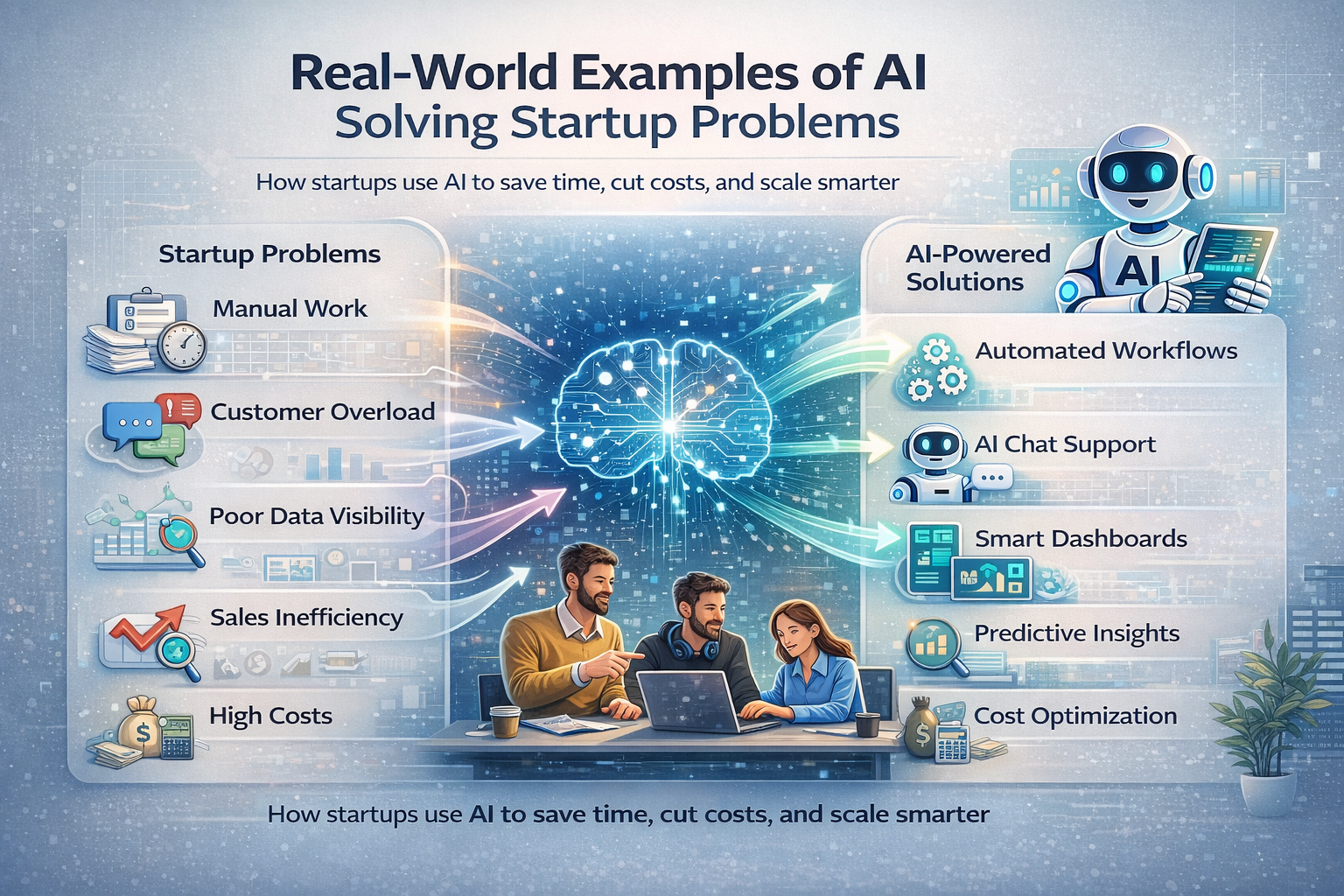
Every startup faces problems. Limited budgets, small teams, slow growth, customer churn, and decision overload are common challenges. Founders often work long hours trying to manage everything manually, but this approach rarely scales. This is where Artificial Intelligence (AI) is proving to be a powerful solution.
AI is no longer just a theory or future technology. It is already solving real startup problems across industries. From reducing costs and saving time to improving customer experience and increasing productivity, AI is helping startups overcome challenges that once required large teams and high spending.
What makes AI especially valuable for startups is its ability to work continuously, analyse data quickly, and automate repetitive tasks. This allows founders to focus on strategy and innovation instead of daily operational stress.
This article explores real-world examples of AI solving startup problems, showing how startups are using AI in practical ways to grow smarter, faster, and more sustainably. These examples highlight lessons that any founder can apply, regardless of industry or stage.
Why Startups Struggle Without AI
Startups operate under constant pressure.
Common problems include:
- Limited manpower
- Time-consuming manual work
- Slow decision-making
- Poor data visibility
- High operational costs
AI helps startups solve these problems by replacing inefficiency with intelligence.
How AI Solves Startup Problems in Practice
AI does not solve everything at once.
It solves specific, repeated problems that slow growth.
Below are real-world examples across different startup functions.
Example 1: AI Reducing Customer Support Overload
The Problem
A SaaS startup received hundreds of customer queries daily. Most questions were repetitive, such as login issues, pricing details, and feature explanations. Hiring more support agents increased costs, but response delays hurt customer satisfaction.
The AI Solution
The startup implemented AI-powered chat support that handled common questions automatically. The system learned from previous tickets and FAQs.
The Result
- Response time dropped from hours to seconds
- Support tickets reduced by more than 60%
- Customer satisfaction increased
- Support costs stayed low
AI allowed the startup to scale support without growing the team.
Example 2: AI Improving Lead Quality for Sales Teams
The Problem
A B2B startup generated many leads but struggled with low conversion rates. Sales teams wasted time chasing unqualified prospects.
The AI Solution
The startup used AI-based lead scoring to analyse behaviour, engagement, and past conversion data. Leads were ranked based on purchase probability.
The Result
- Sales focused on high-quality leads
- Conversion rates increased
- Sales cycle became shorter
- Less manual follow-up
AI helped the startup sell smarter, not harder.
Example 3: AI Automating Marketing Campaign Optimisation
The Problem
A digital startup spent heavily on ads but lacked clarity on which campaigns performed best. Manual analysis was slow and inaccurate.
The AI Solution
AI tools were used to track performance in real time and automatically adjust targeting, budgets, and messaging.
The Result
- Lower customer acquisition cost
- Better campaign performance
- Faster optimisation decisions
- Higher return on ad spend
AI replaced guesswork with precision.
Example 4: AI Helping Startups Predict Customer Churn
The Problem
A subscription-based startup lost customers without warning. Churn hurt growth and revenue stability.
The AI Solution
AI analysed usage patterns, engagement levels, and support history to predict churn risk early.
The Result
- At-risk customers were identified in advance
- Retention campaigns were launched proactively
- Churn rate dropped significantly
- Customer lifetime value increased
AI turned churn into a manageable problem.
Example 5: AI Reducing Burn Rate for Early-Stage Startups
The Problem
An early-stage startup struggled to control expenses and forecast cash flow. Financial planning was reactive.
The AI Solution
AI-based financial tools analysed spending, revenue trends, and forecasts to guide budgeting decisions.
The Result
- Better cash flow visibility
- Smarter expense control
- Reduced burn rate
- Improved investor confidence
AI helped founders make calm, informed financial decisions.
Example 6: AI Speeding Up Product Development Decisions
The Problem
A tech startup built features based on assumptions instead of real user behaviour. Development resources were wasted.
The AI Solution
AI analysed user interaction data to identify which features were used, ignored, or requested.
The Result
- Product roadmap became data-driven
- Feature adoption increased
- Development time was saved
- Customer satisfaction improved
AI ensured the product evolved in the right direction.
Example 7: AI Automating Reporting and Analytics
The Problem
Founders spent hours preparing weekly and monthly reports. Data came from multiple sources.
The AI Solution
AI dashboards automatically collected, cleaned, and visualised data from all tools.
The Result
- Reporting time reduced by over 70%
- Real-time insights available
- Faster decision-making
- Less manual work
AI turned data into instant clarity.
Example 8: AI Improving Hiring Decisions
The Problem
A growing startup hired quickly but faced high turnover and skill mismatch.
The AI Solution
AI-assisted hiring tools analysed resumes, skill patterns, and performance data to shortlist better candidates.
The Result
- Better candidate fit
- Faster hiring process
- Reduced hiring mistakes
- Stronger teams
AI improved people decisions without removing human judgment.
Example 9: AI Personalising Customer Experience at Scale
The Problem
An e-commerce startup struggled to personalise experiences for thousands of users manually.
The AI Solution
AI personalised recommendations, emails, and offers based on behaviour and preferences.
The Result
- Higher engagement
- Increased conversions
- Better repeat purchases
- Stronger brand loyalty
AI made personalisation scalable.
Example 10: AI Supporting Founder Decision-Making
The Problem
Founders felt overwhelmed by data and daily decisions.
The AI Solution
AI tools summarised performance, highlighted risks, and suggested next actions.
The Result
- Reduced decision fatigue
- Clear priorities
- Faster execution
- Better leadership focus
AI acted as a decision support system.
Key Patterns Across All Examples
Across these real-world examples, some patterns are clear.
AI succeeds when it:
- Solves specific problems
- Removes repetitive work
- Supports humans, not replaces them
- Uses clean data
- Aligns with business goals
AI fails when used without strategy.
What Startup Founders Can Learn from These Examples
These examples show that AI is practical, not theoretical.
Founders should:
- Start small
- Focus on real pain points
- Measure results
- Improve continuously
AI adoption is a journey.
Common Mistakes Startups Make with AI
Some startups struggle due to mistakes.
Common issues include:
- Using too many tools
- Expecting instant results
- Ignoring data quality
- Avoiding team training
Success requires patience and clarity.
How to Start Using AI to Solve Startup Problems
A simple approach works best.
Start by:
- Identifying repetitive tasks
- Improving data visibility
- Automating one process at a time
- Reviewing results regularly
Small wins build confidence.
The Future of AI Problem-Solving in Startups
In the future:
- AI will be embedded in all tools
- Automation will be standard
- Data-driven culture will be expected
Startups that adapt early will lead.
Final Thoughts
AI is already solving real startup problems across industries. It is reducing costs, saving time, improving decisions, and helping small teams achieve big results. These real-world examples prove that AI is not about replacing people or adding complexity. It is about working smarter.
For startup founders, the question is no longer whether AI should be used. The real question is how and where to use AI for maximum impact. Startups that learn from these examples will build stronger, more resilient, and more scalable businesses.
Read More Blog–How AI Startup Edge Is Helping Businesses Grow Smarter
Frequently Asked Questions (FAQs)
1. Are these AI solutions only for tech startups?
No. AI works across industries and business models.
2. Is AI expensive for startups?
Many AI tools are affordable and scalable.
3. Do founders need technical knowledge?
No. Strategic understanding is enough.
4. Can AI really reduce startup costs?
Yes. Automation reduces manual effort and errors.
5. How fast can startups see results?
Many see improvements within weeks.







Comments are closed