


Artificial Intelligence is growing very fast. In 2026, AI is not just about chatbots or simple automation. Now we have AI agents that can think, plan, decide, and take actions on their own. Many businesses, startups, and professionals are using AI agents to save time, reduce cost, and improve productivity. But one important question comes to mind: how does an AI agent actually work? The answer is AI agent architecture.
Understanding AI agent architecture in 2026 is very important because it helps you build smarter systems. If you are a startup founder, developer, marketer, or business owner, this guide will help you understand how AI agents are designed, how they make decisions, and how you can use them in real life. In this article, we will explain everything in very simple language so that anyone can understand it easily.
What is AI Agent Architecture?
AI agent architecture means the internal design and structure of an AI agent. It explains how the agent:
- Receives input
- Processes information
- Makes decisions
- Takes actions
- Learns from experience
In simple words, AI agent architecture is like the brain structure of an AI system.
In 2026, AI agents are more advanced. They do not only answer questions. They can:
- Plan tasks
- Use tools
- Access databases
- Communicate with other systems
- Work independently for long tasks
This is why understanding modern AI agent architecture is very important.
Why AI Agent Architecture is Important in 2026
Before we look at the components, let us understand why this topic is important today.
AI agents are being used in:
- Customer support automation
- AI-powered lead generation
- Healthcare systems
- Finance automation
- E-commerce personalization
- Robotics and smart devices
Without proper AI architecture, the agent may:
- Give wrong answers
- Take wrong actions
- Fail in complex tasks
- Become unsafe or biased
In 2026, businesses need reliable AI systems. A strong AI agent framework ensures:
- Better decision making
- Safe AI behavior
- Scalable systems
- Long-term automation
Core Components of AI Agent Architecture 2026
Modern AI agent architecture includes multiple layers. Let us understand each layer in simple language.
1. Perception Layer (Input System)
The perception layer helps the AI agent understand the world.
It collects information from:
- Text input
- Voice commands
- Images
- Sensors
- APIs
- Databases
For example, in a customer support AI agent, the perception layer reads the user message.
In robotics, it can use cameras and sensors.
This layer converts raw data into meaningful information.
2. Memory System
Memory is very important in AI agent architecture 2026.
Earlier AI systems did not remember past conversations properly. But now agents use different types of memory:
- Short-term memory (current conversation)
- Long-term memory (past data)
- Vector databases for knowledge storage
- User behavior history
Memory helps AI agents:
- Personalize responses
- Continue long tasks
- Learn user preferences
- Improve over time
For example, if a customer buys shoes from an online store, the AI agent remembers this and recommends related products.
3. Reasoning Engine
The reasoning engine is the brain of the AI agent.
It uses:
- Large Language Models (LLMs)
- Logical reasoning
- Planning algorithms
- Chain-of-thought processing
In 2026, advanced models like:
- OpenAI
- Google DeepMind
- Anthropic
have improved reasoning capabilities.
The reasoning engine helps the AI agent:
- Understand complex instructions
- Break big tasks into small steps
- Choose the best action
- Avoid mistakes
For example, if you say, “Plan a marketing strategy for my startup,” the agent will:
- Analyze the business
- Identify target audience
- Suggest marketing channels
- Create a content plan
This step-by-step thinking is part of modern AI agent design.
4. Planning Module
Planning is a major upgrade in AI agent architecture 2026.
Older chatbots only responded. Modern AI agents plan tasks.
Planning module helps to:
- Set goals
- Create sub-tasks
- Monitor progress
- Adjust strategy
For example, in AI automation tools, the agent can:
- Collect leads
- Send follow-up emails
- Track responses
- Optimize campaigns
Planning makes AI agents more autonomous.
5. Action Layer (Execution System)
After thinking and planning, the AI agent must take action.
The action layer connects AI to tools and systems like:
- CRM software
- Email platforms
- Payment gateways
- APIs
- Web browsers
- Cloud services
This is called tool integration.
In 2026, AI agents can:
- Book appointments
- Update spreadsheets
- Generate reports
- Deploy code
- Run ads
This makes them very powerful for business automation.
6. Learning and Feedback System
AI agent architecture in 2026 includes continuous learning.
The system improves by:
- User feedback
- Performance data
- Reinforcement learning
- Human-in-the-loop supervision
If the agent makes a mistake, it learns and improves.
This ensures:
- Better accuracy
- Reduced bias
- Improved personalization
Types of AI Agent Architectures in 2026
Different use cases require different architectures. Let us understand the main types.
1. Reactive Agents
Reactive agents respond directly to input.
They:
- Do not store long memory
- Do not plan deeply
- Act based on rules
These are used in simple automation systems.
2. Deliberative Agents
Deliberative agents think before acting.
They:
- Use internal models
- Plan actions
- Analyze outcomes
These are used in advanced AI systems like robotics and complex decision tools.
3. Hybrid Agents
Hybrid architecture combines reactive and deliberative models.
This is the most popular AI agent architecture 2026.
It allows:
- Fast responses
- Deep planning
- Smart decision-making
Most enterprise AI systems use hybrid architecture.
4. Multi-Agent Systems
In 2026, multi-agent architecture is trending.
In this model:
- Multiple AI agents work together
- Each agent has a specific role
- They communicate with each other
For example:
- One agent handles research
- One agent handles writing
- One agent handles analysis
- One agent handles execution
This system is used in large AI workflows.
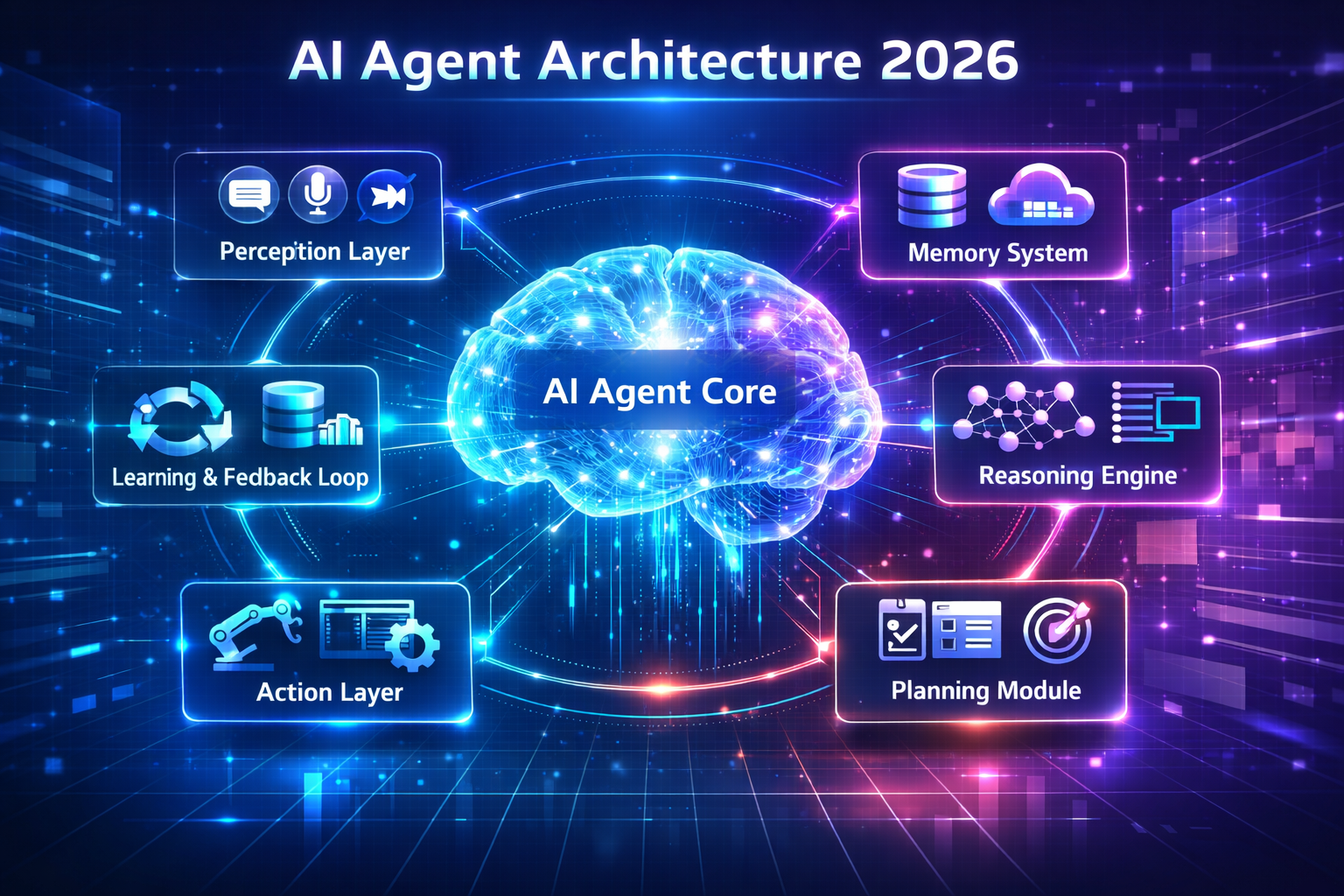
AI Agent Architecture Diagram Explanation
The diagram above shows a simple AI agent workflow.
It usually follows this order:
- Input Layer
- Memory System
- Reasoning Engine
- Planning Module
- Tool Execution
- Feedback Loop
This circular system allows continuous improvement.
Key Technologies Used in AI Agent Architecture 2026
AI agents in 2026 use advanced technologies.
Large Language Models (LLMs)
LLMs help in:
- Understanding language
- Generating responses
- Reasoning tasks
They are the core brain of modern AI agents.
Vector Databases
Vector databases store knowledge in smart format.
They help in:
- Fast retrieval
- Semantic search
- Context understanding
This improves memory system.
API Integration
APIs connect AI agents to external systems.
Without API integration, AI cannot take real-world actions.
Cloud Infrastructure
Cloud platforms provide:
- Scalability
- High performance
- Secure storage
This is important for enterprise AI deployment.
Real-World Use Cases of AI Agent Architecture 2026
Now let us understand practical applications.
1. AI in Startups
AI agents help startups in:
- Lead generation
- Email automation
- Customer support
- Market research
- Content creation
This reduces manpower cost.
2. AI in Healthcare
AI agents:
- Analyze patient data
- Assist doctors
- Schedule appointments
- Monitor health reports
This improves efficiency.
3. AI in E-commerce
AI agents:
- Recommend products
- Manage inventory
- Handle returns
- Personalize marketing
This increases sales.
4. AI in Finance
AI agents:
- Detect fraud
- Analyze risk
- Automate reporting
- Manage investments
Security-focused AI architecture is very important here.
How to Build AI Agent Architecture in 2026
If you want to build your own AI agent, follow this simple structure.
Before starting development, you must define your goal clearly.
Step 1: Define the Purpose
Ask:
- What problem will the agent solve?
- Who will use it?
- What actions should it take?
Step 2: Choose AI Model
Select a suitable LLM based on:
- Budget
- Performance
- Security needs
Step 3: Design Memory System
Decide:
- What data to store
- How long to store
- Where to store
Step 4: Add Tool Integration
Connect APIs and tools for action execution.
Step 5: Test and Improve
Use feedback to improve:
- Accuracy
- Speed
- Reliability
Challenges in AI Agent Architecture 2026
Even in 2026, some challenges exist.
These include:
- Data privacy concerns
- Model hallucination
- High infrastructure cost
- Ethical risks
- Bias in decision making
This is why AI governance and safety frameworks are becoming important.
Future of AI Agent Architecture Beyond 2026
The future may include:
- Fully autonomous AI employees
- Self-learning systems
- Human-AI collaboration models
- Emotion-aware AI agents
- Decentralized AI networks
AI agent systems will become more intelligent and responsible.
Frequently Asked Questions (FAQs)
1. What is AI agent architecture in simple words?
AI agent architecture is the internal structure that helps an AI system think, decide, and act.
2. What are the main components of AI agent architecture 2026?
The main components are perception layer, memory system, reasoning engine, planning module, action layer, and feedback system.
3. How is AI agent different from chatbot?
Chatbots only respond to messages. AI agents can plan, take actions, use tools, and work independently.
4. What is multi-agent architecture?
It is a system where multiple AI agents work together and divide tasks to complete complex work.
5. Is AI agent architecture safe?
It can be safe if proper security, monitoring, and ethical guidelines are followed.
6. Can startups use AI agent architecture?
Yes. Startups can use AI agents for automation, marketing, customer service, and operations.
Conclusion
AI agent architecture 2026 is more advanced, powerful, and practical than ever before. It is not just about answering questions. It is about building intelligent systems that can think, plan, and act independently. Understanding its structure helps businesses design better AI systems. Whether you are a startup founder, developer, or entrepreneur, learning AI agent architecture will give you a strong advantage in the AI-driven future.
If you want to stay competitive in 2026 and beyond, now is the best time to understand and implement modern AI agent architecture.
Read More Blog–AI Agents vs Chatbots: What’s the Real Difference?