


Introduction
Artificial intelligence is becoming a part of everyday life, and one of the most important concepts in this field is the AI agent. In 2026, AI agents are no longer just a technical idea used by developers. They are now used by businesses, students, freelancers, and even beginners to automate tasks, save time, and improve productivity.
But many people still ask a simple question: What is an AI agent?
Understanding this concept is very important because AI agents are changing how we work, communicate, and run businesses. From answering customer questions to managing complete workflows, AI agents are becoming powerful digital assistants.
In this beginner-friendly guide, you will learn the AI agent definition in simple language, how AI agents work, their types, real-life examples, benefits, challenges, and how you can start using them in 2026.
This article will solve all your doubts in a clear and practical way.



What Is an AI Agent? (Simple Definition)
Before going deeper, let us understand the basic definition.
An AI agent is a software program that can observe, think, and act to complete tasks automatically using artificial intelligence.
In simple words:
An AI agent is like a smart digital assistant that can do work for you.
Instead of just following fixed instructions, AI agents can:
- understand your input
- analyze information
- make decisions
- take actions
This makes them more powerful than traditional software.
AI Agent Definition in Technical Terms
For better understanding, let us look at a slightly more detailed explanation.
An AI agent is a system that:
- perceives its environment
- processes information using AI models
- takes actions to achieve specific goals
This process is often called:
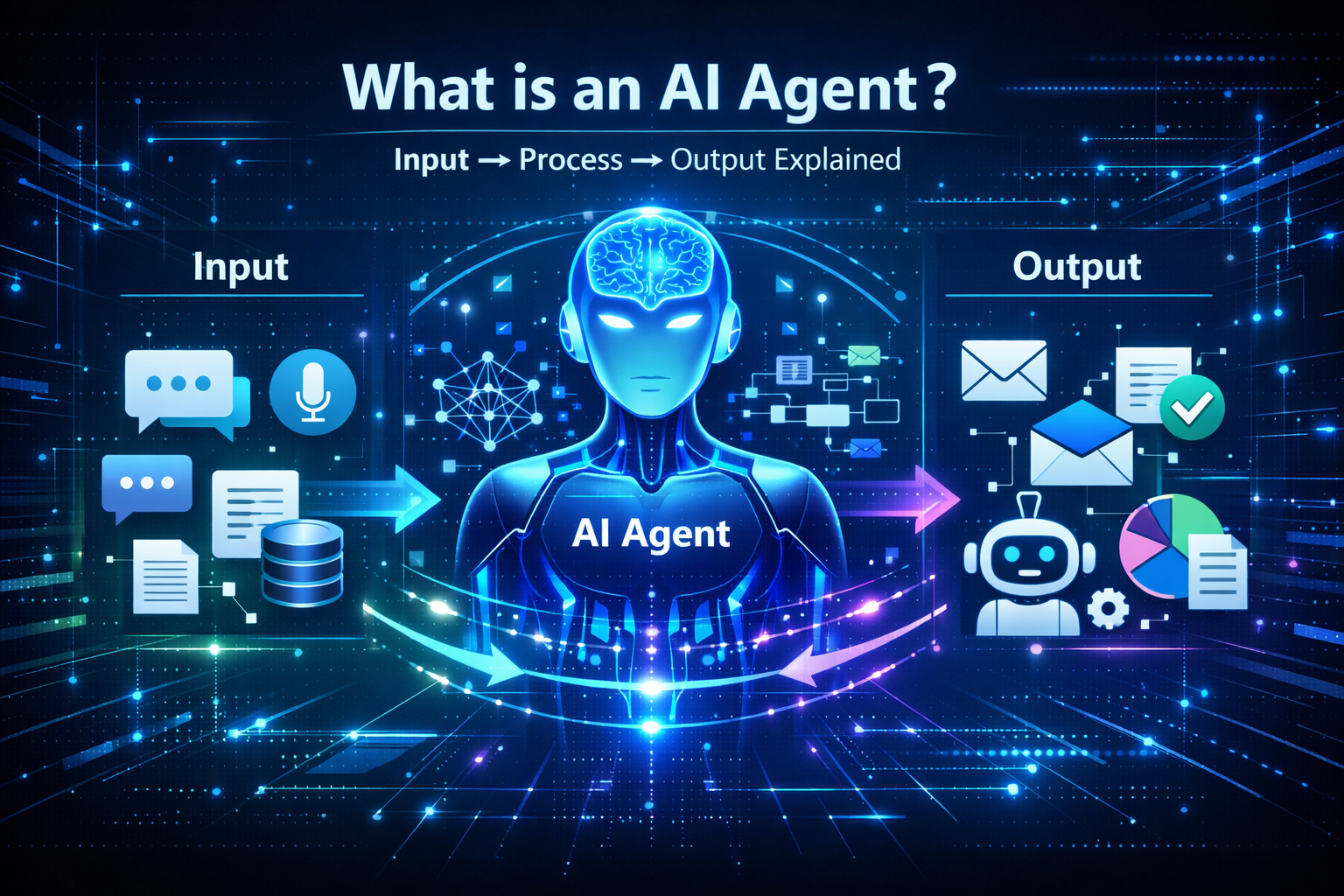
Sense → Think → Act
This means the AI agent first understands the situation, then decides what to do, and finally performs the action.
Key Components of an AI Agent
To understand AI agents properly, you need to know their main parts.
Every AI agent is built using several components that work together.
1. Input (Perception)
The AI agent receives input from the environment.
This input can be:
- text (chat messages)
- voice commands
- data from systems
- user instructions
This is how the AI agent understands what needs to be done.
2. Processing (Decision Making)
After receiving input, the AI agent processes it.
This involves:
- analyzing data
- understanding context
- making decisions
This step uses artificial intelligence models.
3. Output (Action)
Finally, the AI agent performs an action.
Examples include:
- replying to a message
- sending an email
- updating a database
- generating a report
4. Memory (Optional)
Some AI agents remember past interactions.
This helps them:
- improve responses
- personalize communication
- learn from previous data
How AI Agents Work (Step-by-Step)
Understanding how AI agents work is very important for beginners.
Below is a simple step-by-step explanation.
Step 1: Receive Task
The user gives a command.
Example:
“Reply to customer email”
Step 2: Understand the Task
The AI agent analyzes the instruction.
It identifies:
- what is required
- what data is needed
Step 3: Plan the Action
The AI agent decides how to complete the task.
It may:
- gather information
- use tools
- break the task into steps
Step 4: Execute the Task
The AI agent performs the task.
Example:
- writes email
- sends response
Step 5: Learn and Improve
Some AI agents learn from feedback and improve over time.
Types of AI Agents (Explained Simply)
AI agents are not all the same. There are different types depending on how they work.
1. Simple Reflex Agents
These agents follow basic rules.
They react to situations without memory.
Example:
- basic chatbot
- auto-reply system
2. Model-Based Agents
These agents understand the environment better.
They use internal data to make decisions.
Example:
- navigation systems
- recommendation engines
3. Goal-Based Agents
These agents work to achieve a specific goal.
They plan actions to reach the goal.
Example:
- task automation agents
- workflow managers
4. Learning Agents
These agents improve over time.
They learn from data and feedback.
Example:
- recommendation systems
- AI assistants
Real-Life Examples of AI Agents in 2026
AI agents are already used in many areas.
Below are some real-world examples.
Customer Support AI
AI agents answer customer queries on:
- websites
- chat apps
AI Marketing Agents
They help businesses:
- create content
- run ads
- analyze campaigns
AI Personal Assistants
They help users:
- manage schedules
- send reminders
- organize tasks
AI Business Automation
AI agents can:
- manage CRM systems
- handle leads
- automate workflows
Benefits of AI Agents
AI agents offer many advantages.
Increased Efficiency
AI agents work faster than humans.
Time Saving
They reduce manual work.
24/7 Availability
They can work anytime.
Better Decision Making
AI analyzes data and provides insights.
Challenges of AI Agents
AI agents also have some limitations.
Data Privacy Issues
AI systems handle sensitive data.
Errors and Limitations
AI can make mistakes.
Need for Human Control
AI should be monitored.
AI Agents vs Chatbots
Many people confuse AI agents with chatbots.
Let us understand the difference.
AI agents:
- perform tasks
- make decisions
- use tools
Chatbots:
- mainly answer questions
- follow scripts
AI agents are more advanced than chatbots.
Future of AI Agents in 2026 and Beyond
AI agents are growing very fast.
Future developments may include:
- autonomous AI workers
- multi-agent collaboration
- AI-powered businesses
- smart decision systems
AI agents will become part of everyday life.
How Beginners Can Start Using AI Agents
If you are new, you can start easily.
Step 1: Identify Tasks
Find tasks you want to automate.
Step 2: Use AI Tools
Use tools like:
- AI chat assistants
- automation platforms
Step 3: Start Small
Begin with simple tasks.
Step 4: Learn Gradually
Explore advanced features later.
Conclusion
AI agents are one of the most important technologies in 2026. They are not just tools for experts but are now accessible to beginners as well. By understanding the AI agent definition, how they work, and where they are used, anyone can start using them effectively.
AI agents help automate tasks, save time, and improve productivity. While they have some challenges, their benefits are much greater.
As technology continues to grow, AI agents will become a powerful part of daily life and business operations.
Learning about AI agents today will help you stay ahead in the future.
FAQs
1. What is an AI agent in simple words?
An AI agent is a smart software program that can do tasks automatically by understanding and processing information.
2. Are AI agents difficult to use?
No. Many AI tools are beginner-friendly and easy to use.
3. What is the difference between AI agents and chatbots?
AI agents can perform tasks and make decisions, while chatbots mainly respond to messages.
4. Where are AI agents used?
They are used in business, marketing, customer support, education, and productivity tools.
5. Can beginners use AI agents?
Yes. Beginners can start with simple tools and gradually learn advanced features.