



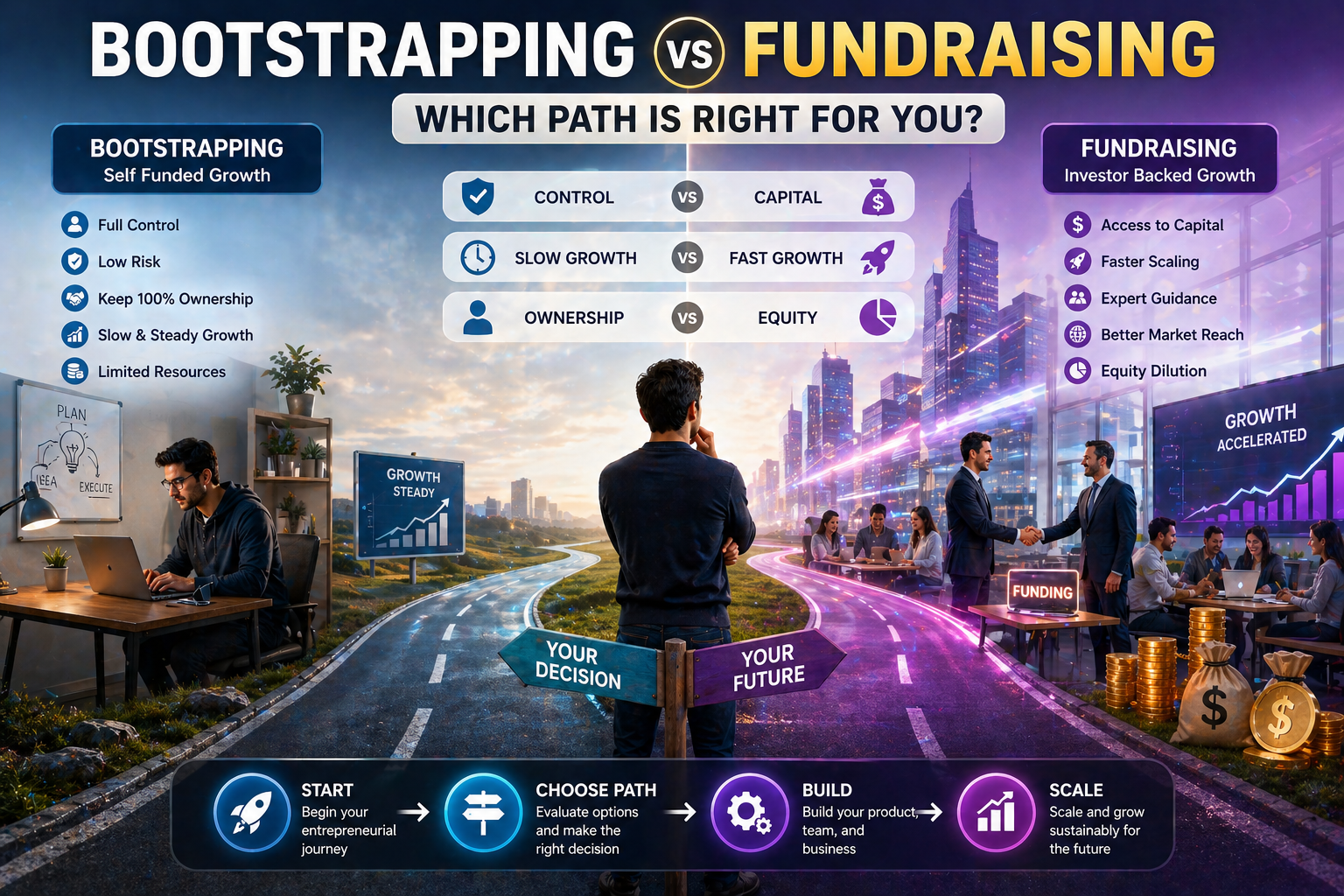
Introduction
Every startup founder faces one big question in the early stage: should you build your business using your own money or raise funds from investors? This decision can shape the future of your startup. Some founders prefer bootstrapping because it gives full control. Others choose fundraising to grow faster with external support.
There is no single right answer. The best choice depends on your goals, business model, and risk level.
If you are a founder, entrepreneur, or planning to start a business, this guide will help you make the right decision. In this article, we will explain bootstrapping vs fundraising in very simple language. You will learn the meaning, advantages, disadvantages, real examples, and how to choose the right path for your startup in 2026.
What Is Bootstrapping?
Before going deeper, let us understand bootstrapping.
Bootstrapping means starting and growing a business using your own money.
You do not take money from investors.
You use:
Personal savings
Revenue from customers
Small loans
This gives you full ownership and control.
What Is Fundraising?
Fundraising means raising money from external investors.
You give them a share of your company in return.
Investors can be:
Angel investors
Venture capitalists
Private investors
This helps you grow faster.
Key Difference Between Bootstrapping and Fundraising
Both approaches are different.
Bootstrapping focuses on self-funding.
Fundraising focuses on external funding.
Bootstrapping gives control.
Fundraising gives capital.
Bootstrapping grows slowly.
Fundraising grows faster.
Understanding this difference is important.
Why This Decision Matters
Choosing the wrong path can create problems.
Importance of Right Choice
Your decision affects:
Ownership
Growth speed
Risk level
Business control
You must choose carefully.
Advantages of Bootstrapping
Bootstrapping has many benefits.
Key Benefits
You have full control
No pressure from investors
Keep all profits
Make independent decisions
Build sustainable business
It is a safe and flexible option.
Disadvantages of Bootstrapping
Bootstrapping also has challenges.
Limitations
Limited resources
Slow growth
Higher personal risk
Less market reach
You need patience and discipline.
Advantages of Fundraising
Fundraising offers strong growth opportunities.
Key Benefits
Access to capital
Faster growth
Expert guidance
Networking opportunities
Better market reach
It helps scale quickly.
Disadvantages of Fundraising
Fundraising also has drawbacks.
Limitations
Loss of ownership
Investor pressure
Decision restrictions
Dilution of equity
You must manage investor expectations.
When to Choose Bootstrapping
Bootstrapping is best in certain situations.
Ideal Conditions
Small or medium business
Low startup cost
Steady revenue model
Founder wants full control
It works well for service-based businesses.
When to Choose Fundraising
Fundraising is useful in different cases.
Ideal Conditions
High growth potential
Large market opportunity
Tech startups
Need for fast scaling
It works for scalable startups.
Types of Bootstrapping
Bootstrapping is not one method.
Types
Personal savings
Revenue-based growth
Part-time business
Family support
These methods help start small.
Types of Fundraising
Fundraising has different stages.
Types
Pre-seed funding
Seed funding
Series A, B, C
Venture capital
Each stage supports growth.
Both have different costs.
Bootstrapping Cost
Personal financial risk
Limited investment
Slow returns
Fundraising Cost
Equity loss
Investor pressure
High expectations
You must understand these costs.
Control and Ownership
Control is a major difference.
Bootstrapping Control
Full control
Independent decisions
No external influence
Fundraising Control
Shared ownership
Investor involvement
Limited decision power
Choose based on your preference.
Growth Speed Comparison
Growth speed depends on funding.
Bootstrapping Growth
Slow but stable
Organic growth
Low risk
Fundraising Growth
Fast scaling
High competition
High pressure
Both have pros and cons.
Risk Comparison
Risk is part of business.
Bootstrapping Risk
Personal financial risk
Limited resources
Fundraising Risk
Business pressure
Investor expectations
Growth pressure
You must manage risk.
Real Example of Bootstrapping
Many successful companies started with bootstrapping.
Example
Small service businesses
Freelance startups
Local brands
They grow slowly but steadily.
Real Example of Fundraising
Many big startups used funding.
Example
Tech companies
App-based startups
Global platforms
They scale quickly.
Hybrid Approach (Best of Both)
Some founders use both methods.
Hybrid Strategy
Start with bootstrapping
Then raise funds later
This reduces risk and improves control.
How to Decide the Right Path
Choosing the right path depends on your situation.
Key Factors
Business model
Market size
Growth goals
Risk tolerance
Financial condition
Analyze these factors carefully.
Questions to Ask Yourself
Before deciding, ask these questions.
Important Questions
Do I need fast growth?
Can I manage without funding?
Am I ready to share ownership?
What is my risk level?
These answers guide your decision.
Common Mistakes Founders Make
Many founders make mistakes.
Mistakes
Raising funds too early
Avoiding funding when needed
Ignoring business model
Not planning finances
Avoid these mistakes.
Long-Term Impact
Your choice affects future.
Bootstrapping Impact
Strong control
Stable growth
Higher ownership
Fundraising Impact
Fast scaling
Market dominance
Shared ownership
Think long-term.
Future Trends in Startup Funding (2026)
Funding is evolving.
Trends
More bootstrapped startups
Increase in angel investors
AI-driven funding decisions
Global funding opportunities
The ecosystem is growing.
Why Many Startups Fail
Failure is common.
Reasons
Poor funding decisions
Lack of planning
Ignoring market
Over-scaling
Funding strategy plays a big role.
Final Advice for Founders
Here are simple tips.
Practical Advice
Start small
Validate idea
Choose wisely
Focus on value
Plan long-term
This helps success.
Conclusion
Bootstrapping and fundraising are two powerful paths for building a startup. There is no right or wrong choice. The best path depends on your goals, business model, and mindset.
If you want control and stability, bootstrapping is a good option. If you want fast growth and scaling, fundraising is better.
You can also combine both strategies for better results.
Think carefully, plan properly, and choose the path that fits your vision.
Your decision today will shape your startup’s future.
Read More Blog-AI Startup Edge
Frequently Asked Questions (FAQs)
1. What is bootstrapping in startups?
It means building a business using your own money.
2. What is fundraising?
It means raising money from investors.
3. Which is better bootstrapping or fundraising?
It depends on your goals and business type.
4. Can I start with bootstrapping and later raise funds?
Yes, many startups follow this approach.
5. Is fundraising risky?
Yes, because you lose ownership and face pressure.
6. Is bootstrapping slow?
Yes, but it is stable and controlled.
7. What is the best strategy?
Choose based on your business needs and goals.