

Introduction
Artificial Intelligence is moving beyond simple chatbots and content generators. The latest evolution is called Agentic AI, where AI systems can independently plan, remember, collaborate, and complete complex tasks with minimal human input. One of the biggest developments in this space is the launch of new features in Anthropic Claude Managed Agents, especially the improvements in multi-agent orchestration and long-term memory.
These new features are designed to help businesses, developers, startups, and enterprises automate production workflows faster than ever before. Instead of one AI assistant handling everything, multiple AI agents can now work together like a digital team. They can divide tasks, remember previous interactions, analyze data, generate reports, write code, manage operations, and continuously improve workflow efficiency.
This technology is important because businesses today face increasing pressure to reduce costs, improve speed, and scale operations without hiring massive teams. Claude Managed Agents aim to solve these challenges by bringing intelligent workflow automation into real-world business environments. In this article, you will learn everything about agentic workflows, Claude Managed Agents, multi-agent orchestration, long-term memory systems, benefits, use cases, challenges, future opportunities, and how this innovation is changing AI automation in 2026.
What Are Agentic Workflows?
Agentic workflows are AI-driven systems where intelligent agents can independently perform tasks, make decisions, coordinate with other agents, and complete complex objectives.
Traditional AI tools usually wait for human instructions. Agentic AI behaves differently. It can:
- Plan tasks
- Break work into smaller steps
- Collaborate with other AI agents
- Remember previous interactions
- Adapt based on results
- Automate repetitive operations
This creates a smarter and more autonomous AI ecosystem.
For example, imagine running a digital marketing agency. Instead of manually managing content, SEO, analytics, and customer communication, an agentic workflow can assign different AI agents to:
- Content writing
- Keyword research
- Performance analysis
- Social media posting
- Client reporting
All agents work together automatically.
Understanding Claude Managed Agents
Claude Managed Agents are advanced AI-powered autonomous systems developed by Anthropic. These agents are designed to execute tasks with minimal supervision while maintaining safety, reliability, and workflow efficiency.
The newest updates focus on:
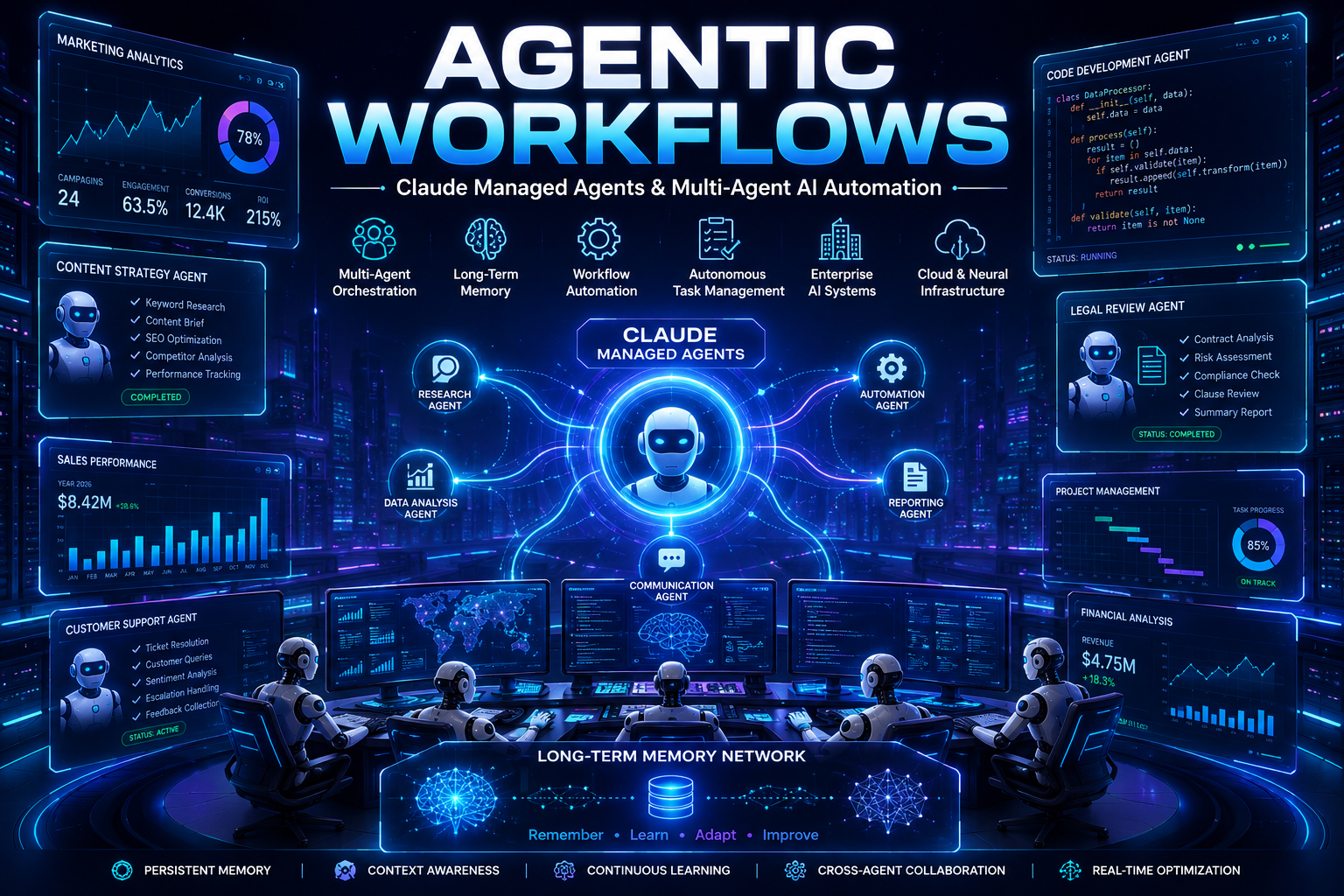
- Multi-agent orchestration
- Long-term memory
- Workflow automation
- Task delegation
- Production acceleration
- Enterprise integration
- Context retention
The goal is to make AI function more like a coordinated workforce instead of a single chatbot.
What Is Multi-Agent Orchestration?
Multi-agent orchestration refers to a system where multiple AI agents collaborate to complete a larger task.
Instead of relying on one AI model for everything, orchestration allows specialized agents to handle specific responsibilities.
For example:
A software development workflow may include:
- Research Agent
Collects technical information. - Coding Agent
Writes code based on requirements. - Testing Agent
Finds bugs and validates functionality. - Documentation Agent
Creates user manuals and reports. - Deployment Agent
Handles release management.
These agents communicate with each other and share information automatically.
This dramatically speeds up production workflows.
Why Multi-Agent Systems Are Important
Modern business operations are becoming increasingly complex. Single AI systems struggle with large-scale coordination.
Multi-agent systems solve this problem by introducing specialization.
Key advantages include:
Faster execution
Different agents work simultaneously instead of sequentially.
Better accuracy
Specialized agents focus on narrower tasks, reducing errors.
Scalability
Businesses can add more agents as workflows grow.
Reduced human workload
Teams spend less time on repetitive operations.
Improved decision-making
Agents continuously analyze information in real time.
Long-Term Memory in Claude Managed Agents
One of the most important upgrades is long-term memory.
Traditional AI systems often forget previous interactions after conversations end. Long-term memory changes this behavior.
Claude Managed Agents can now:
- Remember project details
- Store workflow history
- Retain user preferences
- Learn operational patterns
- Reuse previous context
- Improve future performance
This creates continuity across tasks and projects.
How Long-Term Memory Works
Long-term memory systems store structured information from previous interactions.
The process usually involves:
Context collection
The AI gathers useful information during interactions.
Memory filtering
Important information is identified and stored.
Retrieval systems
Relevant memories are recalled when needed.
Continuous updating
The system refines stored knowledge over time.
This allows AI agents to behave more intelligently during future workflows.
Benefits of Long-Term Memory in AI Workflows
Long-term memory provides several operational advantages.
Better personalization
AI remembers user behavior and preferences.
Reduced repetitive instructions
Users no longer need to repeat the same details.
Faster workflow execution
Agents reuse previous knowledge.
Improved collaboration
Agents share persistent memory across workflows.
Stronger business intelligence
AI identifies patterns from historical operations.
Real-World Use Cases of Claude Managed Agents
The new features are useful across many industries.
Digital Marketing Automation
Marketing agencies can automate:
- SEO research
- Content creation
- Social media scheduling
- Ad campaign optimization
- Analytics reporting
Multiple AI agents collaborate to manage campaigns efficiently.
Software Development
Development teams can use AI agents for:
- Writing code
- Testing applications
- Security analysis
- Documentation
- Deployment pipelines
This accelerates product launches.
Customer Support Automation
Businesses can deploy AI agents to:
- Handle support tickets
- Escalate issues
- Analyze customer sentiment
- Generate responses
- Update CRM systems
Long-term memory helps agents remember customer history.
Legal and Compliance Operations
Legal firms can automate:
- Contract analysis
- Case research
- Compliance monitoring
- Legal drafting
- Document summarization
This is especially valuable for LegalTech platforms.
Healthcare Workflow Optimization
Healthcare organizations may use AI agents for:
- Patient record analysis
- Appointment scheduling
- Clinical documentation
- Insurance verification
- Workflow coordination
E-Commerce Operations
Online businesses can automate:
- Inventory tracking
- Product recommendations
- Customer engagement
- Sales forecasting
- Order management
How Agentic Workflows Improve Productivity
Agentic workflows reduce operational bottlenecks.
Instead of humans manually switching between tools and tasks, AI agents coordinate everything automatically.
Productivity improvements include:
Reduced manual labor
Employees focus on high-value work.
Faster task completion
Parallel processing increases speed.
24/7 operations
AI agents continue working continuously.
Lower operational costs
Businesses reduce repetitive staffing requirements.
Better workflow consistency
AI follows standardized processes.
Difference Between Traditional AI and Agentic AI
| Traditional AI | Agentic AI |
|---|---|
| Responds to prompts | Executes goals autonomously |
| Limited memory | Long-term contextual memory |
| Single-task focused | Multi-task collaboration |
| Human-dependent | Semi-autonomous operation |
| Sequential processing | Parallel orchestration |
This shift represents a major evolution in artificial intelligence.
AI Agents vs AI Assistants
Many people confuse AI agents with AI assistants.
AI Assistants
These tools respond to direct user requests.
Examples include:
- Chatbots
- Voice assistants
- Search assistants
AI Agents
AI agents go beyond answering questions.
They can:
- Plan objectives
- Execute tasks
- Collaborate with other agents
- Make decisions
- Monitor outcomes
- Improve workflows
This makes them more powerful for enterprise automation.
Enterprise Benefits of Claude Managed Agents
Large organizations are especially interested in agentic workflows.
Major enterprise advantages include:
Faster operational scaling
Businesses can automate large processes quickly.
Better resource management
AI reduces dependency on manual coordination.
Improved workflow visibility
Managers track AI-driven task execution.
Enhanced innovation
Teams focus on strategic initiatives.
Cross-department collaboration
AI agents connect workflows between departments.
How Multi-Agent Collaboration Works
Multi-agent collaboration involves structured communication between agents.
The process typically follows these stages:
Task assignment
The system divides work among agents.
Specialized execution
Each agent performs assigned functions.
Shared memory exchange
Agents exchange workflow information.
Validation and optimization
Results are reviewed and improved.
Final delivery
Completed output is generated.
This creates highly efficient automation systems.
AI Memory Systems and Context Retention
Memory is becoming one of the most important aspects of advanced AI systems.
Without memory, AI cannot maintain continuity.
Claude Managed Agents improve:
- Context retention
- User personalization
- Workflow continuity
- Cross-session intelligence
- Historical analysis
This enables more human-like operational behavior.
The Role of Agentic AI in Business Automation
Businesses increasingly rely on automation for growth.
Agentic AI takes automation further by adding intelligence and adaptability.
Areas where agentic AI helps include:
- Operations management
- Project coordination
- Marketing automation
- Financial reporting
- HR management
- Customer communication
- Supply chain optimization
Challenges of Agentic Workflows
Despite the advantages, there are still challenges.
Security concerns
AI agents handling sensitive data require strong protection.
Workflow complexity
Multi-agent systems can become difficult to manage.
Hallucination risks
AI-generated errors still exist.
Compliance issues
Businesses must follow legal regulations.
Infrastructure requirements
Large-scale AI orchestration requires computing resources.
Ethical Concerns Around Autonomous AI Agents
As AI agents become more autonomous, ethical discussions are growing.
Key concerns include:
- Decision transparency
- Data privacy
- Human oversight
- Bias reduction
- Accountability
Companies must balance automation with responsible AI practices.
Claude Managed Agents for Startups
Startups can benefit significantly from these technologies.
Smaller teams often struggle with limited resources.
AI agents can help startups:
- Reduce operational costs
- Automate repetitive tasks
- Scale faster
- Improve customer service
- Increase productivity
This creates competitive advantages.
Future of Multi-Agent AI Systems
The future of AI is moving toward collaborative intelligence.
Experts expect future systems to include:
- Self-improving AI agents
- Autonomous business operations
- Persistent memory ecosystems
- AI workforce management
- Cross-platform orchestration
- Real-time adaptive workflows
Agentic AI may become a standard business infrastructure layer.
AI Workflow Automation Trends in 2026
Several major trends are shaping the future.
AI-native enterprises
Companies built entirely around AI operations.
Hyperautomation
Combining AI, robotics, and workflow systems.
Memory-driven AI
Persistent context across applications.
AI collaboration networks
Multiple AI systems working together.
Autonomous decision engines
AI making operational decisions independently.
Claude Managed Agents vs Competitors
Several companies are developing agentic AI systems.
Major competitors include:
However, Claude Managed Agents are gaining attention because of their focus on:
- Safety
- Long-context understanding
- Memory systems
- Enterprise workflow orchestration
How Businesses Can Prepare for Agentic AI
Organizations should begin adapting early.
Important preparation steps include:
Build AI-ready workflows
Standardize processes before automation.
Train employees
Teams should learn AI collaboration skills.
Invest in data infrastructure
Good AI systems need clean data.
Focus on security
Protect sensitive information.
Start with pilot projects
Test smaller workflows before scaling.
Skills Needed in the Age of Agentic AI
As AI evolves, human skills are also changing.
Important future skills include:
- AI workflow management
- Prompt engineering
- Data analysis
- Strategic thinking
- AI governance
- Automation integration
- Human-AI collaboration
People who understand AI orchestration will have major advantages.
Will AI Agents Replace Human Jobs?
This is one of the biggest concerns worldwide.
The reality is more balanced.
AI agents will automate many repetitive tasks, but humans are still needed for:
- Creativity
- Leadership
- Emotional intelligence
- Strategic planning
- Ethical decisions
- Innovation
Most industries will likely experience job transformation rather than complete replacement.
The Future of Human and AI Collaboration
The future is not humans versus AI.
The future is humans working alongside intelligent AI systems.
AI agents can handle:
- Repetitive work
- Data-heavy operations
- Process coordination
Humans can focus on:
- Creativity
- Vision
- Relationship building
- Strategic leadership
This combination can significantly improve productivity.
Why Claude Managed Agents Matter in 2026
The latest innovations represent more than just another AI update.
They signal the beginning of a new operational model where AI systems become active collaborators rather than passive tools.
The combination of:
- Multi-agent orchestration
- Long-term memory
- Autonomous workflows
- Persistent context
- Enterprise automation
creates a major shift in how businesses operate.
Companies adopting these systems early may gain significant competitive advantages.
Conclusion
Agentic workflows are rapidly becoming one of the most important developments in artificial intelligence. The new features in Claude Managed Agents, especially multi-agent orchestration and long-term memory, are helping businesses automate complex workflows with greater intelligence, speed, and efficiency.
Instead of relying on single AI assistants, organizations can now deploy collaborative AI systems capable of planning, remembering, coordinating, and executing tasks across entire production pipelines. This improves scalability, reduces operational costs, and accelerates innovation.
While challenges related to security, governance, and ethical AI still exist, the potential benefits are enormous. Businesses, startups, developers, marketers, legal firms, and enterprises are already exploring how agentic AI can transform their operations.
As AI continues evolving in 2026 and beyond, agentic workflows may become a core part of everyday business infrastructure. Organizations that understand and adopt these technologies early will likely lead the next generation of digital transformation.
Frequently Asked Questions (FAQs)
1. What are agentic workflows in AI?
Agentic workflows are AI-driven systems where autonomous agents can plan, execute, collaborate, and complete tasks with minimal human supervision.
2. What are Claude Managed Agents?
Claude Managed Agents are advanced AI systems developed by Anthropic that focus on workflow automation, multi-agent orchestration, and long-term memory.
3. What is multi-agent orchestration?
Multi-agent orchestration is a system where multiple AI agents work together to complete complex workflows by dividing responsibilities.
4. Why is long-term memory important in AI?
Long-term memory allows AI systems to remember previous interactions, maintain context, and improve future workflow performance.
5. How do AI agents improve productivity?
AI agents automate repetitive tasks, coordinate workflows, reduce manual labor, and enable faster operational execution.
6. Which industries can benefit from agentic AI?
Industries including marketing, healthcare, legal services, software development, finance, and e-commerce can benefit significantly.
7. Are AI agents different from chatbots?
Yes. Chatbots mainly respond to prompts, while AI agents can independently plan, execute, and manage workflows.
8. Can startups use Claude Managed Agents?
Yes. Startups can use AI agents to automate operations, reduce costs, and scale business processes faster.
9. What are the risks of agentic AI?
Risks include data privacy concerns, AI hallucinations, workflow complexity, compliance issues, and security challenges.
10. Will AI agents replace humans completely?
No. AI agents will automate repetitive tasks, but humans remain essential for creativity, leadership, and strategic decision-making.
11. What is the future of agentic AI?
The future includes autonomous AI systems, persistent memory networks, collaborative AI workflows, and intelligent enterprise automation.
12. Why are Claude Managed Agents important in 2026?
They represent a major advancement in AI automation by enabling intelligent collaboration, long-term memory, and scalable workflow orchestration.