

Introduction
Running a startup is exciting, but it also comes with many financial challenges. Indeed, one of the biggest problems every founder faces is managing the company’s burn rate. In fact, burn rate is the speed at which a startup spends money before becoming profitable. Meanwhile, if expenses keep increasing while revenue grows slowly, a startup may run out of cash much sooner than expected. Generally, this is where Artificial Intelligence (AI) becomes a game changer. Certainly, AI is no longer only for large companies with huge budgets. Today, affordable AI tools help startups automate repetitive work, improve decision-making, reduce operational costs, increase employee productivity, and serve customers more efficiently. Eventually, by using AI wisely, startups can save thousands of pounds every month while maintaining growth.
Then, in this guide, you will learn practical AI strategies to cut startup burn rate, understand where startups waste money, discover the best AI tools for different business functions, and learn how to build a lean, profitable business using AI in 2026. Whether you are launching your first startup or managing a growing business, this article will help you reduce costs without reducing quality.
What Is Startup Burn Rate?
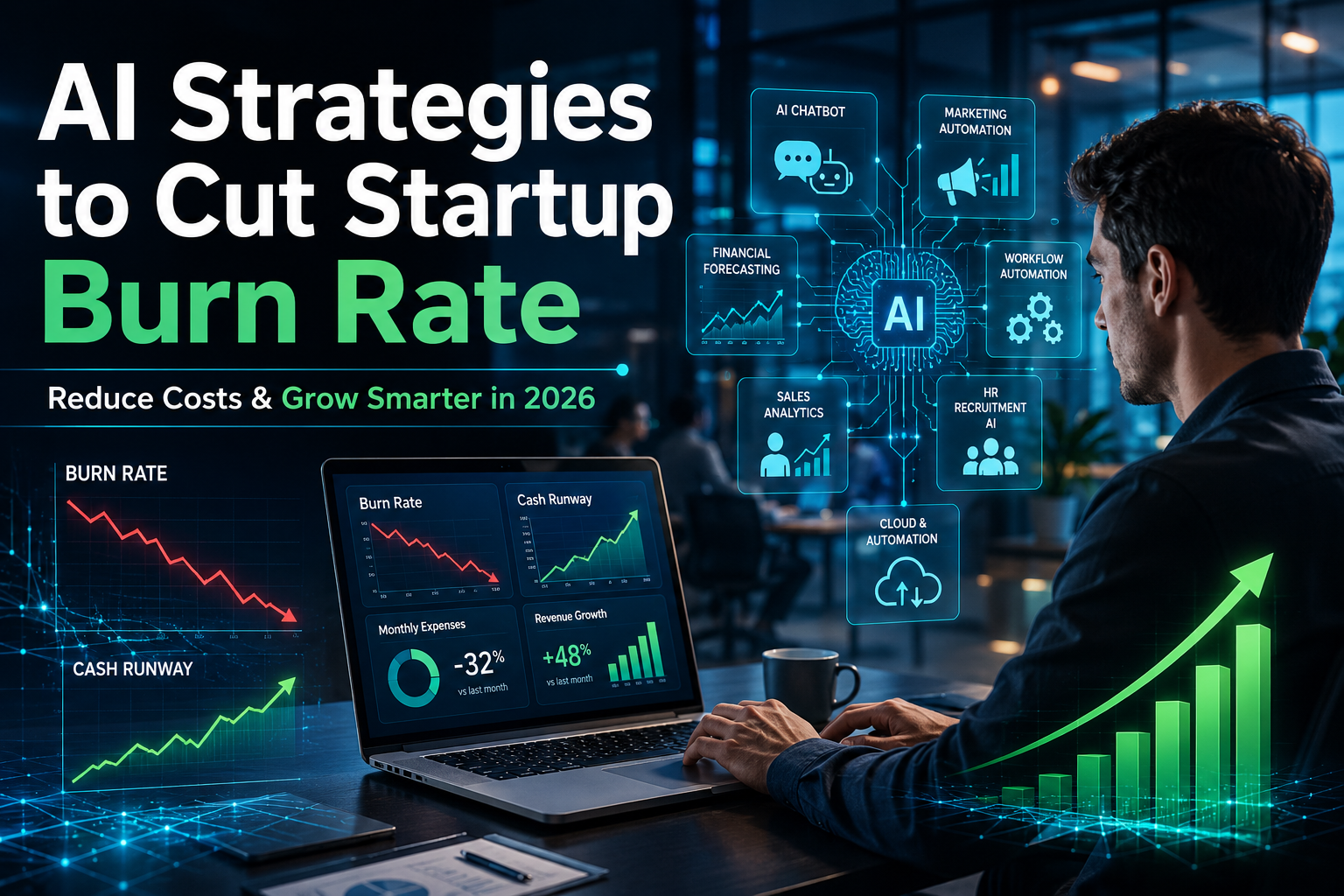
Startup burn rate is the amount of money a company spends every month before it becomes profitable.
For example:
Certainly, if your startup spends £30,000 every month and earns only £10,000, your monthly burn rate is £20,000.
Indeed, a high burn rate means your available cash will disappear quickly unless revenue increases or expenses decrease.
Investors carefully monitor burn rate because it shows how efficiently founders manage company resources.
Why Reducing Startup Burn Rate Matters
Overall, lowering your burn rate provides several advantages.
- Also increases your cash runway
- Also gives more time to reach profitability
- Also makes fundraising easier
- Also reduces financial stress
- Also allows better investment decisions
- Also improves investor confidence
- Also helps survive market downturns
- Also creates a stronger business foundation
Instead of simply cutting expenses, startups should improve efficiency. Indeed, AI helps achieve exactly that.
How AI Helps Reduce Startup Burn Rate
Specifically, Artificial Intelligence automates tasks that normally require human effort.
Instead of hiring multiple employees for repetitive work, AI software performs those tasks quickly, accurately, and at a much lower cost.
Specifically, AI helps startups:
- Also saves time
- Also reduces labour costs
- Also improves customer service
- Also increases productivity
- Also reduces errors
- Also predicts future trends
- Also improves marketing performance
- Also makes smarter business decisions
AI Strategy 1: Automate Work to Cut Startup Burn Rate
Basically, many startups spend hours every week on routine tasks.
Specifically, examples include:
- Data entry
- Scheduling meetings
- Sending emails
- Creating reports
- Organising documents
- Updating spreadsheets
As a result, AI automation tools can complete these tasks automatically.
Additionally, benefits include:
- Fewer manual errors
- Faster operations
- Lower staffing costs
- Better productivity
Generally, employees can focus on high-value work instead of repetitive activities.
AI Strategy 2: Lower Startup Burn Rate with AI Customer Support
Similarly, hiring customer support teams can become expensive.
Generally, modern AI chatbots answer customer questions 24 hours a day.
Specifically, they can handle:
- Product enquiries
- Order status
- Refund requests
- Frequently asked questions
- Appointment booking
- Technical guidance
Overall, benefits include:
- Lower support costs
- Faster response times
- Improved customer satisfaction
- Reduced workload for staff
Generally, human agents only handle complex cases.
AI Strategy 3: Reduce Marketing Costs with AI
Meanwhile, marketing is often one of the largest startup expenses.
Specifically, AI tools help create:
- Blog articles
- Social media posts
- Ad copy
- Email campaigns
- Product descriptions
- Landing pages
Meanwhile, AI also analyses campaign performance and recommends improvements.
Additionally, benefits include:
- Lower content creation costs
- Better advertising performance
- Higher conversion rates
- Faster campaign launches
AI Strategy 4: Improve Hiring Efficiency
Similarly, recruitment is expensive.
Similarly, AI helps startups hire better employees while spending less.
Specifically, AI recruitment tools can:
- Screen CVs
- Rank candidates
- Schedule interviews
- Analyse candidate skills
- Remove duplicate applications
Overall, benefits include:
- Faster hiring
- Lower recruitment costs
- Better hiring decisions
- Reduced HR workload
AI Strategy 5: Forecast Cash Flow to Control Startup Burn Rate
In fact, many startups fail because they run out of cash unexpectedly.
Specifically, AI forecasting tools analyse:
- Revenue trends
- Expenses
- Customer payments
- Market conditions
- Sales forecasts
As a result, this helps founders make smarter financial decisions.
Additionally, benefits include:
- Better budgeting
- Earlier warning signs
- Improved financial planning
- Reduced unnecessary spending
AI Strategy 6: Optimise Inventory Management
Certainly, inventory mistakes can waste thousands of pounds.
Meanwhile, too much inventory locks up cash.
Similarly, too little inventory loses sales.
Then, AI predicts customer demand using historical sales data.
Overall, benefits include:
- Lower storage costs
- Reduced waste
- Better purchasing decisions
- Higher profit margins
AI Strategy 7: Use AI Sales Assistants
Overall, AI sales assistants improve productivity without increasing payroll.
Specifically, they can:
- Generate leads
- Score prospects
- Send follow-up emails
- Schedule meetings
- Predict buying behaviour
Additionally, benefits include:
- Higher sales
- Lower acquisition costs
- Better conversion rates
- Increased revenue
AI Strategy 8: Reduce Software Costs
In fact, many startups pay for software they rarely use.
Then, AI software management platforms analyse:
- Employee software usage
- Subscription costs
- Duplicate applications
- Licence utilisation
Overall, benefits include:
- Cancel unused subscriptions
- Reduce software spending
- Improve budget management
AI Strategy 9: Improve Financial Operations and Reduce Startup Burn Rate
Similarly, bookkeeping consumes valuable time.
Specifically, AI accounting software automates:
- Invoice creation
- Expense tracking
- Bank reconciliation
- Tax calculations
- Financial reporting
Additionally, benefits include:
- Lower accounting fees
- Faster reporting
- Better financial accuracy
- Improved compliance
AI Strategy 10: Predict Customer Churn
Indeed, finding new customers costs more than keeping existing ones.
Meanwhile, AI analyses customer behaviour to predict who may leave.
Then, businesses can take action through:
- Personalised offers
- Better support
- Targeted communication
Additionally, benefits include:
- Higher retention
- Increased recurring revenue
- Lower customer acquisition costs
AI Strategy 11: Optimise Pricing
Generally, pricing products correctly directly affects profitability.
Specifically, AI studies:
- Competitor prices
- Customer demand
- Market trends
- Purchase history
Basically, AI recommends the best pricing strategy.
Overall, benefits include:
- Better profit margins
- Increased sales
- Competitive pricing
AI Strategy 12: Improve Decision Making with AI Analytics
In fact, startups generate huge amounts of data.
Then, AI converts raw information into useful insights.
Specifically, business leaders can understand:
- Customer behaviour
- Product performance
- Marketing ROI
- Revenue growth
- Operational efficiency
Additionally, benefits include:
- Faster decisions
- Better investments
- Reduced waste
AI Strategy 13: Automate Internal Communication
Similarly, AI improves team collaboration.
Specifically, it can automatically:
- Summarise meetings
- Generate action items
- Organise documents
- Search company knowledge
- Translate conversations
Overall, benefits include:
- Better teamwork
- Reduced meeting time
- Faster communication
AI Strategy 14: Prevent Fraud
Indeed, financial fraud can seriously damage startups.
Certainly, AI identifies unusual activity immediately.
Specifically, examples include:
- Suspicious payments
- Fake transactions
- Account misuse
- Unusual spending
Additionally, benefits include:
- Lower financial losses
- Better security
- Greater investor confidence
AI Strategy 15: Build Lean Teams
Instead of hiring large departments, startups can combine AI with small expert teams.
For example:
For example, one marketing manager supported by AI can often produce the work that previously required multiple specialists.
Similarly, one customer support manager using AI chatbots can assist hundreds of customers every day.
Overall, this approach keeps payroll under control while maintaining productivity.
Areas That Increase Startup Burn Rate
In fact, many startups increase their burn rate because of unnecessary expenses.
Specifically, common examples include:
- Hiring too quickly
- Paying for unused software
- Manual repetitive work
- Poor marketing campaigns
- Excess inventory
- Long recruitment processes
- Inefficient customer support
- Poor financial planning
- Low employee productivity
- Weak data analysis
As a result, AI helps reduce nearly all these unnecessary costs.
Best AI Tools to Reduce Startup Burn Rate
Generally, several affordable AI tools help startups lower expenses and improve efficiency.
| Business Area | AI Solution |
|---|---|
| Content Creation | ChatGPT |
| Automation | n8n |
| Customer Support | AI Chatbots |
| Accounting | AI Accounting Software |
| Recruitment | AI Hiring Platforms |
| Sales | AI CRM Assistants |
| Marketing | AI Marketing Platforms |
| Data Analytics | AI Business Intelligence |
| Meeting Notes | AI Meeting Assistants |
| Finance | AI Forecasting Tools |
Additionally, many of these tools offer free plans or affordable monthly subscriptions, making them accessible even for early-stage startups.
Common Mistakes That Increase Startup Burn Rate with AI
Indeed, many startups fail to get results because they use AI incorrectly.
Then, avoid these mistakes:
- Buying too many AI tools
- Ignoring employee training
- Automating everything immediately
- Not checking AI-generated output
- Using AI without clear goals
- Forgetting customer experience
- Ignoring data privacy
Overall, AI works best when combined with human expertise.
How to Implement AI Successfully
Generally, successful AI adoption happens step by step.
Then, follow this process:
- Identify expensive manual tasks.
- Calculate current costs.
- Choose one AI solution.
- Test it with a small team.
- Measure results.
- Improve the workflow.
- Expand AI gradually.
- Continue monitoring savings.
Overall, this approach reduces risk while maximising return on investment.
The Future of AI and Startup Burn Rate
Certainly, AI is becoming more affordable every year.
Eventually, startups will increasingly use AI for:
- Autonomous business operations
- Predictive financial planning
- AI-powered product development
- Intelligent customer support
- Automated coding
- Sales forecasting
- Business strategy
- Market research
- Workflow automation
- Investor reporting
Indeed, founders who adopt AI early will have a significant competitive advantage.
Conclusion: Mastering Startup Burn Rate with AI
Managing startup burn rate is essential for long-term success. Certainly, every pound saved extends your financial runway and gives your business more time to grow. Overall, Artificial Intelligence provides practical solutions for reducing unnecessary expenses without sacrificing quality or innovation. From automating repetitive tasks and improving customer support to forecasting cash flow and optimising marketing, AI enables startups to operate more efficiently with smaller teams and smarter processes. Basically, the key is to begin with one or two high-impact areas, measure the results, and expand AI adoption gradually. Rather than replacing people, AI empowers teams to focus on strategic work that drives growth. Then, startups that embrace AI thoughtfully will not only reduce their burn rate but also build stronger, more resilient businesses ready to compete in the fast-changing market of 2026 and beyond.
Frequently Asked Questions (FAQs)
1. What is startup burn rate?
In essence, startup burn rate is the amount of money a company spends each month before becoming profitable.
2. How does AI reduce startup burn rate?
Basically, AI automates repetitive tasks, improves productivity, reduces staffing costs, enhances decision-making, and minimises operational waste.
3. Is AI affordable for small startups?
Yes. Additionally, many AI tools offer free plans and low-cost subscriptions suitable for startups with limited budgets.
4. Which department benefits the most from AI?
Overall, marketing, customer support, finance, sales, operations, and HR all benefit significantly from AI automation.
5. Can AI replace employees?
Generally, AI is designed to assist employees rather than replace them. Instead, it handles repetitive tasks, allowing people to focus on strategic and creative work.
6. What is the biggest advantage of using AI in startups?
In short, the biggest advantage is improved efficiency, which helps startups lower their burn rate while maintaining growth and delivering better customer experiences.
7. Should every startup invest in AI?
Generally, most startups can benefit from AI, especially if they want to reduce costs, improve productivity, and scale operations efficiently. Generally, the best approach is to start with one high-impact use case and expand as the business grows.