


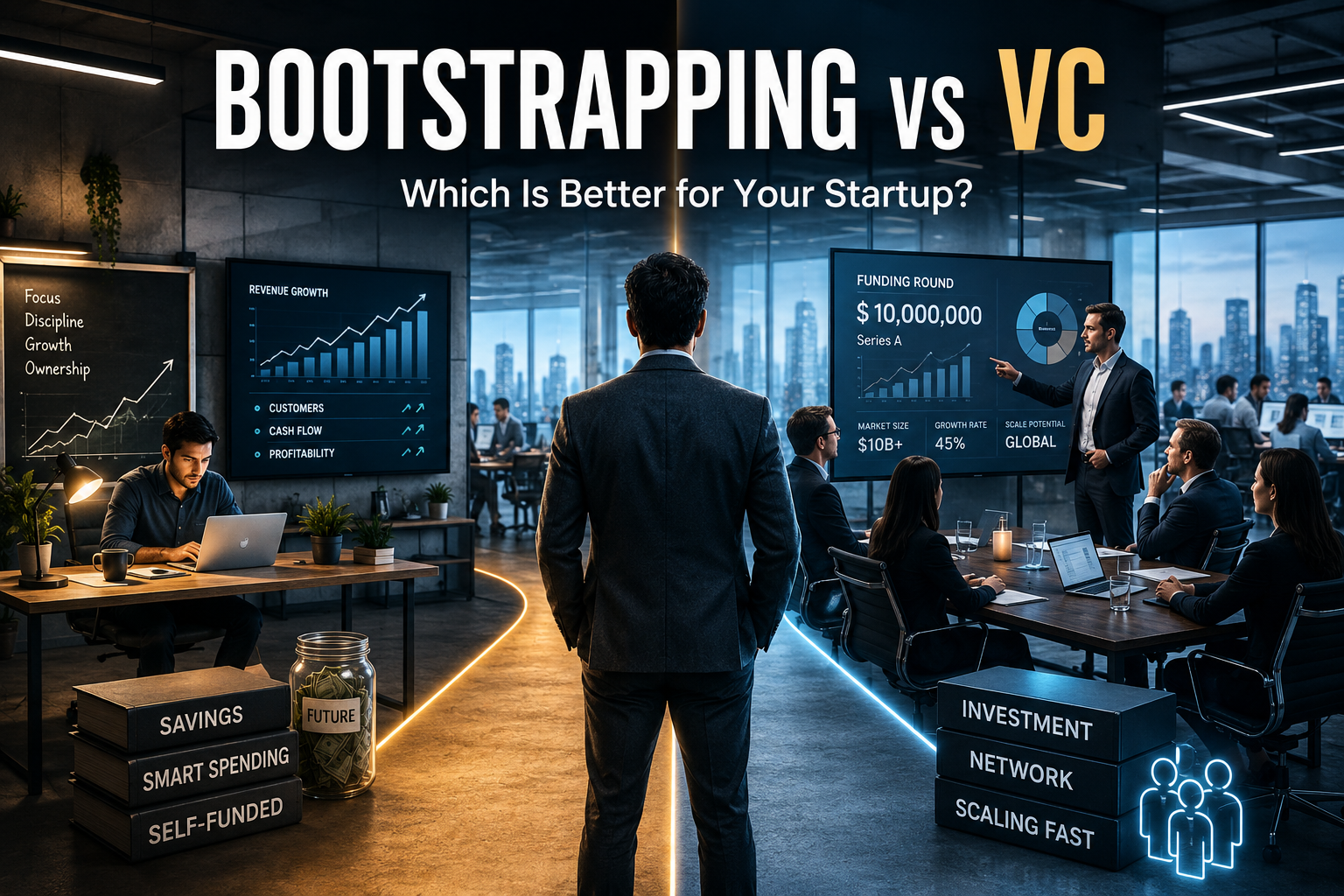
Starting a business is exciting, but one of the biggest questions founders face is how to fund it. Should you use your own money and grow slowly, or should you raise money from venture capital investors and grow faster? This is where the debate about bootstrapping vs VC becomes important. The funding choice can affect your ownership, business decisions, growth speed, financial risk, and long-term goals.
However, there is no single answer that works for every startup. Some businesses can grow successfully without outside investment, while others need large amounts of capital to compete in a fast-moving market. Understanding the difference between bootstrapping and venture capital can help you make a smarter decision before giving away equity or putting your personal savings at risk. In this guide, we will compare both options in simple language, explain their advantages and disadvantages, discuss when each option makes sense, and help you choose the right funding strategy for your startup. By the end, the bootstrapping vs VC decision should feel much clearer.
Bootstrapping vs VC: What Is Bootstrapping?
Bootstrapping means starting and growing a business using your own money and the money generated by the business.
Instead of raising money from venture capital firms or other outside investors, the founder usually uses personal savings, income from an existing job, early customer payments, or business revenue.
For example, imagine you want to start a small SaaS company. You spend ₹2 lakh from your savings to build the first version of your software. Then, you get your first customers and use the revenue to improve the product. You continue this process without raising money from investors.
In short, this is called bootstrapping a startup.
However, bootstrapping does not always mean that a founder never receives outside money. A business can use customer revenue, small business loans, grants, or other non-equity funding while still avoiding traditional venture capital.
In essence, the main idea is simple: the founder tries to build the company with limited external equity funding.
Bootstrapping vs VC: What Is Venture Capital?
Venture capital, commonly called VC, is funding provided by professional investors to startups that have the potential to grow significantly.
Specifically, a venture capital firm invests money in exchange for ownership, also called equity, in the startup.
For example, suppose your startup is valued at ₹5 crore and a VC firm invests ₹1 crore for a percentage of the company. The startup now has additional capital to hire employees, develop products, market the business, and expand.
In return, the investors expect the company to become much more valuable over time.
Generally, venture capital is usually designed for startups with large growth opportunities. It is especially common in technology, artificial intelligence, fintech, SaaS, healthcare, consumer technology, and other markets where companies may need significant capital to scale.
Bootstrapping vs VC: The Main Difference
In fact, the biggest difference between bootstrapping and venture capital is where the money comes from and who controls the business.
Typically, with bootstrapping, founders generally keep more ownership and control. However, they have fewer financial resources and may need to grow more carefully.
In contrast, with VC funding, the startup receives more capital and may grow faster. However, founders give away equity and usually have investors who expect strong growth and eventually a profitable exit.
Ultimately, the right choice depends on your startup model, market, financial needs, growth plans, and personal goals.
Bootstrapping vs VC Comparison
Before choosing a funding model, it helps to understand the major differences.
| Factor | Bootstrapping | Venture Capital |
|---|---|---|
| Source of money | Founder and business revenue | Investors |
| Ownership | Usually higher founder ownership | Founder gives away equity |
| Control | More control | Shared influence |
| Growth speed | Usually slower | Can be faster |
| Financial pressure | Revenue-focused | Growth and investor-focused |
| Risk | Personal financial risk can be higher | Business pressure can be higher |
| Hiring | Usually more careful | Can hire aggressively |
| Marketing budget | Often limited | Can be significantly larger |
| Decision-making | Founder-led | Investors may influence decisions |
| Exit pressure | Usually lower | Often higher |
| Suitable for | Sustainable businesses | High-growth startups |
Bootstrapping vs VC: Advantages of Bootstrapping
Indeed, bootstrapping can be a powerful strategy when a startup can grow using customer revenue.
Here are some of its biggest benefits.
1. You Keep More Ownership
One of the biggest advantages of bootstrapping is that you do not need to give investors a percentage of your company just to get started.
If you own 100% of your company at the beginning and continue growing through revenue, you can potentially maintain a much larger ownership stake.
This can become extremely valuable if the business becomes successful.
2. You Have More Control
Additionally, bootstrapped founders generally have greater control over business decisions.
You can decide:
- What product to build
- Which customers to target
- How much to spend
- When to hire
- Whether to expand
- How quickly to grow
- Whether to sell the company
You do not have to regularly explain every decision to external investors.
3. You Can Focus on Customers
Also, bootstrapped startups often need to generate revenue early.
This can encourage founders to solve real customer problems rather than focusing only on growth metrics.
As a result, a company that depends on customers for survival may become disciplined about product quality, pricing, customer service, and cash flow.
4. Less Investor Pressure
VC-backed startups often have aggressive growth targets.
Investors may expect the startup to increase revenue, users, market share, or valuation quickly.
In contrast, a bootstrapped company may have more freedom to choose a sustainable growth rate.
5. You Can Build a Profitable Business
Bootstrapping can encourage founders to focus on profitability.
Instead of asking, “How can we raise our next funding round?” the founder may ask, “How can we make the business financially sustainable?”
This can create a strong foundation for long-term growth.
Bootstrapping vs VC: Disadvantages of Bootstrapping
Bootstrapping also has important disadvantages.
1. Limited Capital
However, your available money may limit what you can do.
For instance, you may not be able to hire a large team, spend heavily on advertising, or develop an expensive product.
2. Slower Growth
Meanwhile, a competitor with significant funding may move faster.
They could hire more employees, enter new markets, spend more on marketing, and develop products faster than your bootstrapped startup.
3. Personal Financial Risk
If you use your own savings to fund the business, you are taking personal financial risk.
Indeed, a startup may fail, and the money invested may not come back.
For this reason, founders should think carefully before investing large amounts of personal savings.
4. Founder Stress
Notably, bootstrapping can put significant pressure on the founder.
When money is limited, the founder may need to manage sales, marketing, product development, customer support, and finances at the same time.
Bootstrapping vs VC: Advantages of Venture Capital
VC funding can provide startups with resources that would be difficult to obtain through bootstrapping.
1. More Capital for Growth
Certainly, the most obvious benefit is access to capital.
A startup can use VC funding for:
- Product development
- Hiring
- Marketing
- Sales
- Technology
- Research
- International expansion
- Customer acquisition
This can help a company grow faster.
2. Faster Market Expansion
Some markets reward companies that move quickly.
If a startup has a strong opportunity to become a market leader, waiting several years to generate enough revenue may allow competitors to take the opportunity.
VC funding can help founders act faster.
3. Access to Investor Networks
Moreover, good venture capital investors can offer more than money.
They may introduce founders to:
- Customers
- Business partners
- Employees
- Industry experts
- Other investors
- Advisors
Overall, these connections can be valuable for a growing startup.
4. Hiring Better Talent
Funding can make it easier to hire experienced employees.
A startup may need engineers, sales professionals, marketing specialists, product managers, and executives.
VC capital can provide the financial resources needed to build a larger team.
5. Ability to Take Bigger Risks
A well-funded startup can experiment more aggressively.
It can test new markets, launch new products, invest in technology, and try different customer acquisition strategies.
This does not guarantee success, but it gives the startup more room to experiment.
Bootstrapping vs VC: Disadvantages of Venture Capital
VC funding is not free money.
It comes with significant responsibilities.
1. You Give Away Equity
When investors invest in your company, they usually receive ownership.
This means your percentage of ownership decreases.
For example, if you own 100% of the startup before investment and sell 20% to investors, you now own 80%.
If you raise multiple rounds, your ownership can decrease further.
2. Less Control
Investors may have rights that influence important decisions.
Depending on the investment agreement and company structure, investors may have board representation, voting rights, or approval rights for certain major decisions.
Therefore, raising money can change how your company is governed.
3. Pressure to Grow
VC investors typically invest in startups because they expect significant growth.
A lifestyle business that generates stable revenue may not fit the traditional VC model.
Investors usually want the company to become much more valuable.
4. Exit Expectations
Many venture capital funds have a limited investment period.
Investors generally expect an eventual liquidity event, such as an acquisition or IPO.
This means founders may eventually face pressure to pursue an exit.
5. Fundraising Takes Time
Raising VC funding can take months.
Founders may need to prepare a pitch deck, financial model, business plan, investor list, meetings, due diligence, negotiations, and legal documents.
This takes time away from building the business.
Bootstrapping vs VC: When Should You Bootstrap Your Startup?
Bootstrapping can be a good option when your startup does not require huge amounts of capital to grow.
Consider bootstrapping if:
- You can start with a small amount of money.
- Your business can generate revenue quickly.
- Your customer acquisition cost is manageable.
- You want to maintain control.
- You do not need rapid expansion.
- Your market does not require massive upfront investment.
- You want to build a profitable company.
- You prefer sustainable growth over aggressive growth.
For example, consulting companies, agencies, niche SaaS products, digital products, online businesses, and many service businesses can sometimes be started successfully through bootstrapping.
Bootstrapping vs VC: When Should You Raise Venture Capital?
VC funding may make more sense when your startup requires substantial capital to compete.
Consider venture capital if:
- Your market is very large.
- You need significant funding before generating revenue.
- Your business has strong growth potential.
- Speed is important.
- Competitors are well funded.
- You need expensive technology or research.
- You need to build a large team.
- You plan to expand into multiple markets quickly.
- You are comfortable giving up some ownership.
For example, a startup developing advanced AI infrastructure may need expensive computing resources and highly skilled technical employees before it can generate significant revenue.
In such a situation, external funding may be useful.
Bootstrapping vs VC: Is Bootstrapping Better Than VC?
There is no universal winner in the bootstrapping vs VC debate.
Bootstrapping is better for some founders, while venture capital is better for others.
If your goal is to build a profitable company while maintaining control, bootstrapping may be a better choice.
If your goal is to build a large company quickly and your market requires significant capital, VC funding may be more suitable.
The important question is not:
“Which funding option is better?”
The better question is:
“Which funding option is better for my specific business?”
How Much Ownership Should You Give Investors?
There is no universal percentage that every founder should accept.
The percentage depends on factors such as:
- Startup valuation
- Amount being raised
- Business traction
- Revenue
- Growth rate
- Market size
- Negotiating power
- Investor interest
Founders should not focus only on the amount of money being offered.
They should also consider how much ownership they are giving away and what rights investors receive.
A large investment can be attractive, but giving away too much equity too early can create problems later.
Can You Bootstrap First and Raise VC Later?
Yes.
This is actually a common strategy.
A founder can bootstrap the startup until it has:
- A working product
- Paying customers
- Revenue
- Market validation
- Strong user growth
- Clear business metrics
Then the founder can approach investors.
This can make fundraising easier because investors can see evidence that the business is working.
It may also improve the founder’s negotiating position.
Can You Mix Bootstrapping and VC Funding?
Yes.
Startup funding does not always have to be completely bootstrapped or completely VC-backed.
A founder might use personal savings to launch the business, generate early revenue, and later raise a smaller investment.
This approach can provide a balance between ownership and growth capital.
Other funding sources can also be considered, such as grants, angel investors, bank financing, revenue-based financing, or strategic partnerships.
Each option has different costs, risks, and requirements.
Bootstrapping vs Angel Investors vs VC
It is also useful to understand the difference between angel investors and venture capital.
Angel investors are usually individuals who invest their own money in startups.
VC firms invest money from investment funds.
An angel investor may sometimes invest earlier when a startup has limited traction.
Venture capital investors generally look for startups with strong growth potential and the possibility of a large future exit.
Neither option is automatically better.
The best choice depends on the startup’s stage and funding requirements.
What Should First-Time Founders Consider?
First-time founders should avoid raising money simply because other startups are raising money.
Before choosing funding, think about the business fundamentals.
Start by understanding how much money you actually need.
Then consider how quickly you can generate revenue.
Also think about your personal financial situation, your risk tolerance, your desired ownership, and the type of company you want to build.
A founder should not raise ₹5 crore if the business can reach its next major milestone with ₹50 lakh.
Similarly, a startup should not avoid external funding if lack of capital could cause it to lose a major market opportunity.
A Simple Framework to Choose
You can use the following framework to make your decision.
Step 1: Calculate Your Initial Capital Requirement
First, estimate how much money you need to reach your next major business milestone.
Do not simply calculate how much money would be nice to have.
Calculate how much money you actually need.
Step 2: Estimate Your Revenue Potential
Think about how quickly customers can start paying you.
A startup that can reach meaningful revenue quickly may have more opportunities to bootstrap.
Step 3: Study Your Market
Ask whether speed is important.
If your market is changing quickly and competitors are aggressively expanding, additional funding may be valuable.
Step 4: Decide How Much Control Matters
When maintaining maximum founder ownership is very important to you, bootstrapping may be attractive.
If you are comfortable sharing ownership in exchange for capital and support, VC may be a better option.
Step 5: Consider Your Long-Term Goal
Think about the company you want to build.
Do you want a profitable business that gives you flexibility?
Or do you want to build a large venture-backed company that could eventually become a major industry player?
Your answer can influence your funding decision.
Bootstrapping vs VC: Common Mistakes Founders Make
Funding decisions can become expensive mistakes if founders make them emotionally.
Here are some common mistakes to avoid.
Raising Money Too Early
Do not raise VC simply because you can.
If you can validate your idea cheaply, consider doing that before raising a large round.
Giving Away Too Much Equity
Do not focus only on the amount of money you receive.
Understand the percentage of ownership you are giving away.
Spending Too Quickly
A large bank balance can create a false sense of security.
Funding should be used strategically rather than simply increasing expenses.
Ignoring Profitability
Even a VC-backed startup should understand its financial model.
Revenue, gross margin, operating costs, customer acquisition cost, and cash runway are important metrics.
Choosing Investors Only for Money
An investor can become a long-term partner.
Look at their experience, network, reputation, communication style, and understanding of your industry.
Bootstrapping vs VC: Which One Is Right for You?
The following simple guide can help you think about the decision.
Choose bootstrapping if you want:
- More ownership
- More control
- Sustainable growth
- Early profitability
- Less investor involvement
- Greater freedom in business decisions
Choose VC funding if you want:
- Faster growth
- More capital
- Aggressive expansion
- Larger hiring capacity
- Strong investor networks
- The ability to compete in capital-intensive markets
There is also a third option: bootstrap first and raise money later.
For many founders, this can be a practical middle path.
Bootstrapping vs VC: Final Thoughts
The decision between bootstrapping vs VC is one of the most important funding decisions a startup founder can make. However, there is no universal answer.
Bootstrapping gives founders more control and can help them build a business around real customers and revenue. The downside is that growth can be slower and personal financial risk may be higher.
Venture capital provides access to significant capital, talent, networks, and faster expansion. However, founders give away equity and may face greater pressure to achieve rapid growth and eventually provide a return to investors.
The best funding strategy depends on your startup’s business model, market, capital requirements, growth opportunity, and personal goals.
Before raising money, understand exactly why you need it and what milestone the funding will help you achieve. Before bootstrapping, make sure you are not limiting the company so much that a major opportunity is lost.
In the end, the best startup funding strategy is the one that helps you build the company you actually want to own and operate.
Frequently Asked Questions
1. Bootstrapping vs VC: What Is the Difference?
Bootstrapping means using your own money and business revenue to grow a startup. VC means raising money from venture capital investors in exchange for equity.
2. Bootstrapping vs VC: Is Bootstrapping Better?
Not always. Bootstrapping can be better for founders who value ownership and control. VC can be better for startups that need significant capital and rapid growth.
3. Can a startup be successful without VC funding?
Yes. Many businesses can grow successfully through customer revenue and careful spending without raising venture capital.
4. Why do startups choose venture capital?
Startups usually choose VC because they need capital to hire, develop products, market their business, expand into new markets, or grow faster.
5. Does VC funding mean founders lose control?
It can reduce founder control, depending on the investment terms, ownership structure, voting rights, and board arrangements.
6. Can I bootstrap first and raise VC later?
Yes. Bootstrapping first can help founders validate their product, acquire customers, generate revenue, and potentially negotiate better terms when they eventually raise funding.
7. What types of startups are good for bootstrapping?
Businesses that can start with relatively low capital and generate revenue quickly can be good candidates for bootstrapping. Examples include agencies, consulting businesses, niche SaaS products, and digital businesses.
8. What types of startups are more suitable for VC?
Startups that require significant upfront investment and have the potential for rapid, large-scale growth may be more suitable for VC funding.
9. Should I raise VC just because my competitors have funding?
Not necessarily. Funding should solve a specific business need. Raising money without a clear reason can create unnecessary dilution and pressure.
10. What should I consider before accepting VC funding?
Consider the valuation, equity dilution, investor rights, board structure, expected growth, investor reputation, future fundraising requirements, and long-term exit expectations.
11. Is bootstrapping less risky than VC?
Not necessarily. Bootstrapping can reduce equity dilution but may increase the founder’s personal financial risk. VC reduces the need to use personal capital but creates investor expectations and business pressure.
12. What is the best funding strategy for a new startup?
There is no single best strategy. Start with your capital requirements, revenue potential, market opportunity, growth speed, ownership goals, and long-term vision. Then choose the funding method that fits those factors.