


Introduction: How to Start a Startup With No Money
Starting a startup can feel impossible when you have little or no money. Many people believe they need a large investment, office, employees, expensive software, and paid advertising before they can start. That is not always true. Today, many businesses can be started with a laptop, internet connection, useful skills, free tools, and a good understanding of customer problems. The key is not to build a large business immediately. The key is to start small, test your idea, get your first customers, and use revenue to grow. If you are searching for how to start a startup with no money, this guide will help you understand the practical steps. You will learn how to find a useful business idea, validate demand, build an MVP, find customers, reduce startup costs, use AI and free tools, and grow your business without taking unnecessary financial risks.
Can You Really Start a Startup With No Money?
Yes, it is possible to start some types of businesses with very little money.
However, starting with no money does not mean that you will never have business expenses. As your company grows, you may need to pay for registration, hosting, software, employees, marketing, legal services, equipment, or other costs.
The goal is to avoid unnecessary expenses during the early stage.
Instead of asking, “How much money do I need to build my startup?” ask:
“What is the cheapest way to test whether people will pay for my solution?”
This change in thinking can save you a lot of money.
For example, if you want to build an expensive mobile application, you could first create a simple landing page and manually provide the service to a few customers. If people are willing to pay, you have evidence that your idea has potential.
This approach is often connected with bootstrapping and the lean startup method.
1. Start With a Real Problem
The first step in learning how to start a startup with no money is finding a real problem.
Many entrepreneurs start with a product idea instead of a customer problem. They think about what they want to build but do not first ask whether people actually need it.
A better approach is to identify a problem that people already experience.
Look at problems related to:
- Saving time
- Finding customers
- Reducing costs
- Managing employees
- Marketing products
- Getting education
- Finding jobs
- Managing information
- Automating repetitive work
- Booking services
- Selling products online
- Improving productivity
A strong startup idea usually solves a problem that is important enough for someone to spend money on.
If you already understand an industry, start there. Your knowledge can help you identify problems faster than someone who knows nothing about that market.
2. Use Your Skills as Your First Investment
When you do not have money, your skills can become your startup capital.
Think about what you can already do well.
Your skills may include:
- Writing
- Coding
- Graphic design
- SEO
- Digital marketing
- Sales
- Video editing
- Web development
- Consulting
- Teaching
- Data analysis
- Social media management
- AI automation
Now connect your skill with a customer problem.
For example, someone who understands SEO could help small businesses get more search traffic. A programmer could create simple automation solutions. A designer could provide branding services.
In fact, this can be much easier than creating a completely new product from the beginning.
For instance, you can start by selling a service and later turn that service into a scalable product.
3. Choose a Low-Cost Business Model to Start a Startup With No Money
Some businesses require a lot of capital. Others can be started with almost no initial investment.
If money is your biggest limitation, choose a business model with low fixed costs.
Some examples include:
Service-Based Business
Similarly, a service business can be started using your existing knowledge.
Examples include:
- SEO services
- Website development
- Content writing
- Graphic design
- Consulting
- Social media management
- AI automation
- Video editing
- Virtual assistance
In this case, you can find a customer first and then deliver the service.
Digital Products
Meanwhile, digital products do not require physical inventory.
Examples include:
- E-books
- Templates
- Online courses
- Guides
- Design files
- Business documents
- Digital resources
Once created, some digital products can be sold repeatedly.
SaaS Startup
If you have technical skills, you can build a small software product that solves one specific problem.
Instead, do not try to compete with a large software company immediately.
Rather, find a narrow problem and build a simple solution.
Marketplace Business
A marketplace connects customers with providers or sellers.
Basically, you may not need to own the products yourself.
Generally,, the business can earn money through commissions, subscriptions, listing fees, or other models depending on the marketplace.
4. Validate Your Startup Idea Before Spending Money
One of the most important rules for a startup without investment is to validate your idea before spending heavily.
Do not spend six months building a product only to discover that customers do not want it.
First, talk to potential customers.
Ask questions such as:
- What problem are you currently facing?
- How do you solve it today?
- How often does the problem happen?
- How much time or money does it cost you?
- Have you tried another solution?
- Also, what would make a new solution useful?
Avoid asking only whether someone “likes” your idea.
However, people may say that an idea sounds good without ever buying it.
In fact, a stronger form of validation is action.
Look for people who are willing to:
- Join a waiting list
- Book a call
- Start a trial
- Provide detailed feedback
- Give a pre-order
- Pay for an early version
Ultimately, customer behavior gives you better information than compliments.
5. Build an MVP to Start a Startup With No Money
MVP stands for Minimum Viable Product.
It means creating the simplest version of your product that can solve the main customer problem.
Indeed, you do not need every feature on day one.
Suppose you want to create an online appointment platform.
A full platform might require:
- Mobile applications
- Customer accounts
- Payment systems
- Provider dashboards
- Notifications
- Reviews
- Analytics
- Automated reminders
Naturally, building everything at once could be expensive.
Instead, you could start with a simple website and manually manage bookings.
If customers use the service, you can gradually add automation and features.
In short, the purpose of an MVP is to learn what customers actually need before spending significant money.
6. Start With Manual Work
Automation is useful, but you do not need to automate everything at the beginning.
Basically, manual work can help you understand the business.
For example, imagine you want to create an AI lead-generation platform.
Instead of building software immediately, you could offer lead-generation as a service.
Instead, you manually research leads, organize the information, and provide it to customers.
After serving several customers, you may discover which tasks are repetitive.
Eventually, those tasks can later become automated features.
Overall, this approach allows you to learn from real customers before investing in technology.
7. Use Free and Low-Cost Tools to Start a Startup With No Money
Modern entrepreneurs have access to many free or affordable digital tools.
You can use free tools for:
- Communication
- Documents
- Spreadsheets
- Project management
- Design
- Website development
- Customer research
- Analytics
- Marketing
- Social media
- AI assistance
Indeed, you do not need dozens of paid subscriptions.
Start with the basic tools required to operate your business.
For example, your early setup may include:
- A simple website or landing page
- A professional email address
- A spreadsheet or simple CRM
- A communication platform
- A payment solution
- Basic analytics
- A project management tool
Then, upgrade your tools only when the business requires them.
For a curated list of free options, see our guide to the best free AI tools for startups, and consider exploring Y Combinator’s Startup School for additional free founder resources.
8. Find Your First Customer
Notably, your first customer is one of the most important milestones for a new startup.
Do not wait for customers to discover you.
Find them yourself.
You can use:
- Personal contacts
- Business communities
- Local networking
- Referrals
- Social media
- Industry groups
- Direct outreach
First, create a simple message that explains the problem you solve and how your service can help.
Avoid sending the same generic message to hundreds of people.
Personalized communication is usually more effective.
For example, instead of saying:
“Hello, we provide marketing services.”
Instead, you could explain a specific problem you noticed and offer a simple way to help.
9. Start With People You Already Know
Your existing network can help you find your first customers.
Tell friends, former colleagues, business contacts, and professional connections what you are building.
Rather, you are not asking them to buy something simply because they know you.
You are asking whether they know someone who has the problem you solve.
Certainly, this can create useful introductions.
Sometimes, your first customer may come from someone you already know.
10. Use Pre-Sales
Also, pre-sales can be useful when you have a strong idea but limited money.
Instead of building the entire product first, you can sell early access.
For example, suppose you want to create an online training program.
You can create:
- A course outline
- A landing page
- A clear description
- An early-bird offer
Then find customers.
Once people pay, you can use the revenue to create the complete course.
Overall, this approach reduces the risk of spending money on something nobody wants.
Notably, pre-sales can work particularly well for digital products, consulting programs, training, memberships, and some software products.
11. Turn Your First Revenue Into Startup Capital
Ultimately, your first revenue should help the business become stronger.
Do not spend all your early revenue on things that do not improve the business.
Consider reinvesting money into:
- Better tools
- Product development
- Customer acquisition
- Website improvements
- Customer support
- Business registration
- Important professional services
For example, if you earn ₹50,000 from your first customers, you could use part of it to improve your service and acquire more customers.
This creates a simple growth cycle:
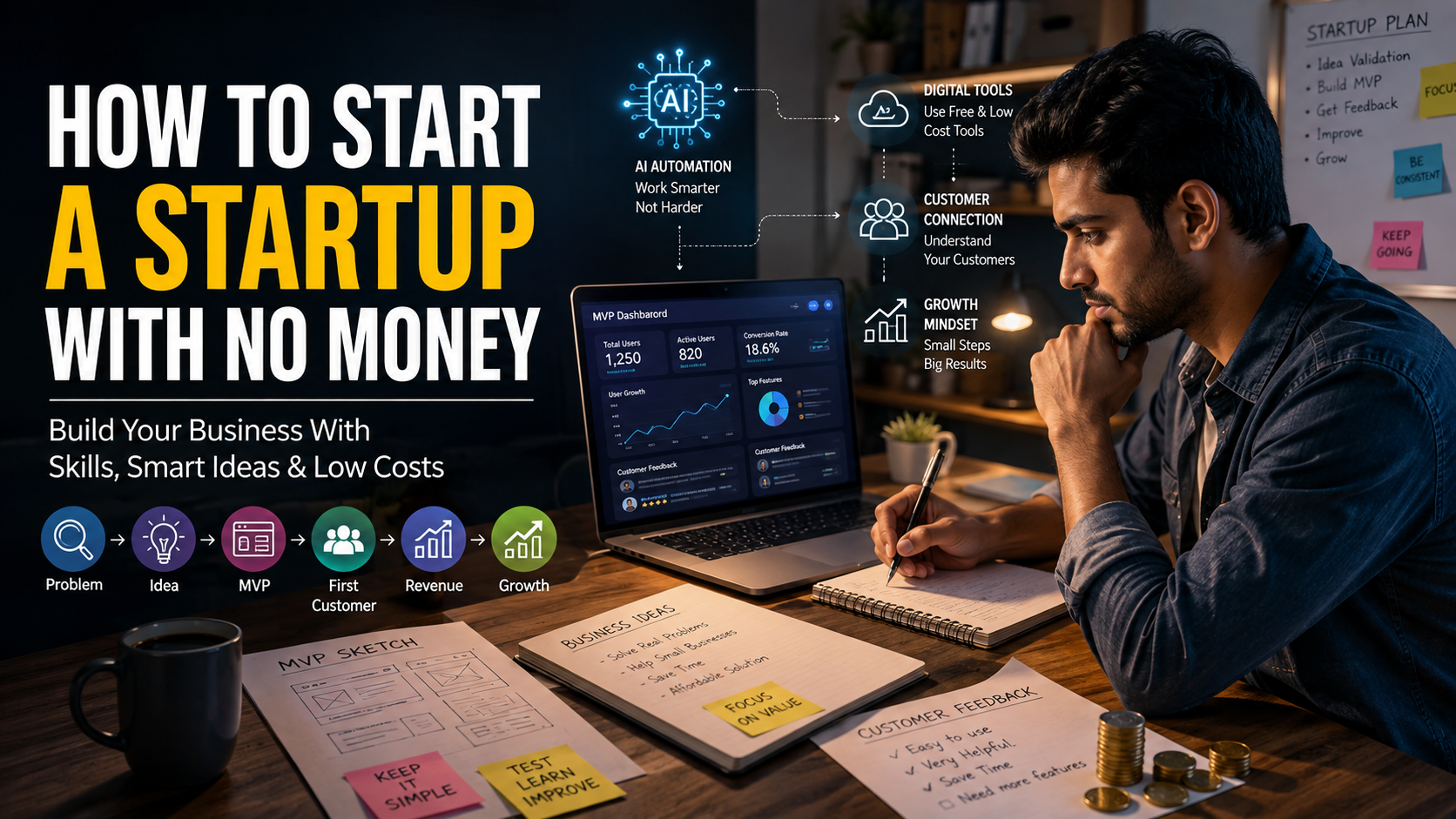
Customer Problem → Solution → Customer → Revenue → Reinvestment → Growth
This is the basic idea behind bootstrapping a startup.
12. Build a Simple Website
Indeed, you do not need an expensive website at the beginning.
A simple website can explain:
- What your startup does
- Who it helps
- The problem it solves
- Your main benefits
- Your pricing or starting offer
- Customer testimonials
- Contact information
- Frequently asked questions
Basically, your website should make it easy for visitors to understand your business.
Do not spend too much money on design before you have validated your business model.
Overall, the website should support your business, not become the business itself.
13. Use Content Marketing
Similarly, content marketing can help startups attract customers without depending completely on paid advertising.
You can create:
- Blog posts
- Tutorials
- Videos
- Case studies
- Guides
- Social media posts
- Industry reports
- Customer stories
- Educational content
Create content around the problems your customers are searching for.
For example, if your startup provides AI automation for small businesses, create useful content about repetitive business tasks, AI workflows, productivity, and automation.
Eventually, good content can help build trust before someone contacts you.
14. Use Social Media Carefully
Social media can be a useful low-cost marketing channel.
However, you do not need to create content on every platform.
First understand where your customers spend time.
A B2B startup may find LinkedIn useful. A consumer-focused brand may find Instagram, YouTube, or other platforms more relevant.
Then, choose one or two channels.
Also, post useful information regularly.
Share:
- Customer results
- Tips
- Educational content
- Product demonstrations
- Behind-the-scenes updates
- Industry insights
- Answers to common questions
Certainly, the goal is not simply to collect followers.
Instead, the goal is to build trust and generate business opportunities.
15. Ask for Customer Referrals
Similarly, referrals can be a powerful way to grow without spending heavily on advertising.
When you successfully solve a customer’s problem, ask whether they know someone who may need the same solution.
Indeed, satisfied customers can introduce you to new customers.
You can also create a formal referral program if it makes sense for your business.
Ultimately, the important thing is to provide enough value that customers feel comfortable recommending you.
16. Avoid Unnecessary Costs When Starting a Startup With No Money
When starting a startup with no money, controlling expenses is extremely important.
Avoid spending heavily on:
- Expensive offices
- Fancy furniture
- Large teams
- Unnecessary software
- Expensive branding packages
- Large advertising campaigns
- Equipment you do not need
- Features customers have not requested
Before spending money, ask:
“Will this expense help me get customers, serve customers, or improve my product?”
If the answer is no, you may be able to delay the expense.
17. Do Not Hire Too Early
Generally, employees can become one of the biggest expenses for a startup.
In the early stage, you may be able to handle many tasks yourself.
When work starts increasing, you can consider:
- Freelancers
- Contractors
- Part-time workers
- Virtual assistants
- Specialized agencies
- Automation tools
Hire full-time employees when there is a genuine and sustainable business need.
Certainly, the objective is not to avoid hiring.
Instead, the objective is to avoid building a large fixed cost before the business has predictable revenue.
18. Use AI to Lower Operating Costs
Indeed, AI can help a small startup do more with fewer resources.
Depending on your business, AI can assist with:
- Market research
- Writing
- Coding
- Customer support
- Data analysis
- Sales research
- Content ideas
- Documentation
- Workflow automation
- Product research
- Internal processes
For example, a small team can use AI to prepare research summaries, draft content, analyze information, or automate repetitive tasks.
However, AI is not a substitute for understanding customers.
Do not start a business simply because a technology is popular.
Instead, start because there is a real problem worth solving.
19. Start as a Side Business
If you already have a job, you do not necessarily need to quit immediately.
In this case, you can test your startup as a side business.
A simple path can be:
Job → Side Business → First Customers → Consistent Revenue → Full-Time Startup
Overall, this approach can reduce financial pressure.
Meanwhile, your existing income can support your personal expenses while you test the startup.
Once your business has more predictable revenue, you can make a better decision about whether to move into it full-time.
20. Consider Grants and Startup Programs
Certainly, bootstrapping is not the only way to fund a startup.
Depending on your location, industry, and eligibility, you may find:
- Government schemes
- Startup grants
- Incubators
- Accelerators
- University programs
- Startup competitions
- Business loans
- Angel investors
- Venture capital
However, funding should not become the only goal.
First focus on proving that customers want your product or service.
Indeed, a startup with customers, revenue, or strong user growth has a stronger foundation when approaching investors or funding programs.
21. Create a Simple Business Plan
Basically, you do not need a 50-page business plan when you are starting.
Create a one-page plan that answers a few important questions.
Problem
What customer problem are you solving?
Target Customer
Who has this problem?
Solution
What are you offering?
Business Model
How will you make money?
Marketing Strategy
How will customers find you?
Competition
What alternatives already exist?
Startup Costs
Which expenses are actually necessary?
First Goal
What do you want to achieve in the next 30 to 90 days?
Overall, this simple plan can help you stay focused.
22. Focus on Your First 10 Customers
Do not think about getting 100,000 customers immediately.
Instead, focus on your first 10.
Notably, your first customers can teach you important lessons.
Ask them:
- Why did you choose our product?
- What problem were you trying to solve?
- What did you like?
- What did you dislike?
- What should we improve?
- Then, would you recommend us?
- Overall, what other problems do you have?
Then, use their answers to improve your product.
After learning from your first customers, try to reach 100.
Then build systems that can help you reach more people.
23. Choose a Specific Niche to Start a Startup With No Money
Certainly, a common mistake is trying to sell to everyone.
For example, saying “We provide marketing for all businesses” is very broad.
A more focused approach could be:
“Digital marketing for local healthcare businesses.”
Indeed, a niche helps you understand your customers better.
It can also make your marketing message clearer.
Once you become successful in one niche, you can expand into other markets.
24. Track Every Rupee
Even if your startup is small, keep records of your income and expenses.
Track:
- Revenue
- Software costs
- Marketing costs
- Customer acquisition costs
- Freelance expenses
- Operational expenses
- Taxes and other obligations
Basically, you need to know whether the business is actually making money.
However, revenue alone does not mean profitability.
A startup that earns ₹1 lakh but spends ₹1.5 lakh has a problem.
Overall, basic financial discipline is important from the beginning.
25. Know When to Change Your Idea
Not every startup idea will work.
Sometimes the problem is the product.
Other times, the target customer is wrong.
Sometimes the market is too small.
In other cases, customers are interested but unwilling to pay.
If your idea is not working, do not continue spending money simply because you have already invested time in it.
Then, study the feedback.
You may need to change:
- The product
- The customer segment
- The pricing
- The business model
- The marketing strategy
This is sometimes called a pivot.
Instead, the goal is not to protect an idea.
Rather, the goal is to find a business model that creates real value.
How Much Money Do You Need to Start a Startup?
There is no single amount that works for every startup.
A digital service business may need very little initial capital.
In contrast, a software startup may require more money for development and infrastructure.
A manufacturing company may require significant investment in equipment, inventory, and operations.
Therefore, the amount depends on your business model. This is one of the most common questions people ask when learning how to start a startup with no money.
Overall, the best strategy is to calculate the minimum amount needed to test your idea.
First, start with the smallest practical version.
Then use customer revenue to fund the next stage wherever possible.
Can You Start a Startup With No Money and Without Investors?
Yes.
Indeed, you can build a startup through bootstrapping. Bootstrapping is one of the clearest ways to start a startup with no money while keeping full ownership.
The main advantages are:
- Additionally, you maintain greater ownership.
- Also, you have more control.
- Then, you can make decisions independently.
- Naturally, you can focus on customers.
- Overall, you do not have immediate investor pressure.
However, bootstrapping also has disadvantages.
Naturally, growth may be slower because you have fewer resources.
In contrast, some businesses, especially capital-intensive startups, may need outside funding.
Therefore, the right funding strategy depends on the type of business you are building.
What If You Have No Money and No Skills to Start a Startup?
If you have neither money nor useful business skills, start by learning one valuable skill.
Instead, do not try to learn everything at once.
Then, choose one skill that has market demand.
Examples include:
- Sales
- Coding
- SEO
- Web development
- Copywriting
- Graphic design
- Video editing
- Data analysis
- AI automation
Also, use free learning resources and practice by creating small projects.
Once you become capable of solving a real problem, start offering your service.
Eventually, your first service business can generate the money and experience needed to build a larger startup later.
A Simple 90-Day Plan to Start a Startup With No Money
If you want to start immediately, a 90-day plan can keep you focused.
Days 1–15: Find a Problem
First, choose a specific customer group.
Talk to potential customers.
Identify a problem that appears frequently.
Days 16–30: Validate the Idea
Then, create a simple solution or offer.
Talk to potential buyers.
Try to get your first paying customer or pre-order.
Days 31–45: Build the MVP
First, create the simplest version of your product or service.
Do not add unnecessary features.
Days 46–60: Find More Customers
Use direct outreach, referrals, content marketing, social media, and networking.
Days 61–75: Improve the Business
Then, ask customers for feedback.
Fix the biggest problems.
Also, improve your product and customer experience.
Days 76–90: Build a Repeatable Process
Track your revenue and expenses.
Document your sales process.
Next, identify your best marketing channel.
Improve your pricing and customer acquisition strategy.
At the end of 90 days, you should have enough information to decide whether to continue, change direction, or invest more money.
Common Mistakes When Starting a Startup With No Money
Starting a startup with no money requires careful decisions. Some common mistakes should be avoided.
Building Before Validating
Do not spend months building something without knowing whether customers want it.
Spending Too Much on Branding
Indeed, a beautiful logo does not create customer demand.
Hiring Too Early
Also, keep fixed costs low until your revenue becomes predictable.
Trying to Serve Everyone
Start with a clear customer group.
Ignoring Sales
However, a great product cannot survive without customers.
Following Every New Trend
Do not create a business only because AI, blockchain, or another technology is popular.
Offering Everything for Free
Free trials can help with customer acquisition, but you need a path toward paid customers.
Growing Too Quickly
Meanwhile, fast growth without strong systems can create financial and operational problems.
Final Thoughts: How to Start a Startup With No Money
Learning how to start a startup with no money is not about finding a magical business that requires absolutely zero investment.
Instead, it is about learning how to use limited resources intelligently.
Start with a real problem.
Use your existing skills.
Choose a low-cost business model.
Talk to potential customers.
Validate your idea before spending heavily.
Build a simple MVP.
Get your first customer.
Generate revenue.
Reinvest that revenue.
Then grow.
Indeed, you do not need a large office, expensive technology, or a huge team on the first day.
Basically, your first goal should be simple: prove that someone has a problem and is willing to pay for your solution.
Once you have that proof, you can gradually improve your product, build a team, invest in marketing, and explore external funding.
Starting small is not a weakness. It can help you stay focused, reduce risk, understand your customers, and build a stronger foundation.
If you have an idea today, do not wait for the perfect time.
First, write down the problem.
Talk to five potential customers.
Then, create a simple solution.
Try to get your first sale.
Indeed, that first customer can teach you more about your startup than months of planning.
Frequently Asked Questions About How to Start a Startup With No Money
1. Can I really start a startup with no money?
Yes. Some service businesses, digital businesses, consulting businesses, and simple online startups can be started with very little money. Your skills, time, customer research, and free tools can help you get started.
2. What Is the Best Way to Start a Startup With No Money?
There is no single best startup for everyone. Service businesses, consulting, digital products, AI services, online education, and simple SaaS ideas can be suitable because they can have relatively low initial costs.
3. How Can I Start a Startup With No Money or Zero Investment?
Start by using an existing skill to solve a specific problem. Find potential customers through personal networking, social media, referrals, communities, and direct outreach. Get your first customer before making large investments.
4. What is bootstrapping?
Basically, bootstrapping means building a business using your own resources and business revenue instead of depending primarily on outside investors.
5. Can I Start a Tech Startup With No Money?
Yes, especially if you have technical skills. You can start with a simple MVP, free development tools, manual processes, and early customers. Later, you can invest in more advanced technology.
6. How can I get my first startup customer?
First, identify people who have the problem you are solving. Contact them directly, explain your solution clearly, offer a simple initial service, and ask for referrals after delivering good results.
7. Should I build my product before finding customers?
Usually, you should validate the problem and customer demand before spending heavily on development. An MVP or manual service can help you test the idea at a lower cost.
8. Can AI help me start a startup with no money?
Certainly, AI can reduce the time and cost of many tasks, including research, writing, coding, marketing, analysis, customer support, and automation. However, AI does not guarantee that customers will want your product.
9. Should I Quit My Job to Start a Startup With No Money?
Instead, not necessarily. If possible, you can test the startup as a side business first. Once revenue becomes more predictable, you can make a more informed decision about going full-time.
10. How can I fund a startup without investors?
Then, you can use customer revenue, pre-orders, consulting income, freelancing, grants, startup competitions, incubators, accelerators, or other suitable funding sources.
11. When should I look for investors?
Also, consider investors when you have evidence that the business can grow and you need capital to reach the next stage. Customers, revenue, user growth, or strong market validation can strengthen your case.
12. What should I do if my startup idea fails?
First, find out why it failed. Talk to customers, review your assumptions, and decide whether to improve the product, change your target market, adjust pricing, or try another idea.
13. How Can I Reduce Startup Costs When Starting With No Money?
Also, start from home, use free or affordable tools, avoid unnecessary hiring, build an MVP, use organic marketing, validate demand before development, and reinvest early revenue into the business.
14. How Long Does It Take to Start a Startup With No Money?
Overall, there is no fixed timeline. You can test a business idea within days or weeks, but building a sustainable startup may take months or years. Focus on learning and customer validation rather than a specific launch date.
15. What is the most important thing when starting a startup with no money?
Ultimately, the most important thing is solving a real problem for a specific customer group. Money can accelerate growth, but customer demand is what makes a business sustainable.