


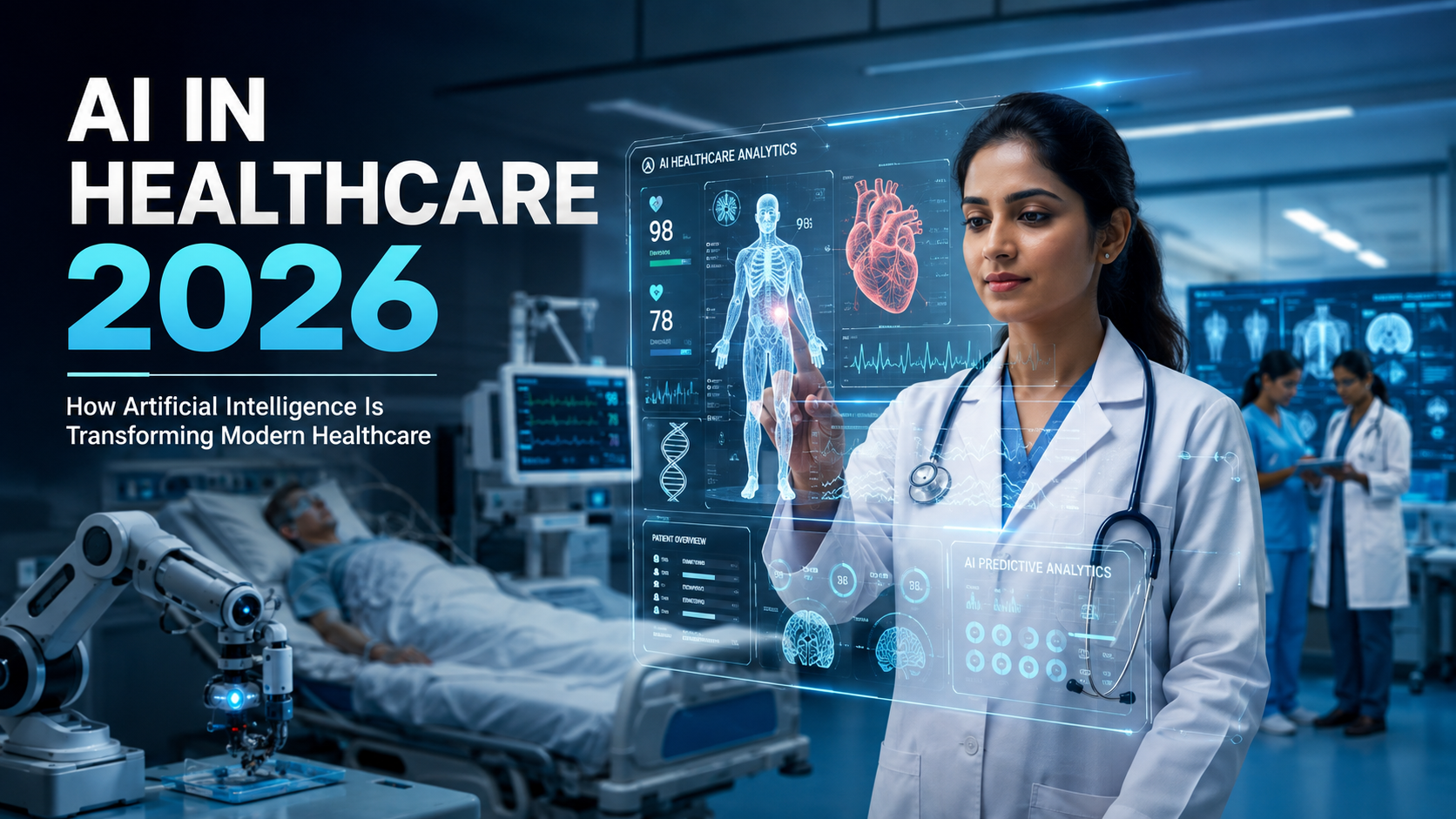
Artificial intelligence is changing healthcare faster than many people expected. For example, in 2026, AI is being used not only in research labs but also in hospitals, medical imaging, drug development, patient support, health monitoring, and healthcare administration. AI can help doctors analyze large amounts of medical information, identify patterns in images, support clinical decisions, and reduce repetitive work. It can also help patients access health information and digital services more easily. However, AI is not a replacement for doctors, nurses, or other healthcare professionals. Its value comes from helping people make better and faster decisions. In addition, the World Health Organization says AI is already being used across areas such as diagnosis, clinical care, drug development, disease surveillance, and health-system management.
This guide explains AI in healthcare 2026 in simple language, including its uses, benefits, challenges, examples, risks, future trends, and what patients and healthcare businesses should know.
What Is AI in Healthcare?
AI in healthcare means using artificial intelligence technologies to support healthcare tasks that normally require human intelligence.
Similarly, these technologies can analyze information, recognize patterns, understand language, make predictions, and assist with decisions.
For example, an AI system can examine a medical image and identify a pattern that may require a doctor’s attention. In fact, another AI system can help organize patient information or summarize medical records.
AI in healthcare can include several technologies:
- Machine learning
- Generative AI
- Large language models
- Likewise, natural language processing
- Computer vision
- Predictive analytics
- Speech recognition
- AI-powered medical devices
- However, clinical decision-support systems
- Robotic systems
The important point is that AI supports healthcare professionals rather than automatically replacing them. As a result, WHO’s 2026 work on evidence-informed health policy also emphasizes that AI should augment human judgment rather than replace it.
Why Is AI in Healthcare Important in 2026?
Healthcare produces huge amounts of information every day. Meanwhile, medical images, laboratory reports, prescriptions, electronic health records, research papers, wearable-device data, and patient information can be difficult for humans to process quickly.
AI can help organize and analyze this information.
In 2026, the discussion has moved beyond simply asking whether healthcare should use AI. Instead, the bigger question is how healthcare organizations can deploy AI safely, responsibly, and at scale. WHO has highlighted the importance of data infrastructure, governance, workforce skills, and institutions when implementing AI in health systems.
Overall, there is also growing regulatory attention. In August 2026, the U.S. FDA published a discussion paper seeking feedback on how generative-AI-enabled medical devices should be assessed, including risk assessment, premarket evaluation, and postmarket monitoring.
How Is AI Used in Healthcare?
Likewise, AI has many applications in modern healthcare. Some are already being used in real healthcare settings, while others are still developing.
1. AI for Medical Diagnosis
However, one of the most important uses of AI in healthcare is supporting diagnosis.
AI can examine medical images, laboratory information, patient records, and other clinical data to identify patterns.
For example, AI can support the analysis of:
- X-rays
- CT scans
- MRI scans
- Ultrasound images
- Pathology images
- Eye images
- ECG data
Moreover, the AI does not necessarily make the final medical decision. Instead, it can highlight areas that a healthcare professional should examine more closely.
Additionally, the FDA’s current AI-enabled medical-device information includes authorized technologies across areas such as radiology and cardiovascular care.
2. Early Disease Detection
AI may help identify signs of disease at an earlier stage.
Traditional healthcare often depends on symptoms, examinations, laboratory tests, and medical imaging. Consequently, AI can analyze large datasets and look for patterns that may not be immediately obvious.
Potential applications include:
- Cancer screening
- Moreover, heart disease risk assessment
- Eye disease detection
- Lung disease analysis
- Additionally, neurological conditions
- Diabetes-related complications
Furthermore, early detection does not mean AI can guarantee that a person has or does not have a disease. Medical professionals still need to interpret results and consider the complete clinical situation.
3. AI in Medical Imaging
Medical imaging is one of the areas where AI has developed rapidly.
For example, computer vision models can analyze images and help healthcare professionals find abnormalities.
AI may assist with:
- Image classification
- Image reconstruction
- Abnormality detection
- Image prioritization
- Measurement
- Consequently, comparison with previous scans
In addition, the FDA describes applications of AI/ML in medical devices that include image processing, early disease detection, diagnosis, prognosis, and risk assessment.
This can potentially reduce workload and help clinicians focus their attention where it is most needed.
4. AI for Personalized Healthcare
Every patient is different.
Similarly, age, medical history, lifestyle, genetics, medications, environment, and other factors can influence health outcomes.
AI can analyze multiple types of information to support more personalized healthcare.
For example, AI may help healthcare professionals understand:
- Which patients may need closer monitoring
- Which treatment options may require consideration
- Furthermore, how a patient is responding to treatment
- Which patients may have higher health risks
Personalized healthcare does not mean that AI independently chooses treatment. Instead, it can provide additional information to help professionals make informed decisions.
5. AI in Drug Discovery
In fact, developing a new medicine can take many years and require significant research.
AI is being used to support different stages of drug discovery and development.
As a result, AI can help researchers:
- For example, analyze biological data
- Identify potential drug targets
- Study molecular structures
- In addition, predict possible interactions
- Screen potential compounds
- Similarly, analyze research information
- Support clinical-trial planning
This can help researchers process information faster, although AI-generated predictions still need scientific and clinical validation.
6. AI in Clinical Trials
Clinical trials generate large amounts of information.
Meanwhile, AI can support researchers by helping with tasks such as:
- Finding potential participants
- In fact, organizing trial data
- Identifying patterns
- As a result, monitoring information
- Predicting possible recruitment challenges
- Analyzing research documents
The goal is not simply to make clinical trials faster. Instead, the larger goal is to improve research quality and help develop safe and effective treatments.
7. Generative AI in Healthcare
Generative AI is one of the biggest healthcare technology trends in 2026.
It can create or transform content based on information provided to it.
Overall, in healthcare, possible applications include:
- Meanwhile, summarizing medical notes
- Drafting administrative documents
- Instead, supporting patient communication
- Searching medical information
- Creating educational material
- Overall, assisting healthcare documentation
- Supporting research workflows
However, generative AI can produce incorrect information or misleading answers. Therefore, healthcare organizations need strong validation and human oversight.
The FDA is specifically examining regulatory questions around generative-AI-enabled medical devices because these systems can introduce risks that differ from traditional software.
8. AI Healthcare Chatbots
AI-powered healthcare chatbots can provide basic information and help users navigate healthcare services.
For example, a chatbot may help a patient:
- Likewise, understand general health information
- Find healthcare services
- Prepare questions for a doctor
- However, receive appointment information
- Understand administrative procedures
- Get reminders
However, a chatbot should not be treated as a replacement for professional medical diagnosis.
Likewise, users should be particularly careful when an AI chatbot gives information about serious symptoms, medications, emergencies, or treatment decisions.
9. AI for Remote Patient Monitoring
Wearable devices and connected health technologies can collect information such as:
- Heart rate
- Activity
- Sleep
- Blood oxygen levels
- Glucose information
- Other health measurements
AI can analyze this information and identify changes or unusual patterns.
However, this can be useful for people who require regular monitoring, particularly when healthcare professionals need to manage large numbers of patients.
10. AI in Hospital Management
AI is not limited to clinical care.
Moreover, hospitals also have many administrative tasks, and AI can help improve operational efficiency.
Possible applications include:
- Appointment scheduling
- Moreover, patient flow management
- Staff planning
- Additionally, hospital resource management
- Documentation
- Billing support
- Consequently, inventory forecasting
- Bed management
- Workflow automation
This can reduce repetitive administrative work and allow healthcare workers to spend more time on patient-related activities.
Benefits of AI in Healthcare
Additionally, AI can provide several benefits when it is properly designed, tested, and implemented.
Here are the major benefits.
Faster Analysis
Consequently, AI can process large amounts of information quickly.
This can help healthcare professionals review information more efficiently.
Improved Decision Support
AI can identify patterns and provide additional information that may support clinical decision-making.
Reduced Administrative Work
Furthermore, healthcare workers spend significant time on documentation and repetitive tasks. AI can automate or assist with some of this work.
Better Patient Monitoring
For example, AI can help analyze continuous information from connected devices and identify changes that may require attention.
Support for Medical Research
Researchers can use AI to process large datasets and accelerate certain research tasks.
More Accessible Digital Healthcare
AI-powered digital tools may make some healthcare information and services easier to access.
Support for Healthcare Professionals
In addition, AI can act as an assistant for doctors, nurses, researchers, administrators, and other healthcare workers.
The objective should be to make healthcare professionals more effective rather than remove human responsibility.
What Are the Risks of AI in Healthcare?
Similarly, AI has significant potential, but healthcare is a high-risk environment. An incorrect AI output can potentially affect a person’s health.
Therefore, AI healthcare systems must be designed with safety in mind.
1. Incorrect AI Results
In fact, AI systems can make mistakes.
A model may incorrectly identify a medical condition or fail to identify an important abnormality.
As a result, this is why AI output should not automatically be treated as fact.
2. Bias in Healthcare AI
AI learns from data.
If the training data does not properly represent different populations, the system may perform differently across groups.
Meanwhile, WHO has identified bias and equity as important concerns in AI-enabled health systems.
3. Patient Data Privacy
Healthcare data is highly sensitive.
Instead, AI systems may process:
- Medical records
- Personal information
- Laboratory results
- Images
- Genetic information
- Medication information
Healthcare organizations must protect this information and follow applicable privacy and security requirements.
4. Lack of Transparency
Some advanced AI models can be difficult to understand.
Overall, healthcare professionals may want to know why an AI system produced a particular result.
Greater transparency can help improve trust and accountability.
5. Cybersecurity Risks
Likewise, connected healthcare systems can become targets for cyberattacks.
Healthcare organizations need strong security practices when implementing AI.
6. Overdependence on AI
AI should not become a substitute for professional judgment.
However, A healthcare professional must be able to question an AI result when it does not match the patient’s condition.
7. Accountability
An important question is: Who is responsible if an AI system makes a harmful mistake?
Moreover, this is one reason governance and regulation are becoming increasingly important.
WHO reported in July 2026 that many countries were already deploying AI in healthcare while governance and liability frameworks were still developing.
AI in Healthcare and the Role of Doctors
A common question is whether AI will replace doctors.
Additionally, the simple answer is AI is more likely to change the role of doctors than completely replace them.
Doctors bring human skills that AI cannot fully reproduce, including:
- Clinical experience
- Communication
- Empathy
- Ethical judgment
- Understanding patient preferences
- Physical examination
- Furthermore, responsibility for medical decisions
- Understanding the wider social and personal context
Consequently, AI can provide information, but healthcare decisions often require understanding the complete person.
The future is therefore more likely to be doctor + AI rather than doctor versus AI.
AI in Healthcare in India
India is also developing its approach to artificial intelligence in healthcare.
Furthermore, in February 2026, India launched the Strategy for AI in Healthcare for India (SAHI), described as a strategic framework for using AI in public health responsibly, safely, and at scale. WHO noted applications including diagnostics, health surveillance, research, and more efficient service delivery.
For example, india has several factors that make healthcare AI important:
- A large population
- High demand for healthcare services
- Uneven access to specialists
- For example, growing digital health infrastructure
- Increasing healthcare data
- In addition, expanding telemedicine
- Growth of health technology startups
AI could help expand healthcare capacity, but implementation must consider affordability, language diversity, digital access, privacy, and clinical safety.
AI Healthcare Trends to Watch in 2026
The healthcare AI landscape is changing quickly. In addition, several trends are especially important in 2026.
Multimodal AI
Multimodal AI can work with different forms of information, such as text, images, audio, and other data.
Similarly, in healthcare, this could allow AI systems to analyze several information types together.
AI Medical Assistants
AI assistants are increasingly being designed to support healthcare professionals with documentation, information retrieval, communication, and workflow tasks.
AI-Powered Medical Devices
More medical devices are incorporating AI technologies.
In fact, the FDA maintains an AI-enabled medical-device list and continues updating information about authorized devices.
Clinical Decision Support
AI systems can increasingly help healthcare professionals identify patterns and evaluate information during clinical workflows.
AI for Preventive Healthcare
Instead of focusing only on treating illness, AI can increasingly support risk prediction, monitoring, and preventive care.
Responsible AI
Healthcare organizations are paying greater attention to:
- AI governance
- Data quality
- Privacy
- Bias
- Explainability
- Human oversight
- Cybersecurity
- Regulatory compliance
This is becoming just as important as AI performance.
How Healthcare Organizations Should Adopt AI
As a result, healthcare organizations should not adopt AI simply because it is popular.
A practical approach is more important.
Meanwhile, organizations should begin by identifying a real problem.
For example, instead of saying “we need AI,” a hospital could ask:
“How can we reduce the time doctors spend on repetitive documentation?”
Instead, then the organization can evaluate whether AI is actually the right solution.
A responsible AI adoption process can include these steps:
- Similarly, identify a specific healthcare problem.
- Define measurable goals.
- Evaluate available AI solutions.
- Check data quality.
- Test the system in a controlled environment.
- In fact, evaluate accuracy and safety.
- Involve healthcare professionals.
- Protect patient information.
- As a result, monitor performance after deployment.
- Regularly review and improve the system.
WHO’s recent implementation work similarly emphasizes that successful AI adoption requires more than software. Health systems need suitable infrastructure, governance, workforce capabilities, and institutions.
Is AI in Healthcare Safe?
AI in healthcare can be safe when it is appropriately designed, validated, monitored, and used under suitable human oversight.
Overall, no AI system should be assumed to be perfect.
Safety depends on factors such as:
- Meanwhile, quality of training data
- Model performance
- Clinical validation
- Intended use
- Human oversight
- Cybersecurity
- Monitoring
- Regulatory requirements
- Instead, proper implementation
Likewise, the FDA’s AI-enabled medical-device framework reflects the need to evaluate safety and effectiveness before applicable devices are marketed.
What Does the Future of AI in Healthcare Look Like?
The future of healthcare will probably involve a combination of human expertise and intelligent technology.
AI may become a normal part of many healthcare workflows.
However, A doctor could use AI to summarize a patient’s history before an appointment. A radiologist could receive AI assistance when reviewing images. Moreover, A researcher could use AI to analyze scientific information. A hospital manager could use AI to forecast demand.
At the same time, humans will remain responsible for important decisions.
Additionally, the biggest change may not be the replacement of healthcare workers. Instead, it may be the transformation of how healthcare workers use information.
Consequently, AI can potentially make healthcare more predictive, personalized, efficient, and accessible. But these benefits will only be meaningful if technology is implemented responsibly.
What Should Patients Know About AI in Healthcare?
Patients should understand that AI can be a useful healthcare tool, but it is not automatically a doctor.
Furthermore, if you use an AI healthcare application:
- Do not assume every answer is correct.
- Overall, do not use AI alone for emergency decisions.
- Do not stop prescribed medication based only on AI advice.
- Ask a qualified healthcare professional about important medical decisions.
- Likewise, understand how your health data is being used.
- Be careful when entering sensitive personal information into unknown AI services.
AI should help people access and understand healthcare, not create false confidence.
Frequently Asked Questions About AI in Healthcare 2026
What is AI in healthcare?
For example, AI in healthcare is the use of artificial intelligence technologies to support medical diagnosis, treatment, research, patient care, monitoring, administration, and other healthcare activities.
How is AI used in healthcare in 2026?
In 2026, AI is being used for medical imaging, diagnosis support, drug discovery, clinical research, patient monitoring, healthcare documentation, hospital operations, digital health services, and other applications.
Will AI replace doctors?
AI is unlikely to completely replace doctors. Instead, AI is expected to assist healthcare professionals by analyzing information, automating repetitive work, and providing decision support.
What are the main benefits of AI in healthcare?
The main benefits include faster data analysis, decision support, reduced administrative work, improved monitoring, research support, and potentially more personalized healthcare.
What are the biggest risks of AI in healthcare?
In addition, important risks include incorrect results, biased data, privacy problems, cybersecurity threats, lack of transparency, overdependence on AI, and unclear accountability.
Can AI diagnose diseases?
AI can support disease detection and diagnosis, particularly in areas such as medical imaging. However, AI results should be evaluated by qualified healthcare professionals and should not automatically be treated as a final diagnosis.
Is generative AI useful in healthcare?
Yes. Generative AI can support documentation, research, communication, information retrieval, and other healthcare workflows. However, its outputs require appropriate validation because generative AI can produce incorrect information.
How is AI changing healthcare in India?
India is developing strategies for responsible AI adoption in healthcare. AI can support diagnostics, health surveillance, research, and healthcare service delivery. Similarly, india’s 2026 healthcare AI strategy provides a framework for responsible and scalable adoption.
Can AI improve patient care?
AI can potentially improve patient care by supporting faster analysis, monitoring, decision support, personalization, and administrative efficiency. In fact, the actual benefit depends on the quality and implementation of the AI system.
What is the future of AI in healthcare?
The future is likely to include more AI-powered medical devices, multimodal AI, clinical decision-support systems, AI assistants, predictive healthcare, personalized medicine, and stronger AI governance.
Conclusion
AI in Healthcare 2026 is no longer just a future concept. As a result, artificial intelligence is already influencing diagnosis, medical devices, research, drug development, patient monitoring, healthcare administration, and public health. At the same time, healthcare AI must be treated differently from ordinary consumer technology because mistakes can have serious consequences. For readers tracking the wider research landscape, our guide to AI research topics covers healthcare-specific research directions in more depth. Likewise, founders evaluating this space can find healthcare listed among the strongest categories in our guide to AI startup ideas.
Meanwhile, the most useful future is not one where AI replaces doctors. It is one where AI helps healthcare professionals work with better information, patients receive better support, and healthcare systems become more efficient without sacrificing safety or human judgment.
As AI adoption grows, responsible implementation will become increasingly important. Instead, privacy, bias, cybersecurity, transparency, regulation, clinical validation, and human oversight must develop alongside the technology. WHO and regulators such as the FDA are increasingly focusing on these issues as healthcare AI moves from experimentation toward broader real-world deployment.
Overall, for patients, healthcare professionals, hospitals, startups, and technology companies, understanding AI in healthcare today is important because the technology is likely to become a normal part of healthcare delivery in the years ahead.