
Subtotal $0.00



Email : 4
Strong customer relationships are one of the few advantages a competitor cannot copy overnight. Anyone can match your price or your feature list. It is much harder to match years of trust. That trust shows up directly in the numbers. G2’s 2026 retention research found that B2B SaaS companies average 90% retention. Net revenue retention now drives more than 80% of the variance in lifetime value across public SaaS companies. These 5 proven ways to build better customer relationships focus on the habits that actually move those numbers, not just the ones that sound good in a meeting.
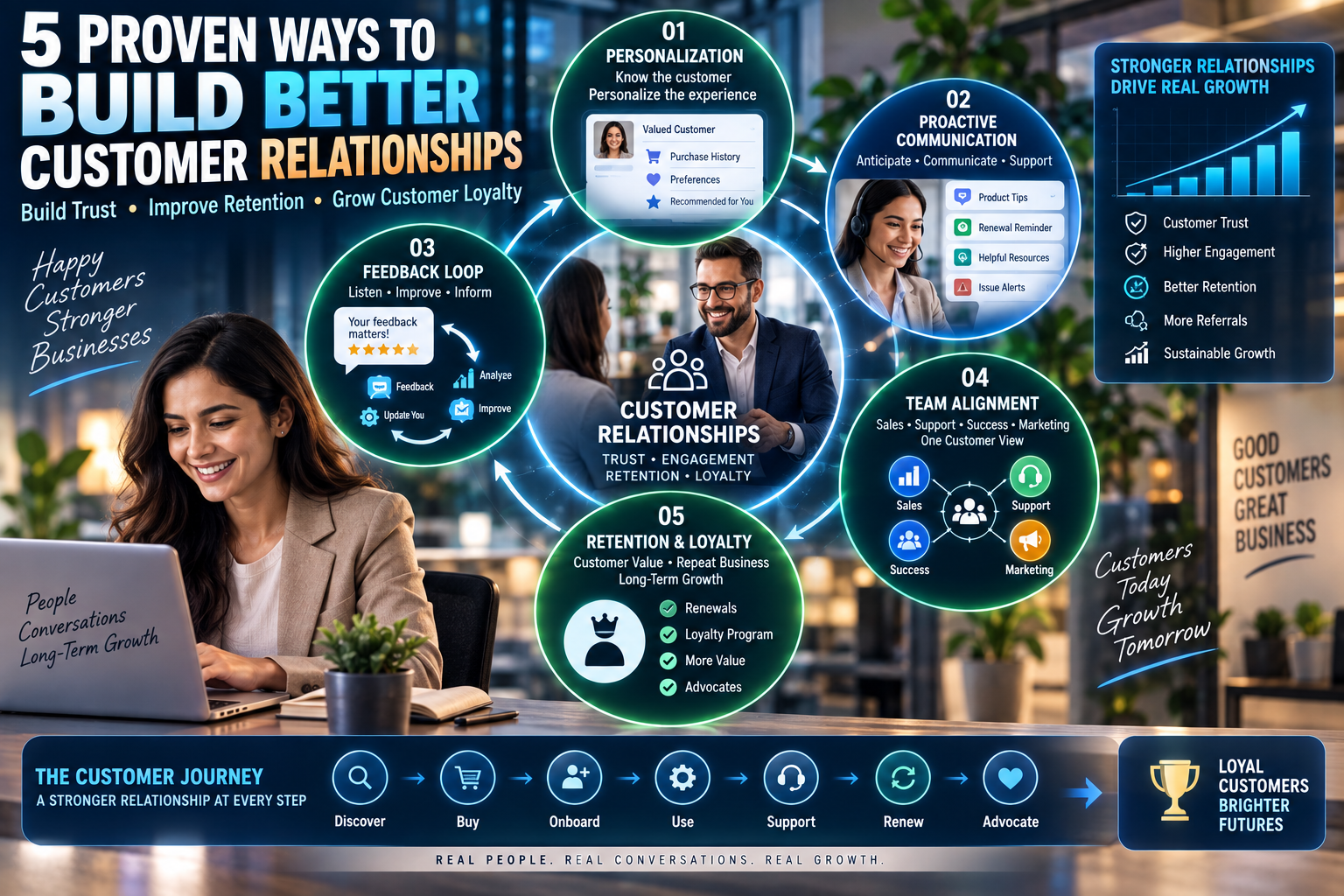
1. Personalize Every Interaction to Build Better Customer Relationships
Personalization is one of the fastest ways to build better customer relationships. But it only works when it feels helpful rather than creepy. That means using what a customer has already told you. Their purchase history, their support tickets, and their stated goals should make the next interaction easier. It does not mean tracking everything you can technically collect. Capgemini research cited by G2 found that 85% of consumers are uncomfortable with companies storing personal data they never explicitly agreed to share. That is a strong signal that respectful personalization beats aggressive personalization every time.
In practice, this looks like remembering a returning customer’s preferences. It also means following up at the right moment instead of the most convenient moment for your team, and acknowledging milestones like a renewal date or an account anniversary. Done well, personalization tells a customer you see them as a person, not a record in a database.
2. Shift From Reactive Support to Proactive Communication
Most companies only talk to customers when something breaks. That is reactive support, and it trains customers to associate contact with your brand with a problem. Proactive communication flips that pattern. Send a helpful check-in before a renewal decision. Share an educational tip tied to how the customer actually uses your product. Flag a known issue before the customer notices it themselves.
This single shift is one of the most repeated recommendations in recent customer experience research. That is precisely because it is so rarely done well. Teams that only show up during a crisis will always be associated with crises. Teams that show up in between crises build a relationship instead of a support queue.
3. Close the Feedback Loop on Every Piece of Customer Input
Asking for feedback is easy. Showing customers what happened to their feedback is where most companies stop. Closing the loop means going back to the people who reported a bug, requested a feature, or left a critical review. Tell them what changed because of it. Even a short note, “you asked for this, we built it,” does more for loyalty than a general product announcement ever will.
This matters because it proves the relationship runs both directions. A customer who sees their input reflected in a real product change has a reason to keep giving that input. They also have a reason to stay a customer while they wait to see what happens next.
4. Align Every Team That Touches the Customer
A customer does not experience your org chart. They experience one continuous relationship with your brand, even when five different teams are involved behind the scenes. If sales overpromises, support cannot quietly absorb the gap. If support resolves an issue but never tells account management, that team can walk into a renewal call blind to a recent problem.
Building better customer relationships at scale requires sales, support, customer success, and marketing to work from the same information about each account. A shared view of customer history is not just an operational nicety. It is what keeps a customer from having to re-explain their situation to a fourth person in the same week.
5. Treat Retention as Seriously as Acquisition
Retention rates vary a lot by industry, and knowing where you stand matters. G2’s 2026 analysis puts B2B SaaS retention around 90%. Enterprise companies with 1,000 or more employees average around 82%, and e-commerce sits closer to 38%. Whatever your baseline is, treating retention as a core metric rather than an afterthought changes how a team prioritizes its time.
Loyalty programs are one visible example. Antavo’s research found that 89% of businesses believe loyalty programs generate additional value beyond the direct transaction. The underlying principle applies with or without a formal program, though. A company that budgets real time and real people for retention keeps customers that a company chasing only new sign-ups will eventually lose.
How to Build Better Customer Relationships Into Your Growth Strategy
None of these 5 ways to build better customer relationships work in isolation from the rest of how a company grows. Teams that already have a solid startup marketing strategy find it easier to keep the promises that strong relationships depend on. The message customers heard before they bought matches the experience they get after. The same is true on the acquisition side. If your team is focused on getting startup customers without paid ads, those early relationships tend to start on a more personal footing already. That makes every step in this guide easier to execute from day one.
Frequently Asked Questions About How to Build Better Customer Relationships
What is the fastest way to build better customer relationships?
Proactive communication tends to show results fastest. A single well-timed check-in, sent before a customer has a problem, does more to build trust than most reactive support interactions. It shows the relationship exists outside of moments of friction.
How does personalization actually improve customer relationships?
Personalization works when it uses information a customer already gave you to remove friction from their next interaction. It backfires when it feels like surveillance. Most consumers are uncomfortable with data collection they did not explicitly agree to. The safest approach is visible, opt-in personalization rather than silent tracking.
Why does closing the feedback loop matter so much?
It proves the relationship is not one-directional. A customer who never hears back after giving feedback has no reason to keep giving it, and eventually stops engaging altogether. A short update on what changed because of their input keeps that channel open.
Is customer retention really more important than acquisition?
They are not competing priorities, but retention is the one companies underinvest in more often. Net revenue retention alone accounts for over 80% of the variance in lifetime value across public SaaS companies. That makes it one of the highest-leverage areas a growing company can focus on.
Final Thoughts
Building better customer relationships is not one campaign or one tool. It is a set of small, repeatable habits. Personalize without overreaching. Communicate before problems happen. Close the loop on feedback, keep every team aligned, and treat retention like the growth lever it actually is. None of these 5 ways require a large budget. They require consistency, and a team willing to measure whether their customers actually feel the difference.