
Subtotal $0.00



Email : 16
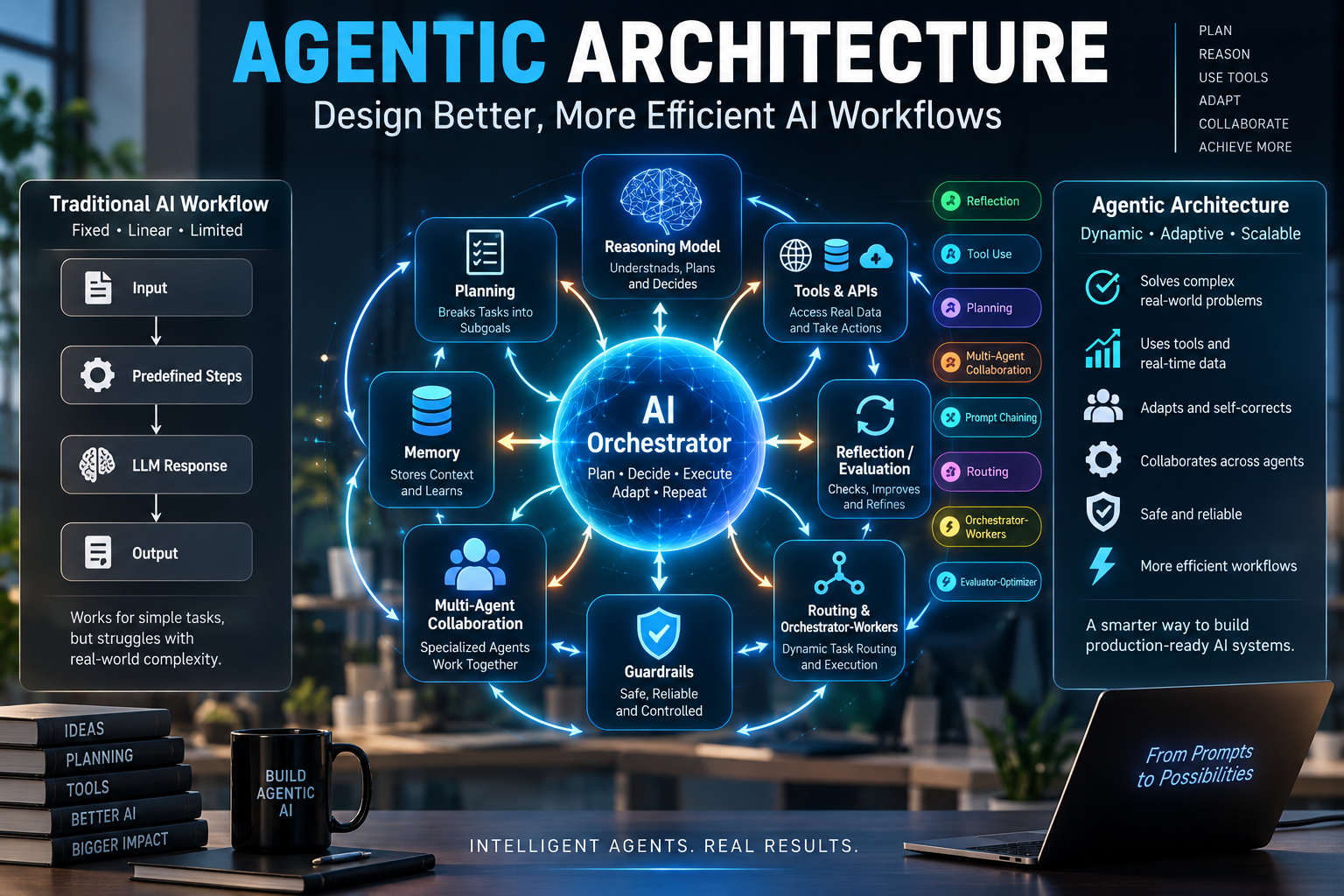
Agentic architecture is quickly becoming the standard way to design AI systems that can plan, use tools, and adapt instead of just answering a single prompt. Instead of one large model trying to do everything in one shot, this approach breaks a task into smaller decisions. It lets the system call tools when it needs real data and checks its own work before finishing. For teams building anything beyond a simple chatbot, this shift matters because production tasks rarely fit into one clean prompt.
Additionally, in this guide, we will break down what agentic architecture actually means and the core components every agentic system needs. We will also cover the design patterns used by leading AI teams, plus a practical process for designing efficient AI workflows that hold up outside a demo.
What Is Agentic Architecture?
For example, agentic architecture is the underlying structure that lets an AI system reason, plan, use tools, and adjust its own actions instead of following one fixed prompt. Rather than generating a single response, an agent decides what to do next based on the current state of a task. It then repeats that cycle until the goal is met or a limit is reached.
Generally, most systems built this way share the same building blocks: a model that reasons, tools the model can call, and memory that stores context. They also share some form of control loop that decides when the task is finished.
Agentic Architecture vs Traditional AI Workflows
In fact, traditional AI workflows run through a fixed sequence of steps that a developer defines in advance. Every input follows the same path, which makes these systems predictable, but also brittle when a task does not match the expected shape.
In contrast, agentic architecture lets the model decide the path itself. Anthropic’s own engineering team draws this exact line: workflows orchestrate LLMs and tools through predefined code paths. Agents, on the other hand, let the model dynamically direct its own process and tool use. For a deeper look at how these systems operate in practice, see our guide on agentic AI workflows.
Overall, workflows are the better choice for narrow, well-defined tasks. Agentic architecture earns its added complexity on open-ended problems where the right path is not known ahead of time.
Core Components of Agentic Architecture
Similarly, a working agentic architecture usually includes the following pieces:
- Reasoning model: the LLM that interprets the task and decides the next action.
- Tools: external functions, APIs, or databases the agent can call for real data or actions.
- Memory: short-term context for the current task and, in some systems, long-term storage across sessions.
- Orchestrator: the control loop that routes decisions, manages state, and decides when to stop.
- Guardrails: rules and limits that keep the agent inside safe, expected behavior.
Key Agentic Design Patterns
Specifically, most production agentic systems are built from a small set of proven patterns rather than one single architecture. Learning these patterns first makes it much easier to design a new system instead of starting from scratch.
1. Reflection
However, in reflection, the agent generates an output, critiques its own work, and revises it across iterations before returning a final answer. This pattern works well for coding, writing, and analysis tasks where the first draft is rarely the best one.
2. Tool Use
Meanwhile, tool use lets the agent call external APIs, run code, or query a database instead of relying only on what the model already knows. This is often the single biggest improvement teams can make to accuracy. It grounds the agent in current, verifiable data.
3. Planning
Overall, planning breaks a large task into smaller subgoals before execution starts. As a result, the agent can tackle multi-step problems, like researching a topic and then writing a report, without losing track of the overall goal.
4. Multi-Agent Collaboration
Therefore, in multi-agent collaboration, several specialized agents, each with its own prompt and tools, work together on one problem. A research agent might gather information while a writing agent drafts the output, for example, with a coordinator agent tying the results together.
5. Prompt Chaining
Generally, prompt chaining passes the output of one LLM call directly into the next call in a fixed sequence. Unlike more autonomous patterns, this keeps the process deterministic and easy to debug. That makes it a strong starting point for teams new to this style of system design.
6. Routing
In practice, routing classifies an incoming request and sends it to the specialized process built to handle it. Customer support systems use this constantly, directing billing questions one way and technical questions another.
7. Orchestrator-Workers
In short, here, a central orchestrator model breaks a task apart and delegates the pieces to worker models, then combines their results. This pattern suits problems where the number and shape of subtasks cannot be known in advance, such as codebase-wide refactors.
8. Evaluator-Optimizer
As a result, in an evaluator-optimizer loop, one model generates a response while a second model checks it against clear criteria. It sends the work back for revision if needed. Consequently, output quality tends to improve significantly, though at the cost of extra latency and token spend.
How to Design an Efficient Agentic Architecture
Overall, designing an efficient agentic architecture is less about picking the most advanced pattern and more about matching the design to the actual problem. The following process works well for most teams.
- Additionally, start with the simplest workflow that could solve the problem, and only add agentic complexity once a fixed sequence proves insufficient.
- For example, define clear success criteria before writing any code, since an agent without a measurable goal is difficult to evaluate or improve.
- Give the agent the smallest set of tools it actually needs. A smaller tool set is easier to secure and easier for the model to use correctly.
- Add bounded execution, such as maximum step counts or tool-call limits, so a stuck agent fails safely instead of looping indefinitely.
- Log every decision the agent makes so failures can be traced back to a specific step during debugging.
- Test with real, messy inputs rather than clean examples, since production data rarely resembles a demo.
Common Mistakes in Agentic Architecture
Similarly, most agentic architecture failures come from a small set of repeated mistakes rather than exotic edge cases.
- Giving the agent too much autonomy too early, before the team trusts its judgment on lower-stakes tasks.
- Skipping guardrails, which leaves no way to stop an agent that starts calling tools incorrectly or repeatedly.
- Ignoring cost and latency, since chaining multiple LLM calls can quickly become slow and expensive at scale.
- Treating every problem as an agent problem, when a simple, deterministic workflow would be faster, cheaper, and easier to maintain.
Tools and Frameworks for Agentic Architecture
Therefore, most teams do not build agentic architecture entirely from scratch. A growing set of frameworks and platforms now handle orchestration, memory, and tool calling directly.
Developer-focused frameworks such as LangGraph and CrewAI provide the building blocks for custom multi-agent systems in code. Meanwhile, no-code and low-code platforms let smaller teams assemble agentic workflows visually. Our practical guide to building AI agents from scratch walks through this process step by step.
Real-World Examples of Agentic Systems
In practice, agentic architecture already powers systems many teams use every day. Coding assistants plan a change, edit files, run tests, and fix failures without a human approving every step. Customer support agents route tickets, pull account data through tools, and escalate only when a case falls outside their guardrails. Research agents search the web, read multiple sources, and synthesize a summary instead of returning a single search result.
Frequently Asked Questions About Agentic Architecture
What is agentic architecture in AI?
Agentic architecture is the structure that lets an AI system reason, use tools, and adapt its own actions to complete a task. It does this instead of following one fixed prompt.
How is this different from a normal AI workflow?
A normal workflow follows a fixed, predefined sequence of steps. This approach instead lets the model decide its own path based on the current state of the task.
What are the main components of an agentic system?
The main components are a reasoning model, tools, memory, an orchestrator that manages the control loop, and guardrails that keep behavior safe.
Do I need this approach for every AI project?
No. Simple, well-defined tasks are usually better served by a deterministic workflow. It is more predictable, cheaper, and easier to debug than a full agentic system.
What frameworks are used to build agentic systems?
Popular options include LangGraph and CrewAI for code-first development, along with no-code platforms for visual workflow building.
What is the biggest risk with autonomous AI agents?
The biggest risk is giving an agent too much autonomy without guardrails. Without them, it can loop indefinitely, call tools incorrectly, or take actions outside its intended scope.
Final Thoughts
Agentic architecture is not a single technology, it is a set of design patterns for giving AI systems the structure to reason, use tools, and adapt safely. The teams that get the most value from it start simple and add complexity only when a fixed workflow proves insufficient. They also build in guardrails from day one rather than after something goes wrong.