
Subtotal $0.00



Email : 2
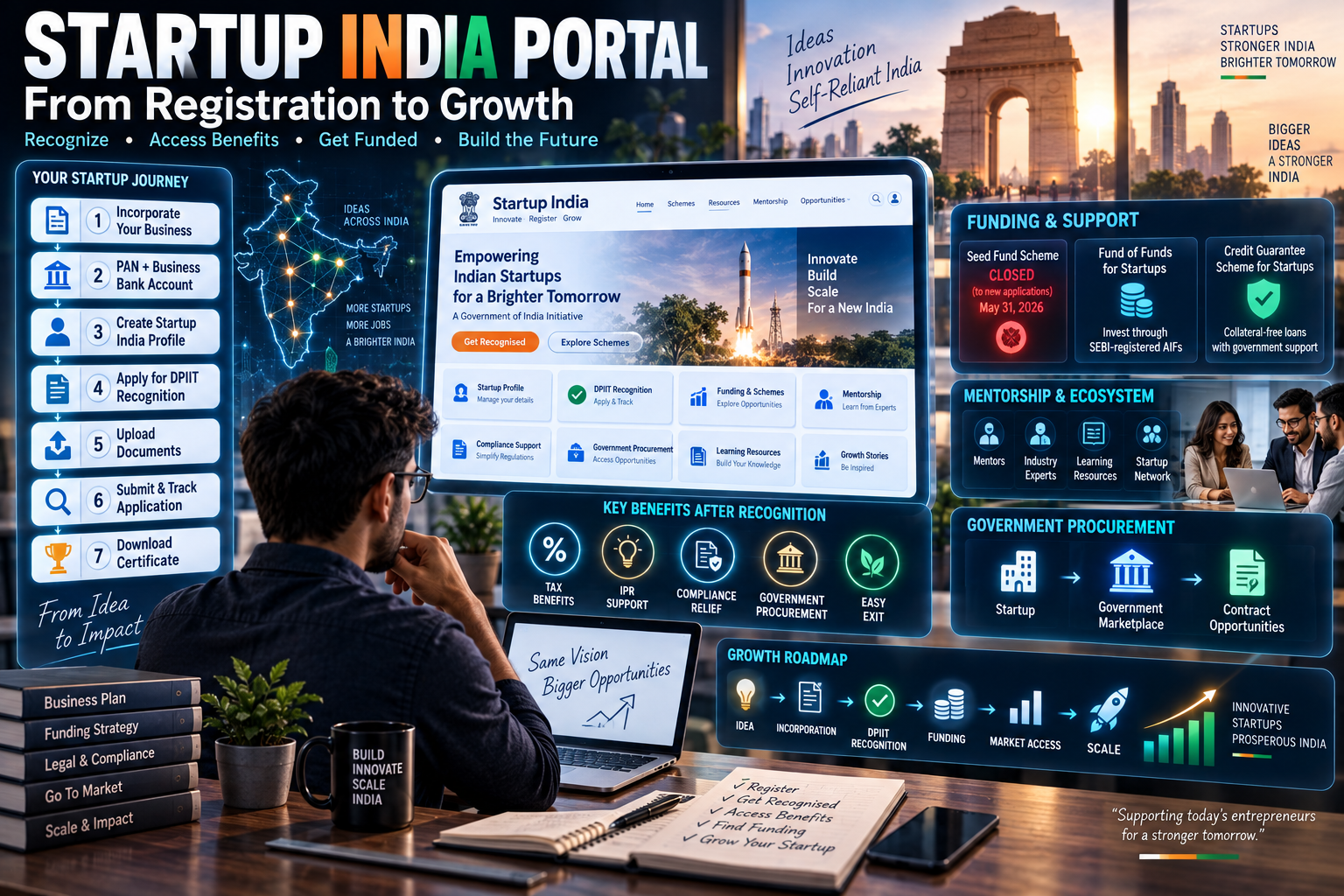
The Startup India portal is the government’s single entry point for official startup recognition. It also unlocks tax breaks, funding access, and easier compliance. Most founders only use a fraction of what it actually offers. This guide walks through the whole path. It covers everything from creating your profile to using the growth resources available once you are recognized.
What Is the Startup India Portal?
The Startup India portal is run by the Department for Promotion of Industry and Internal Trade, or DPIIT. It is where an eligible business applies for official startup status. That status is what unlocks tax exemptions, patent fee rebates, and access to government funding schemes. Without it, your company is just a regular registered entity in the eyes of these programs.
Who Is Eligible for DPIIT Recognition?
Eligibility comes down to a few clear rules. Your entity must be a Private Limited Company, an LLP, a Partnership Firm, or a Cooperative Society. Sole proprietorships do not qualify. Your company must be less than 10 years old, or under 20 years for deep-tech ventures. Annual turnover must stay under the current DPIIT threshold for your track. The business also cannot be formed by splitting up or restructuring an already existing company.
There is one more requirement that trips up a lot of applicants. You have to demonstrate real innovation or a scalable business model, not just a standard product with a new logo. A vague description here is one of the most common reasons applications get rejected.
How to Register on the Startup India Portal
The process runs in a clear sequence. Skipping a step usually means going back and redoing work later.
Step 1: Incorporate Your Business First
You need a formal legal entity before the portal will accept your application. Incorporate as a Private Limited Company, an LLP, or a registered Partnership Firm through the Ministry of Corporate Affairs process.
Step 2: Get a PAN and a Business Bank Account
Apply for a Permanent Account Number in your entity’s name. Open a business bank account as well. Both are required before you can complete the DPIIT application.
Step 3: Create Your Startup India Profile
Go to startupindia.gov.in and register using your business email. You will enter your startup’s name, sector, incorporation date, entity type, and founding team details.
Step 4: Apply for DPIIT Recognition
Open the “Get Recognised” section on your dashboard. Fill in your entity details, PAN, incorporation date, and industry classification. Then write a clear, specific description of what makes your business innovative and scalable. This is the part worth spending real time on.
Step 5: Upload Your Documents
Submit your Certificate of Incorporation and entity PAN card. Add proof of innovation, such as a pitch deck, a patent filing, product screenshots, or your live website. Include any awards or recognition letters if you have them.
Step 6: Submit and Track Your Application
Once you submit, you will receive an acknowledgement number. Use it to track your status on the dashboard. Straightforward applications are often approved within 24 to 72 hours, though more complex ones can take longer.
Step 7: Download Your Certificate and Activate Benefits
Once approved, download your DPIIT Certificate of Recognition. This certificate and its recognition number are what you will use to access every benefit described below.
Benefits You Unlock After DPIIT Recognition
Recognition on its own does not automatically apply every benefit. Some require a separate application, but all of them become available once you are recognized.
The headline benefit is the Section 80-IAC income tax exemption. It allows a 100% deduction on profits for any 3 consecutive financial years within your first 10 years. You must apply for it separately through the portal, and an Inter-Ministerial Board reviews each request. Recognized startups also get an 80% rebate on patent filing fees and a 50% concession on trademark fees. On the compliance side, you can self-certify under 6 labor laws and 3 environmental laws. No inspections happen for a set number of years after that. Recognized startups are also exempt from prior turnover and experience requirements when bidding for government contracts on the GeM platform, and can wind up the business within 90 days under simplified insolvency rules if things do not work out.
Growth Resources: Funding and Support Beyond Recognition
DPIIT recognition is the entry point, not the finish line. The portal connects recognized startups to several funding and growth programs. It is worth knowing which ones are actually active right now.
The Startup India Seed Fund Scheme, which offered grants up to 20 lakh rupees and convertible debt up to 50 lakh rupees, closed to new applications on May 31, 2026. If you see it listed as an open option somewhere, check the date on that source before relying on it. Two other programs remain active. The Fund of Funds for Startups channels government capital through SEBI-registered Alternative Investment Funds, rather than funding companies directly. The Credit Guarantee Scheme for Startups backs collateral-free loans up to 10 crore rupees, with the government guaranteeing the loan instead of requiring the founder to pledge assets.
Beyond funding, the portal also gives recognized startups access to mentorship programs, learning resources, and government procurement opportunities that are not open to unrecognized businesses. Once your startup business plan is solid enough to act on, these are the programs worth building into your actual funding roadmap.
Common Mistakes That Get Startup India Applications Rejected
Most rejections trace back to a small number of avoidable mistakes. A vague or generic innovation description is the biggest one. Reviewers need specifics, not marketing language. Applying before your entity is properly incorporated is another common error. Missing or low-quality supporting documents, like a blurry incorporation certificate, also slow things down or trigger a rejection. Founders sometimes apply under the wrong entity type, or list a turnover figure that does not match their actual filings. Double-checking every field before submission avoids most of these problems entirely.
Frequently Asked Questions About the Startup India Portal
How long does Startup India portal recognition take?
Simple, well-documented applications are often approved within 24 to 72 hours. Applications with unclear innovation descriptions or missing documents take longer, since they may need clarification before a reviewer can approve them.
Is DPIIT recognition the same as company registration?
No. You must incorporate your company first through the Ministry of Corporate Affairs. DPIIT recognition on the Startup India portal is a separate status you apply for afterward, and it is what unlocks the tax and funding benefits.
Is the Startup India Seed Fund Scheme still accepting applications?
No, new applications for the Seed Fund Scheme closed on May 31, 2026. Recognized startups can still access the Fund of Funds for Startups and the Credit Guarantee Scheme, which remain active.
Do sole proprietorships qualify for Startup India recognition?
No. Only Private Limited Companies, LLPs, Partnership Firms, and Cooperative Societies are eligible. A sole proprietorship needs to convert to one of these structures before applying.
Final Thoughts
The Startup India portal rewards founders who treat it as more than a registration form. Getting DPIIT recognition is the first step, not the whole strategy. The real value shows up afterward, in the tax exemptions, the funding access, and the compliance relief you only get once you are recognized. Go in with your documents ready and a specific, honest description of what makes your business worth backing. That preparation is usually the difference between a same-week approval and weeks of back and forth.