


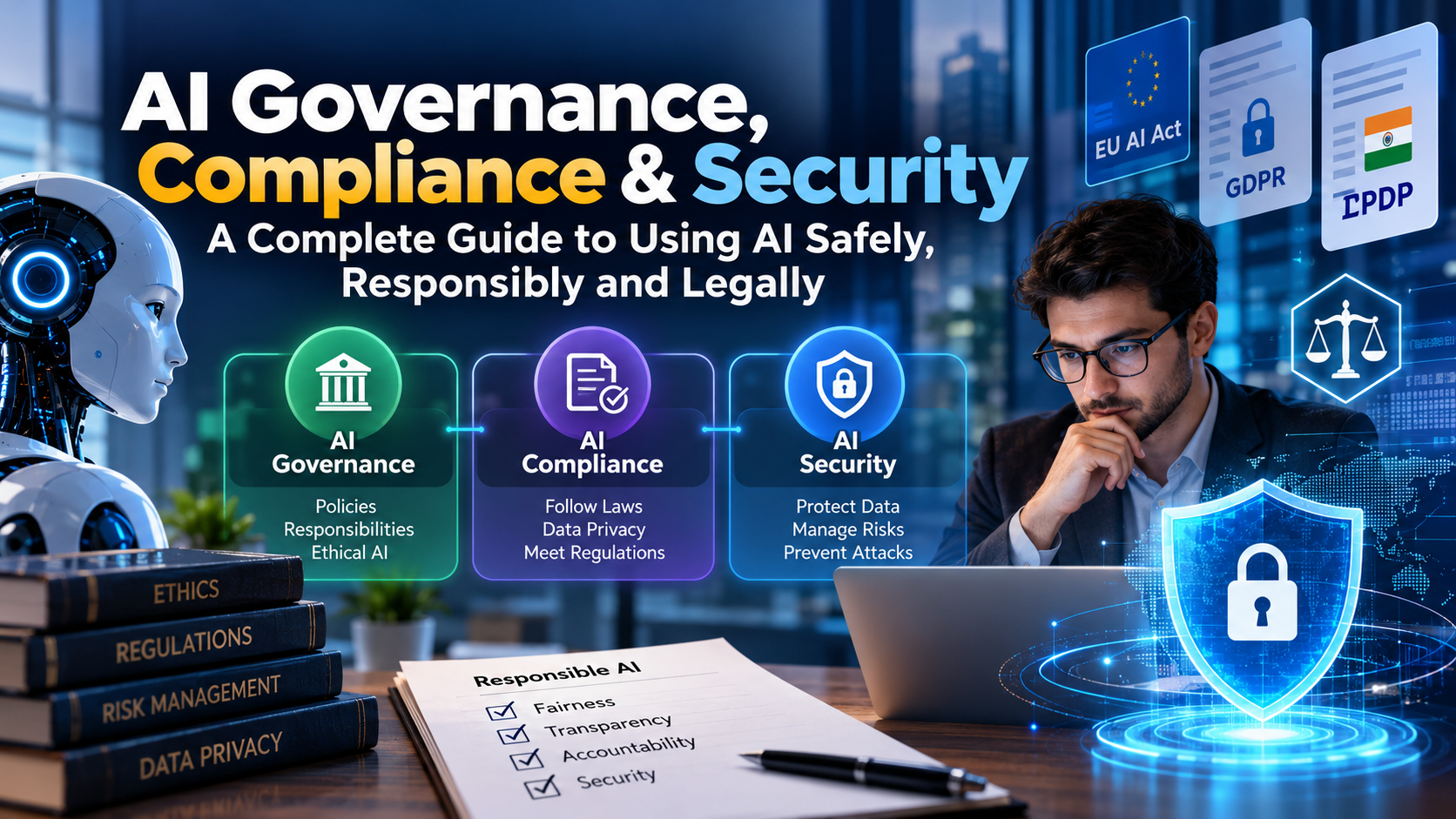
Artificial intelligence (AI) is changing how businesses work, how people find information, and how companies make decisions. From AI chatbots and automated customer support to smart business tools and AI agents, this technology is becoming part of everyday life. However, using AI also brings important questions. Is the information safe? Can the AI system make unfair decisions? Does it follow the law? Who is responsible if something goes wrong?
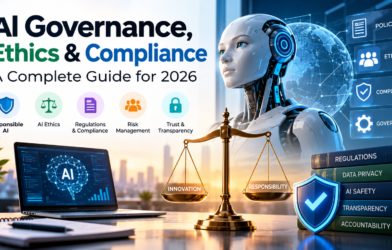
This is where AI governance, compliance, and security become important. They help businesses use artificial intelligence in a safe, fair, transparent, and responsible way. They also help protect customer information, reduce business risks, and build trust.
Whether you run a startup, manage a company, develop AI software, or simply use AI tools at work, understanding these topics is essential. In this guide, you will learn what AI governance means, how AI compliance works, which security risks businesses should understand, and what practical steps you can take to use AI more safely.
1. What Is AI Governance?
AI governance is the process of creating rules, responsibilities, policies, and systems for developing and using artificial intelligence responsibly.
In simple words, AI governance explains how an organization should manage its AI systems. It helps ensure that AI tools are used for the right purposes, protect people’s rights, and follow the organization’s values and legal responsibilities.
For example, imagine an online company uses AI to review job applications. If the system unfairly rejects candidates because of their gender, age, disability, or other personal characteristics, the company may face serious ethical and legal problems. An AI governance framework can help the company test the system, identify unfair results, and establish human oversight.
AI governance is not only for large technology companies. Small businesses, startups, schools, hospitals, financial companies, and government organizations can also benefit from it.
Why Is AI Governance Important?
AI systems can process large amounts of information and make recommendations quickly. However, they can also produce incorrect answers, repeat bias in their training data, or make decisions that are difficult to explain.
A good governance system helps organizations understand these risks before they cause harm.
The main benefits of AI governance include:
- Better decision-making: Clear policies help employees understand when and how to use AI.
- Improved accountability: People know who is responsible for AI systems and their outcomes.
- Reduced risks: Organizations can identify problems before deploying AI.
- Customer trust: Transparent practices help customers understand how AI is used.
- Legal awareness: Businesses can identify applicable laws and regulatory obligations.
- Responsible innovation: Teams can develop useful AI solutions without ignoring safety and fairness.
AI governance does not mean stopping innovation. It means creating the right conditions for innovation to happen responsibly.
2. What Is AI Compliance?
AI compliance means ensuring that an AI system and the organization using it follow applicable laws, regulations, contractual obligations, and internal policies.
Different countries have different legal requirements. The rules that apply depend on the location, industry, type of AI system, purpose of use, and information being processed.
For example, a company using AI to analyze customer information may need to follow data protection and privacy laws. A business using AI for recruitment may need to consider employment, discrimination, and automated decision-making requirements.
AI compliance is not a single certificate or one-time activity. It is an ongoing process that may require regular assessments, documentation, testing, employee training, and updates when laws or systems change.
What Does AI Compliance Include?
AI compliance can cover several areas of business operations.
- Data protection: Collecting, processing, storing, and deleting personal information lawfully.
- Transparency: Providing appropriate information about how AI is used.
- Fairness: Identifying and reducing discriminatory outcomes.
- Documentation: Maintaining records of AI systems, their purposes, risks, and controls.
- Human oversight: Ensuring people can review important AI-assisted decisions where appropriate.
- Security: Protecting AI systems against unauthorized access and manipulation.
- Consumer protection: Avoiding misleading claims about AI products and their capabilities.
- Industry requirements: Meeting additional obligations in areas such as healthcare, finance, education, and employment.
Not every requirement applies to every organization. Businesses should identify the laws and standards relevant to their particular use case instead of assuming that one general AI policy is sufficient.
3. What Is AI Security?
AI security refers to the methods used to protect AI models, applications, data, infrastructure, and connected systems from attacks, misuse, unauthorized access, and other security problems.
Traditional cybersecurity remains important, but AI introduces additional risks. AI applications may accept natural-language instructions, retrieve information from external sources, connect to company databases, or perform actions through tools.
These features can make AI useful, but they can also create new ways for attackers to influence a system.
For example, an AI assistant connected to internal business documents could accidentally reveal confidential information if its access permissions are poorly designed. An AI agent with permission to send emails or update records could cause damage if an attacker manipulates its instructions.
Common AI Security Risks
Understanding the main risks is the first step toward protecting AI systems.
1. Data leakage
AI tools may expose private customer details, employee records, financial information, source code, or company secrets if data access and sharing are not controlled.
2. Prompt injection
An attacker may place malicious instructions in a prompt, document, website, or other content that an AI system processes. These instructions may attempt to override the intended task or make the system reveal information or perform unauthorized actions.
3. Data poisoning
Attackers may manipulate training data or other data used during model development. This can affect model behavior, accuracy, or reliability.
4. Model theft
Unauthorized users may attempt to copy a model, extract its behavior, or steal valuable intellectual property.
5. Insecure integrations
AI applications often connect to APIs, databases, plugins, and external services. Weak authentication or excessive permissions can expose these systems to attacks.
6. Unreliable outputs
AI can produce incorrect information, invented references, or misleading recommendations. In high-impact situations, these errors may lead to financial, legal, or safety problems.
7. Unauthorized actions
An AI agent may take an unwanted action if it has broad permissions or insufficient safeguards. This is especially important when AI can transfer information, change records, or interact with business systems.
A strong AI security program should consider both conventional cybersecurity threats and risks created by AI-specific behavior.
4. Understanding the Difference Between AI Governance, Compliance, and Security
AI governance, compliance, and security are connected, but they serve different purposes.
| Area | Main purpose | Simple example |
|---|---|---|
| AI governance | Establish rules, roles, and oversight | Creating an AI usage policy |
| AI compliance | Meet applicable legal and policy requirements | Checking whether personal data is processed lawfully |
| AI security | Protect AI systems, data, and access | Preventing unauthorized access to an AI application |
Think of a business that wants to launch an AI customer support assistant.
Governance determines what the assistant is allowed to do, who approves it, and which risks need review. Compliance checks the relevant privacy, consumer protection, and other legal requirements. Security protects customer information, limits system access, and reduces the risk of attacks.
All three areas must work together. A company can have a secure AI system that still violates privacy requirements. It can also follow a documented compliance process while leaving its AI application vulnerable to cyberattacks.
That is why organizations should treat governance, compliance, and security as connected parts of one responsible AI strategy.
5. Major AI Regulations and Standards Businesses Should Know
AI regulations and standards help organizations understand their responsibilities and improve the way they develop and use AI.
However, there is no single worldwide law that covers every AI system in the same way. Legal requirements vary by country, sector, and application. Businesses should verify the current rules that apply to their activities.
European Union AI Act
The European Union AI Act establishes a legal framework for artificial intelligence using a risk-based approach.
Different AI applications can face different obligations depending on their classification and intended use. Certain prohibited practices are restricted, while some high-risk AI systems face requirements involving risk management, data governance, documentation, human oversight, and other controls.
The Act also includes transparency obligations for certain AI applications and requirements relating to general-purpose AI models.
Businesses should check the applicable implementation dates and transitional provisions before relying on a particular deadline. The relevant obligations depend on the system and the organization’s role.
GDPR and AI Data Privacy
The General Data Protection Regulation (GDPR) applies to qualifying processing of personal data within its legal scope. It can affect AI systems that collect, analyze, store, or use information about identifiable people.
Important considerations include lawful processing, transparency, data minimization, security, individual rights, and rules relating to certain automated decisions.
Using AI does not remove an organization’s existing data protection responsibilities. Companies should understand what information their AI providers receive, where it is processed, how long it is retained, and whether it is used to train models.
NIST AI Risk Management Framework
The US National Institute of Standards and Technology developed the AI Risk Management Framework (AI RMF) to help organizations manage AI risks.
The framework is voluntary and is not itself a law. It provides a practical structure built around four core functions:
- Govern: Establish organizational responsibilities, policies, and oversight.
- Map: Understand the AI system, its context, affected people, and possible risks.
- Measure: Assess and monitor risks through testing, evaluation, and analysis.
- Manage: Prioritize risks and take appropriate action to reduce them.
Organizations can use these functions to build an AI risk management process that fits their needs.
ISO/IEC 42001
ISO/IEC 42001 is an international standard for an AI management system.
It helps organizations establish policies, responsibilities, processes, and continual improvement activities for managing AI. It can support a structured approach to responsible AI development and use.
Certification may be available through suitable certification arrangements, but following a standard or obtaining certification does not automatically prove compliance with every law.
India’s Digital Personal Data Protection Framework
Businesses operating in India should pay attention to the Digital Personal Data Protection Act, 2023, and the associated rules and commencement notifications applicable to their activities.
The framework addresses the processing of digital personal data and includes obligations and rights that may affect organizations using AI to process personal information.
AI businesses should assess consent or other applicable legal grounds and requirements, notices, security safeguards, data handling, and the responsibilities of relevant parties. The precise obligations and effective dates must be checked against current official notifications and the organization’s circumstances.
The DPDP framework is not a universal AI law. It concerns digital personal data, so its relevance depends on the data and processing involved.
Why Do These Regulations Matter?
Regulations and standards can help organizations establish more reliable processes, but following a checklist is not enough on its own.
Businesses should identify the rules that apply to their AI use, document their decisions, and review their systems when requirements or risks change. For important legal questions, qualified legal and compliance professionals can help interpret the relevant obligations.
6. How to Build an AI Governance Framework
An AI governance framework gives a business a practical method for managing AI systems throughout their life cycle.
The framework should be appropriate for the size of the organization, the sensitivity of the data, and the potential impact of the AI application. A small company using AI to draft marketing captions will not need the same controls as a hospital using AI to support clinical decisions.
Step 1: Create an AI Usage Policy
An AI usage policy explains how employees and contractors can use AI tools responsibly.
It should describe which tools are approved, what information can be shared, which tasks require human review, and what activities are prohibited.
For example, a business might allow employees to use an approved AI assistant for general research but prohibit them from uploading customer identity documents or confidential contracts to an unapproved service.
The policy should be easy to understand and accessible to everyone who needs it.
Step 2: Identify All AI Systems
Businesses should maintain a record of the AI systems they develop, purchase, or use.
This record may include the system’s name, purpose, provider, business owner, data types, integrations, risk level, and approval status.
An AI inventory helps organizations discover systems that employees may be using without formal approval. It also makes it easier to review changes, investigate incidents, and understand where important decisions depend on AI.
Step 3: Assess AI Risks
Before introducing an AI system, assess what could go wrong and how serious the consequences might be.
Consider privacy risks, cybersecurity threats, unfair outcomes, inaccurate information, legal obligations, operational disruption, and potential harm to customers or employees.
Document the findings and decide whether additional controls are needed before deployment.
Step 4: Assign Clear Responsibilities
AI governance works best when responsibilities are clear.
Business leaders should approve the overall approach. Technical teams should implement security controls and test the system. Legal and compliance professionals should assess applicable obligations. Data protection or security specialists should review relevant risks.
Employees should also know how to report errors, suspicious behavior, and possible data exposure.
Step 5: Set Human Oversight Rules
Some AI tasks can be automated with limited risk. Others require careful human review.
For example, an AI tool may help draft a customer email, but a person should review sensitive legal or financial advice before it is sent. High-impact decisions may require more formal review, appeal, or intervention processes depending on the use case and applicable law.
Human oversight should be meaningful. A person must have enough information, authority, and time to identify problems rather than simply approve every AI recommendation.
Step 6: Document Decisions
Keep records of the system’s intended purpose, risk assessments, testing, approvals, data sources, known limitations, and monitoring arrangements.
Good documentation helps employees use the system correctly and allows the organization to investigate problems. It can also support audits and compliance reviews.
Step 7: Review the Framework Regularly
AI systems change over time. Providers may update models, businesses may connect new data sources, and laws may introduce new obligations.
Review the framework periodically and whenever a significant change occurs. A system that was acceptable for one task may need a new assessment if it begins making higher-impact recommendations or receives access to more sensitive information.
7. Best Practices for AI Security
AI security should be built into the design, development, deployment, and maintenance of AI systems.
Organizations should not wait for a security incident before deciding how to protect their AI applications. The right controls depend on the system’s capabilities, access, and potential impact.
Protect Sensitive Data
Start by identifying the information that enters and leaves the AI system.
Avoid sharing personal, confidential, or commercially sensitive information with AI services unless the use is authorized and the provider’s data handling arrangements have been reviewed. Apply appropriate retention limits, encryption, access controls, and secure deletion practices.
Businesses should also understand whether a provider uses submitted information for model training and which account or service settings control that use.
Apply the Principle of Least Privilege
An AI system should have only the access it needs to perform its approved task.
For example, an AI assistant that answers questions about public product information should not automatically receive access to payroll records or customer payment details.
Use separate permissions for different functions, secure authentication, and additional approval for sensitive actions.
Test for Prompt Injection
Applications that process documents, websites, emails, or external content should be tested for prompt injection risks.
Treat external content as untrusted input. Do not rely on a model’s ability to follow instructions as the only security control.
Sensitive operations should use independently enforced access checks and validation. An AI model should not be able to grant itself permission simply because a prompt tells it to do so.
Validate AI Outputs
AI-generated answers should be checked before they are used in important decisions.
Validation may include checking facts against trusted sources, applying business rules, reviewing structured output, and testing for unexpected behavior.
In higher-risk applications, automated checks and human review may both be necessary.
Secure APIs and Integrations
AI systems often depend on external services and internal tools.
Protect API keys, rotate credentials when appropriate, restrict permissions, and monitor unusual activity. Keep software updated and review the security of third-party integrations.
Secrets such as passwords and private API keys should not be placed in public prompts, source code repositories, or unrestricted logs.
Monitor and Respond to Incidents
Businesses should monitor relevant system activity, access attempts, errors, and unusual patterns.
Create a response plan for incidents such as data leakage, unauthorized actions, model manipulation, and service disruption. The plan should explain how to contain the issue, preserve evidence, notify responsible people, and determine whether legal notification obligations apply.
Security monitoring should respect privacy and collect only the information needed for a legitimate purpose.
8. Responsible AI: Fairness, Transparency, and Accountability
Responsible AI means developing and using AI in ways that consider safety, fairness, privacy, transparency, and the effects on people.
A system can be technically secure and still produce unfair or harmful outcomes. Responsible AI therefore requires more than cybersecurity controls.
Fairness
AI systems can repeat patterns found in historical data. If the data contains unfair treatment, the resulting system may reproduce or even strengthen it.
Organizations should test outcomes across relevant groups where lawful and appropriate. They should investigate unexplained differences and take action when the results indicate a problem.
Fairness testing should reflect the real-world use of the system rather than relying on a single general test.
Transparency
People should receive appropriate information about AI involvement when it matters to their decisions or rights.
For example, a business might explain when a customer is interacting with an AI assistant, describe the limitations of an AI-supported recommendation, or provide information about automated processing when legally required.
Transparency does not always require publishing a model’s source code. It means giving relevant people useful information about how the system operates, what it is used for, and where its limitations matter.
Accountability
Organizations should identify who is responsible for AI systems and how concerns can be reported.
When an AI system makes a serious mistake, the business should have a process for investigating the cause, correcting the problem, and preventing similar incidents.
It is not enough to blame the AI tool. The organization remains responsible for its own decisions, controls, and legal obligations.
Privacy
Privacy protection begins with collecting only the information needed for the intended task.
Organizations should understand the purpose of processing, the applicable legal requirements, who can access the data, how long it is retained, and whether it is shared with external providers.
Privacy risks should be considered before deployment, not only after a complaint or breach.
9. AI Governance for Startups and Small Businesses
Startups often have limited budgets, small teams, and pressure to launch products quickly. This makes a practical and risk-based approach to AI governance especially useful.
A startup does not necessarily need a large compliance department to begin managing AI responsibly. It can start with clear policies, basic documentation, sensible security controls, and regular reviews.
Start With High-Risk Use Cases
First, identify the AI systems that could cause the most harm if they fail.
For example, an AI tool that creates social media captions generally has a different risk profile from one that recommends loan approvals, evaluates job applicants, or processes sensitive medical information.
Give higher-risk applications more testing, stronger access controls, clearer oversight, and more formal approval.
Choose AI Providers Carefully
Before selecting an AI provider, review its security practices, privacy terms, data retention arrangements, access controls, service reliability, and contractual responsibilities.
Ask how the provider handles submitted information, whether it uses customer data for training, how incidents are managed, and what options exist for deleting data.
Do not assume every provider offers the same protections. The details may differ between consumer accounts, business plans, APIs, and enterprise services.
Train Employees
Employees should understand what AI can and cannot do.
Training should explain how to protect sensitive data, identify suspicious instructions, verify important answers, avoid copying unverified claims, and report problems.
Simple examples and clear instructions are often more effective than long technical documents that employees rarely read.
Keep Costs and Risks Under Control
Small businesses can start with a short AI inventory, a basic risk register, approved tools, and a clear process for reviewing new use cases.
As the business grows, these controls can be expanded to include formal audits, structured testing, supplier reviews, incident exercises, and external assessments where appropriate.
The aim is to build safeguards that match the actual risks rather than creating unnecessary paperwork.
10. AI Governance and Security for AI Agents
AI agents can do more than generate text. Depending on their design, they may search information, use software tools, update databases, send messages, or complete multi-step workflows.
These abilities create additional governance and security challenges because an agent’s actions may affect real business systems.
Set Clear Boundaries
Every AI agent should have a defined purpose and a list of permitted actions.
For example, an agent designed to organize customer enquiries may be allowed to categorize messages and draft responses. It may need separate approval before sending messages, changing customer account details, or issuing refunds.
Require Approval for Sensitive Actions
High-impact or difficult-to-reverse actions should have appropriate human approval or other safeguards.
Examples include transferring money, deleting records, publishing important statements, changing permissions, and sending confidential information outside the organization.
The level of approval should reflect the potential harm and the ability to reverse an action.
Control Memory and Data Access
Some agents retain context or retrieve information from external sources. Businesses should define what information can be stored, who can access it, and when it should be deleted.
Access to documents and databases should follow the user’s or agent’s authorized permissions. Information from one customer or department should not automatically become available to another.
Test Multi-Step Workflows
An agent may behave safely during one task but fail during a longer workflow.
Test how it responds to misleading documents, conflicting instructions, unavailable tools, repeated failures, and unexpected results. Monitor its actions and provide a reliable way to stop or disable it when necessary.
AI agent security should be considered before an agent receives broad access to business systems.
11. Common AI Governance Mistakes to Avoid
Organizations can weaken their AI programs by treating governance as a document-writing exercise instead of an ongoing business process.
The following mistakes are particularly important to avoid.
1. Using AI without clear rules: Employees may expose confidential information or use unsuitable tools when expectations are unclear.
2. Trusting every AI answer: AI-generated content can be inaccurate, incomplete, or misleading. Important claims should be verified.
3. Ignoring data privacy: Personal information should not be shared or processed without considering the relevant legal requirements and safeguards.
4. Giving AI too much access: Excessive permissions increase the potential damage from errors, misuse, or attacks.
5. Skipping testing: A system should be evaluated against realistic tasks, failure conditions, and relevant security risks before deployment.
6. Assuming compliance is permanent: New laws, model updates, business changes, and new integrations may require another review.
7. Failing to assign responsibility: Every important AI system should have a clear owner and a process for escalating concerns.
8. Ignoring third-party risks: An AI provider or connected service can introduce security, privacy, and reliability problems that the organization must consider.
Avoiding these mistakes can help businesses build a more reliable AI environment without slowing down every project.
12. A Practical AI Governance, Compliance, and Security Checklist
A checklist can help organizations turn general AI principles into everyday practices. The following steps provide a starting point, but they do not replace a legal assessment or a security review tailored to the business.
- Create an AI usage policy that employees can understand.
- Maintain an inventory of AI tools, models, and agents.
- Identify the purpose and risk level of each important AI system.
- Review applicable laws, contractual terms, and industry requirements.
- Identify the personal and confidential data processed by each system.
- Check the security and privacy practices of AI providers.
- Apply least-privilege access controls and secure authentication.
- Test for inaccurate outputs, bias, prompt injection, and unauthorized actions.
- Establish human review for important or high-impact decisions.
- Document assessments, approvals, limitations, and corrective actions.
- Train employees to use AI safely and responsibly.
- Monitor systems for failures, suspicious activity, and changing risks.
- Establish an incident response and escalation process.
- Review controls when models, data, providers, or intended uses change.
- Reassess the program regularly and improve it based on evidence.
Organizations should prioritize the actions that address their most serious risks first. They can then expand the program as their AI use becomes more complex.
13. What Is the Future of AI Governance, Compliance, and Security?
AI is becoming more capable and is being used in more business processes. AI agents, multimodal models, automated decision-support systems, and connected software tools are creating new opportunities, but they also introduce new questions about responsibility and control.
AI governance is likely to become a more important part of product development, procurement, cybersecurity, and everyday business management.
Organizations may increasingly use automated testing and monitoring to identify risks, check compliance evidence, and review system behavior. However, automated governance tools also need human oversight because they can miss problems or produce incorrect results.
Regulations and technical standards will continue to develop. Businesses that operate across countries will need to understand how different requirements affect their systems and customers.
The strongest approach is to build AI governance into the entire AI life cycle, from choosing a use case to developing, testing, deploying, monitoring, and eventually retiring the system.
Companies that take this approach can respond to problems more effectively, demonstrate responsible practices, and build trust with customers and partners.
Conclusion
AI governance, compliance, and security are essential parts of using artificial intelligence responsibly. Governance establishes clear rules and responsibilities. Compliance helps organizations meet applicable legal and policy requirements. Security protects AI systems, data, and connected business tools from unauthorized access and misuse.
These three areas work best when they are managed together. Businesses should understand their AI risks, protect sensitive information, test systems carefully, provide meaningful human oversight, and review their practices as technology and regulations change.
Startups and small businesses do not need to solve every challenge at once. They can begin by approving suitable tools, creating a clear usage policy, limiting data access, training employees, and checking the risks of their most important AI applications.
The key message is simple: AI should be useful, but it should also be safe, fair, secure, and accountable. A thoughtful approach to AI governance, compliance, and security helps organizations innovate with greater confidence while protecting the people who depend on their technology.
Will AGI Replace Human Jobs? Jobs Most at Risk
Frequently Asked Questions (FAQs)
1. What is AI governance in simple words?
AI governance is a set of rules, responsibilities, and processes that guide how an organization develops and uses artificial intelligence. It helps make AI use safer, fairer, more transparent, and more accountable.
2. Why are AI governance, compliance, and security important?
They help businesses manage AI risks, protect personal information, follow applicable laws, reduce security threats, and build trust with customers and employees.
3. What is the difference between AI governance and AI compliance?
AI governance focuses on how an organization manages AI, including policies, responsibilities, and oversight. AI compliance focuses on meeting the legal, regulatory, contractual, and internal requirements that apply to its AI activities.
4. What is AI security?
AI security involves protecting AI models, applications, data, and connected systems against cyberattacks, unauthorized access, data leakage, manipulation, and misuse.
5. What are the biggest AI security risks?
Common risks include prompt injection, data leakage, data poisoning, model theft, insecure integrations, inaccurate outputs, and unauthorized actions by AI agents.
6. What is an AI governance framework?
An AI governance framework is a structured approach to managing AI systems. It usually includes policies, assigned responsibilities, risk assessments, documentation, testing, human oversight, and ongoing monitoring.
7. Which AI regulations should businesses know about?
Depending on their location and activities, businesses may need to consider the EU AI Act, GDPR, India’s Digital Personal Data Protection framework, and other applicable privacy, cybersecurity, consumer protection, or sector-specific laws.
8. Is AI governance mandatory for every business?
There is no single universal AI governance law that applies identically to every business. However, particular AI systems and business activities may be subject to legal obligations. A basic governance program is a useful way to manage risks even when a specific framework is voluntary.
9. How can a startup implement AI governance?
A startup can begin by creating an AI usage policy, listing its AI tools, identifying sensitive data, assessing risks, selecting providers carefully, training employees, and establishing human review for important decisions.
10. How can businesses protect confidential data when using AI?
Businesses should use approved AI services, review provider data-handling terms, limit the information shared, apply access controls, and follow applicable privacy requirements. Employees should not upload confidential information to unapproved tools.
11. What is responsible AI?
Responsible AI means designing and using artificial intelligence with attention to fairness, transparency, safety, privacy, accountability, and potential effects on people.
12. What is the NIST AI Risk Management Framework?
The NIST AI Risk Management Framework is a voluntary framework that helps organizations manage AI risks through four functions: Govern, Map, Measure, and Manage.
13. What is ISO/IEC 42001?
ISO/IEC 42001 is an international standard for establishing and continually improving an AI management system. It helps organizations manage AI responsibilities and risks through a structured process.
14. How is AI governance different for AI agents?
AI agents may use tools, access data, and perform actions rather than only generate content. Their governance therefore needs clear permissions, controlled memory, activity monitoring, testing, and approval safeguards for sensitive actions.
15. How often should AI systems be reviewed?
Review frequency should reflect the system’s risk and rate of change. High-impact systems may require more frequent monitoring, while all important systems should be reassessed after significant model, data, provider, integration, or intended-use changes.
16. Can AI governance prevent every AI risk?
No. AI governance cannot eliminate every error, attack, or unexpected outcome. It helps organizations identify risks, reduce their likelihood and impact, detect problems earlier, and respond more effectively.
17. Does using an AI tool automatically make a business compliant?
No. Using a reputable AI tool does not automatically make a business compliant. The organization must still consider how it uses the tool, what data it processes, which laws apply, and whether appropriate safeguards are in place.
18. What is the first step toward better AI security?
The first step is to understand which AI tools the organization uses, what information they process, and what actions they can perform. This inventory helps the business identify its most important risks and select appropriate controls.