


Artificial Intelligence (AI) is changing the way people work, communicate, shop, study, and run businesses. From AI chatbots and virtual assistants to facial recognition, automated hiring systems, and self-driving vehicles, AI has become an important part of everyday life. However, as AI technology grows, important questions are also increasing. Who is responsible when an AI system makes a mistake? How safe is our personal information when we use AI tools? Can companies use customer data without permission? What rules should businesses follow when developing or using artificial intelligence?
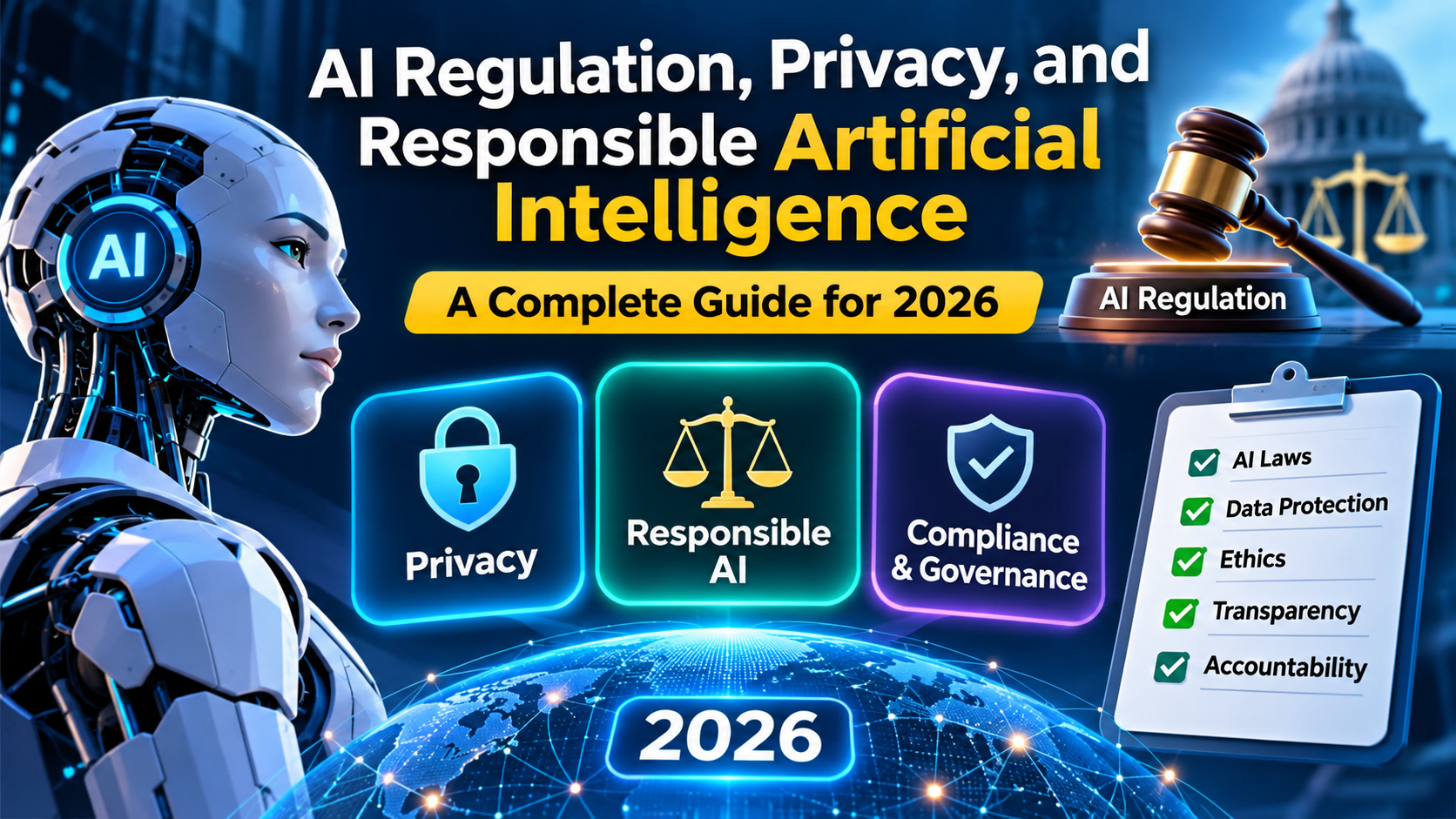
These questions make AI regulation, privacy, and responsible artificial intelligence important topics in 2026. Governments around the world are introducing new laws and guidelines to make AI safer, more transparent, and more trustworthy. This article explains how AI regulations work, why data privacy matters, what responsible AI means, and how individuals and businesses can use AI safely. Whether you are a student, business owner, developer, or technology enthusiast, understanding these topics can help you make better decisions in an AI-powered world.
1. What Is AI Regulation?
AI regulation refers to the laws, rules, policies, and guidelines created to control how artificial intelligence is developed, tested, and used. These regulations aim to ensure that AI systems are safe, fair, transparent, and respectful of people’s rights.
AI technology can make decisions much faster than humans. It can analyse thousands of documents, recognise faces, recommend products, detect financial fraud, and even help doctors understand medical reports. However, AI systems can also make incorrect decisions, expose personal information, or create unfair results.
Without proper rules, organisations may use AI in ways that negatively affect individuals and society.
For example, imagine a company using an AI system to select candidates for job interviews. If the system has been trained using biased information, it may unfairly reject qualified candidates from certain backgrounds.
AI regulation helps reduce these risks by establishing responsibilities for organisations that develop and use AI.
The main objectives of AI regulation include:
- Protecting human rights: Making sure AI does not unfairly discriminate against people.
- Protecting personal information: Ensuring that private data is collected and used responsibly.
- Improving transparency: Helping people understand when and how AI is being used.
- Ensuring accountability: Making organisations responsible for the AI systems they develop or operate.
- Improving safety: Reducing the chances of harmful or incorrect AI decisions.
- Supporting innovation: Creating clear rules that allow businesses to develop useful AI technologies responsibly.
AI regulation does not mean stopping technological development. Its purpose is to encourage innovation while protecting people, businesses, and society.
2. Why Are AI Regulation and Privacy Important in 2026?
Artificial intelligence is becoming more powerful and accessible. Businesses can now use AI to create marketing campaigns, write content, analyse customer behaviour, automate customer support, and manage business operations.
Individuals also use AI assistants for education, research, personal productivity, and everyday tasks.
As AI adoption increases, the amount of information processed by AI systems also grows. This creates new challenges related to privacy, security, and responsible use.
Consider a simple example. A person uploads a document containing their address, phone number, financial details, or medical information to an AI tool. If that information is not handled properly, it could create privacy and security risks.
Similarly, a business that uses AI to analyse customer information must understand whether it has the legal right to collect and process that information.
AI regulation and privacy are important for several reasons:
- Personal data protection: People need control over how their information is collected, stored, and used.
- Trust in technology: Users are more likely to use AI when they understand its risks and limitations.
- Business protection: Following relevant laws can help companies avoid legal problems and reputational damage.
- Preventing discrimination: Responsible AI practices help reduce unfair treatment.
- Cybersecurity: Strong security practices help protect AI systems from misuse and data breaches.
- Human control: Important decisions should not always be left entirely to automated systems.
In 2026, AI governance is not only a technical concern. It is also a legal, business, social, and ethical responsibility.
3. What Is Responsible Artificial Intelligence?
Responsible Artificial Intelligence, also known as Responsible AI, means developing and using AI systems in a way that is safe, fair, transparent, and beneficial to people.
AI should not only focus on speed, automation, and business profits. It should also consider how its decisions affect individuals, employees, customers, and society.
For example, an AI-powered customer service chatbot should provide helpful information without misleading customers. An AI recruitment system should evaluate candidates fairly instead of making decisions based on gender, age, or other personal characteristics.
Responsible AI requires organisations to consider possible risks before launching an AI product.
The important principles of responsible artificial intelligence are:
- Fairness: AI systems should treat people fairly and avoid discrimination.
- Transparency: Users should understand when AI is being used and what it can do.
- Accountability: Companies and developers should take responsibility for AI-related decisions.
- Privacy: AI systems should protect personal and sensitive information.
- Safety: AI applications should be tested to reduce errors and harmful outcomes.
- Human control: People should be able to review important AI decisions.
- Reliability: AI systems should work consistently and provide dependable results.
Responsible AI is important because technology should improve human life rather than create unnecessary risks.
4. Understanding AI Privacy and Data Protection
AI privacy refers to protecting personal information when it is collected, processed, stored, or used by artificial intelligence systems.
Most AI applications need data to perform their tasks. For example, an AI recommendation system may analyse shopping history to suggest products. A chatbot may process customer questions to provide answers. An AI healthcare application may analyse medical information to support healthcare professionals.
However, not all information should be collected or used without proper permission and legal justification.
Personal information can include:
- Full name and date of birth.
- Phone numbers and email addresses.
- Home and business addresses.
- Financial and payment information.
- Medical and health records.
- Location information.
- Photographs and biometric information.
- Online activity and browsing behaviour.
When this information is processed by AI systems, organisations must take appropriate steps to protect it.
Why is AI data privacy important?
There are several reasons why data privacy should be a priority when using artificial intelligence.
- Preventing identity theft: Personal information can be misused by criminals.
- Protecting financial details: Financial information must be handled carefully to reduce fraud risks.
- Maintaining customer trust: People expect companies to protect the information they share.
- Avoiding unauthorised access: Strong security practices help prevent data leaks.
- Protecting personal freedom: Individuals should have appropriate control over their personal information.
For businesses, privacy protection should be included from the beginning of AI development. It should not be treated as a final step after launching a product.
5. Major AI Regulations Around the World in 2026
Different countries are developing AI laws and governance frameworks according to their legal systems, economic needs, and technology policies.
Some countries focus on strict legal requirements, while others use guidelines, industry standards, and existing data protection laws.
Understanding these regulations is important for companies that develop AI products or provide AI-powered services internationally.
5.1 European Union AI Act
EUROPEAN UNION

The European Union AI Act is one of the most important AI regulatory frameworks in the world.
It aims to make artificial intelligence safe while protecting human rights, health, and fundamental freedoms.
The law uses a risk-based approach. This means AI systems are treated differently depending on the level of risk they may create.
The main risk categories include:
- Unacceptable risk: Certain AI practices are prohibited because they can seriously threaten people’s rights and safety.
- High risk: AI systems used in areas such as employment, education, essential services, and certain biometric applications face additional requirements.
- Limited risk: Some AI applications have transparency requirements, such as informing users when they interact with an AI chatbot.
- Minimal risk: Many everyday applications, such as spam filters, generally face fewer specific requirements under the AI Act.
The EU AI Act entered into force on 1 August 2024, and its requirements are being introduced in stages.
As of November 2026, important milestones include:
- February 2025: Prohibited AI practices and AI literacy provisions began applying.
- August 2025: Obligations for general-purpose AI models and governance provisions began applying.
- August 2026: Most of the main provisions, including applicable transparency requirements, became enforceable.
- December 2026: Certain additional prohibitions relating to non-consensual intimate material and child sexual abuse material take effect.
- December 2027: Certain high-risk AI system requirements are scheduled to apply.
- August 2028: Requirements for high-risk AI systems embedded in certain regulated products are scheduled to apply.
These dates reflect the updated implementation framework available in 2026. AI Act Service Desk+3
The law is particularly important for businesses that develop, sell, or use AI systems in the European market.
5.2 India’s Digital Personal Data Protection Act
INDIA

India is also developing its digital privacy and AI governance framework.
The Digital Personal Data Protection Act, 2023 (DPDP Act) is an important law that regulates the processing of digital personal data in India.
The Digital Personal Data Protection Rules, 2025 were notified on 14 November 2025. These rules provide more detailed requirements for implementing the Act. Press Information Bureau+1
The framework focuses on protecting individuals’ personal data while allowing organisations to use information for lawful purposes.
Important aspects of India’s data protection framework include:
- Notice and consent: Organisations must provide appropriate information about personal data processing and obtain consent where required by law.
- Data security: Organisations must take reasonable security measures to protect personal information.
- Individual rights: People have rights relating to their personal data, subject to the conditions in the law.
- Data breach responsibilities: Organisations must follow applicable requirements when personal data breaches occur.
- Children’s data: Special protections apply to children’s personal data.
- Organisational responsibility: Companies handling personal data must understand and follow their legal responsibilities.
India has also introduced the India AI Governance Guidelines to encourage safe, trusted, and inclusive AI development.
These guidelines promote responsible innovation, accountability, safety, and human-centred AI adoption. They also recommend stronger institutional support for AI governance and safety. Press Information Bureau+1
For Indian businesses, understanding both data protection requirements and AI governance recommendations is becoming increasingly important.
5.3 United States AI Regulations
UNITED STATES

The United States follows a different approach to AI regulation.
Instead of relying on one comprehensive AI law covering every application, its regulatory environment includes federal actions, state laws, existing consumer protection rules, and sector-specific requirements.
Different states may introduce their own rules for AI applications involving employment, healthcare, consumer protection, and personal information.
Federal agencies can also regulate AI-related activities within their existing areas of authority.
Important areas of US AI regulation include:
- Consumer protection and preventing misleading AI-generated claims.
- Protection of personal information.
- Fairness in automated employment decisions.
- Transparency in certain AI applications.
- Security and reliability of AI systems.
- Regulation of AI applications in sensitive industries.
Businesses operating in the United States should not assume that following one AI guideline automatically makes them compliant with every state or federal requirement.
The US regulatory environment continues to change, so organisations should monitor applicable laws in the locations where they operate. AI Safety Association+1
5.4 China’s AI Governance Approach
CHINA

China has introduced several regulations and requirements covering different types of AI services.
Its regulatory approach includes rules for recommendation algorithms, deep synthesis technologies, and generative AI services.
These rules focus on areas such as:
- Responsible use of AI-generated information.
- Protection of personal information.
- Security of AI services.
- Management of synthetic and manipulated content.
- Platform responsibilities.
- Prevention of harmful or misleading information.
Companies providing AI services in China need to understand the rules that apply to their particular technology and business activities.
The important point is that AI regulation is not the same everywhere. Businesses operating internationally must understand the legal requirements of each relevant market.
6. What Are the Biggest Privacy Risks of Artificial Intelligence?
AI provides many benefits, but it also introduces privacy risks that individuals and businesses should understand.
Some risks come from poor security, while others result from careless data collection or inappropriate use of AI technology.
Here are some major AI privacy risks.
6.1 Unauthorised Use of Personal Data
AI applications may process personal information provided by users, customers, or employees.
Problems can arise when organisations collect information without an appropriate legal basis or use it for purposes that people were not properly informed about.
For example, a company might collect customer information to provide a service and later use the same information for unrelated AI training without properly assessing its legal responsibilities.
Organisations should explain their data practices and follow applicable privacy requirements.
6.2 Data Breaches and Cyberattacks
AI platforms can become targets for cybercriminals.
If attackers gain access to an AI company’s systems, they may attempt to steal customer information, business documents, or other confidential data.
A data breach can damage a company’s reputation and create legal consequences.
Businesses should use appropriate security controls, access restrictions, encryption, and regular security testing.
6.3 AI Training Data Privacy
AI models are trained using different types of information.
If training datasets contain personal or sensitive information, organisations must carefully consider how that data was collected, whether its use is lawful, and what safeguards are necessary.
Poor data management can create privacy problems even before an AI product reaches customers.
6.4 Facial Recognition and Biometric Privacy
Facial recognition systems can identify or analyse people using their facial features.
These systems can be useful in certain security and verification applications. However, they also raise concerns about surveillance, consent, accuracy, and misuse.
Biometric information requires particularly careful protection because people cannot easily change their faces or fingerprints like they can change a password.
6.5 AI Chatbot Data Exposure
Many people share business information, personal details, and confidential documents with AI chatbots.
Users may not always understand how their information is handled by the particular service they are using.
Before uploading sensitive information, users should check the platform’s privacy settings, data policies, and organisational rules.
6.6 Deepfakes and Identity Misuse
Deepfake technology can create realistic-looking images, videos, and audio recordings.
It can be used for creative projects, entertainment, and legitimate educational purposes. However, criminals may also use it to impersonate people, spread false information, or create harmful content without consent.
This makes digital identity protection and content transparency important parts of responsible AI.
7. What Is AI Ethics and Why Does It Matter?
AI ethics refers to the moral principles that guide the development and use of artificial intelligence.
It helps organisations decide what is acceptable when building and using AI technologies.
For example, an AI system may technically be capable of analysing someone’s personal behaviour. However, that does not automatically mean every possible use of that information is ethical.
AI ethics encourages developers and businesses to think about human values, fairness, privacy, and social impact.
Some important AI ethics principles include:
- Respect for human rights: AI should respect human dignity and individual freedom.
- Fair treatment: AI should not create unnecessary discrimination.
- Honest communication: Organisations should not mislead people about AI capabilities.
- Human responsibility: People and organisations should remain responsible for important decisions.
- Privacy protection: Personal information should be handled carefully.
- Social benefit: AI should create positive value for society.
AI ethics is important because not every problem can be solved by technical rules alone.
A system may follow technical requirements but still create an unfair or harmful experience for people. Ethical thinking helps identify these issues before they become serious problems.
8. How Can Businesses Use AI Responsibly?
Artificial intelligence can help businesses save time, reduce repetitive work, improve customer service, and make better decisions.
However, businesses should not adopt AI without considering its risks.
A responsible AI strategy should combine technology, employee training, privacy protection, and proper management.
Here are practical ways businesses can use AI responsibly.
8.1 Create an AI Usage Policy
Businesses should create clear rules explaining how employees can use AI tools.
The policy should describe which tools are approved, what information can be uploaded, and which activities require human review.
For example, employees should not upload confidential customer records into an unapproved AI chatbot.
8.2 Protect Customer Information
Customer information should be collected and processed only for appropriate purposes and in accordance with applicable laws.
Companies should avoid collecting unnecessary information.
They should also restrict access to sensitive customer records.
8.3 Check AI-Generated Content
AI can produce incorrect facts, outdated information, and misleading statements.
Businesses should review AI-generated content before publishing it or sharing it with customers.
This is particularly important for healthcare, financial services, legal information, and other sensitive industries.
8.4 Maintain Human Oversight
AI should support human decision-making rather than automatically replacing human judgment in every situation.
Important decisions involving employment, financial services, education, or healthcare may require additional safeguards and human review.
8.5 Train Employees
Employees should understand the benefits and limitations of artificial intelligence.
Training should cover privacy, data protection, AI-generated misinformation, cybersecurity, and ethical AI use.
8.6 Monitor AI Performance
AI systems should be monitored regularly to identify errors, unexpected behaviour, bias, and security problems.
Businesses should update their systems when problems are discovered.
8.7 Document AI Activities
Companies should maintain appropriate records about their AI systems, including their purpose, data sources, risk assessments, testing, and human oversight.
Good documentation makes it easier to investigate problems and demonstrate responsible management.
9. Responsible AI in Digital Marketing and SEO
Artificial intelligence is changing digital marketing.
Marketing agencies and businesses now use AI tools for keyword research, content planning, social media management, customer support, advertising analysis, and website optimisation.
AI can improve productivity, but using it without proper checks can create problems.
For example, publishing hundreds of automatically generated articles without reviewing their quality may result in inaccurate information, repetitive content, and a poor experience for readers.
Responsible AI use in digital marketing means using AI as a supporting tool rather than depending on it completely.
Best practices for responsible AI marketing include:
- Review AI-generated articles: Check facts, grammar, originality, and usefulness before publishing.
- Protect customer information: Do not upload private customer data to unapproved AI services.
- Avoid fake reviews: Never use AI to create misleading customer testimonials.
- Be transparent: Clearly disclose AI-generated or manipulated content where required.
- Respect copyright: Check the rights and licensing conditions associated with content, images, and other materials.
- Avoid misleading advertising: Verify product claims and promotional statements.
- Maintain human creativity: Add genuine experience, research, and original ideas to AI-assisted content.
For digital marketing agencies, responsible AI can help build long-term customer trust.
The objective should be to create useful content and better customer experiences, not simply to publish more content in less time.
10. How Can Individuals Protect Their Privacy While Using AI Tools?
AI tools are becoming part of everyday life. People use them to write emails, prepare assignments, create images, translate languages, and solve work-related problems.
However, users should understand that sharing information with an online AI service requires care.
You do not need to stop using AI to protect your privacy. You simply need to develop safer habits.
Follow these practical tips when using AI tools:
- Avoid sharing passwords: Never enter your banking passwords, account credentials, or private security information into an AI chatbot.
- Do not upload sensitive documents unnecessarily: Avoid sharing identity documents, confidential contracts, and private financial records unless the service is approved for that purpose.
- Read privacy policies: Understand how the AI service handles your information.
- Check privacy settings: Review available data controls, including options for chat history, model improvement, and data retention.
- Use trusted platforms: Choose AI services with clear privacy policies and appropriate security practices.
- Remove unnecessary personal information: When possible, hide names, phone numbers, addresses, and other identifying details before sharing documents.
- Verify AI responses: Do not automatically trust every answer generated by artificial intelligence.
- Use strong account security: Enable multi-factor authentication wherever available.
- Be careful with AI-generated images: Avoid uploading photographs of other people without appropriate permission.
- Report suspicious activity: If you notice misuse of your information, contact the service provider and follow the relevant reporting process.
These simple practices can reduce privacy risks while allowing you to enjoy the benefits of artificial intelligence.
11. What Is AI Governance?
AI governance refers to the policies, processes, responsibilities, and management systems that organisations use to control artificial intelligence.
AI regulation and AI governance are related, but they are not exactly the same.
AI regulation generally refers to external laws and government requirements. AI governance refers to how an organisation manages its AI systems internally and meets its responsibilities.
For example, a company may use AI to analyse customer behaviour. Its AI governance policy should explain who can access customer data, how the AI system is tested, who checks its results, and what happens when something goes wrong.
Important elements of AI governance include:
- AI policies: Clear rules for developing and using artificial intelligence.
- Risk management: Identifying possible problems before launching AI systems.
- Data governance: Managing the collection, quality, storage, and use of information.
- Human supervision: Making sure responsible people can review important AI decisions.
- Security management: Protecting AI systems against unauthorised access and misuse.
- Compliance monitoring: Checking whether AI activities follow relevant laws.
- Regular auditing: Reviewing AI performance, fairness, accuracy, and reliability.
Organisations can also use established frameworks to improve their AI governance practices.
For example, the NIST AI Risk Management Framework provides guidance for identifying and managing AI-related risks. Its generative AI profile also discusses risks associated with generative AI applications. NIST
AI governance helps businesses move from informal AI experimentation towards organised and responsible AI adoption.
12. The Role of Human Oversight in Responsible AI
Artificial intelligence can process large amounts of information and generate results within seconds. However, speed does not always mean accuracy.
AI systems can misunderstand questions, produce false information, and make incorrect predictions.
This is why human oversight is an important part of responsible AI.
Human oversight means that qualified people monitor, review, and manage AI systems, especially when their decisions can affect people’s rights, safety, or opportunities.
For example, an AI-powered recruitment system may shortlist job applicants. However, a human recruitment professional should review the results and check whether qualified candidates have been unfairly excluded.
Similarly, an AI healthcare system may help analyse medical information, but medical professionals must use their expertise when making clinical decisions.
Human oversight provides several benefits:
- It helps identify AI-generated mistakes.
- It reduces the risk of unfair decisions.
- It provides a way to challenge or review certain decisions.
- It improves trust between businesses and customers.
- It makes responsibility clearer when AI systems fail.
- It helps organisations respond to unexpected problems.
Human oversight does not mean that every small AI task needs manual approval. The level of supervision should depend on the risks involved.
13. Challenges in Implementing AI Regulations
AI regulation is necessary, but implementing effective rules is not always easy.
Artificial intelligence changes quickly. New models, tools, and applications are introduced regularly. Governments and organisations must continuously understand these developments.
Some major challenges include:
13.1 Rapid Technological Development
AI technology develops faster than many traditional legal processes.
A rule created for older AI systems may not address new risks associated with advanced generative AI, autonomous agents, or multimodal models.
Governments need flexible regulatory approaches that can respond to technological changes.
13.2 Different Laws in Different Countries
AI regulations vary between countries.
A business operating in India, the United States, and Europe may need to follow different privacy and AI requirements.
Understanding these differences can be difficult, especially for small companies.
13.3 High Compliance Costs
Following AI regulations may require legal experts, security professionals, technical audits, and employee training.
These expenses can create challenges for startups and small businesses.
13.4 Lack of AI Awareness
Many organisations use AI without fully understanding how it works.
Employees may share confidential information, trust incorrect AI responses, or use AI-generated content without checking its accuracy.
Proper education and training are necessary to address these problems.
13.5 Difficulty in Identifying Responsibility
Sometimes an AI product involves several organisations.
One company may develop the model, another may provide the software, and a third may use it for customer services.
When something goes wrong, identifying responsibilities can become complicated.
Clear contracts, documentation, governance policies, and legal responsibilities are important.
13.6 Bias in AI Systems
AI systems learn from data. If their training data contains unfair patterns, their outputs may also reflect those patterns.
Identifying and reducing bias requires careful testing and ongoing monitoring.
13.7 Cross-Border Data Protection
AI services may process information across different countries.
This can create additional legal and technical challenges involving international data transfers, data storage, and privacy requirements.
Organisations must understand which legal rules apply to their data processing activities.
14. How Can Startups Build Responsible AI Products?
Startups are using AI to create new products in healthcare, education, finance, marketing, customer support, and other industries.
However, responsible AI should be considered from the beginning of product development.
It is usually more effective to build privacy, security, and fairness into a product from the start than to fix major problems after launch.
Here is a practical approach for AI startups.
- Define the product’s purpose: Clearly explain what the AI system is designed to achieve.
- Identify potential risks: Consider privacy, security, fairness, and safety risks.
- Use appropriate data: Collect and process information according to applicable legal requirements.
- Protect user information: Apply appropriate access controls and security measures.
- Test the AI model: Check accuracy, reliability, bias, and performance before releasing the product.
- Explain AI limitations: Tell users what the system can and cannot do.
- Include human support: Provide a way for people to contact a human when necessary.
- Monitor performance: Review the system regularly after launch.
- Maintain documentation: Keep records of development, testing, risk management, and updates.
- Review legal requirements: Understand the regulations that apply to the product and its target markets.
Startups should also consider established AI standards and risk management frameworks when developing their products.
Responsible AI can become a competitive advantage because customers increasingly value products that are secure, reliable, and transparent.
15. The Future of AI Regulation, Privacy, and Responsible Artificial Intelligence
The future of artificial intelligence will depend not only on technological progress but also on how safely and responsibly it is used.
AI systems are becoming more capable of understanding information, generating content, interacting with software, and completing complex tasks.
As these capabilities increase, governments, companies, developers, and individuals will need to pay greater attention to AI safety and privacy.
Here are some important developments likely to shape the future of AI governance.
15.1 Stronger AI Transparency
People will increasingly expect to know when they are interacting with AI instead of a human.
Organisations may also need clearer processes for identifying synthetic content and explaining how AI systems are used.
15.2 Better Data Protection
Privacy protection will become an important part of AI product development.
Businesses will need better ways to control access to personal information, reduce unnecessary data collection, and manage data retention.
15.3 More Responsible AI Agents
AI agents can perform tasks, interact with software, and make decisions within defined permissions.
However, autonomous actions create additional risks.
Organisations will need clear limits on what agents can access, which actions they can perform, and when human approval is required.
15.4 Improved AI Security
AI security will become increasingly important as AI systems are connected to business applications, databases, and online services.
Companies will need to protect their models, training data, user information, and connected systems.
15.5 Greater Focus on AI Accountability
Organisations will need clearer ways to investigate AI-related errors and explain important decisions.
Accountability will remain important when AI affects employment, education, healthcare, financial services, and public administration.
15.6 International AI Cooperation
AI technologies operate across international borders.
Governments and technology organisations will need to work together on common safety principles, security practices, and responsible AI standards.
15.7 AI Education and Awareness
AI literacy will become increasingly important for students, employees, business owners, and ordinary internet users.
People should understand how AI works, what its limitations are, and how to use it safely.
The future should not be about choosing between AI innovation and human protection. It should be about building technology that supports both.
16. Why Responsible AI Is Important for Society
Responsible AI is not only a concern for large technology companies. It affects everyone who uses digital services.
Students use AI for learning. Employees use AI for productivity. Businesses use AI to understand customers. Healthcare professionals use AI to support medical work. Governments explore AI for public services.
These applications can create significant benefits, but they also require proper safeguards.
For example, AI can make educational resources more accessible, but students should still receive accurate information and fair treatment.
AI can help businesses understand customer needs, but companies must respect customer privacy.
AI can help identify potential health problems, but patients should not be misled into treating automated outputs as guaranteed medical diagnoses.
A responsible AI-powered society should focus on five important goals:
- Protect people’s rights and personal information.
- Make AI technology accessible and useful.
- Reduce discrimination and harmful outcomes.
- Maintain human responsibility and meaningful oversight.
- Encourage innovation without ignoring safety.
When these principles are followed, artificial intelligence can become a valuable tool for long-term social and economic development.
Conclusion
AI regulation, privacy, and responsible artificial intelligence are becoming essential parts of the modern digital world. As AI technology continues to grow, protecting personal information, preventing discrimination, improving transparency, and ensuring accountability will become increasingly important.
Governments are introducing new regulatory frameworks, while businesses are developing policies to manage AI-related risks. The European Union AI Act, India’s Digital Personal Data Protection framework, and India’s AI Governance Guidelines are important examples of these developments.
However, responsible AI is not only about following government rules. It also requires ethical thinking, human supervision, secure data management, and honest communication.
Individuals should learn how to use AI tools safely, while businesses should build privacy and security into their AI systems from the beginning.
The real goal is not to stop artificial intelligence from developing. It is to make sure that technological progress benefits people without putting their privacy, safety, or fundamental rights at risk.
The future of artificial intelligence should be intelligent, innovative, transparent, and responsible.
Frequently Asked Questions (FAQs)
1. What is AI regulation?
AI regulation refers to laws, rules, and guidelines that control how artificial intelligence is developed and used. Its main purpose is to protect people’s rights, privacy, security, and safety while supporting responsible innovation.
2. Why is AI regulation important in 2026?
AI regulation is important because artificial intelligence is being used in healthcare, education, banking, recruitment, marketing, and many other industries. Regulations help prevent misuse, protect personal information, reduce discrimination, and improve accountability.
3. What is responsible artificial intelligence?
Responsible artificial intelligence means developing and using AI systems ethically, safely, and transparently. It focuses on fairness, privacy, accountability, human oversight, and reliability.
4. How does AI affect personal privacy?
AI systems may collect and process personal information such as names, photographs, financial details, location data, and online activity. If this information is not properly protected, it can create risks involving data leaks, identity theft, and unauthorised access.
5. What is the EU AI Act?
The EU AI Act is a European Union regulation that establishes rules for artificial intelligence based on different levels of risk. It introduces requirements for prohibited AI practices, high-risk applications, general-purpose AI models, and transparency.
6. What is India’s Digital Personal Data Protection Act?
India’s Digital Personal Data Protection Act, 2023, is a law that regulates the processing of digital personal data. Its supporting Digital Personal Data Protection Rules, 2025, provide detailed requirements relating to data protection, individual rights, and organisational responsibilities.
7. Can businesses use AI without violating privacy laws?
Yes, businesses can use AI while respecting privacy laws. They should follow applicable data protection requirements, provide appropriate notices, establish a lawful basis for processing information, protect personal data, and implement suitable security measures.
8. What are the biggest risks of artificial intelligence?
Some major AI risks include data breaches, privacy violations, biased decisions, misinformation, deepfakes, cybersecurity threats, inaccurate information, and misuse of personal data.
9. How can individuals protect their information while using AI tools?
Individuals should avoid sharing passwords, confidential documents, banking information, and unnecessary personal details. They should use trusted AI services, review privacy settings, and understand how their information may be processed.
10. What is the difference between AI ethics and AI regulation?
AI ethics refers to moral principles that guide the responsible development and use of artificial intelligence. AI regulation refers to legal requirements and government rules that organisations must follow. Both help make AI safer and more trustworthy.
11. What is AI governance?
AI governance is the process of managing artificial intelligence through internal policies, risk assessments, security controls, documentation, human supervision, and compliance monitoring.
12. Will AI regulations stop artificial intelligence innovation?
No. The purpose of AI regulations is not to stop innovation. Their purpose is to encourage safe development, reduce harmful outcomes, protect users, and build public trust in artificial intelligence.
13. Why is human oversight important in AI?
Human oversight helps identify incorrect AI results, prevent unfair decisions, and ensure that important decisions receive appropriate human attention. It also makes organisations more accountable for their AI systems.
14. What is the future of responsible artificial intelligence?
The future of responsible AI will focus on stronger privacy protection, transparent AI systems, improved cybersecurity, ethical AI development, human oversight, and international cooperation.
15. How can startups follow responsible AI practices?
Startups can follow responsible AI practices by using appropriate data, protecting customer information, testing AI systems, identifying potential risks, maintaining human oversight, documenting their processes, and understanding applicable regulations.