


Introduction
Artificial Intelligence agents are becoming a major part of modern businesses. They help companies automate tasks, improve customer service, analyze information, and increase productivity. However, as AI agents collect and process large amounts of data, privacy and security concerns are growing rapidly. Many organizations are now asking an important question: How much data does an AI agent really need to perform its job effectively?
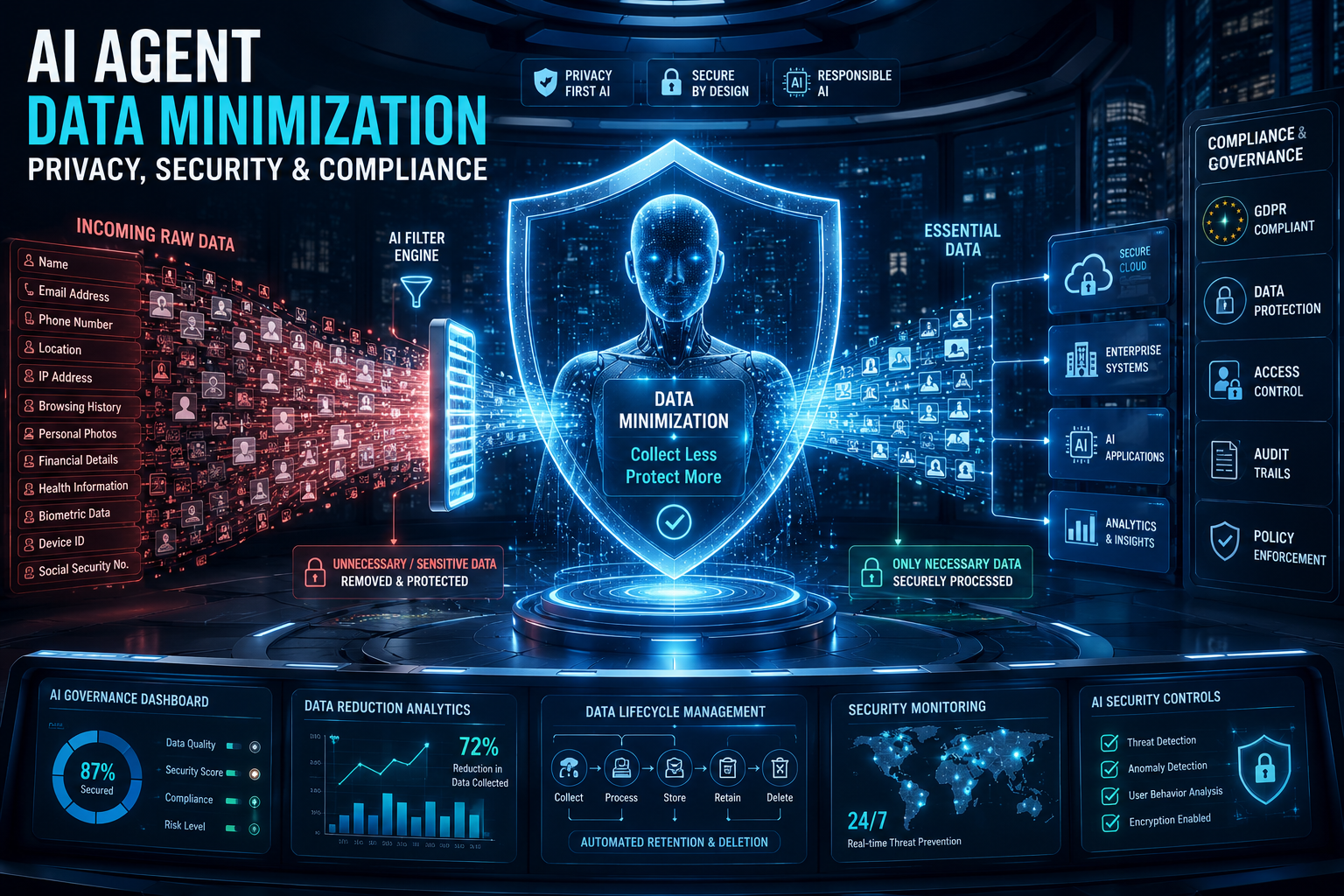
This is where AI Agent Data Minimization becomes essential. Data minimization is the practice of collecting, storing, and using only the data that is necessary for a specific purpose. By reducing unnecessary data collection, businesses can improve privacy, lower security risks, reduce storage costs, and comply with data protection regulations.
In this guide, you will learn what AI agent data minimization is, why it matters, how it works, its benefits, challenges, implementation strategies, best practices, and future trends. Whether you are a business owner, startup founder, developer, or AI enthusiast, this article will help you understand how to build safer and more responsible AI systems.
What is AI Agent Data Minimization?
AI Agent Data Minimization refers to the process of limiting the collection, processing, and storage of data by AI agents to only what is necessary for completing a specific task.
The principle is simple:
Collect less data.
Store less data.
Process only relevant data.
Delete unnecessary information.
For example, if an AI customer support agent only needs a customer’s name and order number to resolve an issue, it should not collect additional personal details such as income information, medical records, or unrelated browsing history.
The goal is to reduce privacy risks while maintaining the effectiveness of AI systems.
Why AI Agent Data Minimization is Important
As AI agents become more powerful, they gain access to larger amounts of sensitive information.
This creates several risks:
- Data breaches
- Identity theft
- Unauthorized access
- Regulatory penalties
- Loss of customer trust
- Increased storage costs
Data minimization helps organizations reduce these risks significantly.
When less information is collected, less information can be exposed, stolen, or misused.
This approach follows a fundamental privacy principle that has become central to modern AI governance and cybersecurity frameworks.
How AI Agents Use Data
Before understanding minimization, it is important to understand how AI agents typically use data.
AI agents often collect:
- Customer information
- Behavioral data
- Transaction records
- Communication history
- Business documents
- System logs
- User preferences
The agent uses this information to:
- Answer questions
- Generate recommendations
- Automate workflows
- Make predictions
- Personalize experiences
However, not all collected data is necessary.
Data minimization focuses on identifying which information is truly required.
Core Principles of AI Agent Data Minimization
Several principles guide effective data minimization practices.
1. Purpose Limitation
Data should only be collected for a clearly defined purpose.
Organizations must determine exactly why information is needed before collecting it.
2. Data Relevance
Only relevant information should be processed.
Irrelevant data should never enter the AI system.
3. Limited Retention
Data should not be stored forever.
Information should be deleted when it is no longer needed.
4. Access Restriction
Only authorized users and systems should access sensitive data.
5. Continuous Review
Organizations should regularly evaluate whether collected data remains necessary.
Benefits of AI Agent Data Minimization
AI data minimization provides multiple advantages.
Improved Privacy Protection
When less personal information is collected, users face lower privacy risks.
Customers increasingly prefer businesses that respect their data.
Stronger Security
Smaller datasets reduce attack surfaces.
Cybercriminals have fewer opportunities to steal valuable information.
Regulatory Compliance
Many regulations encourage or require data minimization.
Examples include:
- GDPR
- CCPA
- DPDP Act India
- HIPAA
- PIPEDA
Organizations following data minimization practices often find compliance easier.
Reduced Storage Costs
Storing large amounts of data can be expensive.
Minimization reduces:
- Cloud storage expenses
- Database management costs
- Backup requirements
Better Customer Trust
Consumers are becoming more aware of privacy concerns.
Businesses that collect only necessary data often gain stronger customer confidence.
Risks of Excessive Data Collection in AI Agents
Many organizations unintentionally collect too much data.
This can create significant problems.
Increased Breach Impact
If a security incident occurs, more data is exposed.
This can increase financial and reputational damage.
Compliance Violations
Regulators may impose fines when organizations collect unnecessary personal information.
Biased Decision Making
Large datasets often contain irrelevant or biased information.
This can negatively affect AI outcomes.
Operational Complexity
Managing excessive data creates additional administrative burdens.
Data Minimization in Different Types of AI Agents
Different AI agents require different minimization strategies.
Customer Support AI Agents
These agents may need:
- Customer name
- Account ID
- Issue details
They typically do not need:
- Medical history
- Financial investments
- Personal relationships
HR AI Agents
Necessary data may include:
- Skills
- Experience
- Education
Unnecessary data may include:
- Personal beliefs
- Irrelevant social activity
Healthcare AI Agents
Healthcare systems must carefully limit access to sensitive medical records.
Only relevant treatment information should be processed.
Financial AI Agents
Financial AI systems should process only information required for risk analysis, fraud detection, or customer support.
AI Agent Data Minimization Techniques
Organizations can apply several practical techniques.
Data Filtering
Data is filtered before entering the AI system.
Only required information is allowed through.
Data Masking
Sensitive information is hidden or partially concealed.
Examples include:
- Masked credit card numbers
- Hidden personal identifiers
Data Anonymization
Personal identifiers are removed completely.
The data can no longer be linked to a specific individual.
Data Aggregation
Instead of individual records, summarized information is used.
Automatic Data Deletion
AI systems can automatically remove information after a defined retention period.
Privacy by Design and AI Data Minimization
Privacy by Design is a framework that integrates privacy into system development from the beginning.
Instead of adding privacy controls later, organizations build them into the AI architecture.
Key elements include:
- Minimal data collection
- Secure storage
- User transparency
- Access controls
- Data lifecycle management
This approach supports long-term AI governance.
Regulatory Requirements Supporting Data Minimization
Many global regulations emphasize data minimization.
GDPR
The General Data Protection Regulation requires organizations to collect only necessary personal data.
Failure to comply can result in significant penalties.
CCPA
The California Consumer Privacy Act gives consumers greater control over personal information.
India’s DPDP Act
The Digital Personal Data Protection Act encourages responsible collection and processing of personal data.
Organizations operating in India should pay close attention to these requirements.
Challenges of AI Agent Data Minimization
Although beneficial, implementation is not always easy.
Balancing Performance and Privacy
Some organizations worry that collecting less data may reduce AI accuracy.
The challenge is finding the right balance.
Legacy Systems
Older systems may already contain large volumes of unnecessary information.
Data Classification Difficulties
Determining which data is truly necessary can be complex.
Organizational Resistance
Teams may prefer collecting more data “just in case.”
This mindset often conflicts with minimization principles.
Best Practices for AI Agent Data Minimization
Organizations should follow proven best practices.
Conduct Data Audits
Regularly review collected information.
Identify unnecessary datasets.
Define Clear Data Policies
Establish guidelines for:
- Collection
- Storage
- Access
- Deletion
Use Role-Based Access Control
Limit access according to job responsibilities.
Automate Retention Management
Create automatic deletion schedules.
Train Employees
Educate teams about privacy and data protection responsibilities.
Monitor AI Systems Continuously
Regular reviews help identify emerging privacy risks.
Building a Data Minimization Strategy
Organizations should follow a structured approach.
Step 1: Identify AI Agent Objectives
Clearly define what the agent needs to accomplish.
Step 2: Map Required Data
List information necessary for each task.
Step 3: Remove Unnecessary Fields
Eliminate data that does not directly support objectives.
Step 4: Establish Retention Rules
Determine how long information should be stored.
Step 5: Monitor and Improve
Regularly update policies as business needs evolve.
Future of AI Agent Data Minimization
The future of AI will increasingly focus on responsible data usage.
Several trends are emerging.
Privacy-First AI
Organizations are prioritizing privacy from the beginning of development.
Federated Learning
AI models can learn without transferring raw data to centralized servers.
Synthetic Data
Artificially generated datasets reduce dependence on sensitive information.
Automated Privacy Controls
Future AI systems will automatically identify and remove unnecessary data.
Stronger Regulations
Governments worldwide continue introducing stricter privacy requirements.
Common Mistakes to Avoid
Organizations often make avoidable mistakes.
These include:
- Collecting data without a clear purpose
- Storing information indefinitely
- Ignoring retention policies
- Failing to classify data properly
- Giving excessive access permissions
- Overlooking third-party risks
Avoiding these mistakes strengthens privacy and security.
Conclusion
AI Agent Data Minimization is no longer optional. As businesses increasingly rely on AI agents for automation, customer service, analytics, and decision-making, protecting personal and sensitive information becomes essential. Data minimization helps organizations collect only what is needed, reduce security risks, improve compliance, lower costs, and build customer trust.
The principle is simple yet powerful: collect less, store less, and protect more. Organizations that embrace data minimization today will be better prepared for future regulations, stronger cybersecurity challenges, and growing consumer expectations around privacy.
By implementing clear data policies, conducting regular audits, using privacy-by-design principles, and continuously monitoring AI systems, businesses can create AI agents that are both effective and responsible. The future of AI belongs to organizations that can balance innovation with privacy, security, and trust.
Frequently Asked Questions (FAQs)
1. What is AI Agent Data Minimization?
AI Agent Data Minimization is the practice of collecting, storing, and processing only the data necessary for an AI agent to perform its intended task.
2. Why is data minimization important for AI?
It reduces privacy risks, improves security, lowers storage costs, and helps organizations comply with data protection regulations.
3. Does data minimization reduce AI performance?
Not necessarily. Well-designed AI systems can perform effectively using only relevant data while avoiding unnecessary information.
4. Which regulations support data minimization?
Major regulations include GDPR, CCPA, HIPAA, PIPEDA, and India’s DPDP Act.
5. How can organizations implement AI data minimization?
Organizations can conduct data audits, establish retention policies, limit data collection, use anonymization techniques, and continuously monitor AI systems.
6. What is the difference between data minimization and data deletion?
Data minimization focuses on collecting only necessary information, while data deletion removes information that is no longer needed.
7. Can AI agents work with anonymized data?
Yes. Many AI agents can operate effectively using anonymized or aggregated datasets, reducing privacy risks.
8. What are the biggest risks of collecting too much data?
The main risks include data breaches, compliance violations, increased storage costs, privacy concerns, and loss of customer trust.
9. What is Privacy by Design in AI?
Privacy by Design is an approach that incorporates privacy protections into AI systems from the start rather than adding them later.
10. What is the future of AI Agent Data Minimization?
Future trends include privacy-first AI development, federated learning, synthetic data, automated privacy controls, and stronger global regulations.