

Introduction
Artificial Intelligence is changing how businesses work. Today, AI agents can answer customer questions, write content, analyze data, automate workflows, and even make decisions without constant human support. As companies use more AI agents, managing them becomes more difficult. Simply building an AI agent is no longer enough. Businesses also need to monitor, maintain, secure, improve, and scale these intelligent systems. This is where AgentOps becomes important.
AgentOps is becoming one of the most valuable practices for organizations using AI agents. It helps ensure AI systems remain reliable, safe, efficient, and cost-effective throughout their lifecycle. Whether you are a developer, startup founder, enterprise leader, or AI enthusiast, understanding AgentOps can help you build better AI solutions while avoiding common problems.
In this complete guide, you will learn everything about AgentOps, including how it works, why it matters, its architecture, tools, lifecycle, benefits, challenges, best practices, future trends, and how to implement AgentOps successfully in your organization.
What is AgentOps?
AgentOps stands for Agent Operations. It is a set of processes, tools, and best practices used to manage AI agents throughout their entire lifecycle.
Just as DevOps helps software teams manage applications and MLOps helps manage machine learning models, AgentOps focuses specifically on AI agents.
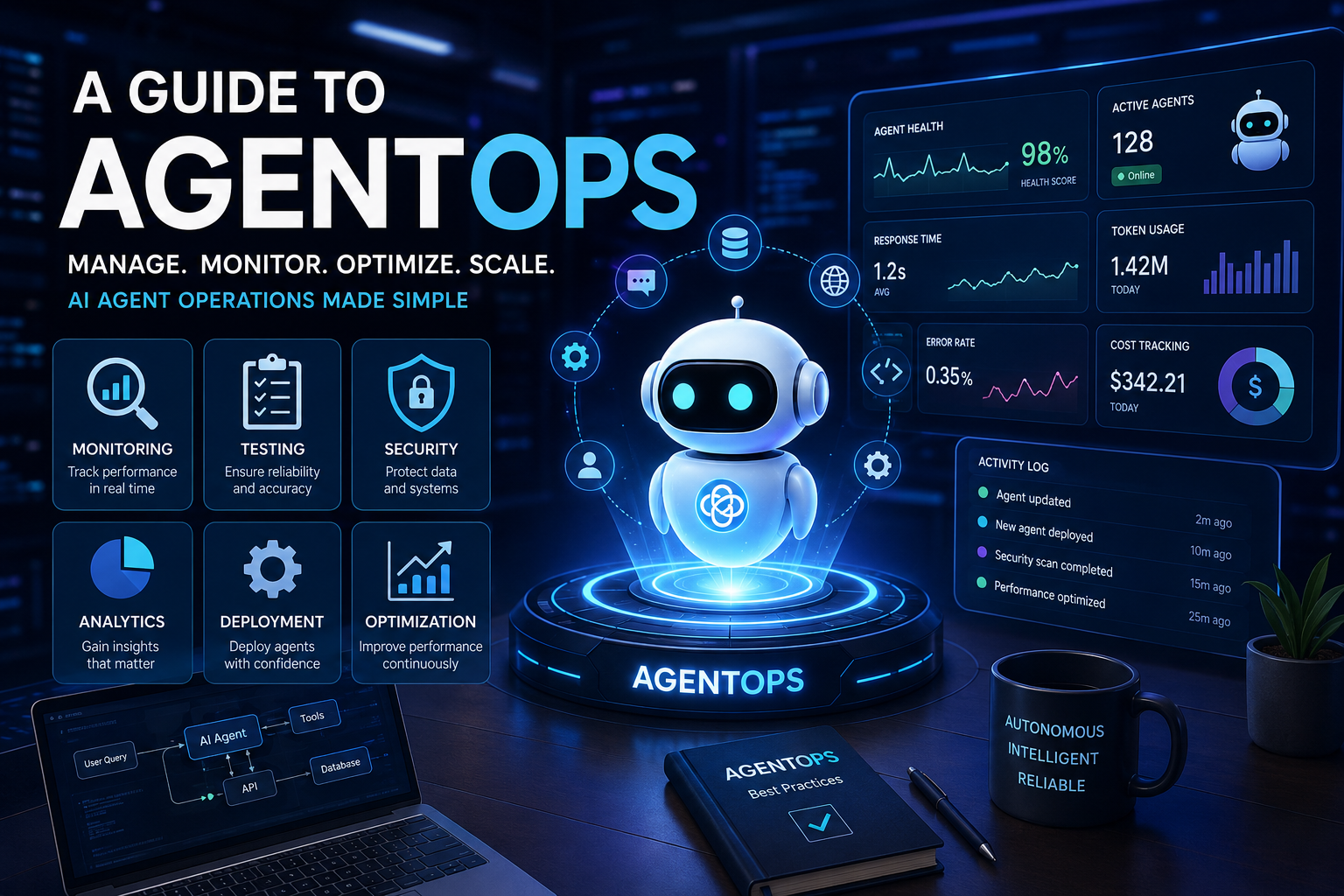
AgentOps ensures AI agents continue to perform well after deployment by providing monitoring, testing, security, logging, governance, optimization, and continuous improvement.
Instead of treating AI agents as one-time software projects, AgentOps manages them as continuously evolving intelligent systems.
Why AgentOps is Important
As businesses deploy more AI agents, they face new operational challenges.
Without proper management, AI agents may:
- Produce incorrect responses
- Consume excessive AI tokens
- Become expensive to operate
- Fail unexpectedly
- Access sensitive information
- Drift away from business goals
- Create inconsistent customer experiences
AgentOps solves these problems through continuous monitoring and management.
It allows organizations to maintain high-quality AI services while reducing operational risks.
Understanding the AgentOps Lifecycle
Every AI agent goes through several stages during its lifecycle.
1. Planning
The first stage involves defining the business objective.
Organizations identify:
- Business problem
- Target users
- AI capabilities
- Success metrics
- Compliance requirements
Proper planning reduces future risks.
2. Development
Developers build the AI agent.
This stage includes:
- Prompt engineering
- Tool integration
- Workflow creation
- Memory implementation
- Knowledge base connection
The goal is to create a functional AI agent.
3. Testing
Testing ensures the AI behaves correctly.
Testing includes:
- Functional testing
- Prompt testing
- Safety testing
- Hallucination testing
- Performance testing
- Security testing
Testing helps identify issues before deployment.
4. Deployment
After successful testing, the AI agent is deployed into production.
Deployment can happen through:
- Web applications
- Mobile apps
- Customer support platforms
- Enterprise software
- Internal business systems
5. Monitoring
Monitoring is one of the most important parts of AgentOps.
Teams monitor:
- Response quality
- Latency
- Errors
- User satisfaction
- Token usage
- API costs
- Security events
Continuous monitoring ensures reliable performance.
6. Optimization
Based on collected data, organizations improve the AI agent.
Optimization includes:
- Better prompts
- Updated workflows
- New tools
- Improved reasoning
- Faster execution
- Lower costs
7. Continuous Improvement
AI agents should continuously learn from operational data.
Organizations regularly:
- Update prompts
- Improve workflows
- Expand knowledge
- Enhance security
- Add new features
This keeps AI agents useful over time.
Core Components of AgentOps
AgentOps includes several essential components.
Monitoring
Monitoring tracks everything happening inside AI agents.
It measures:
- Agent health
- API failures
- Completion quality
- User satisfaction
- Resource usage
Monitoring provides real-time visibility.
Logging
Logs record every action performed by AI agents.
Logs include:
- User requests
- Agent reasoning
- Tool usage
- API calls
- Responses
- Errors
Logs help developers debug problems.
Observability
Observability goes beyond logging.
It helps answer questions like:
- Why did the agent fail?
- Why was the answer incorrect?
- Which tool caused the delay?
- Which prompt performed poorly?
Observability provides deeper operational insights.
Evaluation
Evaluation measures AI quality.
Common evaluation metrics include:
- Accuracy
- Relevance
- Safety
- Response consistency
- User ratings
- Task completion rate
Regular evaluation improves performance.
Security
AI agents require strong security controls.
Security includes:
- Authentication
- Authorization
- Encryption
- Secure APIs
- Data protection
- Prompt injection prevention
Security protects both users and organizations.
Governance
Governance ensures responsible AI usage.
Governance includes:
- Compliance
- Policy enforcement
- Human oversight
- Data privacy
- Risk management
- Ethical AI practices
Governance builds trust.
AgentOps Architecture
A typical AgentOps architecture contains several layers.
User Layer
Users interact with the AI agent.
Examples include:
- Customers
- Employees
- Developers
- Business users
Agent Layer
This layer contains:
- LLM
- Prompt templates
- Memory
- Planning engine
- Decision engine
This is where intelligence operates.
Tool Layer
AI agents connect with external systems.
Examples include:
- CRM
- ERP
- Databases
- Slack
- APIs
Monitoring Layer
Tracks:
- Performance
- Errors
- Costs
- Usage
- Latency
Governance Layer
Controls:
- Permissions
- Policies
- Compliance
- Security
- Auditing
AgentOps vs DevOps
Although both aim to improve operations, they focus on different systems.
| Feature | DevOps | AgentOps |
|---|---|---|
| Focus | Software | AI Agents |
| Main Goal | Reliable software | Reliable intelligent agents |
| Monitoring | Infrastructure | Agent behavior |
| Testing | Code | Reasoning + prompts |
| Deployment | Applications | AI agents |
| Optimization | Performance | Intelligence + cost |
AgentOps vs MLOps
Many people confuse these two concepts.
| MLOps | AgentOps |
| Manages ML models | Manages AI agents |
| Model training | Agent behavior |
| Data pipelines | Agent workflows |
| Model deployment | Agent deployment |
| Prediction monitoring | Decision monitoring |
AgentOps builds on MLOps by managing complete AI agent systems.
Benefits of AgentOps
Organizations gain several advantages by implementing AgentOps.
Better Reliability
Continuous monitoring reduces failures.
AI agents become more dependable.
Higher Accuracy
Regular evaluation improves response quality.
Users receive better answers.
Lower Costs
Cost tracking identifies expensive operations.
Organizations optimize token usage.
Improved Security
Security monitoring protects against attacks.
Sensitive information remains safe.
Better Compliance
AgentOps supports regulatory requirements.
Businesses reduce legal risks.
Easier Scaling
Organizations can deploy hundreds of AI agents using standardized operational practices.
Faster Innovation
Teams spend less time fixing issues and more time building new AI capabilities.
Common AgentOps Challenges
Every organization faces challenges while managing AI agents.
Hallucinations
AI agents may generate false information.
Continuous testing helps reduce hallucinations.
Prompt Drift
Prompts may become less effective over time.
Regular optimization keeps performance high.
Tool Failures
External APIs sometimes stop working.
AgentOps detects failures quickly.
High Costs
Large AI models can become expensive.
Cost monitoring helps reduce unnecessary spending.
Security Risks
AI agents may face:
- Prompt injection
- Data leakage
- Unauthorized access
Proper security policies reduce these risks.
Best Practices for AgentOps
Organizations should follow proven best practices.
Define Clear Success Metrics
Measure:
- Accuracy
- Cost
- User satisfaction
- Completion rate
Metrics guide improvements.
Monitor Everything
Track:
- Errors
- Latency
- Token usage
- API failures
- User feedback
Visibility improves reliability.
Test Continuously
Testing should never stop after deployment.
Frequent evaluations improve long-term performance.
Secure Every Agent
Implement:
- Authentication
- Encryption
- Access controls
- Secure APIs
Security should always come first.
Maintain Human Oversight
Humans should review important decisions.
This improves trust and accountability.
Keep Documentation Updated
Document:
- Prompts
- Workflows
- APIs
- Integrations
- Policies
Documentation simplifies maintenance.
Popular AgentOps Tools
Several tools support AgentOps workflows.
Some popular options include:
- LangSmith
- OpenTelemetry
- Weights & Biases
- MLflow
- Grafana
- Prometheus
- Phoenix
- Arize AI
- Helicone
- OpenLit
Organizations choose tools based on their infrastructure.
AgentOps for Startups
Startups benefit greatly from AgentOps.
It helps them:
- Launch AI products faster
- Reduce operational costs
- Improve customer satisfaction
- Monitor AI quality
- Scale efficiently
Even small AI startups should adopt AgentOps early.
AgentOps for Enterprises
Large organizations often operate hundreds of AI agents.
AgentOps enables them to:
- Standardize operations
- Improve governance
- Meet compliance requirements
- Reduce security risks
- Optimize enterprise AI investments
Real-World Use Cases of AgentOps
AgentOps supports AI operations across many industries.
Customer Support
AI chatbots require continuous monitoring to maintain high response quality and customer satisfaction.
Healthcare
Healthcare AI agents require strict compliance, security, and human oversight.
Banking
Financial institutions use AgentOps for fraud detection, customer service, and regulatory compliance.
E-commerce
Online retailers monitor recommendation agents and shopping assistants.
Software Development
AI coding assistants benefit from continuous evaluation and optimization.
Education
Learning assistants improve through feedback and performance monitoring.
Future of AgentOps
AgentOps will become even more important as AI continues to evolve.
Future trends include:
- Autonomous agent management
- AI-driven monitoring
- Multi-agent orchestration
- Predictive maintenance
- Self-healing AI systems
- Better governance frameworks
- Real-time optimization
- Advanced security automation
Organizations investing in AgentOps today will be better prepared for tomorrow’s AI ecosystem.
How to Implement AgentOps Successfully
Building an AgentOps strategy requires careful planning.
Step 1
Identify business objectives.
Step 2
Select the right AI models.
Step 3
Design secure workflows.
Step 4
Deploy monitoring tools.
Step 5
Define evaluation metrics.
Step 6
Automate testing.
Step 7
Monitor continuously.
Step 8
Optimize regularly.
Step 9
Strengthen governance.
Step 10
Scale responsibly.
Following these steps helps organizations build reliable AI operations.
Conclusion
AgentOps is quickly becoming one of the most important disciplines in artificial intelligence. Building an AI agent is only the beginning. Real success comes from keeping that agent reliable, secure, accurate, and efficient over time. AgentOps provides the framework to achieve these goals through continuous monitoring, testing, optimization, governance, and security.
Whether you are a startup launching your first AI assistant or a large enterprise managing hundreds of intelligent agents, AgentOps helps improve performance while reducing operational risks. As AI systems become more autonomous and businesses depend on them for critical tasks, the demand for effective AgentOps practices will continue to grow.
By adopting the strategies, best practices, and tools covered in this guide, organizations can confidently scale AI agents, improve user experiences, reduce costs, and build trustworthy AI solutions for the future.
Read More Blogs– AI Startup Edge
Frequently Asked Questions (FAQs)
1. What is AgentOps?
AgentOps is the practice of managing, monitoring, securing, testing, and optimizing AI agents throughout their lifecycle.
2. Why is AgentOps important?
It ensures AI agents remain reliable, secure, cost-effective, and accurate after deployment.
3. Is AgentOps different from DevOps?
Yes. DevOps manages software applications, while AgentOps focuses on intelligent AI agents and their operational behavior.
4. What skills are needed for AgentOps?
Useful skills include AI development, prompt engineering, cloud computing, automation, security, observability, and performance monitoring.
5. Which industries use AgentOps?
Industries such as healthcare, banking, e-commerce, education, manufacturing, software development, and customer support all benefit from AgentOps.
6. Can startups use AgentOps?
Yes. Startups can improve AI reliability, reduce costs, and scale products more efficiently by adopting AgentOps from the beginning.
7. What are the biggest challenges in AgentOps?
Common challenges include hallucinations, prompt drift, security risks, high operational costs, tool failures, and governance.
8. What is the future of AgentOps?
The future includes autonomous monitoring, self-healing AI systems, multi-agent orchestration, AI governance, and intelligent operational automation.