

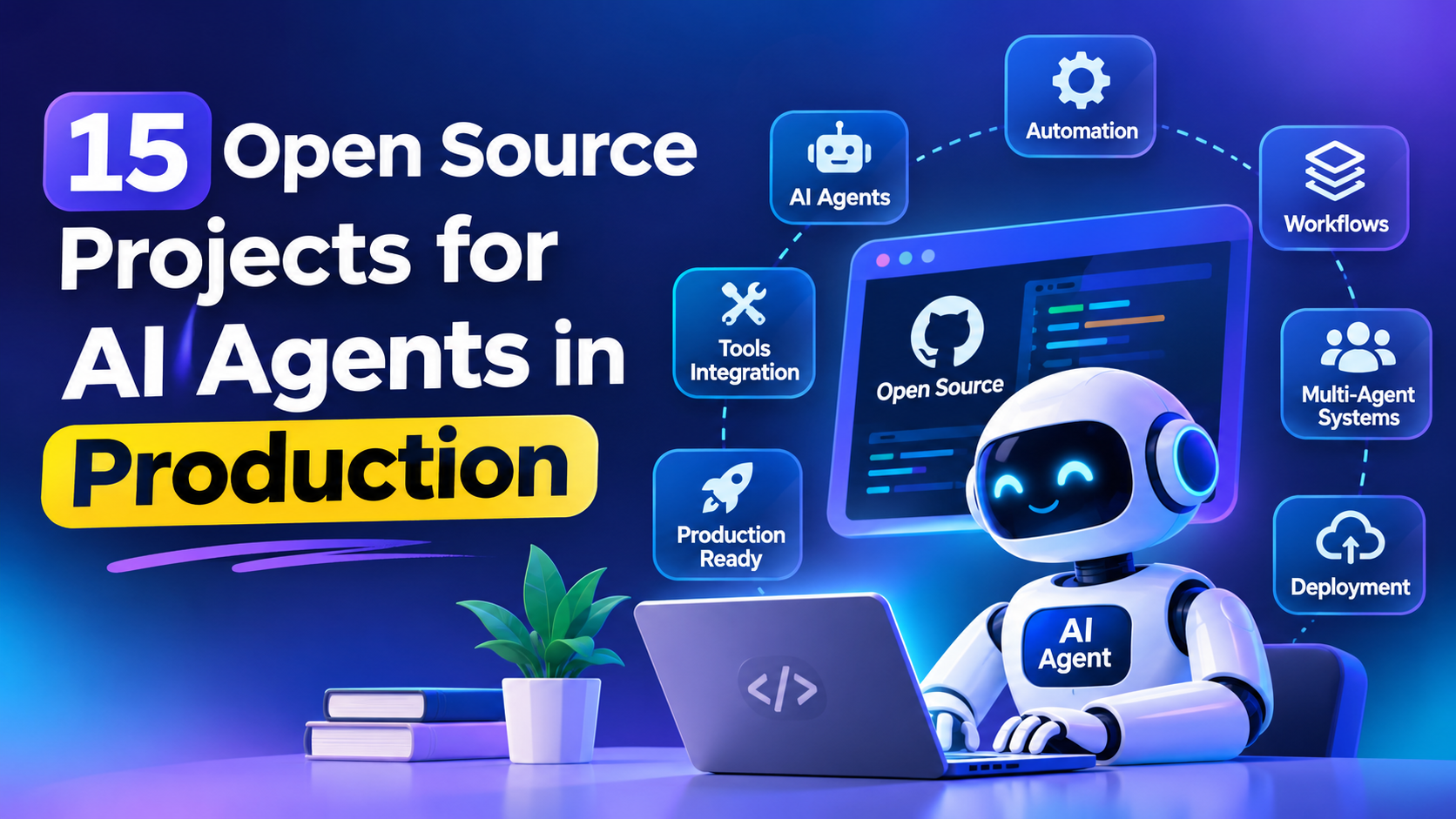
Artificial Intelligence is changing how businesses work. Today, AI agents can do much more than answer questions. They can understand instructions, use tools, search information, manage workflows, analyze documents, write code, and complete tasks with less human involvement. However, building an AI agent for real-world business use is not as simple as creating a chatbot. A production AI agent needs proper planning, memory, security, monitoring, reliable workflows, and the ability to handle errors.
This is where open source AI agent projects become useful. Developers and businesses can use these projects to build, test, customize, and deploy their own AI agents without depending entirely on expensive commercial platforms. In this article, we will explore 15 open source projects for AI agents in production in 2026. You will learn what each project does, its important features, practical use cases, and how to choose the right solution for your business or development needs.
What Are Open Source AI Agent Projects?
Open source AI agent projects are software frameworks, libraries, and platforms that developers can use to create intelligent systems capable of performing tasks automatically.
Unlike a basic chatbot, an AI agent can understand a goal, decide what steps are required, use external tools, and take action based on the available information.
For example, imagine an AI agent designed for an online business. It can receive a customer question, check the company’s product database, find the correct information, prepare an answer, and send the response after following the required approval process.
Open source projects provide the technical foundation for creating these systems.
Most projects offer features such as:
- Tool Integration: Connect AI agents with APIs, databases, websites, and external applications.
- Memory Management: Store useful information from previous interactions.
- Workflow Automation: Complete multiple tasks through connected steps.
- Multi-Agent Systems: Allow different AI agents to work together.
- Human Approval: Request human permission before performing important actions.
- Self-Hosting: Run software on your own infrastructure when supported.
- Monitoring: Track agent activities, errors, and performance.
Not every framework includes all these features by default. Some provide basic development tools, while others offer complete platforms for building and managing AI applications.
Why Are Open Source AI Agent Projects Important for Production?
Building a small AI experiment is different from running an AI agent for hundreds or thousands of users.
A production system must work consistently, protect business information, manage unexpected errors, and provide reliable results.
Open source AI agent frameworks help developers create more controlled systems.
Here are some important reasons businesses use them.
1. More Development Control
Developers can inspect the source code, customize workflows, and connect the system with existing business applications.
2. Flexible Deployment
Many frameworks support self-hosting, allowing businesses to run their applications on their own servers or cloud infrastructure.
3. Lower Software Costs
Open source frameworks can reduce software licensing expenses. However, businesses still need to consider server costs, AI model usage, maintenance, and development expenses.
4. Better Integration
AI agents can connect with CRM systems, websites, databases, customer support platforms, and internal business tools.
5. Faster Development
Instead of creating every feature from the beginning, developers can use existing frameworks for memory, orchestration, tool calling, and workflow management.
15 Open Source Projects for AI Agents in Production
The following projects provide different approaches to AI agent development. Some are suitable for developers who want complete programming control, while others provide visual builders or specialized tools.
1. LangGraph
Website: https://www.langchain.com/langgraph
Best For: Building complex and stateful AI agents.
LangGraph is one of the important frameworks for developing production-ready AI agents. It helps developers create agents using a graph-based architecture.
In simple words, developers can divide an AI workflow into different steps. Each step performs a particular task, and the system decides which step should run next.
For example, a customer support agent can receive a question, identify the topic, search a knowledge database, prepare an answer, and request human approval when necessary.
LangGraph is useful when an AI agent needs to remember its progress and continue working after an interruption.
Key Features:
- Stateful AI agent workflows.
- Memory and checkpointing support.
- Human-in-the-loop approvals.
- Multi-agent orchestration.
- Conditional workflow execution.
- Support for Python and JavaScript/TypeScript.
Real-World Use Cases:
- Customer support automation.
- Enterprise AI assistants.
- Research agents.
- Business process automation.
- Multi-step decision-making systems.
Why Choose LangGraph?
Choose LangGraph when you need more control over how an AI agent behaves. It is particularly useful for complex applications where every step needs to be managed carefully.
2. CrewAI
Website: https://www.crewai.com/
Best For: Multi-agent AI systems.
CrewAI is an open source framework that allows developers to create teams of AI agents.
The main idea is simple: instead of asking one AI agent to complete every task, you can assign different responsibilities to different agents.
For example, imagine a content marketing workflow.
- A research agent collects information.
- A writing agent creates the article.
- An SEO agent checks keywords and headings.
- An editing agent reviews the final content.
These agents can work together through a coordinated workflow.
CrewAI uses concepts such as agents, tasks, crews, and flows to organize AI operations.
Key Features:
- Multi-agent collaboration.
- Role-based agent configuration.
- Task management.
- Workflow automation.
- Tool integration.
- Python-based development.
Real-World Use Cases:
- Marketing automation.
- Business research.
- Lead generation.
- Content creation.
- Data analysis.
- Customer service workflows.
Why Choose CrewAI?
CrewAI is a good option when you want to build a system where multiple AI agents have separate responsibilities. It is also helpful for developers who want to experiment with collaborative AI workflows.
3. Microsoft Agent Framework
Website: https://github.com/microsoft/agent-framework
Best For: Enterprise AI agent development.
Microsoft Agent Framework is an open source framework designed to help developers build and manage AI agents and multi-agent workflows.
It brings together ideas and capabilities from Microsoft’s earlier AutoGen and Semantic Kernel projects.
The framework supports developers working with Python and .NET. This makes it relevant for organizations that already use Microsoft technologies.
For example, a company can build an AI assistant that connects internal business information with different tools and services. The agent can receive a request, perform the required steps, and return a result.
Key Features:
- AI agent orchestration.
- Multi-agent workflows.
- Python and .NET support.
- Tool integration.
- Workflow management.
- Enterprise development support.
Real-World Use Cases:
- Enterprise AI assistants.
- Internal business automation.
- Document processing.
- Employee productivity tools.
- Multi-agent business applications.
Why Choose Microsoft Agent Framework?
It is worth considering if your organization uses Microsoft technologies and needs a structured approach to developing AI agents.
Developers starting new Microsoft-based projects should evaluate this framework rather than automatically choosing older AutoGen examples.
4. LlamaIndex
Website: https://www.llamaindex.ai/
Best For: Data-driven AI agents and RAG applications.
LlamaIndex is a data framework that helps developers connect large language models with external information.
Many businesses want AI agents that can answer questions using company documents, reports, databases, and internal knowledge.
However, language models do not automatically know the latest information stored inside a company’s private systems.
LlamaIndex helps solve this problem through data ingestion, indexing, retrieval, and workflow capabilities.
For example, a company can build an AI assistant that searches its internal documents before answering employee questions.
Key Features:
- Data connectors.
- Retrieval-Augmented Generation (RAG).
- Document indexing.
- Agent tool integration.
- Workflow development.
- Knowledge retrieval.
Real-World Use Cases:
- Company knowledge assistants.
- Document search systems.
- Research automation.
- Financial document analysis.
- Enterprise question-answering systems.
Why Choose LlamaIndex?
Choose LlamaIndex when your AI agent needs to work with large amounts of business information and provide answers based on relevant documents.
5. Haystack
Website: https://haystack.deepset.ai/
Best For: Production RAG and document-processing systems.
Haystack is an open source framework for building AI applications that work with documents, search systems, language models, and data pipelines.
It helps developers create structured systems instead of depending on one large AI prompt.
For example, an AI agent can receive a question, search a document collection, retrieve relevant information, and generate an answer based on the available sources.
This approach is useful when accuracy and information retrieval are important.
Key Features:
- Document processing.
- Search and retrieval pipelines.
- RAG application development.
- LLM integration.
- Tool-based workflows.
- Modular components.
Real-World Use Cases:
- Enterprise document search.
- Customer support assistants.
- Knowledge management.
- Research applications.
- Automated document analysis.
Why Choose Haystack?
Haystack is a strong option when your main requirement is building reliable AI applications around search, documents, and retrieval.
6. Pydantic AI
Website: https://ai.pydantic.dev/
Best For: Reliable and structured Python AI agents.
Pydantic AI is a Python framework designed to make AI application development more structured and type-safe.
One common problem with AI systems is that models can return unexpected information or incorrect data formats.
For example, a business application may expect an AI agent to return a customer name, email address, order number, and delivery status. If the response does not follow the required structure, the application may fail.
Pydantic AI helps developers define and validate structured outputs.
Key Features:
- Type-safe agent development.
- Structured output validation.
- Tool calling.
- Dependency injection.
- Multiple model integrations.
- Testing and evaluation support.
Real-World Use Cases:
- Business data extraction.
- Customer support agents.
- Financial information processing.
- Structured report generation.
- Backend AI applications.
Why Choose Pydantic AI?
Choose this framework when your AI application needs predictable data structures and strong integration with Python applications.
7. Agno
Website: https://www.agno.com/
Best For: Building scalable AI agent applications.
Agno is an open source framework for building AI agents and multi-agent systems.
It provides tools for creating agents that can use external services, access information, maintain sessions, and work together.
One useful feature of Agno is its focus on creating applications that can be deployed as services.
For example, a business can create an AI research assistant that searches information, analyzes results, and prepares reports.
Key Features:
- Single and multi-agent systems.
- Agent memory and sessions.
- Tool integration.
- Knowledge management.
- API-based deployment options.
- Model flexibility.
Real-World Use Cases:
- AI research assistants.
- Business intelligence systems.
- Enterprise automation.
- Data analysis.
- Multi-agent applications.
Why Choose Agno?
Agno is worth exploring when you want to develop AI agents with memory, tools, and deployment-oriented capabilities.
8. Hugging Face smolagents
Website: https://github.com/huggingface/smolagents
Best For: Lightweight AI agent development.
smolagents is an open source Python library developed by Hugging Face.
Its main advantage is simplicity. Developers can create AI agents without working with a very large and complicated framework.
It supports tool-based agents and code-oriented execution. This allows agents to solve tasks by using available tools and executing generated code in an appropriately configured environment.
For example, a research agent can search information, perform calculations, and prepare a summary.
Key Features:
- Lightweight Python framework.
- Tool-based agents.
- Code execution support.
- Hugging Face ecosystem integration.
- Model flexibility.
- Simple development structure.
Real-World Use Cases:
- Research automation.
- Data analysis.
- Small AI assistants.
- Educational AI projects.
- Developer experiments.
Why Choose smolagents?
It is a useful choice when you want a simple framework and prefer building your own agent logic instead of using a large orchestration system.
9. Google Agent Development Kit (ADK)
Website: https://google.github.io/adk-docs/
Best For: Developing structured AI agents within the Google ecosystem.
Google Agent Development Kit, commonly called Google ADK, is a framework for building, testing, and deploying AI agents.
It provides a structured approach to creating agents and connecting them with tools and workflows.
Developers can use it to create an agent that performs different operations based on user instructions.
For example, an AI travel assistant can collect travel requirements, search relevant information, and organize a suggested itinerary.
Google ADK is designed to work with Google’s AI ecosystem, while also supporting different model and deployment configurations.
Key Features:
- Agent development tools.
- Multi-agent architecture.
- Tool integration.
- Workflow support.
- Testing and debugging.
- Google Cloud ecosystem integration.
Real-World Use Cases:
- Business assistants.
- Travel planning agents.
- Research automation.
- Customer service applications.
- Enterprise workflows.
Why Choose Google ADK?
Choose Google ADK when you want structured agent development and expect to use Google Cloud or Google’s AI services.
10. AWS Strands Agents
Website: https://github.com/strands-agents/sdk-python
Best For: Model-driven AI agents and AWS environments.
Strands Agents is an open source SDK developed by AWS for building AI agents.
It uses a model-driven approach. Developers provide the model with instructions and tools, and the agent decides how to use them to complete a task.
This approach can reduce the amount of custom orchestration code required for simpler agent applications.
For example, a business assistant can use tools to retrieve information, perform calculations, and interact with external services.
Key Features:
- Model-driven agent execution.
- Tool integration.
- Multi-agent capabilities.
- Python SDK.
- Model flexibility.
- AWS ecosystem support.
Real-World Use Cases:
- Cloud automation.
- Enterprise assistants.
- Infrastructure operations.
- Research applications.
- Business process automation.
Why Choose Strands Agents?
It is a good option for developers who work with AWS and want to create AI agents that can use different tools.
11. OpenHands
Website: https://github.com/All-Hands-AI/OpenHands
Best For: Autonomous software development agents.
OpenHands is an open source project focused on AI-powered software development.
Unlike general-purpose agent frameworks, it is designed around software engineering tasks.
It can help AI agents work with code, interact with development environments, execute commands, and support programming workflows.
For example, a developer can give an AI coding agent a task to investigate a software issue, modify code, and run tests.
However, code execution must take place in a properly isolated environment with suitable permissions.
Key Features:
- AI-powered coding assistance.
- Development environment interaction.
- Terminal and tool usage.
- Software engineering workflows.
- Code modification support.
- Self-hosting options.
Real-World Use Cases:
- Bug investigation.
- Code generation.
- Software testing.
- Repository maintenance.
- Developer productivity.
Why Choose OpenHands?
Choose OpenHands when your goal is to build or use autonomous coding agents rather than general business assistants.
12. AG2
Website: https://github.com/ag2ai/ag2
Best For: Collaborative multi-agent development.
AG2 is an open source multi-agent framework that continues the AutoGen-style approach to agent collaboration.
It allows different AI agents to communicate, exchange information, and work together to complete tasks.
For example, a business research system can include a research agent, an analysis agent, and a reporting agent.
Each agent can have a specific responsibility, making it easier to organize complicated workflows.
Key Features:
- Multi-agent conversations.
- Agent collaboration.
- Tool integration.
- Human participation.
- Python-based development.
- Flexible agent configurations.
Real-World Use Cases:
- Collaborative research.
- Data analysis.
- Software development workflows.
- Business automation.
- Multi-agent experiments.
Why Choose AG2?
AG2 is useful for developers interested in conversational multi-agent systems and workflows inspired by the AutoGen approach.
13. RAGFlow
Website: https://github.com/infiniflow/ragflow
Best For: Document-based AI agents and advanced RAG systems.
RAGFlow is an open source RAG platform designed to help developers build AI applications using documents and knowledge sources.
It focuses on improving how AI applications process and retrieve information from different document formats.
This is especially useful for organizations that manage large amounts of PDFs, reports, manuals, and business documents.
For example, a legal research assistant can search relevant documents and provide answers based on the available information.
Key Features:
- Document understanding.
- Knowledge extraction.
- Retrieval-Augmented Generation.
- Document parsing.
- Knowledge base management.
- AI application integration.
Real-World Use Cases:
- Legal document research.
- Business knowledge assistants.
- PDF question-answering.
- Enterprise search.
- Technical documentation assistants.
Why Choose RAGFlow?
Choose RAGFlow when your AI application depends heavily on understanding, organizing, and retrieving information from documents.
14. Langflow
Website: https://www.langflow.org/
Best For: Visual AI agent development.
Langflow is an open source visual development platform for building AI applications and workflows.
Instead of writing every workflow step manually, developers can connect components using a visual interface.
This makes it easier to understand how data moves between models, tools, databases, and other components.
For example, a developer can create a chatbot workflow that connects a language model with a document retriever and an output component.
Key Features:
- Visual workflow builder.
- Drag-and-drop components.
- LLM integration.
- RAG workflow development.
- API integration.
- Python ecosystem support.
Real-World Use Cases:
- AI chatbots.
- Business assistants.
- Document search.
- AI prototypes.
- Workflow development.
Why Choose Langflow?
Langflow is useful for developers and technical teams who prefer visual development and want to understand AI workflows without writing everything from scratch.
15. Mastra
Website: https://mastra.ai/
Best For: Production AI agents using TypeScript.
Mastra is an open source TypeScript framework for building AI applications and agents.
It is especially useful for developers who already work with JavaScript and TypeScript.
Many AI development frameworks focus heavily on Python. Mastra provides another option for teams building AI features inside JavaScript applications.
For example, a SaaS company can build an AI assistant that connects with its existing application, accesses business information, and completes tasks through defined tools.
Key Features:
- TypeScript-based development.
- AI agent creation.
- Workflow orchestration.
- Memory support.
- Tool integration.
- Evaluation and testing capabilities.
Real-World Use Cases:
- SaaS AI assistants.
- Customer support automation.
- Business applications.
- Research agents.
- JavaScript-based AI workflows.
Why Choose Mastra?
Choose Mastra when your development team prefers TypeScript and wants an integrated framework for building AI-powered applications.
Comparison of 15 Open Source AI Agent Projects
Before selecting a framework, it is important to understand the main purpose of each project.
| Project | Main Purpose | Best For |
|---|---|---|
| LangGraph | Agent orchestration | Complex workflows |
| CrewAI | Multi-agent collaboration | Team-based AI tasks |
| Microsoft Agent Framework | Enterprise orchestration | Microsoft environments |
| LlamaIndex | Data and retrieval | Knowledge assistants |
| Haystack | RAG pipelines | Document applications |
| Pydantic AI | Structured AI agents | Reliable Python applications |
| Agno | Agent development | Scalable agent services |
| smolagents | Lightweight agents | Simple Python projects |
| Google ADK | Agent development | Google ecosystem |
| Strands Agents | Model-driven agents | AWS environments |
| OpenHands | Coding agents | Software development |
| AG2 | Multi-agent conversations | Collaborative workflows |
| RAGFlow | Document-based RAG | Enterprise document search |
| Langflow | Visual AI development | Drag-and-drop workflows |
| Mastra | TypeScript agents | JavaScript applications |
Note: This table describes the primary strengths of each project, not a ranking. Features, supported integrations, and licensing can change. Always check the official repository and documentation before commercial deployment.
How to Choose the Best Open Source AI Agent Framework for Production
Choosing the right AI agent framework is an important decision. The best option depends on your business requirements, development experience, infrastructure, and project complexity.
Here are some important factors to consider.
1. Understand Your Business Requirements
First, identify what you want your AI agent to do.
For example, if you want to create a customer support agent, you may need document retrieval, memory, tool integration, and human approval.
If you want to develop a coding agent, a specialized project such as OpenHands may be more suitable.
2. Check Programming Language Support
Different projects support different programming languages.
Python developers can explore LangGraph, CrewAI, Pydantic AI, Haystack, and smolagents.
Developers working with JavaScript or TypeScript can consider LangGraph’s JavaScript support and Mastra.
Choose a framework that matches your team’s existing technical skills.
3. Check Memory and State Management
Memory is important when an agent needs to remember previous conversations or continue a task.
For production applications, check whether the framework supports persistent storage, checkpointing, session management, and workflow recovery.
Do not assume that every framework provides permanent memory automatically.
4. Evaluate Security Features
AI agents can access sensitive information and perform important actions.
Check whether the framework supports access controls, human approvals, secure tool execution, and suitable isolation.
Also consider prompt injection protection, secret management, and data privacy.
5. Consider Scalability
A framework that works for ten test users may not work equally well for thousands of users.
Consider server resources, database performance, concurrent requests, API limits, and model costs before deployment.
6. Check Documentation and Community Support
Good documentation makes development easier.
Check the project’s GitHub repository, release history, issue discussions, examples, and community activity.
An actively maintained project can make it easier to receive updates and fix problems.
7. Understand the Software License
Open source does not always mean that every project has identical usage rights.
Check the exact license before using a project in a commercial product, especially when distributing, modifying, or offering it as a service.
For example, projects with MIT or Apache 2.0 licenses generally offer broad permissions, subject to their license terms. Some platforms use modified or source-available licenses.
How to Deploy AI Agents in a Production Environment
Developing an AI agent is only the first step. The next challenge is deploying it so that real users can access it safely and reliably.
A production AI agent needs a proper technical environment.
Here are the important steps.
1. Select an AI Model
Choose a suitable language model based on your requirements. Consider response quality, speed, API costs, privacy, and available infrastructure.
2. Connect External Tools
Connect the agent with the tools it needs, such as databases, APIs, websites, CRM systems, and business applications.
3. Configure Memory
Set up suitable storage to maintain conversation history, user preferences, and task progress.
4. Add Security Controls
Protect API keys, business information, and user data. Apply access permissions and restrict the actions an agent can perform.
5. Test Different Scenarios
Test the agent with normal requests, unexpected inputs, incorrect information, and failure situations.
6. Deploy the Application
Deploy the application using suitable infrastructure, such as Docker, Kubernetes, or cloud services.
7. Monitor Performance
Track response quality, execution time, errors, token usage, and operating costs.
A production AI agent should also have logging, error handling, retry limits, and a human escalation process.
Practical Examples of AI Agents Built with Open Source Projects
Understanding practical examples makes it easier to decide which framework is suitable for your project.
Here are five business applications.
1. AI Customer Support Agent
An AI customer support agent can answer common customer questions, retrieve information from company documents, and help users find solutions.
Suggested technologies:
- LangGraph for workflow management.
- LlamaIndex for knowledge retrieval.
- Pydantic AI for structured responses.
2. AI Lead Generation Agent
A lead generation agent can help businesses collect information, organize potential customers, and prepare follow-up messages.
Suggested technologies:
- CrewAI for multiple agent roles.
- LangGraph for controlled workflows.
- External CRM APIs for lead management.
Human approval should be used before sending messages or performing actions that affect customers.
3. AI Research Agent
An AI research agent can collect information, compare sources, analyze data, and prepare reports.
Suggested technologies:
- Agno for agent development.
- smolagents for lightweight tool-based execution.
- LangGraph for multi-step research workflows.
4. AI Document Processing Agent
A document processing agent can extract information from PDFs, invoices, reports, and other business documents.
Suggested technologies:
- RAGFlow for document processing.
- Haystack for retrieval pipelines.
- LlamaIndex for data integration.
5. AI Software Development Agent
A software development agent can investigate bugs, understand code, suggest modifications, and support testing.
Suggested technologies:
- OpenHands for coding tasks.
- LangGraph for customized development workflows.
- Microsoft Agent Framework for structured agent applications.
These are suggested technology combinations, not ready-made integrations. Developers must configure and test the connections.
Common Challenges When Building Production AI Agents
Although open source frameworks make AI development easier, production systems still have several challenges.
1. Incorrect AI Responses
AI models sometimes provide incorrect or incomplete information. Use reliable data sources, validation, and human review for important decisions.
2. High Operating Costs
AI model usage, cloud infrastructure, and database operations can become expensive. Monitor usage and select models according to task complexity.
3. Security Risks
Agents that can access websites, databases, and business applications may create security risks. Apply permission controls and isolate code execution.
4. Complex Multi-Agent Workflows
Too many agents can make a system difficult to manage. Start with a simple workflow and add additional agents only when they provide real value.
5. Memory Management
An agent may lose useful context if its memory is not stored correctly. Use suitable databases and persistent storage.
6. Difficult Debugging
When an agent performs several steps, identifying the cause of an error can be challenging. Use execution logs, tracing, and evaluation tools.
What Is the Future of Open Source AI Agents?
Open source AI agents are becoming an important part of modern software development.
Businesses are moving beyond simple chatbots and exploring systems that can complete complete workflows.
Several developments are likely to remain important.
- Multi-Agent Collaboration: Different agents will work together to complete complicated business tasks.
- Agentic Workflow Automation: AI agents will connect with business software and automate repetitive processes.
- Local AI Agents: More developers will explore running AI models and agents on private infrastructure.
- Better AI Security: Permission management, monitoring, and controlled execution will become essential.
- Model Flexibility: Businesses will want the freedom to choose different AI models for different tasks.
- Human-AI Collaboration: Important decisions will continue to involve human review and approval.
Open source development will help companies experiment, customize, and build AI systems according to their own requirements.
However, successful production deployment will depend on more than selecting a popular framework. Good architecture, reliable models, secure infrastructure, and proper monitoring will remain equally important.
Frequently Asked Questions (FAQs)
1. What are the best open source projects for AI agents in production?
Some useful projects include LangGraph, CrewAI, Microsoft Agent Framework, LlamaIndex, Haystack, Pydantic AI, Agno, Google ADK, and Mastra. The best choice depends on your application requirements and development environment.
2. Which is the best open source AI agent framework in 2026?
There is no single best framework for every project. LangGraph is suitable for complex workflows, CrewAI is useful for multi-agent collaboration, and Pydantic AI is helpful for structured Python applications.
3. Can I build AI agents without coding?
Yes. Visual development platforms such as Langflow allow users to create AI workflows through a graphical interface. However, advanced production applications may still require programming and technical configuration.
4. Which AI agent framework is best for Python developers?
LangGraph, CrewAI, Pydantic AI, Haystack, Agno, and smolagents are useful options for Python developers.
5. Are open source AI agent frameworks free?
Many open source frameworks can be used without paying software license fees. However, developers may need to pay for AI model APIs, cloud servers, databases, storage, and maintenance.
6. Can open source AI agents be used for enterprise applications?
Yes. Open source frameworks can support enterprise applications such as customer support, document processing, business research, and workflow automation. Enterprises must implement suitable security, monitoring, and access controls.
7. What is the difference between an AI agent and a chatbot?
A chatbot mainly responds to user messages. An AI agent can also use tools, retrieve information, make decisions, and perform actions to complete a task.
8. What is a multi-agent AI system?
A multi-agent AI system uses multiple AI agents that work together. Each agent can have a separate responsibility, such as research, writing, analysis, or decision support.
9. Which open source AI agent framework is best for business automation?
CrewAI and LangGraph are useful for building customized business automation systems. Visual platforms such as Langflow can also help create connected AI workflows.
10. Can I self-host open source AI agents?
Yes. Many frameworks support deployment on private servers or cloud infrastructure. However, hosting requirements, external model dependencies, and licensing conditions vary between projects.
11. Is LangGraph better than CrewAI?
Both frameworks serve different purposes. LangGraph provides more explicit control over stateful workflows and execution paths. CrewAI focuses on organizing agents with different roles and responsibilities. Your project requirements should determine the choice.
12. How do I make an AI agent production-ready?
Use persistent storage, secure tool access, error handling, logging, testing, monitoring, and human approval for sensitive actions. You should also evaluate response quality and operating costs before releasing the application.
13. Which open source AI agent is best for coding?
OpenHands is a strong option for autonomous software development tasks. It can support coding workflows, bug investigation, and software engineering activities.
14. Do AI agents need a database?
Not every AI agent needs a database. However, production agents that require conversation history, long-term memory, customer information, or task recovery generally benefit from persistent storage.
15. What should I learn before building AI agents?
Start with basic Python or JavaScript, API integration, language models, prompt engineering, databases, and workflow automation. Then explore frameworks such as LangGraph, CrewAI, or Pydantic AI.
Conclusion
Open source AI agent projects are creating new opportunities for developers, startups, and established businesses. They make it easier to build intelligent applications that can perform tasks, connect with external tools, analyze information, and automate business processes.
The 15 projects covered in this article offer different solutions for different requirements. LangGraph is useful for complex workflows, CrewAI supports multi-agent collaboration, LlamaIndex and Haystack are valuable for knowledge-based applications, and OpenHands focuses on software development.
If you are starting your AI agent development journey, begin with a small project. Understand its requirements, select a suitable framework, test its performance, and gradually move towards production deployment.
Remember that a successful AI agent is not simply an application that produces intelligent answers. It is a reliable, secure, and well-managed system that solves real problems.