Subtotal $0.00


Email : 59
Artificial Intelligence is becoming a powerful part of modern business. Startups use AI to automate work, analyse data, improve customer experience, and scale faster with fewer resources. While AI brings many advantages, it also raises serious ethical questions that founders cannot ignore.
Many startup founders focus only on speed, growth, and efficiency. However, using AI without ethics can lead to data misuse, biased decisions, loss of customer trust, legal trouble, and long-term damage to the brand. Ethical problems may not appear immediately, but when they do, they can destroy a startup’s reputation overnight.
Ethics in AI is not only about laws or regulations. It is about using technology responsibly, fairly, and transparently. Customers, investors, and governments are paying close attention to how businesses use AI.
This article explains the ethics of AI in business and what startup founders must know, in a simple and practical way. It helps founders understand risks, responsibilities, and best practices so they can build AI-powered startups that are trusted, sustainable, and future-ready.
What Is Ethics in AI?
Ethics in AI means using artificial intelligence in a fair, responsible, and transparent way.
Ethical AI focuses on:
- Respecting user privacy
- Avoiding unfair bias
- Being transparent about AI use
- Protecting data
- Ensuring human accountability
Ethics is about doing what is right, not just what is possible.
Why AI Ethics Matters for Startup Founders
Startups grow fast, and mistakes spread fast too.
AI ethics matters because:
- Trust is critical for startups
- Customers care about data privacy
- Investors look for responsible founders
- Governments are introducing AI regulations
Ignoring ethics can slow growth or end it completely.
The Risks of Ignoring AI Ethics
When startups ignore AI ethics, serious problems can occur.
These problems include:
- Loss of customer trust
- Legal penalties
- Brand damage
- Biased decisions
- Public backlash
Once trust is lost, it is very hard to regain.
Common Ethical Issues in AI for Startups
AI ethics issues usually appear in predictable areas.
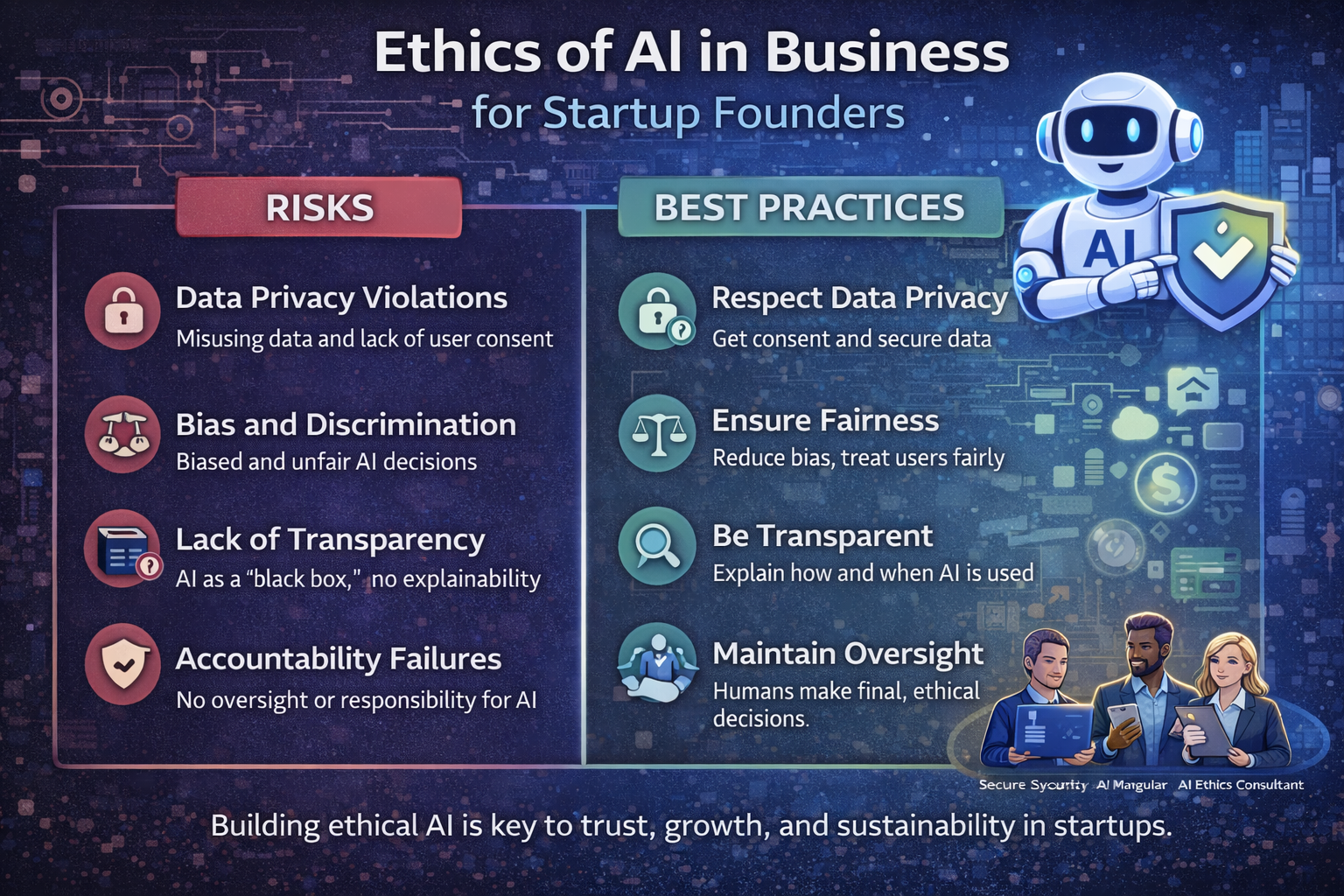
Data Privacy and User Consent
AI systems depend on data.
Ethical problems arise when:
- Data is collected without permission
- Users do not know how data is used
- Sensitive information is stored insecurely
Startups must respect user consent and privacy.
Why Data Privacy Is Critical
Customers share personal information with businesses.
If privacy is violated:
- Customers feel unsafe
- Trust breaks
- Legal action may follow
Ethical AI starts with responsible data handling.
Bias and Discrimination in AI Systems
AI learns from data. If data is biased, AI becomes biased.
This can cause:
- Unfair hiring decisions
- Discrimination in lending
- Unequal customer treatment
Bias can harm people and damage a startup’s image.
How Bias Enters AI Systems
Bias enters AI through:
- Historical data
- Human assumptions
- Poor data diversity
Founders must actively reduce bias.
Transparency and Explainability
Many AI systems work like black boxes.
Ethical concerns arise when:
- Users do not understand AI decisions
- Businesses cannot explain outcomes
- Errors go unnoticed
Transparency builds confidence and accountability.
Why Explainability Matters
When AI decisions affect people:
- Users deserve explanations
- Founders need control
- Regulators expect clarity
Transparent AI builds long-term trust.
Accountability and Responsibility
AI does not remove responsibility.
Ethical issues appear when:
- Founders blame AI for mistakes
- No one monitors AI decisions
- Human oversight is missing
Founders are always accountable.
Ethical Use of Customer Data
Customer data is valuable and sensitive.
Ethical use means:
- Using data only for stated purposes
- Avoiding unnecessary data collection
- Protecting data from misuse
Data ethics protects customer relationships.
AI and Employee Ethics
AI affects internal teams too.
Ethical concerns include:
- Employee monitoring without transparency
- Unfair performance evaluation
- Fear of job replacement
Clear communication reduces fear and resistance.
Ethical AI in Marketing and Sales
AI influences customer behaviour.
Ethical issues appear when:
- AI manipulates users unfairly
- Dark patterns are used
- Personalisation becomes intrusive
Ethical marketing builds loyalty, not pressure.
Why Ethics Builds Competitive Advantage
Ethical AI is not a weakness. It is a strength.
Ethical startups:
- Gain customer trust
- Attract ethical investors
- Avoid legal trouble
- Build strong brands
Trust becomes a growth driver.
How Ethical AI Improves Customer Experience
Ethical AI:
- Respects privacy
- Treats users fairly
- Communicates transparently
Customers feel safe and valued.
AI Ethics and Investor Expectations
Investors care about risk.
They evaluate:
- Data protection practices
- Bias prevention
- Regulatory compliance
Ethical startups appear more stable and mature.
AI Regulations Are Increasing
Governments are introducing AI laws.
Founders must prepare for:
- Data protection regulations
- AI accountability rules
- Transparency requirements
Ethics today prevents compliance problems tomorrow.
How Startup Founders Can Build Ethical AI Systems
Ethical AI requires planning and discipline.
Set Clear Ethical Guidelines Early
Founders should define:
- What data can be used
- How AI decisions are monitored
- Where human approval is required
Guidelines prevent confusion.
Use Quality and Diverse Data
Better data reduces bias.
Founders should:
- Review data sources
- Remove biased samples
- Update datasets regularly
Good data leads to fair AI.
Maintain Human Oversight
AI should assist, not replace judgment.
Human oversight ensures:
- Errors are caught
- Ethical boundaries are respected
- Accountability remains clear
Humans stay in control.
Be Transparent with Users
Transparency builds trust.
Founders should:
- Inform users when AI is used
- Explain how data is processed
- Allow user control where possible
Honesty strengthens relationships.
Protect Data with Strong Security
Ethical AI includes strong security.
Founders must:
- Secure databases
- Limit access
- Follow best security practices
Security failures damage trust instantly.
Regularly Audit AI Systems
AI changes over time.
Audits help:
- Detect bias
- Identify errors
- Improve fairness
Ethics is an ongoing process.
Ethical AI vs Unethical AI
Unethical AI:
- Focuses only on growth
- Ignores long-term impact
- Risks trust and reputation
Ethical AI:
- Balances growth with responsibility
- Protects users
- Builds sustainable success
The difference shows over time.
Common Myths About AI Ethics
There are many misunderstandings.
Myth 1: Ethics Slows Down Innovation
Reality: Ethics prevents costly mistakes.
Myth 2: Small Startups Do Not Need Ethics
Reality: Startups are more vulnerable to damage.
Myth 3: Ethics Is Only Legal Compliance
Reality: Ethics goes beyond laws.
The Future of AI Ethics in Business
AI ethics will become a standard expectation.
In the future:
- Customers will demand transparency
- Investors will require ethical frameworks
- Governments will enforce regulations
Ethics will be non-negotiable.
Why Founders Must Act Now
Waiting increases risk.
Early ethical planning:
- Saves money
- Prevents crisis
- Builds trust early
Ethics is easier to build than to fix later.
Final Thoughts
AI is one of the most powerful tools available to startups today. But power comes with responsibility. Founders who ignore ethics may grow fast, but they will struggle to survive long term. Founders who build ethical AI systems will earn trust, loyalty, and stability.
Ethics of AI in business is not about fear or restriction. It is about using intelligence wisely. Startups that balance innovation with responsibility will define the future of business.
Read More Blog-Will AI Replace Jobs or Create New Startup Opportunities?
Frequently Asked Questions (FAQs)
1. Why is AI ethics important for startups?
Because trust, privacy, and fairness affect growth and survival.
2. Do small startups need AI ethics policies?
Yes. Small startups face higher risk from mistakes.
3. Does ethical AI reduce profitability?
No. It improves long-term sustainability.
4. Who is responsible for AI decisions?
Founders and leadership teams.
5. How can startups start with ethical AI?
By setting guidelines, using clean data, and keeping human oversight.